On the night of May 16, 1990, a single gunshot inside Marlon Brando’s Los Angeles mansion ended the life of a 26-year-old Tahitian man named Dag Drollet. The man who pulled the trigger was Brando’s own son, Christian. The shooting did not just destroy two families; it shattered the carefully guarded myth of the greatest actor in cinematic history. Brando, the star who revolutionized acting and won two Academy Awards, spent decades building an unmatched artistic legacy.
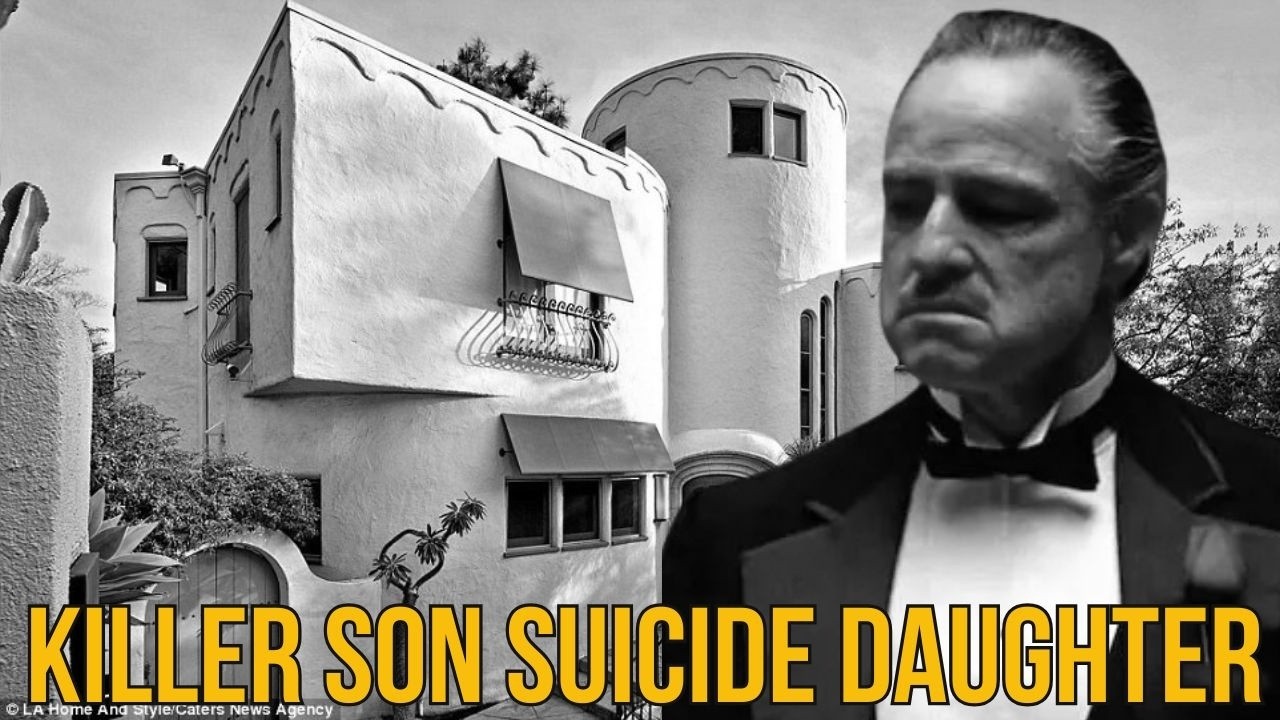
But behind the gates of his Mulholland Drive estate and on his private island in Tahiti, his family was falling apart. He fathered at least eleven children with multiple partners across two continents, yet according to those closest to him, he gave them money and fame but rarely his presence. Born in Omaha, Nebraska, in 1924, Brando grew up in a home poisoned by silent dysfunction. His mother, Dorothy, was a talented amateur actress and an alcoholic.
As a small boy, he would search the bars of Omaha and Chicago to find her drunk and bring her home. His father, Marlon Brando Sr. , was a cold and contemptuous traveling salesman who belittled his sensitive son and beat him. That hunger for love and stability became the engine of Brando’s genius.
He moved to New York, studied the raw emotional techniques of method acting, and in 1947 exploded onto Broadway as Stanley Kowalski in A Streetcar Named Desire. Audiences had never seen acting like this before. Hollywood called, and the 1951 film version made him a star. His performance in On the Waterfront earned him his first Oscar in 1954.
Nearly two decades later, his role as Vito Corleone in The Godfather returned him to the absolute summit of his craft. In 1973, he won a second Oscar for that performance. To the world, he was untouchable. Behind the cameras, however, his personal life was chaos.
He cycled through three marriages and countless affairs, and his children grew up scattered, neglected, and starved for a father who was always elsewhere. The damage had already begun with his firstborn. Christian Brando was born in May 1958 to Brando and his first wife, actress Anna Kashfi. Their marriage was short and turbulent, and before the child could even walk, his parents turned him into a weapon in one of the ugliest custody battles Hollywood had ever seen.
The fight lasted for years, with accusations, court hearings, and even a reported kidnapping that made tabloid headlines. As a boy, Christian moved constantly between homes, countries, and caregivers. He attended a staggering number of schools. The lesson he learned before he could fully understand it was the same lesson his father had learned decades earlier: the adults who should protect you will tear you apart instead.
As a young man, Christian struggled with alcohol, drugs, and anger. He worked as a welder and tree trimmer, far from the glamorous world he was born into, unable to build a stable life. The spark that ignited his destruction came in the form of his half-sister from Tahiti. Brando had built a second family on the island while filming Mutiny on the Bounty in the 1960s.
He married Tarita Teriipaia and bought a remote atoll, his private escape from fame and America. Their daughter, Cheyenne, was born in 1970. Described as exceptionally beautiful, she worked as a model but was deeply fragile and unstable, struggling with drugs and violent mood swings. By 1990, the 19-year-old Cheyenne was in love with Dag Drollet, a handsome 26-year-old from a prominent Tahitian family.
She was pregnant with his child. Her mental state was deteriorating badly, and that spring she traveled to her father’s home in Los Angeles with a serious and distorted story. She told her older half-brother Christian that Drollet was abusing and threatening her. Whether that claim was real or a product of her troubled mind has remained disputed ever since.
But Christian believed her. On the evening of May 16, 1990, Christian had been drinking. He and Cheyenne had dinner while talking repeatedly about Drollet. When they returned to the Mulholland Drive house, Drollet was lying on the couch in the living room, watching television, holding a remote control and a lighter.
Christian entered carrying a gun. He later claimed the weapon fired accidentally during a struggle, but physical evidence told a harsher story. Drollet was found still holding the remote, with no clear marks of a fight. Christian Brando shot him in the head at close range, killing him almost instantly.
Brando heard the shot and ran into the room. The greatest actor in the world held the dying man and tried desperately to give him mouth-to-mouth resuscitation. It was too late. Christian was arrested and charged with murder.
The case became a media earthquake, with the son of Marlon Brando accused of killing a man inside the star’s own home. Cheyenne, the pregnant young woman at the center of the tragedy, made statements suggesting the killing was deliberate and even planned, testimony that could have sent her brother to prison for life. But she never appeared in court personally. She remained in Tahiti, where her mental state collapsed beyond the reach of the American legal system.
Brando used his wealth and influence to build a strong defense, and he himself took the witness stand during sentencing, weeping and taking responsibility while pleading for his son. Christian was allowed to plead guilty to voluntary manslaughter and received a ten-year sentence. The Drollet family was devastated and furious, convinced that Brando’s money had bought a lighter punishment. Cheyenne never recovered.
She lost the man she loved and carried his child. In 1990, she gave birth to a son named Tuki. But motherhood did not save her. She descended into severe mental illness, attempted suicide multiple times, and lost custody of her child, who was largely raised by her mother in Tahiti.
In her final years, her relationship with her father became a silent tragedy of its own. Brando, who loved her with particular intensity, blamed himself. He acknowledged that his chaos and absence had helped destroy her. There were reconciliations and estrangements, calls across the world, desperate pleas, and moments of tenderness followed by illness and rage.
But the steady, present father she needed in childhood had never existed. The frantic, guilty, loving father who finally appeared could not undo twenty years of damage. On April 16, 1995, Cheyenne Brando hanged herself at her mother’s home in Tahiti. She was 25 years old.
She left behind her five-year-old son, a boy who lost his father to murder and his mother to suicide before he was old enough to truly know either of them. Friends said Cheyenne’s death destroyed something inside Brando that never returned. Within five years, one gunshot had ended two young lives. Brando largely withdrew from the world.
He became reclusive, obese, and increasingly eccentric, hiding behind the gates of the same house where Drollet died. He appeared in a few more films, mostly for money, far below the level of his talent. In his later and more honest moments, he admitted he had been a bad father, that he had failed his children, and that the chaos of his life had cost them dearly. He could name the curse that stretched from his broken childhood in Omaha to the broken childhoods of his own children, but he could never break it.
Marlon Brando died in Los Angeles on July 1, 2004, at the age of 80. His artistic legacy remained immortal, but his family remained steeped in tragedy. His son Christian served about half of his ten-year sentence and was released in the late 1990s. He never escaped the shadow of that night.
He struggled with drinking, unstable relationships, and trouble with the law. He was briefly investigated but not charged in another high-profile Hollywood murder case involving a woman he had been involved with. His health deteriorated early from decades of hard living, and he died of pneumonia on January 26, 2008, at the age of 49, less than four years after his father. Of the many children Brando fathered, most lived lives shadowed by addiction, instability, legal problems, and the peculiar pain of being an afterthought in the life of a legend.
The cycle continued until one survivor broke it. Tuki, the son of Dag Drollet and Cheyenne Brando, was raised in Tahiti by his grandmother Tarita, far from the chaos of Hollywood. He grew up healthy, became a successful international model, and by all accounts carried none of the darkness that consumed the generation before him. The child born from the heart of the catastrophe broke the chain because he was given the one thing the others never had: a stable, loving, present caregiver.
The curse was never in the Brando blood. It was in the absence, the neglect passed from parent to child across generations. Marlon Brando could become anyone on screen—Stanley Kowalski, Terry Malloy, Vito Corleone—but he could never play the simplest role of all: the father who shows up.
His children paid for that failure with their lives.