It is a summer morning in 70 AD, and on a hill outside Jerusalem, 80,000 pounds of Roman timber, twisted sinew, and cut stone are being hauled into firing position. It would not look like a weapon. It would look like a building. A structure the size of a small house, arms as thick as a man’s thigh, and ropes made from the sinews of a thousand animals, twisted so tightly they hum in the wind.
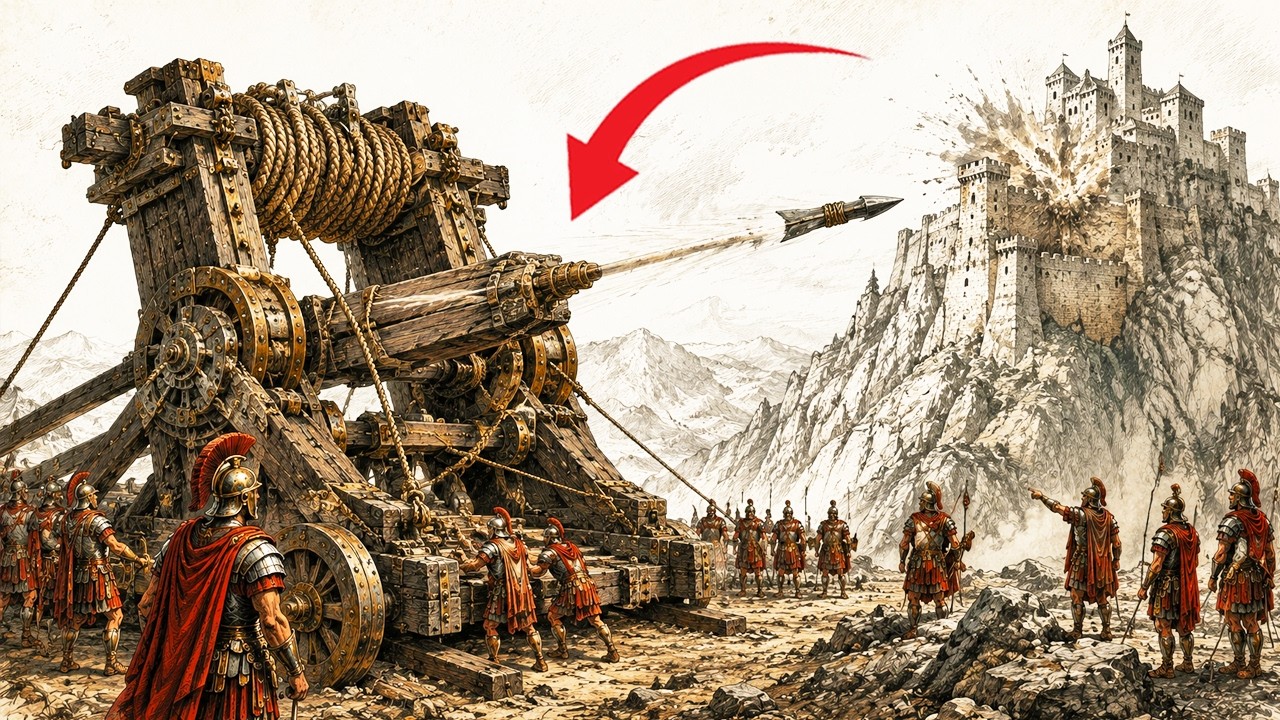
It is aimed at a wall two football fields away, a wall that has never been breached in living memory. Over the next ten seconds, the machine will do something no bow, sling, or human arm had done in the history of warfare: it will hurl a stone weighing as much as a grown man at a speed exceeding 100 miles per hour. When that stone hits the wall, it will deliver the energy of a modern cannonball. The men standing on that wall will not hear it coming, they will not see it approach, and they will simply cease to exist where they stand.
At first, the defenders on the walls could see the stones. The projectiles were white, carved from local limestone, and against the blue sky they looked like slow-moving moons. Lookouts began shouting warnings in their native tongue, two words each time the machine’s arm swung, and people scattered. So the Romans made a decision, a quiet, technical, and terrifying decision recorded by a historian named Josephus in a single line.
After that decision, the stone stopped being visible entirely. This is the second thing that should not have been possible: a machine built from ropes and wood in an age before gunpowder, before steel, and before the compass. A machine that, when tested by modern engineers, outperformed the muskets carried by soldiers at the Battle of Waterloo. Eighteen centuries later, the Roman catapult was not merely a giant bow.
It was something stranger, something the Romans stole from a dying Greek city and turned into the most lethal siege weapon on Earth. Back further, to a city burning on the coast of Sicily, where it all began. Syracuse, 212 BC. A Greek mathematician in his seventies is drawing circles in the sand while Roman ships burn in the harbor behind him.
His name is Archimedes. He is the greatest engineer the ancient world ever produced, and he has spent the past two years turning his city into a mechanical trap. Cranes lift Roman ships out of the water. A machine mounted on a ship hurls a stone weighing three talents, about 78 kilograms, the weight of a large dog, flying through the air over a great distance.
When Syracuse finally falls, a Roman soldier kills Archimedes while he is bent over his plans. It is one of the most famous deaths in ancient history. But what the Romans took from that city is more important than the man they killed. They took the plans.
They took the mathematics. They took the system of twisted rope bundles, the beating heart of the machine, and carried it back to Italy. Two and a half centuries later, on the walls of Jerusalem, there are men who have never heard of Archimedes: priests, farmers who fled the countryside, fanatical militias who believe God Himself will destroy Rome, Edomite allies from the edge of the desert, and fifteen-year-old boys holding spears beside grandfathers who never held one. They know their city is sacred.
They know their walls are high. They do not know that a Greek engineer who died 240 years ago already designed the thing that will kill them. The man coming for them is 29 years old. Titus Flavius Vespasianus, son of a new emperor, a man who two years earlier was nobody, a child of a middling senatorial family from a small Italian town.
He has fought in Britain. He has fought in Germany. He is, by everyone’s account, personally brave and personally cheerful. History will remember him for building the Colosseum, for being called the delight of the human race, and for his policies of mercy.
History will also remember him for what he is about to do to this city. Beside Titus stands a Jewish priest named Joseph ben Matthias, 33 years old. He led Jewish forces in Galilee last year. Then he was captured.
Then he told his captor, a middle-aged general named Vespasian, that Vespasian would become emperor. Vespasian became emperor, and now the priest walks in Roman dress, having taken the Roman name Flavius Josephus. He will spend the coming months watching and recording every stone the Roman machines hurl against his people’s walls. Four legions gather at Jerusalem in the spring of 70 AD.
The Fifth Legion Macedonica. The Twelfth Legion Fulminata, the Lightning Legion, humiliated in an earlier Jewish campaign and now eager to reclaim its honor. The Fifteenth Legion Apollinaris, and the Tenth Legion Fretensis, which bears the wild boar emblem and is known for its iron discipline. Add the auxiliaries, the siege specialists, the engineers, the wagon drivers, and the camp followers, and you are looking at between 60,000 and 80,000 men.
But the men are not the weapon. The weapon is what these men brought with them. Each legion has its own arsenal of artillery. The smaller pieces travel on wagons, carroballistae, small torsion machines mounted on two wheels pulled by mules and capable of being disassembled in minutes.
The larger machines travel disassembled, with huge oak frames, iron fittings, and wrapped bundles of prepared sinew stored in oiled leather to keep them dry. One heavy stone-throwing machine, once assembled with its platform, protective timbers, its pile of stone ammunition, its cranes, and its crew shelter, could weigh 40 tons, and there are dozens of them arriving in the hills around this city. Forget everything you have seen in movies. The catapult is not a giant crossbow.
A crossbow bends a piece of wood. The catapult bends nothing. It stores its power in two vertical bundles of twisted rope, made from bull sinew or, in some cases, human hair, because human hair has a specific elasticity engineers learned to exploit. Each bundle is twisted tighter than any rope you have ever seen, then mounted inside an iron-reinforced wooden frame.
Two arms are inserted through those bundles like a lever through a spring. When the crew pulls those arms back, the bundles do not stretch; they twist more and store, by modern estimates, more than 2,000 pounds of latent force. Release the trigger, and the arms snap forward in a fraction of a second. The bowstring, actually a heavy rope stretched between the arms, hurls its projectile with a violence the physics of torsion still struggles to explain even now.
A stone weighing one talent, about 26 kilograms, roughly the weight of a five-year-old child, leaves the machine at speeds exceeding 100 meters per second. It carries destructive energy equivalent to a modern cannonball. And a well-trained crew can hit a specific section of wall at 400 yards. Consider this for a moment: the effective range of the Roman catapult, hurling a stone the weight of a small child, was roughly four football fields.
The Greek engineer Athenaeus Mechanicus wrote of specialized machines that could fling a lighter projectile 700 to 800 yards, nearly half a mile. In an age before gunpowder, in an age when the main long-range weapon in most armies was a man with a bow, the bolt-firing versions were even more alarming. Modern reconstructions have shown that a well-aimed Roman catapult could hit a human-sized target at 100 yards with greater accuracy than the smoothbore muskets carried by Wellington’s infantry at Waterloo. For 1,700 years, no European soldier surpassed the Roman soldier of 70 AD in range and accuracy.
There is a moment preserved by Josephus himself, one historians have argued over for 2,000 years. It happened on the third or fourth day of the bombardment. Titus sent Josephus, the renegade priest now wandering the Roman camps in Roman dress, to the walls of Jerusalem, close enough for the defenders to hear him. His mission was to shout to his people, to tell them in their own language that continued resistance was madness, that the machines would not stop, and that the walls would fall.
Josephus stepped forward into catapult arrow range. He knows exactly what these weapons can do. He has been watching them for weeks. He has watched them penetrate the walls of their capital.
He has watched the work crews perform their tasks. He knows what the sound of torsion release is like at 50 paces. He knows how long loading takes. He knows what a man’s chest looks like after a bolt goes through it.
He raises his voice in Aramaic and Hebrew and begs the men on the walls to surrender. Josephus writes of the Roman machines: “The stone balls that were hurled weighed one talent and traveled two stades or more. ” This is the voice of a man documenting the weapon killing his people in real time with the detachment of an engineer. Whether Josephus was a coward, a survivor, a realist, or a traitor is a question you could spend your career researching.
What matters here is this: at the moment of choice, standing between his people and the Roman siege line, he chose to record. He chose to be the man who wrote down how those machines worked. Stones from the walls came for him too. A stone from the defenders knocked him unconscious that day.
He survived, and when he woke, the Roman machines were still loading, still drawing back, still adjusting their range. Titus does not attack Jerusalem the way generals attack cities in movies. He does not order a charge. He does not scream at his men.
He does what a Roman commander has been trained to do since adolescence: he encircles. In the first three weeks of the siege, the Roman legions, men who march 20 kilometers a day carrying 50 kilograms of equipment, cut down entire forests. Every tree within 15 kilometers of Jerusalem was felled. Timber was stripped.
Wagon convoys arrived from Syria, Egypt, and Cyprus carrying more. Roman surveyors, the agrimensores, walk the land with rods and ropes, calculating angles and determining lines of sight. They choose the hills. They choose the high ground.
They know a catapult stone travels farther and strikes harder when fired downhill from elevation. Where Jerusalem was high, the Romans climbed higher. Where the defenders built walls, the Romans built platforms higher than those walls. In the ancient world, if you cannot be higher than a mountain fortress, you build your own mountain.
Think about what that means logistically. To keep one heavy catapult operating at 100 shots per day for a month, you need two and a half tons of spherical quarried stones. Multiply that by dozens of machines around Jerusalem. Roman engineers were moving small mountains of ammunition across a war zone every week, while feeding an army of 60,000 men.
This is not a story about brave soldiers; this is a story about the accountants and quarrymen who won the war. Inside Jerusalem, the world had already begun to end before a single stone was thrown. Three factions of defenders were killing each other in the streets, fighting over grain stores, over the Temple, and over doctrine. One faction burned the grain stores to force the others to fight.
Now food was gone. Josephus, watching from outside, describes what happened inside in language later readers believed was exaggerated. It was not. People ate leather.
People ate the straw from their bedding. Mothers rationed food from their children. A city that fed pilgrims from three continents was starving inside its walls, and they had not even been beaten yet. The stones were coming.
The defenders on the walls could see the Romans working, hear the axes felling their orchards, and see the structures rising on the hills, but nothing had been fired yet. This is the strange, suffocating quality of ancient siege warfare: days and weeks of watching your death being built piece by piece in front of your eyes. Roman soldiers bare-chested in the summer heat, lifting oak beams. Roman engineers testing torsion springs with small stones, calibrating, while the defenders watched, knowing and waiting.
The first heavy stone comes on a morning whose date we do not know. Josephus only tells us that the catapults began their bombardment and the city shook. A stone weighing one talent, 58 pounds of limestone, leaves the hilltop platform, cleaves the sky, and strikes the northern wall of Jerusalem. It does not break the wall, not on the first hit.
It tears a section of parapet the size of a dinner table from the wall and turns the man standing behind it into a red smear on the stones. Josephus, watching from behind the Roman line, records this precisely. His account gives the weight, the range, and the impact. He is the reason we know what these machines could do.
He is the reason we can stand 2,000 years later and calculate the results. Every technical fact in this account passed at some point through the pen of a Jewish priest who chose to describe, with the accuracy of a man writing dictation, the machines killing his city. Here is what should astonish you: the Roman catapults could target specific stones in the wall. Not the wall, not a spot on the wall, but a specific stone.
And a specific man. There are accounts from other sieges of catapult crews receiving orders to knock down a single defender from a certain tower, and doing so from 300 yards with a machine that had no gunpowder, no rifling, no telescope, no explosives, only twisted ropes and a man in his mid-twenties who had spent five years learning to read the wind. By the end of the first day, the psychological calculations inside Jerusalem had changed. This was not a bow.
A bow you can see, and a bow you can block with a shield. This was something that came from the sky at speeds beyond perception and turned part of the wall into gravel. The defenders stationed on the walls learned to keep their eyes not on the enemy below but on the hills above and behind, watching for the machine arms swinging forward, trying to track the stone’s path the moment it was fired. If they saw it in time, they could move.
If they did not, they could not. And here the defenders noticed something: the stones, the white stones of death, were visible in the summer sky. If you watched the machines, if you watched the crews, if you had a sharp-eyed man on every section of the wall, you could actually see death coming. And you had exactly enough time to shout a warning.
In the second week of the bombardment, the defenders of Jerusalem invented something no army had tried before. They organized along the north and west walls. They placed young men with the strongest eyesight as lookouts. Each lookout was assigned a section of the horizon, a section of the Roman hill where the war engines were mounted.
Their job was simple: watch the machines, watch the arms, and the moment the arms swung forward and the crews fell back, they were to shout at the top of their lungs in their own language two words that would save lives. The words were in Aramaic: “The son is coming. ” Some translators have argued they were “The stone is coming. ” The two phrases sound almost identical in Aramaic, and Josephus, writing in Greek, seems to have heard them together and preserved them.
It does not matter which. What matters is that on the walls of Jerusalem in the summer of 70, teenage boys with sharp eyes watched the horizon and shouted two-syllable warnings. And men and women threw themselves flat mid-stride on the stone rooftops. Stop and imagine this scene.
A city in the ancient world, no radio, no sirens, no radar, and yet an effective early warning system built entirely of human eyes, human voices, and the physics of a projectile too slow to break the sound barrier. The Roman catapult stones flew at 100 miles per hour. A one-talent stone traveling an arc of 400 yards stays in the air for about six seconds. Six seconds is enough time for a boy to shout, for a woman to grab her child, for a man to drop his spear and roll behind a parapet.
Six seconds is the difference between living and becoming a stain on the wall. The Roman crews did not know this at first. They watched their stones fall and thought they were hitting empty stone. Casualties from the Roman perspective seemed negligible.
Josephus, walking through the Roman camp, would have heard artillery officers muttering. He would have heard calibration crews questioning their range, and he was the only one who knew the answer: his people were watching, shouting, and surviving. Whether he told the Romans is a question Josephus does not answer, and historians have argued about it for 2,000 years. The great irony of the Jerusalem warning system is that it worked for days, perhaps weeks.
The stones kept falling. The walls kept crumbling, but the defenders kept surviving them. By turning a giant machine into a predictable one, they had effectively invented counter-battery observation 18 centuries before the term existed. And somewhere on a Roman hill, an artillery commander sat with his engineers and asked the question that would change everything: Why are we missing?
The Roman siege battery in 70 AD was not firing at random. It was firing at a rhythm dictated by the machines’ loading cycle. The largest catapults required 10 to 20 seconds to winch, another 10 to 20 seconds to load, and a few seconds to aim, about 40 seconds per shot from each machine. With dozens of machines on the hills, that meant a stone falling on Jerusalem on average every second or two during peak bombardment.
Continuous, rhythmic bombardment. A city being crushed on a schedule no defender could break the pattern of. The bolt-throwers were faster, two to four shots per minute by modern reconstruction. The small wheeled bolt-throwers moved forward under cover of the heavy machines and hunted defenders from closer range.
Accuracy at close range was alarming. A trained crew at 100 yards could pierce a man’s chest with a bolt more reliably than a British infantryman at Waterloo could hit a barn wall with a Brown Bess musket. Roman soldiers of the first century surpassed every European army in range and accuracy until the invention of rifled muskets. Josephus recorded this with the coolness of an engineer’s manual.
He described the sound. He described the specific weight of the stone in the unit of measure his Roman patrons understood: the stone balls weighed one talent and traveled two stades or more, about 400 yards. In that sentence he was describing weapons used against the walls behind which his mother and brother, who were probably starving, were sheltering, and he wrote it in the voice of a man cataloging a machine. Consider what the ballistarius, the Roman artilleryman, actually was.
An ordinary soldier, 25 or 30 years old, possibly illiterate in the traditional sense. And yet he was managing torsion mathematics that were not formally solved until the 18th century. He estimated wind drift without instruments, elevation without gauges, and range without optics. He read the vibration of his machine’s own frame the way a pianist reads a keyboard.
Every Roman legion had men like this. There were thousands of them across the empire, and their names are almost entirely lost. We do not know a single one of them. We know their machines, but we do not know the men.
Someone in the Roman camp, a centurion or an engineer, we do not know who, figured it out: the reason casualties were low, the reason the stones were hitting empty stone. He walked close enough to the walls to hear, and he heard the shouts. He heard a two-syllable cry rising before every impact. He watched a stone hit a section of wall that had been guarded by a defender moments before, and he understood.
The defenders were watching the stones. The stones were white, cut from local limestone, bright against the summer sky. And a stone that can be seen for six seconds is a stone that can be dodged. The Roman response is preserved in a single sentence by Josephus, one of the most terrifying in its calmness in the history of ancient warfare.
The Romans blackened the stones. They smeared them with soot, with pitch, with burnt wood residue. They took the white limestone moons and made them invisible against the sky. And the next morning, when the first catapults fired, no one shouted a warning.
No one saw them coming. And death fell from the sky without notice. This is the moment. This is the sentence historians circle in Josephus, because it is the first documented case in human history of a technological arms race between visibility and invisibility in artillery.
This is the ancient world inventing camouflage, not for men but for projectiles. A 2,000-year game of cat and mouse between attacker and defender, played out with soot, lime, and stone. Every modern doctrine of stealth, of covert operations, of the invisible weapon, has a philosophical root in a Roman decision to blacken a rock. Casualties on the walls increased.
The defenders who trusted the shout, who trained their reflexes to the two syllables, continued walking their ramparts as if the warning system still worked, and the stones came with no sound, no visible trace, no way to see them until they arrived. Men were hit standing in their positions, cut in half by a stone the size of a cheese wheel. Women were killed behind walls in courtyards they considered safe while carrying water. Josephus tells us that after this, the sound of the walls changed.
The rhythmic cries of the warning system fell silent. In their place came a different sound: the impact. Then the screaming. Impact.
Screaming. Impact. Screaming. The 40-second rhythm of the catapult, now with no human warning interrupting it.
The siege, which for weeks had a strange musical structure of shouting and impact, turned into continuous noise, and within days entire sections of the wall could no longer be defended. By the sixth week, the walls of Jerusalem were collapsing. Not by a single blow. The catapult does not smash a wall with one hit.
Contrary to popular myth, it was done through thousands of repeated strikes on the same part of the masonry, with Roman engineers watching their hits, adjusting their aim, and concentrating fire. A stone in the third course of the wall’s north face, then another in the second course above it, then another in the first, and slowly, over days, an entire section of the wall begins to weaken, sag, and crack. When it collapsed, it collapsed at once in a cloud of dust and falling stone, a 30-foot section simply ceasing to exist. Behind the breach, the Romans built their rams and their siege towers, and behind them the assault columns formed, but the catapult did not stop firing.
When the walls fell, its position changed. The Romans raised the angle of fire and began shooting over the walls into the streets, squares, and alleys of the city. This is the stage of the siege that Josephus writes about with the most horror, because the defenders no longer had walls to shelter behind. The stones rained from the sky into the market courtyards.
Josephus wrote that the city was filled with the noise of collapsing houses, stones tearing through rooftops and walls, and families killed inside their homes without warning. He noted that the machines hurled stones weighing a talent, reaching two stades or more, and wherever they fell, houses collapsed with them. That is the voice of a man who grew up in those streets, a man who knew the markets, the squares, and the alleys, and watched them one by one disappear under the weight of the machines his masters had built. Here is what history books rarely tell you: the catapult was not primarily a wall-breaker.
The ram breaks walls. The siege ramp breaks walls. The tunnel breaks walls. The catapult’s real job, in siege after siege from Britain to Judea to Spain, was to clear the walls of the men who would resist the rams, the ramps, and the miners.
It was a weapon of suppression. In modern terms, it was a combination of a sniper and an artillery piece. The reason mountain fortresses fell to Rome is not because the catapult crushed their stone. It is because the catapult killed everyone who tried to defend them.
Titus, watching from his command post, gave the order for the final assault. His four legions, the eagles of Macedonica, Fulminata, Apollinaris, and Fretensis, poured into the breaches while the catapult continued to fire over their heads, now aimed into the city itself, at the rooftops, the temple courts, and the last strongholds of the defenders. The machines did not stop when the infantry went in. They kept firing over the infantry.
A one-talent stone traveling at 100 miles per hour does not care who you are. The Roman legions storming the breach could hear their own stones whistling over their heads. When Jerusalem fell in late August of 70, the walls that had stood for centuries were piles of rubble. The burning of the Temple, whether ordered by Titus or against his wishes, is a matter historians still argue about, and as usual Josephus presents both sides.
Fires spread through the upper city. The streets filled with corpses. The Roman legions ransacked the houses one by one. The catapults finally fell silent because there were no more walls to hit and no organized defenders to eliminate.
The machines that had hurled stones for months cooled on their platforms, their sinews relaxed and their arms stiffened, while their crews stared at what they had made. The numbers are impossible to verify precisely; every ancient source has its own agenda. Josephus claims the dead exceeded one million, a figure most modern historians reject as impossible. The true death toll of the siege was probably in the tens of thousands, with tens of thousands more sold into slavery and tens of thousands dispersed as refugees.
The treasures of the Temple were carried to Rome, and notably, the sale of those treasures later helped fund the construction of a certain structure. The white stones, the shouts, the blackened stones became part of Josephus’s narrative and, through him, part of every history of the siege written since. He recorded them because he witnessed them. He wrote them knowing no one else was writing them.
These specific technical details, the visual chess game between attacker and defender, survive in only one source in the entire ancient world. Without Josephus, we would not know it. Without him, we would not know how strange, how modern, and how unexpectedly human it all was. Titus returned to Rome and celebrated his victory.
The Arch of Titus, still standing in the Roman Forum today, shows the treasures of the Temple being carried through the streets. What it does not show, and what no arch has ever shown, is the machines. The catapults themselves were left behind. The frames were dismantled or burned.
The sinews that took months to prepare were unwound and stored in oiled leather for the next campaign. The machines that killed a city returned to the anonymous logistics of the Roman army, and the men who operated them returned to their legions without their names being recorded. Titus became emperor in 79, nine years after the fall of Jerusalem. He ruled barely two years before dying of fever at 41.
In those two years, he was called the delight of the human race. He personally responded to the eruption of Vesuvius. He funded relief operations for the survivors of Pompeii. History remembers him fondly.
History rarely remembers Jerusalem beside him. Yet the 29-year-old commander who watched the catapult fire and ordered the final assault carried that city with him for the rest of his short life. Josephus lived until about 100 AD. He wrote “The Jewish War” in the seventies, then “Antiquities of the Jews” in the nineties.
He was granted Roman citizenship, a pension, and a home in Rome that had once belonged to Vespasian himself. He was hated by his people. He was accepted by his patrons. He became, at the end of his life, a man without a home.
And by pure chance of manuscript survival, he is the reason we know how the catapult worked. The anonymous defenders of Jerusalem, the sharp-eyed boys, the mothers hiding food, and the priests defending the Temple became a diaspora in the aftermath. Some were killed. Some were enslaved and shipped to work in Egyptian mines or on the great construction projects of Italy.
Some escaped. Those sold into Italian slavery may have worked in the years that followed on the greatest building the Flavian dynasty ever constructed: a structure funded in part by the treasures of their city. Because this is the ending history rarely tells you: the gold and silver taken from the Temple of Jerusalem, the spoils displayed in Titus’s triumph in Rome, the spoils carved on the arch that still stands today, were sold, and with the proceeds Vespasian and Titus began construction of a new amphitheater in the heart of Rome. A building we now call the Colosseum.
The stones of Jerusalem, in a very real sense, became the walls of the Colosseum, and the machines that broke the first funded the second. The catapult did not stop at Jerusalem. Roman legions carried torsion artillery from the forests of Germany to the deserts of Syria. From the highlands of Scotland to the hill forts of the Iberian Peninsula, every mountain fortress that fell to Rome, and there were hundreds, fell in part because enormous wooden machines could be hauled up slopes, assembled on terraces, and aimed at defenders who believed, until that moment, that elevation was a form of safety.
Rome ended the age of mountain fortresses, not with soldiers but with engineering. Here is what nearly every popular portrayal of the catapult gets wrong: it was not a giant bow. The image we all have, in films, in video games, on book covers, is anatomically wrong. A crossbow bends.
The catapult, the ballista, does not bend. It stores its energy in twisted ropes, not in a flexible arm. That single difference is why this machine could do what no crossbow could. The second thing that is often missed is this: the late Roman engines by the fourth century could fire a bolt over 2,200 yards, three-quarters of a mile, across a river or a valley.
These were the machines Roman writers described as capable of shooting across the Danube. No one built a machine of comparable range for another 1,500 years. Archaeology has confirmed this. Around the great Roman siege sites around Jerusalem, around hill forts in Spain, and around the walls of ancient British cities, excavators still find spherical catapult stones weighing about 20 to 30 kilograms each, identical in size, quarried and shaped by Roman hands long dead.
They come out of the ground in clusters, sometimes hundreds at a time. Each one was a single shot fired once by a machine that no longer exists, at a target that turned to dust 2,000 years ago. You can hold one. Some museums let you.
It is heavier than you expect. The machine dreamed by Archimedes on the shore of Sicily in 212 BC. The machine the Romans stole and standardized. The machine that killed a city in 70 AD and helped build the Colosseum with its spoils.
That machine shaped the ancient world in ways that are only now becoming clear, thanks to modern reconstructions. The men who crewed it were anonymous. The men who led it are remembered mostly for other things. And the engineer who invented its core technology died face-down over his plans, killed by a Roman soldier who did not know who he was killing.
There is a symmetry to that. The man who designed the machine was unknown to his killer, the killer is unknown to us, and the machine kept working steadily for six centuries after both of them died. Returning to that summer morning in 70: the hills outside Jerusalem, 80,000 pounds of wood, torsion, and stone, the white projectile in the sky, then the black one, and the boys on the walls with their sharp eyes, then the silence when those sharp eyes could no longer see. Every mountain fortress in the ancient world lost the argument with that machine.
And every high wall built afterward for the next fifteen centuries was built by architects who learned from Rome that height alone was no longer enough.