Walk into a smokehouse built before 1900, and the first thing you notice is not the smell, though the odor never fully leaves the space. It is the ceiling. Row after row of blackened iron hooks, stained by a century of tar absorbed into hand-worked wooden beams, or hanging from iron rails that run the width of the building. Some are simple S-hooks, forged in a single heat by a blacksmith working a few hundred yards away.
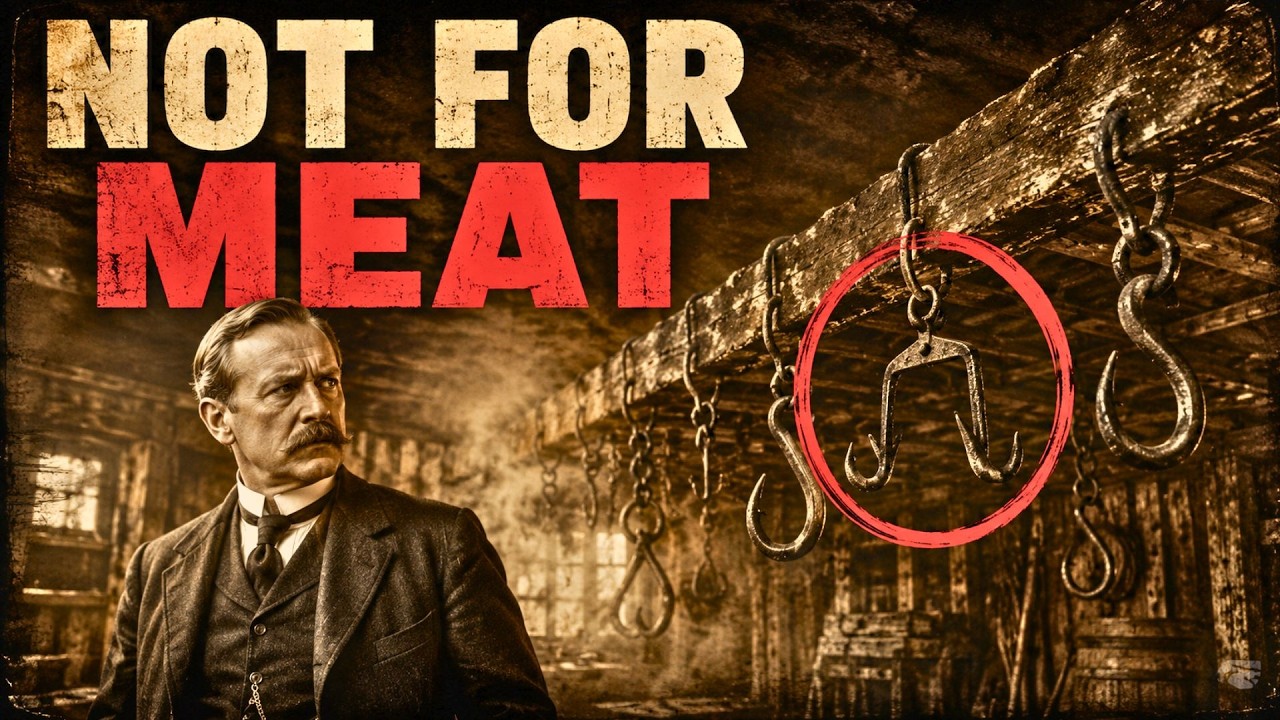
Others are curved to hang a ham from the shank, or heavy rings built to bear the full weight of a pork shoulder for weeks at a time. None of it was decorative. Every piece of iron in that ceiling existed because there was nothing else that could do the job. And for a family that depended on it, that job meant the difference between eating through February and going hungry.
Smokehouses were not primarily about flavor. They were a cooling method before refrigeration existed. The iron inside was engineering, not ornament. To understand why the tools had to be made of iron and why they were built the way they were, you first have to grasp what was actually hung from them and what the room did to that iron every day it was in use.
Salt-curing and smoking meat is ancient, older than any written record of it. Archaeologists have found evidence of smoked and salted fish and game stretching back thousands of years in nearly every culture that had access to both meat and fire. The logic is simple, even if the chemistry behind it took centuries to understand. Salt draws moisture from muscle tissue, and bacteria need moisture to grow.
Smoke adds another layer of protection, coating the surface of the meat with compounds that slow bacterial growth and oxidation, while the low, steady heat of a smoldering fire keeps drying the meat from the outside in. Combined, a ham that would spoil in days at room temperature could hang safely for months. European settlers who arrived in North America brought this knowledge with them. It had been refined through generations of cold-curing traditions in England, Germany, and Scandinavia.
They met a continent with its own deep history of smoking and drying meat, practiced by Indigenous peoples who had preserved fish, venison, and bison for as long as anyone could trace. The techniques that prevailed on American farms during the eighteenth and nineteenth centuries were a blend of traditions, adapted to pig farming, which produced more usable meat per animal than anything else a small farm could raise quickly. A smokehouse had to do several jobs at once, and each requirement shaped what was placed inside it. It had to hold smoke at a controlled density without letting it escape too quickly.
It had to maintain a temperature low enough to smoke the meat rather than cook it, usually between 80 and 100 degrees Fahrenheit for the slow, weeks-long process most farms used. It had to protect the meat entirely from rain and ground moisture. And it had to keep animals out, because a smokehouse full of pork was, to a raccoon, an opossum, a stray dog, or a neighbor’s hungry pig, simply a building full of food. That last requirement is easy to overlook, but it explains as much about the structure of a smokehouse as the smoking process itself.
Farmers built these structures extremely tight. Log walls were chinked with clay or mud to seal every gap. Doors were low and heavy, sometimes barely five feet high, forcing anyone entering to bend down, which also kept heat and smoke from pouring out every time someone went in. Many smokehouses had a single small vent near the ceiling and nothing else.
No windows. No second door. Nothing that offered an easy way in for a determined animal. The entire structure was designed as a small vault.
Economically, that is exactly what it was. A full smokehouse in November represented the family’s entire meat supply for the coming year. Losing it to spoilage, fire, or theft was not a minor inconvenience. It could mean real hunger by spring.
Inside that tight, smoke-filled, slow-cooking vault, meat had to be hung, and hanging was not optional. Meat left on a shelf or floor cures unevenly, develops soft spots where it touches a surface, and is more exposed to insects and rodents. Hanging exposes every side of a ham or shoulder to smoke and airflow evenly and keeps the meat off the ground, where moisture collects and pests travel. A large pork shoulder, with the bone in, can weigh more than 20 pounds, and a full ham often weighed considerably more.
Multiply that by a dozen, 20, or 30 pieces a medium-sized farm family might cure at once, and you have several hundred pounds of steady weight that had to hang motionless, sometimes for six weeks or more, in a hot, humid environment heavy with acidic smoke. Rope would not do the job. Natural fiber rope, whether hemp, jute, or cotton, absorbs moisture and fat. Inside a smokehouse, rope sat directly in a stream of smoke carrying acetic acid, formaldehyde, and a range of other compounds produced by wood burning slowly rather than fully.
Exposed for weeks to heat, humidity, and acidic smoke, the fibers weakened, charred at points of direct heat, and eventually snapped, often without warning. A rope that looked sound on the outside might have lost most of its structural strength within. A broken rope in a smokehouse did not just ruin a cut of pork; it dropped twenty pounds of salted meat into ash and coals, destroying the piece entirely and potentially starting a fire in a wooden building already saturated with smoke and accumulated fat. Wooden pegs and hooks lasted longer than rope, and some smaller, cooler curing operations used them, especially in the early colonial period when iron was scarce and expensive on the frontier.
But wood carries the same essential weaknesses in that environment. It absorbs fat and moisture, which makes it swell, twist, and eventually crack under continuous load. It chars slowly with prolonged heat exposure and loses structural integrity precisely at the point of maximum load. A wooden hook, unlike an iron one, cannot be reshaped or repaired once it begins to fail.
Once a wooden peg splits under the weight of a pork shoulder, it is finished. Iron solved all of these problems at once. It does not absorb moisture or fat. It does not char at the temperatures used in cold and warm smoking.
It can be shaped precisely, with sharp curves for hanging hooks, tight rings for S-hooks, or long straight rods that can carry dozens of hanging pieces at once. And crucially, when iron eventually wears out after decades of acidic smoke exposure, it corrodes slowly and visibly, developing a black, pitted surface rather than breaking suddenly without warning. A farmer could look at an iron hook, inspect the corrosion, and know whether it needed replacing before the meat fell into the fire, something no one could reliably judge by looking at rope or a wooden peg under the same conditions. That is also why the ironwork in old smokehouses often carries an unmistakable mark of hand-forging rather than mass production, at least in buildings dating from before the late nineteenth century.
The rural blacksmith made these hooks to order, heating an iron rod in the forge and hammering it over the anvil, hook after hook. The blacksmith was one of the most important craftsmen in any agricultural community. He was not a secondary tradesman but someone whose work touched nearly everything: plow points, wagon hardware, horseshoes, door hinges, and the specialized hooks and rods that made a smokehouse function. A family might order a full set of hooks and hanging rails when building a new smokehouse.
And this ironwork, unlike most other farm equipment, was designed to outlast the building around it. Smokehouses were sometimes rebuilt or repaired over the decades. The iron hooks inside were often simply moved from the old building to the new one, because a well-made hook, cleaned and tended occasionally, could genuinely last a lifetime, and often did. The hardware outside the building mattered as much as what hung inside.
For a related but different reason, doors needed strong iron hinges capable of supporting a heavy, tight-sealing door without sagging; a sagging door lets in moisture and animals. Many smokehouses had iron latches, bolts, and in some cases actual locks, because their contents were valuable enough to steal. Farm records and diaries from the eighteenth and nineteenth centuries sometimes note break-ins at smokehouses. Sometimes by hungry travelers, sometimes by enslaved people or servants of others who were short of food, and sometimes simply by opportunistic thieves who recognized that a smokehouse in November held more portable value than any other building on the property.
A locked, iron-reinforced door was not an excessive precaution. It was a logical response to what that building actually contained. The type of wood burned to produce smoke mattered enormously to flavor, and farmers had strong regional preferences. Hickory in much of the American South and Appalachia, apple and other fruit woods in parts of the Mid-Atlantic and New England, and oak where it was abundant.
But all of these woods, burned slowly rather than with an open flame, produce broadly similar acidic byproducts. Wood smoke is a complex mixture, a large part of it composed of organic acids, with acetic acid prominent among phenols and aldehydes. These compounds are exactly what give smoked meat its preservative qualities and much of its flavor. But they also cause mild corrosion of most metals with prolonged exposure.
Iron develops a dark patina under this kind of repeated exposure, effectively a thin, coherent layer of iron oxide and carbon deposits that unexpectedly helps protect the metal beneath rather than damaging it further. That black, paint-like appearance on the hooks of old smokehouses is not neglect. It is the product of decades of precise chemical interaction that the entire system was designed to withstand. The same set of pressures, heat, corrosive smoke, and constant heavy loads, shaped smokehouse hardware in parts of Europe that fed the colonial traditions in the first place.
German-speaking regions built dedicated smoking chambers, often integrated into the upper levels of the farmhouse chimney system, where pork and sausage hung directly in the path of smoke rising from the kitchen stove below. English farms kept bacon lofts, often built within the chimney structure itself, with iron hooks set into masonry or heavy oak beams reinforced with iron brackets. Alpine farming communities built small stone or wooden smoking rooms, sometimes shared by several families in a village, with ironwork commissioned from the same blacksmith who shod horses and repaired plows. In each of these independently reached traditions, across different regions and different centuries, the result was the same.
Rope and wood might serve for light loads and short periods. Anything designed to carry real weight amid real heat for real weeks needed iron. It is easy to underestimate the scale of what these buildings actually handled from a modern perspective. Meat arrives at the store already cut, wrapped, and refrigerated.
A single pig, once slaughtered and dressed, can produce two hams, two shoulders, and more than a dozen side pieces for bacon, plus sausage made from trimmings. And that is from just one animal. A farm family raising and slaughtering several pigs each autumn, a common practice across most of rural America until well into the twentieth century, might hang hundreds of pounds of meat in that smokehouse at once. Slaughter time, often called hog-killing day in the American South and Appalachia, was a genuine community event, usually held in late autumn once temperatures dropped enough to slow spoilage during initial butchering.
Neighbors and relatives gathered to help with the killing, rendering lard, making sausage, and salting and hanging the larger cuts. It was communal, hard, cold, bloody work, and the smokehouse was where the harvest of a full day of labor and a full year of food security ended up hanging from those iron hooks. Given these stakes, it is worth being honest about what dark purpose actually means here. There was no hidden conspiracy behind an iron hook, no secret agenda, nothing anyone was trying to conceal.
The darkness, if that is the right word, was simply the reality. Every rural family lived under its shadow, before refrigeration, before organized food supply chains, and before the assumption that a grocery store would always have meat on its shelves regardless of season. If the hooks failed, the meat fell, spoiled, burned, or was stolen, people went hungry. Seriously.
There was no backup plan waiting in a freezer. The iron pieces in the roof of the smokehouse were made the way they were because failure was not a theoretical risk. It was a real, tangible, frightening possibility, and rural communities avoided its causes as carefully as anything else that kept them alive through the winter. Historical records support this in small, telling details.
Probate inventories from the eighteenth and nineteenth centuries, the documents drawn up when a farmer died to assess and divide the estate, often list smokehouse hooks, hanging rails, and even the meat currently being cured as items of specific value, sometimes recorded individually alongside livestock and farm tools. That level of documentation tells you how much the people who lived with these buildings actually valued them. Not as a minor accessory, but as functional infrastructure worth accounting for in an estate just as a plow or wagon would be. The decline of the household smokehouse did not happen all at once, and it did not happen for a single reason, but it is a clearly traceable historical path.
The Meat Inspection Act of 1906, passed in the wake of public concern over conditions in large slaughterhouses, began shifting meat processing toward centralized, regulated facilities, gradually making commercially processed and packaged meat more available and reliable in areas that had relied entirely on home processing. Mechanical refrigeration, existing industrially since the late nineteenth century, became gradually available to households over the first decades of the twentieth century, first as iceboxes supplied by regular ice delivery, then as electric refrigerators once rural electrification brought power beyond major cities and towns. The Rural Electrification Act of 1936 was a turning point for millions of American farms, bringing electric power and with it electric refrigeration to areas that had operated without it for generations. By the years after World War II, home refrigeration was widespread and commercially produced meat was reliable and affordable, turning the smokehouse for most families from a necessity into an occasional practice.
Then, in many places, into a piece of family history rather than a working building. You can still find these structures standing today, scattered across the rural South, Appalachia, the Mid-Atlantic, and parts of the Midwest and New England. Sometimes restored, sometimes simply weathered and empty. Their iron hooks still hang from the ceiling, exactly where a blacksmith placed them a century or more ago.
Living history sites and open-air museums, such as Colonial Williamsburg in Virginia and Old Salem in North Carolina, and many others, preserve working smokehouses specifically to maintain and demonstrate these techniques. The ironwork in those restored buildings is often original, carefully cleaned and preserved rather than replaced, because the hooks themselves are considered artifacts of historical importance in their own right. Conservation specialists and historians examining old smokehouses can sometimes estimate how intensively a structure was used based on wear patterns on the hooks, the depth of the black layer, and how the iron was reshaped or repaired over time across generations of use. The last two decades have also seen a genuine and continuing revival of interest in traditional meat curing, driven by small farmers and a broader movement toward understanding food preservation methods that predate industrial agriculture.
Some of these contemporary practitioners work with blacksmiths to forge hooks matching the originals using the same techniques their eighteenth- and nineteenth-century counterparts would have known, not just out of nostalgia, but because the underlying physics have not changed. Iron still resists heat, humidity, and acidic smoke better than any readily available alternative for this specific application. The materials science that made a rural blacksmith choose iron over rope or wood in 1790 is the same science a curing hobbyist relies on today, whether they realize it or not. Stand inside one of these buildings now if you get the chance, and look up at that black ceiling of hooks and rails.
Nothing in it was accidental, and nothing in it was hidden. It was a practical, visible solution to a problem that mattered enormously to the people who built it. Reached through trial and error and generations of accumulated experience. Then forged into iron by a blacksmith who fully understood what that iron needed to survive.
The smokehouse was never a mystery at all. It was a machine for keeping a family fed through the parts of the year when food could not be obtained by any other means. And the iron that tied its parts together was simply designed to last as long as it was needed. Iron did not simply appear on the farm by itself.
The arrival of a bar of wrought iron at a rural blacksmith in the seventeenth or eighteenth century was a small chapter of colonial economics, and it shaped smokehouse fittings just as much as any decision about curing technique. In the early colonial period, iron was imported from England and shipped as ballast, expensive enough that a family might reuse the same hooks for three or four generations rather than commission new ones. As local ironworks developed, such as the Saugus Iron Works in Massachusetts operating from the 1640s, and later the bog iron furnaces of New Jersey and the Chesapeake, local supply slowly improved. Even so, iron on the farm was never treated as a disposable tool.
Every broken piece, whether a plow point, a worn horseshoe, or a twisted hinge, went back to the blacksmith to be reheated and reshaped into something else. Smokehouse hooks, when they eventually wore out after decades of use, rarely ended up in the trash. They were more likely to be hammered back into new hooks, folded into a hinge, or turned into whatever tool the farm needed that season. Iron moved through the life of the property in a way modern tools never do.
That continuity is part of the reason so many surviving smokehouse hooks show marks of more than one forging. The blacksmith’s decisions about which hook to make were not random, even if they look primitive to a contemporary eye. The gambrel, the curved piece designed to pierce the tendon of a pig’s leg to hang the whole leg downward, had to be shaped to distribute weight across a wide area rather than concentrating it at a single point, because a pointed head under a constant load weighing 20 or 30 pounds for six weeks would eventually cut through tendon and bone alike. The S-hook, by contrast, needed a radius narrow enough at each end that a rope or metal ring would not slip off under the sway of a curing cut of meat, but not so narrow that it wasted the blacksmith’s time or the iron used to form it.
These were not standard designs taken from a pattern book. They were solutions reached through trial and error by generations of blacksmiths, refined slightly with each apprentice who took over the shop, and repeated because they worked, not because anyone had written formal specifications for them. The salt itself deserves more attention than it usually gets in this story, because iron and salt solved two related but different problems, and farmers understood the difference even without modern food science terminology. Dry salting pulled water from muscle fibers through osmosis.
The salt used was typically coarse rock salt, sometimes mixed with a small amount of saltpeter. Farmers had learned from experience that saltpeter helped meat retain an attractive pink color and added an extra layer of protection against a specific and frightening type of spoilage: the kind that produced botulism in meat that had not been properly cured. Eighteenth- and nineteenth-century farmers did not know the biochemistry of nitrates in inhibiting Clostridium botulinum. They knew from generations of accumulated trial and error that meat treated a certain way with a certain addition stayed safe, while meat treated without it might not.
They built their curing recipes accordingly, often guarding their family’s salt-to-sugar ratio as carefully as a modern brewer guards a recipe. Salting usually took place in a separate building or a dedicated corner of a cool pantry or cellar, on a salting box or table, before the meat ever reached the smokehouse. By the time a ham or shoulder was hung from an iron hook for smoking, it had spent one to six weeks buried in salt, pulling out the moisture that would have made it a target for bacteria and insects during the long smoking weeks ahead. Regional variation in the American South produced some of the most documented and commercially significant curing traditions in the country, and Smithfield, Virginia, is the clearest example.
The curing of hams around Smithfield dates to the colonial period. But by the nineteenth century, curers in the region had developed a specific process: a long dry-salt cure followed by an extended cold-smoking period, sometimes up to six months or a year, producing a ham dense and salty enough to be preserved without refrigeration almost indefinitely. The reputation of these hams grew so large that by 1926, the Virginia General Assembly passed a law restricting the legal use of the term original Smithfield ham to meat cured within the city limits of Smithfield itself using hogs that met specific feeding requirements. That level of legal protection for a regional food product was unusual for the period, and it tells you how seriously the economies tied to home and small commercial curing were taken by the people whose livelihoods depended on them.
Every Smithfield curing house, large or small, relied on the same iron hardware used by subsistence farms further inland, scaled up but not fundamentally changed in design, because the physics of hanging a heavy cured leg in a hot, acidic, smoke-filled room did not change with the size of the operation. It is also worth noting the gendered division of labor around the smokehouse, because it complicates an image that might otherwise simplify into a single farmer with an axe. The killing itself, the slaughter and initial butchering, was largely men’s work in most American agricultural communities of the period, often involving a rotating crew of neighbor men moving from farm to farm during slaughter season, sharing both the labor and the risk. But the salting, seasoning, smoke control, and judging when a ham was ready to come down were frequently the tasks of farm women, who watched the salting process the way they watched bread fermenting or butter churning, by touch, smell, and the appearance of surface fat.
These were skills passed from mothers to daughters with a precision matching any blacksmith’s apprenticeship. Memoirs and household account books from the period sometimes record women tending the smokehouse fire themselves, keeping a low, slow flame through the night, waking to check it, adjusting the green wood or damp sawdust used to keep the fire smoldering rather than flaming. The iron hooks were the fixed, unchanging infrastructure. The judgment about how long the meat needed to hang, when the smoke had done its work, and when it was finished, was a skill embedded in people, refined over a lifetime of close attention to a process that allowed no error.
The risk of fire shaped the design and placement of a smokehouse as much as any other factor, something easy to underestimate from a distance. A smokehouse contains by design a slowly smoldering fire inside a wooden or log building, saturated over the years with melted animal fat that penetrates the grain of the wood and never fully evaporates. That combination, a low fire, dry timber, and a fat-soaked wooden structure, made smokehouse fires a real and recurring hazard. Farm layouts across the South and Mid-Atlantic reflect that danger directly.
Smokehouses were almost always built as freestanding structures at a distance from the main house, barn, and other outbuildings, specifically to ensure that if a fire broke out, it would not reach the rest of the farm. Some smokehouses had dirt or clay floors to reduce available fuel in the event of a fire, and the low doors that kept animals out also limited the oxygen available to any ignition, acting as a primitive but effective form of fire containment. Insurance records and probate inventories from the period sometimes note the destruction of a smokehouse by fire. It was a serious enough loss to record alongside the loss of livestock or a barn, because in practical terms it represented a comparable blow to a family’s food security for the coming year.
The archaeological record adds another layer to this picture, because smokehouses, unlike more prominent buildings, were rarely photographed or extensively documented while still in active daily use. Much of what we know about the earliest examples comes from excavation rather than written records. Archaeologists working at historic plantation sites, including sites connected to Mount Vernon and Monticello and numerous smaller farms across Virginia and the Carolinas, have recovered fragments of iron hooks, door hinges, and structural nails from the foundations of smokehouses that no longer stand above ground, allowing historians to reconstruct approximate building dimensions and the placement of metal fixtures even where the wooden structures rotted away centuries ago. These excavations consistently confirm the same pattern found in buildings still standing above ground.
Heavy iron is concentrated especially around the ceiling and hanging points, lighter ironwork appears on doors and latches, and almost no iron is found anywhere else in the structure. There was no other part of the smokehouse that needed to withstand the same combination of pressures applied by hanging meat. By the mid-twentieth century, the commercial meatpacking industry had changed the entire economic logic under which household smokehouses had operated for two centuries. Companies based in Chicago and other railroad hub cities, operating on a scale no farm smokehouse could match, developed refrigerated railroad cars in the 1880s and 1890s, allowing processed meat to travel long distances without spoiling and ending the previous necessity of processing meat near where the animal was raised.
Upton Sinclair’s investigative writing about the Chicago stockyards in 1906, though aimed primarily at exposing labor and sanitation conditions, directly contributed to the public pressure that led to the Meat Inspection Act that same year. The resulting federal inspection gave large-scale commercial meat a level of consumer confidence that home processing, however skilled, could not claim in the same way. None of this happened as a coordinated campaign against household smokehouses specifically. It happened as the ordinary result of industrial capacity, transportation infrastructure, and regulatory change all moving in the same direction at the same time.
The household smokehouse, essential infrastructure for most of two centuries, became a secondary choice within two or three generations. What remains today in the smokehouses still standing across rural America is a kind of physical record of a working system that modern life has almost entirely replaced. The hooks themselves, made by a blacksmith whose name is lost to history in most cases, outlasted the agricultural system that made them necessary. They outlasted the families who commissioned them.
And in many cases they outlasted the houses those families lived in. Still black and pitted, doing the only thing they were made to do, carrying weight in a harsh environment without complaint as long as anyone needed them. There is a particular kind of evidence historians look for when trying to date an unrestored smokehouse without documentary records, and it concerns the hooks as much as the timber. Wrought iron produced before the widespread adoption of Bessemer and open-hearth processes in the second half of the nineteenth century has a distinct fibrous structure that appears when the metal corrodes or breaks, a result of slag impurities left over from the refining process.
Hooks made from original wrought iron, when examined closely at spots of rust or breakage, show a flaky, wood-like texture running the length of the piece. Later hooks made from mild steel, once it became cheap and available by the end of the nineteenth century, corrode differently and more uniformly, without that fibrous pattern. Historic preservation specialists use this distinction to date smokehouse hardware independently of documented construction dates, since modifications and repairs over the decades mean the two dates do not always match. A farm that recorded a smokehouse construction date of 1840 might have replaced individual hooks later when they wore out, so the ironwork in the ceiling can tell a more complex story than the date carved on a cornerstone.
The knowledge required to run a smokehouse properly, from start to finish, was substantial enough that families who lacked it, whether from inexperience or bad luck, faced severe consequences. Historical records indicate documented cases of spoiled or improperly cured meat causing illness, sometimes fatal, meaning the risks were not merely theoretical possibilities. Poorly cured meat that had not absorbed enough salt or had been smoked at too high a temperature and cooked rather than dried could carry dangerous bacteria despite looking and smelling acceptable when it was brought down. That is one reason curing knowledge was carefully guarded and deliberately passed down within families and communities.
Not out of pride, but because a single error in the process could kill someone months after the meat was hung. The iron hardware inside a smokehouse gets most of the attention because it is the part that survives time, the part a visitor today can touch and photograph. The accumulated human knowledge that determined salting duration, smoking temperature, and curing time and safety is harder to see and left less of a trace, but it was just as essential to the success of the entire system. Understanding the smokehouse this way changes what the building actually represents.
It was not merely a shed containing some hooks. It was a piece of applied engineering refined by centuries of people who did not have the luxury of error. Built from the only material capable of surviving the harsh environment the process required, and maintained by craftsmen whose skill was as necessary to farm survival as knowing how to plow a straight furrow or when to bring in the harvest. The blackened iron still hanging in surviving smokehouses today is not just a curiosity.
It is the last visible trace of a system that fed entire communities through winters that modern food supply chains would struggle to imagine. Travelers’ accounts from the era describe the smokehouse in terms that show how central it was to a farm’s identity, not just its economy. Visitors to Southern and Mid-Atlantic farms in the early nineteenth century sometimes noted being taken to see the smokehouse the way a modern host might proudly show a guest a well-stocked pantry or wine cellar, because a full smokehouse in December was evidence that the family had managed its year successfully. Conversely, an empty or half-full smokehouse was a visible sign of a hard season, a sign neighbors might notice and sometimes respond to with informal support.
Because rural communities relied on an informal system of mutual aid during lean years, the contents of the building functioned as public evidence of a family’s fortunes, even though the door remained closed and locked most of the year. The iron latch did exactly the job it was made for. Look up at one of those blackened ceilings today. If you find a smokehouse still standing near you, you are looking at the last working piece of a system that once decided whether a family would survive the winter.
The hooks need no explanation. They explain themselves once you understand what they were designed to carry.