In 2005, PepsiCo launched Mountain Dew MDX, an energy drink carrying one of the most recognized brand names in American consumer history. The company placed the product in roughly 200,000 stores across the United States and spent more money introducing it than Red Bull had spent entering the entire American market eight years earlier. Within three years, MDX was gone—no recall, no lawsuit, no ingredient scandal, and no public explanation from the company. At the time, the energy drink category was the fastest-growing segment in American beverages.
It expanded from about $3 billion in annual retail sales in 2004 to nearly $9 billion by 2011. Red Bull crossed $1 billion in American retail sales while MDX was struggling, and Monster Energy grew from a converted juice company in Corona, California, into one of the most valuable beverage brands in the world. MDX disappeared without competing effectively in any of it. The story of MDX begins with Mountain Dew itself.
In 1940, Barney and Ally Hartman, beverage distributors in Knoxville, Tennessee, were frustrated by unreliable deliveries of the lemon-lime mixer they preferred to sell. They decided to make their own product and named it Mountain Dew, a phrase then used as Appalachian slang for moonshine. The aggressively sweet, heavily carbonated citrus soda became a regional phenomenon across the rural South and parts of the Midwest. Pepsi paid approximately $40 million for Mountain Dew in 1964.
At that point, the brand had virtually no presence in major American cities, but Pepsi believed its rough-edged, working-class identity could be reshaped into something with national reach. For nearly three decades, Mountain Dew grew steadily under Pepsi’s distribution system while retaining its rural base. The transformation came in 1992, when PepsiCo handed the brand to advertising agency BBDO New York. The resulting campaign repositioned Mountain Dew as the drink of extreme sports culture, replacing hillbilly imagery with skateboarders, half-pipes, and snowboard competitions.
By 2000, Mountain Dew was the third best-selling carbonated soft drink in the United States, behind only Coca-Cola Classic and Pepsi-Cola, moving more than 700 million cases annually. Red Bull arrived in the United States in 1997 with an unusual strategy. It sold for roughly $2 for an 8-ounce can at a time when 12 ounces of Mountain Dew cost less than a dollar. It tasted unlike anything in the American beverage market, and it was sold primarily as a single unit through convenience store coolers rather than as a grocery aisle commodity.
By 2004, the American energy drink category was generating an estimated $3. 4 billion to $4 billion in annual retail sales, growing at about 50 percent per year. PepsiCo watched this growth and believed it already owned the cultural territory being commercialized. Mountain Dew had spent years telling young American men that the brand was about energy, speed, and physical intensity.
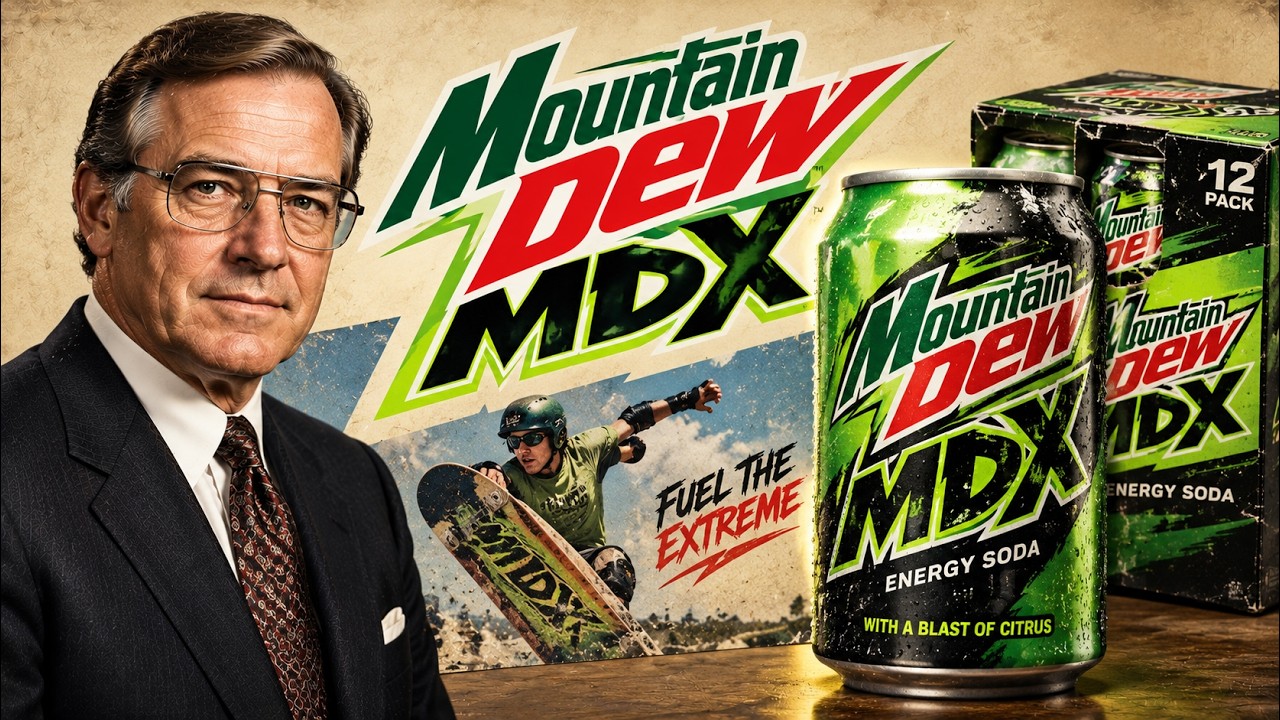
The gap between what Mountain Dew stood for culturally and what Red Bull sold commercially appeared, inside PepsiCo’s conference rooms, like a short step to close. Mountain Dew MDX launched in the spring of 2005. The product was built around four decisions. The formula used a 16-ounce can containing 72 milligrams of caffeine, supplemented with ginseng, guarana extract, and B vitamins.
The packaging featured a dark, nearly black label with aggressive typography, deliberately designed to signal energy category membership. The price was set at roughly $1. 69 to $1. 99 per can, about 50 cents above regular Mountain Dew and well below Red Bull.
The go-to-market strategy deployed the full Mountain Dew distribution network across all 50 states within the first 60 days. In its first 12 months, MDX generated an estimated $100 million in retail sales—a strong launch by most consumer market standards. But in the energy category of 2005, it was a mid-tier result at best. Monster Energy, in its third full year of national distribution, was generating roughly $400 million in estimated retail sales and accelerating.
Red Bull had crossed $1 billion in American retail sales alone. Early data showed a gap between trial and repeat purchase. Consumers who encountered MDX picked it up in meaningful numbers, but they did not return to it with the frequency a healthy beverage product requires. They tried it, found it acceptable, and went back to whatever they had been drinking before.
Energy drink consumption in 2005 was not primarily a taste decision. It was a daily or near-daily ritual anchored to a specific moment of physiological need, and that ritual belonged to products drinkers had already trained themselves to reach for. MDX faced a structural problem in the store. At most of the 200,000 locations where it launched, it was placed in the soda aisle, where families buy volume and make provisioning decisions for several days at a time.
The cooler door at the front of the convenience store—where individuals buy one can for a specific need at a specific moment—was where energy drink rituals were built. MDX launched primarily in the soda aisle, where no energy drink ritual had ever been formed. There was also a second contradiction inside PepsiCo. In 2001, the company acquired SoBe, South Beach Beverage Company, gaining a foothold in the enhanced beverage space.
In 2004, PepsiCo used that infrastructure to launch AMP Energy, a standalone energy drink brand with no explicit Mountain Dew branding, designed for the convenience store cooler and priced at parity with Red Bull. AMP was everything MDX was not: it had a clear category identity, lived in the right part of the store, and made no attempt to occupy two positions simultaneously. When MDX launched in 2005, PepsiCo had two products competing in the energy space. Both fought for the same limited shelf real estate, and both targeted overlapping demographics.
Retail buyers, managing finite cooler space, had limited patience for portfolio complexity. AMP had the cleaner story in those negotiations, and its sales velocity in the convenience channel was measurably stronger than MDX’s. In 2006, PepsiCo attempted to revive consumer interest with MDX Frenzy, a tropical fruit variant with updated label graphics. It moved modestly and performed well in certain regional markets, but it did not change the fundamental velocity numbers.
A new flavor could not fix a channel problem, and a tropical variant of a product drinkers had already decided they did not need to come back to was at best a delay. By the end of 2006, MDX had reached its peak in retail penetration, marketing investment, and consumer awareness. It was producing about $100 million in annual retail sales that were not growing, in a category growing at 50 percent per year around it. Meanwhile, Mountain Dew itself remained the third best-selling carbonated soft drink in America.
Its drinkers were loyal and deeply habituated. They did not need MDX to give them energy; they already had a drink and a ritual. The discontinuation began in 2007 without public announcement. PepsiCo communicated the decision through the supply chain: production orders were reduced, then stopped; distributors were not restocked; retail accounts received no new inventory.
By 2008, Mountain Dew MDX was effectively gone from American retail. PepsiCo never disclosed the exact date of final production, and there was no commemorative final run. MDX was never revived. In the American beverage industry, the absence of revival is itself a data point.
Schlitz beer, destroyed by a formula change in 1974, was relaunched with its original recipe in 2008. Jolt Cola was revived twice after its initial discontinuation. Tab, Coca-Cola’s original diet soda, generated petitions and organized consumer campaigns when it was discontinued in 2020. No petition was filed for MDX, and no consumer campaign formed.
The silence was not indifference from PepsiCo; it was indifference from the market. MDX had been tried, found acceptable, and not loved. The secondary market reflects this absence. A sealed, expired can of Mountain Dew MDX in good condition occasionally appears on auction platforms, selling for between $8 and $25, purchased largely by researchers and collectors documenting discontinued beverages.
There is no active collector community organized around MDX specifically, in sharp contrast to the robust markets for Schlitz neon signs and Tab memorabilia. MDX also left no physical landmark. It was produced through PepsiCo’s existing contracted manufacturing network, and the lines that ran its cans were running other products by 2008. There is no address to visit and no building with the name still visible on the brick.
One operational detail reframes the entire story. When PepsiCo launched MDX, it did not build a dedicated brand team, a separate route-to-market strategy, or a general manager whose sole accountability was the new product’s performance in a new category. Instead, MDX was inserted into the existing Mountain Dew system and asked that system to carry it. The Mountain Dew system excelled at moving product through grocery and convenience channels built around a mass-market soda.
It had never needed to learn how to build a ritual from scratch in a category that ran on rituals, or how to earn a place in the cooler door against competitors who had been there for years. Over the 17 years after MDX disappeared, PepsiCo made product decisions that showed the lesson had been learned. Mountain Dew Kickstart, launched in 2012, was designed explicitly for the morning occasion MDX had never claimed. Mountain Dew Game Fuel, relaunched in 2019 with a resealable can for extended gaming sessions, answered a specific question for a specific person.
And in 2022, PepsiCo launched Mountain Dew Energy, a direct, unambiguous energy drink sold in the convenience store cooler from day one, priced at parity with Monster and Red Bull, making no attempt to occupy the soda aisle simultaneously. It was everything MDX should have been in 2005. Mountain Dew MDX was not a bad idea. The energy category was real, the Mountain Dew equity among young men was real, and the appetite for a trusted, reasonably priced caffeinated alternative was real.
The diagnosis was correct, but the execution missed the person—not a demographic, but a specific individual with a specific daily routine who reached for a specific object at a specific moment because that object had become the answer to a question their body asked every day. Red Bull had that person. Monster had that person. MDX had awareness, distribution, and the most recognized brand name in youth soda standing behind it.
What it never had was the moment.