Joe Maphis died on June 27, 1986, at age 65, with lung cancer claiming the man once crowned the King of the Strings. The music industry that had cheered him decades earlier did not line up to save him, and he passed away in relative obscurity, worried about medical bills rather than enjoying the rewards of the sound he helped create. Born Otis W. Maphis in 1921 in Suffolk, Virginia, he grew up in the hardscrabble hills of Cumberland, Maryland, during the Great Depression.
Music was survival, not a career choice, and the young Joe absorbed the mountain sounds around him. He picked up his father’s fiddle at age eleven, moved through mandolin and banjo, and finally settled on guitar. In the 1930s, guitar was mostly a rhythm instrument in mountain music, but Joe wanted to dictate the beat, not just keep it. He developed a flatpicking style that mimicked rapid banjo rolls, playing single-note melody lines at breathtaking speed.
By his teenage years, he was a local legend. During World War II, Joe served in the U. S. Army and entertained troops, learning that showmanship was not vanity but a necessary act of service.
He performed behind his head and on his knees, developing the flashy stage presence that would later define him on television. He went in as a hillbilly musician and came out a professional entertainer. After the war, he worked the kerosene circuit of small radio stations across Virginia and Maryland, playing early morning shows and late-night dances. It was in Hagerstown, Maryland, that he met Rose Lee, a young dark-haired singer and rhythm guitarist with a powerful Appalachian voice.
They married in 1953, becoming Mr. and Mrs. Country Music. In 1951, the couple faced a choice.
Nashville represented the safe, established path, but Joe found its sound too slow and conservative. He wanted speed, swing, and electricity. The couple packed their car and drove west along Route 66 to Los Angeles, seeking the freer sounds of the West Coast. Los Angeles in the early 1950s was booming with huge dance halls serving defense workers and former Dust Bowl refugees.
Venues like the Town Hall Party in Compton drew thousands of people who wanted loud, raucous music. Joe understood immediately that acoustic subtlety would fail in these massive spaces. He approached a young, eccentric guitar builder named Semie Moseley with a bold request. Joe wanted an instrument that could do everything, combining the low growl of a standard guitar with the high, feverish notes of the mandolin and fiddle he had played in Virginia.
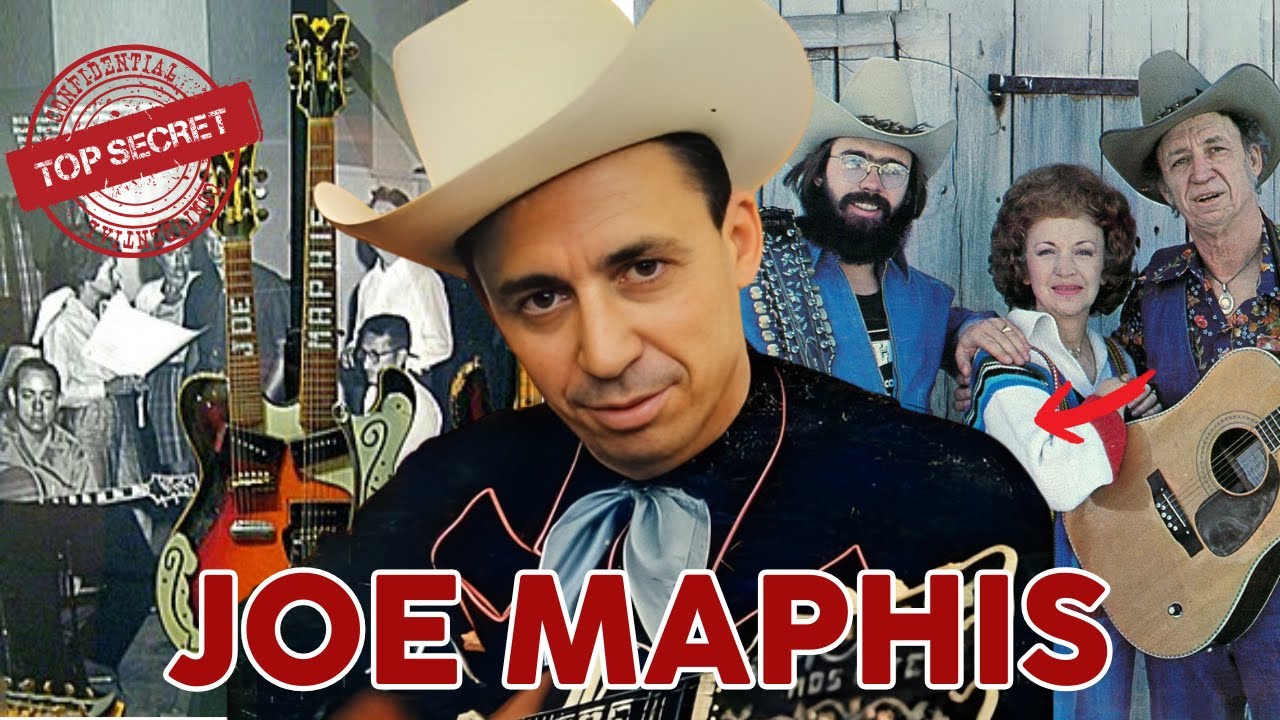
The result was the first Mosrite, a double-neck electric guitar weighing as much as a tombstone, with a standard six-string neck and an octave neck tuned higher. The instrument sounded like nothing else. Joe developed the California crunch, a sharp, metallic, aggressive tone using heavy picks and echo. It was the sonic equivalent of a tailfin on a Cadillac.
With his new weapon, Joe Maphis conquered the West Coast scene, becoming bandleader and musical director of the Town Hall Party, broadcast live on television every Saturday night. He added swing jazz, boogie-woogie, and uptempo R&B rhythms to his country style, creating the DNA of rock-and-roll before anyone had a name for it. He simply called it hot picking. During the mid-1950s, Joe took a young, hyperactive blond boy named Larry Collins under his wing.
Larry, one half of the Collins Kids act with his sister Lorie, was ten years old and eager to learn. Instead of treating the child as a prop, Joe taught him everything he knew, including how to play the double-neck and how to work a crowd. The pairing became the visual hallmark of the Town Hall Party. Joe, the sturdy man in the rhinestone suit standing like a mountain, and Larry, the small boy jumping off drum risers and spinning around, played face-to-face with their double-neck guitars nearly touching.
Their furious instrumental Hurricane became legendary. It was a father-son relationship forged in steel strings and vacuum tubes. While Joe burned up the television screen, Rose Lee quietly shaped the lyrical soul of the movement. She wrote one of their most iconic songs, Dim Lights, Thick Smoke and Loud, Loud Music, which became a standard covered by artists from Flatt & Scruggs to the Flying Burrito Brothers.
The song captured the specific lonely pain of the newcomer on the West Coast. By 1957, Joe was everywhere. He was on television and radio, recording for Columbia Records, and doing studio work for everyone in town. He played on movie soundtracks and influenced a new generation of guitarists.
Buck Owens observed his attack in the Capitol Records studios and took mental notes. Merle Haggard, listening from a detention center, heard that biting high tone and knew it was the sound he wanted. Joe was the architect of the Bakersfield Sound before Bakersfield even claimed the title. But there was a fatal flaw in the design of Joe’s career.
He was a musician, not a businessman. He trusted people, signed contracts without reading the fine print, and gave away his innovations freely. He did not trademark the Mosrite design or demand songwriting credits for arrangements he created for other artists. He was too busy being king to notice that the kingdom was being redivided.
As rock-and-roll took over at the end of the 1950s, the Town Hall Party began to feel like a relic. Teenagers wanted four young men with long hair and electric guitars, not a variety show with fiddles and banjos. Joe tried to adapt, recording a rockabilly album called Fire on the Strings that proved he could play faster and harder than the newcomers. But to the rock-and-roll generation, he looked like their father.
He looked like the establishment. By the early 1960s, the TV era that had made him famous faded. The dance halls emptied, and television executives searched for something new. Joe had successfully revolutionized the electric guitar, creating a vocabulary of speed and aggression that would become standard for rock and heavy metal, but influence does not pay the rent.
Session work dried up as producers chased the new sounds of the 1960s: fuzz tones, distortion, and psychedelia. The family made the difficult decision to leave California. In the mid-1960s, they moved to Nashville, not as conquering heroes but as veterans looking for work. Nashville was a closed ecosystem controlled by a small group of publishers, producers, and A-list session musicians.
Everyone respected Joe’s name and speed, but respect does not get you into recording sessions when the producer wants a soft acoustic sound for a pop ballad. Joe found work in smaller clubs, county fairs, and the regional Opry circuit. He became a musician’s musician, the man the stars came to watch but who was not the star himself. Guitarists sneaked into clubs to see him play, studying his hands and asking about the double-neck Mosrite.
Always the gentleman, Joe smiled, lit a cigar, and showed them a lick or two. He never kept his magic to himself. The custom Cadillacs were replaced by practical station wagons. The California ranch became a memory.
The family lived the reality of working musicians: endless highway miles, thin-walled motels, and two a. m. dinners. Rose Lee kept the family together, raising their children often on the road, managing the finances, and continuing to write.
Then came the cruelest blow. In the late 1960s, Rose Lee became seriously ill. In an era before comprehensive health insurance for freelancers, a major medical crisis was a financial death sentence. The King of the Strings faced a terrifying reality.
He had hands worth a million dollars but no money to pay the hospital. He began selling things. First the small items, then the instruments. Stories circulate in the vintage guitar community about pieces from Joe’s collection appearing in Nashville pawn shops during that time.
Each sale bought a few more weeks of treatment. Joe worked harder, taking any gig offered, playing in bars he would have turned his nose up at in 1955. He never complained on stage. When the curtain went up, the smile appeared, the cigar was lit, and the fingers flew.
In the 1970s, the outlaw country movement brought some recognition. The Nitty Gritty Dirt Band invited Joe to play on their iconic album Will the Circle Be Unbroken. For a brief moment, he sat in a circle with legends like Mother Maybelle Carter, Earl Scruggs, and Roy Acuff, unleashing a rapid acoustic solo that left both hippies and traditionalists staring in awe. But the moment was fleeting.
The album was a critical success but did not lead to a major comeback. The years of smoking caught up with him. The cigars that were his trademark began taking a toll on his lungs, and standing on concrete stages with a ten-pound guitar wrecked his back. In the early 1980s, Joe began feeling chest pain and shortness of breath.
The diagnosis was grim: lung cancer. The treatment was brutal. The man who had been a dynamo of energy, able to play three sets a night and then drive 500 miles, was reduced to a fragile figure in a hospital bed. Even then, the music did not stop.
In his final months, Joe was too weak to hold the big double-neck, so he held a small acoustic guitar. His thin, trembling hands steadied the moment they touched the strings. He played a slow, soft, perfect run, then looked at Rose Lee, the woman who had been his rhythm for forty years, and smiled. I can still find it, he whispered.
He was not talking about the notes. The industry that had built its fortune on the country-rock sound he pioneered largely looked the other way. But the family did not forget, and neither did the tribe of musicians who knew the truth. Johnny Cash came to pay his respects, acknowledging his debt to the West Coast sound.
Barbara Mandrell, by then a superstar with her own television show, came to sit with the man who had treated her like a daughter when she was a steel guitar prodigy. They came to say goodbye to the king. Joe Maphis died on June 27, 1986. He was buried in Hendersonville, Tennessee, the final resting place of many country legends.
The church was filled with the greats of the golden era, but outside, the world spun on with indifferent speed. The evening news did not lead with the story. For the vast majority of the American public, the day Joe Maphis died was just another Friday. In the years after his death, his recordings were largely unavailable, and the Mosrite brand went through a turbulent history of bankruptcies.
Maphis threatened to become a myth, a name whispered by guitar fanatics. Rose Lee, who had written Dim Lights, Thick Smoke, worked as a seamstress in the costume department at the Grand Ole Opry to make ends meet, a humble job for the Queen of the West Coast. But the sound Joe created was too powerful to stay buried. As alternative country and Americana movements rose in the 1990s, searching for authenticity, the searchlights turned back toward the past.
Then YouTube arrived, filled with old VHS tapes and grainy fragments of forgotten television. Footage of Joe and Larry Collins playing at the Town Hall Party surfaced online, showing a man in a rhinestone suit playing a double-neck guitar at impossible speed while chewing a cigar. A teenager in Tokyo clicked on it. A metal guitarist in Sweden clicked on it.
A country guitarist in Texas clicked on it. They had been taught that shredding was invented in the 1980s, but here was a man in black and white, in 1954, doing it better, cleaner, and faster. The comment sections filled with the same bewildered question: Who is this man, and why have I never heard of him? The King of the Strings went viral in his digital afterlife.
A new generation of musicians recognized Joe as the missing link, the bridge between the jazz swing of the 1930s, the rockabilly of the 1950s, and the speed metal of the future. He was the Rosetta Stone of the electric guitar. Today, his famous double-neck Mosrite sits on display in the Country Music Hall of Fame and Museum, even though his name is still missing from the official Hall of Fame roster. The man was never officially inducted, an omission many consider a glaring stain on the institution’s history.
But his tool, his weapon, forced its way inside, standing silent and imposing as a reminder to every tourist that before the big hats and pop hits, there was a man who built this town with fire and strings. Rose Lee survived her husband by 35 years, becoming the matriarch of his legacy. She welcomed historians and young guitarists, told the stories, and kept the flame burning. She lived long enough to see her husband recognized as a pioneer, and she died in 2021 at age 98.
With her death, the last living link to the Mr. and Mrs. Country Music era was broken. Joe Maphis died broke.
That is the hard truth. The man who created a sound that earned billions for the music industry left this world worrying about doctor bills. He never had the stadium tours or private planes. But if you measure wealth by influence, Joe Maphis died a billionaire.
Every time a country guitarist plays a chicken picking riff, they pay tribute to Joe. Every time a rockabilly band uses that echo on the vocals, they channel the barn dance. Every time a kid picks up a guitar and decides to play as fast as possible just to see if they can, they follow in his footsteps.