The Battle of Little Bighorn has long been remembered as a heroic last stand, a neat image of disciplined cavalrymen holding a hill against impossible odds. But the physical evidence left behind on the Montana battlefield tells a very different story. The soldiers were not found in a proud defensive circle. They were discovered broken into fragments across ravines and scattered slopes, in positions no commander would have chosen for a final defense.
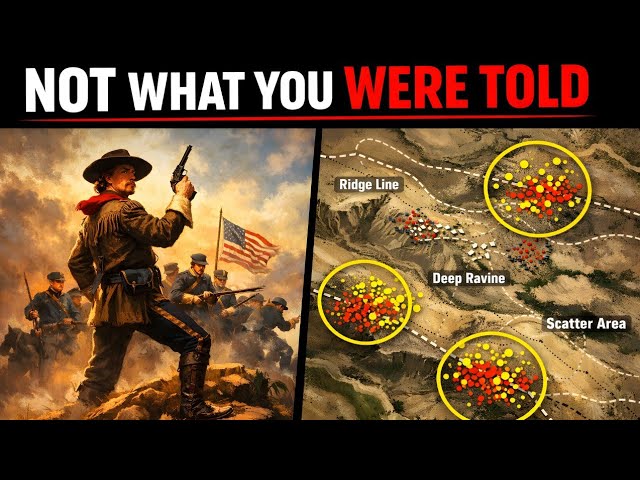
Archaeological mapping of spent cartridges later revealed patterns of panic, tight clusters of men firing wildly rather than controlled volleys. The evidence suggests the unit did not die in glory but collapsed under fear and confusion, overwhelmed by a force they badly underestimated. That version of events never matched the myth that took hold in American memory. The legendary account was shaped by the need to protect reputations, justify government policy, and transform a catastrophic defeat into something the public could accept.
On June 25, 1876, barely 210 men in George Armstrong Custer’s immediate battalion were engulfed by a force of roughly 2,500 Lakota and Cheyenne fighters, supported by the largest gathering of Plains people in generations. In less than an hour, not one soldier from that battalion survived. With no living witnesses, the silence became fertile ground for myth, though the landscape itself never agreed with the legend. To understand the final collapse, it is necessary to look at the weeks before the battle.
The United States was celebrating its centennial while expanding westward, and the discovery of gold in the Black Hills had triggered a flood of trespassers into land protected by treaty and considered sacred to the Lakota. The army believed it was pursuing a small band of scattered fighters, estimating perhaps 800 warriors at most. In reality, the Lakota, Northern Cheyenne, and Arapaho had gathered into a massive encampment of 7,000 to 8,000 people, with nearly 2,000 lodges spread across miles of riverbank. Three figures stood at the center of the conflict.
Custer, the 36-year-old “boy general” of Civil War fame, was a lieutenant colonel whose glory was fading and whose hunger for a dramatic triumph was growing. Sitting Bull, the Hunkpapa Lakota spiritual leader, held the nations together through vision and trust, having foreseen soldiers falling into the village like grasshoppers. Crazy Horse, the Oglala war leader, was not merely brave but tactically intelligent, a commander who understood cavalry behavior and battlefield momentum. The army’s plan was a three-column squeeze, with General Terry from the east, General Gibbon from the west, and General Crook from the south.
But the plan was already compromised, as Crook had been stopped at the Rosebud, a fact the army did not yet know. While the army believed it was closing a trap, the Lakota and Cheyenne were defending the largest gathering of their people in a generation, including families, elders, and children, all within reach of a cavalry attack. A warrior fighting for territory may retreat, but a warrior fighting for his family will not. When the Seventh Cavalry rode out from Fort Abraham Lincoln, it numbered around 600 men armed with single-shot Springfield carbines and Colt revolvers.
The army assumed its enemy would be smaller, less equipped, and likely to scatter. Nearly every assumption was wrong. Many of the warriors carried repeating rifles like Winchesters and Henrys, capable of firing up to 15 shots before reloading. Against that, the Springfield was painfully slow.
This firepower imbalance was a major reason panic spread so quickly once the fighting began. Custer also made a fateful decision before the battle. General Terry offered him Gatling guns, which could have changed the outcome, but Custer refused them, calling them too slow and cumbersome. He wanted speed and the glory of arriving first.
That single decision, rejecting overwhelming firepower for the sake of mobility and personal ambition, would echo through the ravines where his men later died. By June 24, warning signs were unmistakable. Custer’s Crow scouts climbed to a lookout and saw smoke columns, lodge lines, and horse herds so large they seemed to cover the earth. One scout reportedly muttered words that now seem prophetic: “This may end badly for us.
” Custer dismissed the reports, claiming he could not see what they described. His scouts were not reporting rumors but mathematics. Nearly 2,000 lodges meant thousands of people and thousands of warriors. A second warning followed when scouts believed the army had been spotted by Lakota warriors.
Standard military caution demanded waiting for Terry and Gibbon to coordinate a combined strike. But Custer, fearing the camp would scatter and escape him, advanced without delay. He attacked while splitting his force, a decision with catastrophic consequences. Major Reno led roughly 130 men, Captain Benteen about 125, and Custer kept 210 for himself.
The pack train carrying ammunition lagged behind, guarded and slow. Custer underestimated not just the enemy but what the enemy’s repeating rifles would do to his ammunition supply. Some scouts began singing death songs, understanding what Custer refused to accept. One scout later stated he warned Custer that the Sioux outnumbered the soldiers’ bullets.
Custer mocked them. Some scouts left rather than ride into what they believed was an impossible situation. On June 25, Custer drove his exhausted men through the dark before dawn, pushing forward with an obsession for speed. From high ground, morning light revealed the truth: the valley held a nation gathered in one place.
Still, Custer pressed on. Around midday, he split his force again, sending Benteen away on a scouting detour that stripped him of a third of his combat power. Reno was ordered to strike from the south while Custer swung north to hit from behind. The plan rested on one assumption: the warriors would run.
They did not. Reno reached the valley first. Around 3 p. m.
, his scouts warned that warriors were moving out to confront them. Tribes under attack often defended from cover and avoided open engagement, but these fighters were advancing to meet the cavalry. That alone should have signaled this was no ordinary village fight. Reno formed a battle line and charged.
The ground seemed to come alive as warriors appeared in overwhelming numbers. Gunfire erupted from multiple directions, and the village line extended far beyond what Reno had expected. His assault lasted only about 14 minutes before it collapsed. Warriors used the terrain expertly, vanishing and reappearing, closing distance, and striking from angles the cavalry could not control.
Repeating rifle fire caused severe losses among men and horses. Reno ordered a stop, then a dismount, then a retreat into the timber, and that is when discipline snapped. The retreat turned into chaos. Warriors closed in, and troopers were dragged from their mounts.
In the confusion, the scout Bloody Knife was killed beside Reno, a moment so violent it reportedly broke Reno’s composure. What should have been an organized withdrawal became a frantic sprint for survival. The river crossing turned into a killing zone as men and horses tangled in the water and bullets tore through bodies from both banks. Within half an hour, 40 of Reno’s 130 men were dead or missing.
The survivors clawed their way up the bluffs to a hilltop where they were surrounded and desperate. While Reno was collapsing in the south, Custer was marching north into disaster. Still believing he could strike the village from behind, he advanced along the ridges. His final message, sent through trumpeter John Martin, read, “Come quick, big village, bring packs.
” Martin would become the last white man to see Custer’s battalion intact. Somewhere along those ridges, Custer finally understood the village’s true size, miles of lodges, thousands of people. More terrifying still, the warriors were not retreating but surging toward him. Crazy Horse and Gaul were coordinating and redirecting warriors away from Reno and toward Custer.
Once Reno was pinned and no longer an immediate threat, warriors could pivot north in mass. Custer’s 210 men now faced perhaps 1,500 to 2,000 converging fighters. Custer attempted to force a crossing at Medicine Tail Coulee, possibly trying to seize non-combatants as leverage. Gaul’s warriors blocked the crossing and drove him back.
That failure was not just a failed maneuver but the moment the battalion’s momentum died. The soldiers were pushed onto broken ground where every ravine became a trap and every ridge a killing lane. They moved north searching for defensible terrain, but the rolling hills offered no fortifiable position. Warriors slipped through draws and gullies unseen, appearing close, firing fast, and disappearing again.
Losses mounted immediately, and units fragmented. Company C under Captain Custer’s brother-in-law, Captain Calhoun, tried to anchor a defense near what became known as Calhoun Hill, but rapid fire from multiple angles disrupted the formation. The soldiers did what frightened men often do: they clustered. Archaeology later confirmed this with chilling clarity.
Concentrated piles of spent casings showed grouped positions rather than long skirmish lines or controlled fire. The men were huddled together, the worst possible posture when facing overwhelming enemy firepower. The warriors did not simply shoot; they isolated the soldiers. Crazy Horse led mounted charges designed to split the battalion into pieces.
Gaul pressed from the south, and others struck from the west. Each company was cut off from the next, unable to reinforce or retreat as a single body. By roughly 4:15 p. m.
, Custer’s force had splintered into multiple groups across broken ridge lines. Ammunition dwindled rapidly. Each Springfield shot was precious, and every reload was slow while the enemy could fire 15 shots for every one returned. Custer tried again at the river, sending companies forward in a desperate push.
Warriors hidden in the brush unleashed volleys, forcing horses and men into the water as the assault collapsed and survivors retreated under heavy fire. This was not a glorious last stand but a collapse, and the ground later testified to it. When investigators studied spent cartridges decades later, they found patterns that did not match heroic mythology. Soldiers were not firing in controlled bursts but wildly and chaotically, a signature of panic.
White Bull, Sitting Bull’s nephew, led part of the assault that slammed into Calhoun’s position. Here is a detail that obliterates the romantic version of the battle: Calhoun’s command was completely defeated in under seven minutes. Archaeology revealed concentrated casing piles where men bunched together, firing rapidly, overwhelmed. In those few minutes, the battalion broke into scattered groups under pressure.
The soldiers were not a single unit but isolated pockets of men trapped by terrain, outgunned, and surrounded by warriors defending their people. Once fragmentation began, there was no saving them. No cavalry formation survives when it breaks into separated groups with no ammunition resupply, no support, no escape routes, and no enemy hesitation. This was not simply a defeat but a rapid collapse under extreme tactical pressure.
That is why the bodies were later found scattered in ravines. That is why the “last stand” pose does not match the physical evidence. In the years after the battle, a propaganda effort reshaped the narrative into something survivable. A massacre became a legend.
Panic became bravery. Tactical failure became martyrdom. The land, however, never forgot. The ravines still hold the truth, and the archaeology tells the story textbooks refused to print.
The Seventh Cavalry did not hold a neat circle of honor; their positions fragmented, and they retreated in confusion under overwhelming force.