The story of Jacqueline Kennedy Onassis is often reduced to a single, frozen image: a veiled widow standing in silent grief. But the reality of her life after the assassination of President John F. Kennedy was far more complex, controversial, and strategic than the myth of "Camelot" suggests.
The public narrative of a perfect, tragic marriage was carefully constructed. Contrary to popular belief, it was not JFK who coined the Camelot legend. It was Jackie herself. Just one week after the assassination, she summoned journalist Theodore White to Hyannis Port and dictated the narrative, comparing her husband’s administration to the magical, doomed court of King Arthur. She personally orchestrated the details of the state funeral, modeling it on Abraham Lincoln’s to ensure her husband’s place in history. She was not a passive victim; she was a political strategist building an unbreakable legacy.
Behind closed doors, however, the grieving widow was seeking comfort in a shattered world. This led to one of the most explosive rumors of the 1960s: a secret relationship with her brother-in-law, Robert F. Kennedy. According to controversial biographers and decades of Washington gossip, the two bonded over their shared trauma, and the relationship allegedly turned physical. No definitive proof ever emerged, but the fact that so many believed it revealed a darker side to the Kennedy myth.
Hollywood also entered the narrative. In his 1994 autobiography, Marlon Brando claimed he had a drunken, intimate encounter with Jackie in 1964. He wrote that after a night of drinking in Washington, she took the initiative and led him to her bedroom. Whether true or the fantasy of a narcissistic actor, the story shattered the illusion of an untouchable saint.
By 1968, Jackie’s fear for her family’s safety had become overwhelming. The assassination of Robert F. Kennedy in June of that year pushed her into a state of deep paranoia. She became convinced that the Kennedy family was being systematically targeted. She famously told friends, "If they are killing Kennedys, then my children are targets. I want to get out of this country." America no longer felt like home; it felt like a graveyard.
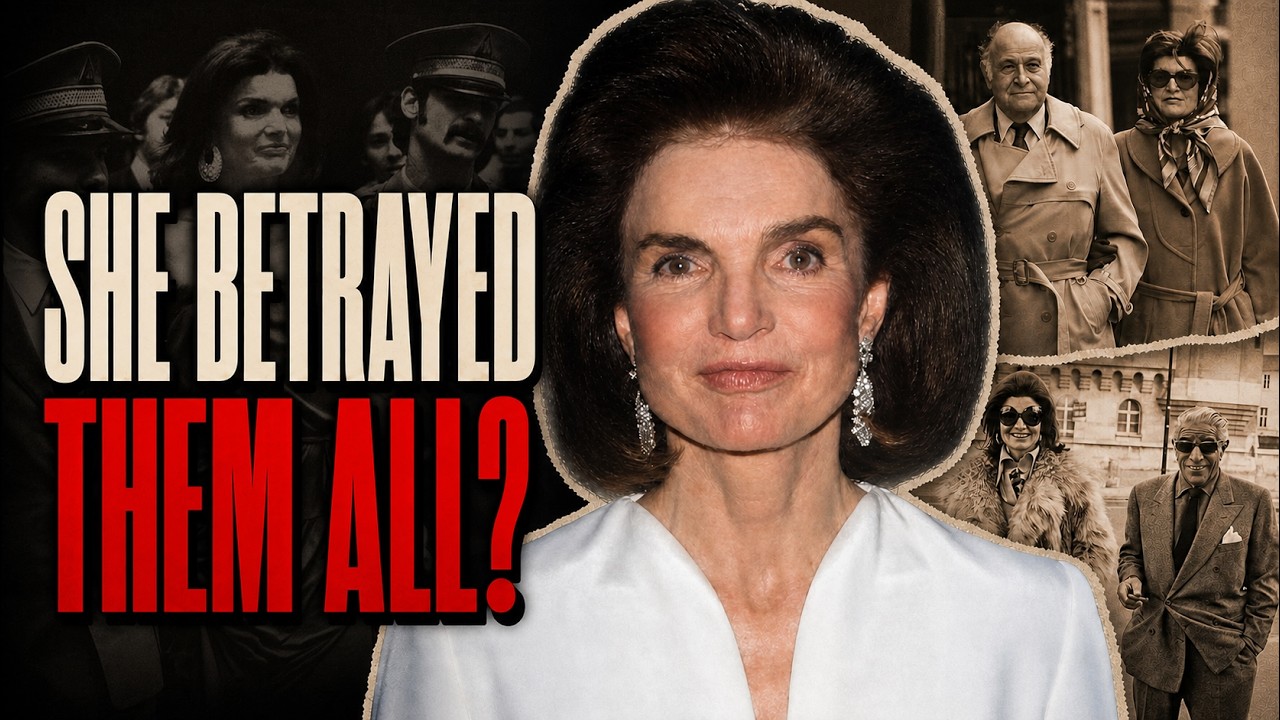
Her solution was a calculated escape. On October 20, 1968, she married Greek shipping magnate Aristotle Onassis, a man 23 years her senior. It was not a fairy-tale romance but a pragmatic arrangement. The prenuptial agreement contained a staggering 170 clauses. Jackie received a $3 million tax-free lump sum, and Onassis established $1 million trusts for each of her children. The contract even stipulated separate bedrooms and allowed them to live largely independent lives.

The Greek billionaire’s family, however, despised her. Onassis’s daughter, Christina, openly referred to Jackie as the "Black Widow," believing she carried a deadly curse. Tragedy soon struck the Onassis empire. In January 1973, Aristotle’s only son, Alexander, was killed in a plane crash. The grieving magnate reportedly began to believe his daughter’s warnings, whispering that his marriage had brought an evil eye upon his lineage. The marriage collapsed, and Onassis allegedly began drafting divorce papers.
Before the divorce could be finalized, a scandal broke. In 1972, paparazzi captured unauthorized nude photos of Jackie sunbathing on the supposedly secure island of Scorpios. The images were eventually published in *Hustler* magazine in 1975. A persistent and malicious rumor claimed that Onassis himself had leaked the security details to the photographers, hoping to humiliate his wife and gain leverage in the impending divorce settlement.
After Onassis’s death in 1975, Jackie returned to New York. She was relentlessly pursued by the press, most notably by photographer Ron Galella. After years of harassment, she fought back. In a famous confrontation, her bodyguards smashed Galella’s camera. She then took him to federal court and won, securing legal restrictions on how close he could get to her and her children.

Then, she did something no one expected. She got a job. In 1975, the former First Lady accepted a position as a consulting editor at Viking Press for just $200 a week. Many laughed, but she proved relentless. Over the next two decades, she worked on over 100 books, eventually becoming a prominent editor at Doubleday. She used her influence to secure major deals, including Michael Jackson’s 1988 autobiography, *Moonwalk*. She transformed herself from a political figure into a respected literary intellectual.
In her final years, Jackie found a quiet but controversial companion: Maurice Tempelsman, a wealthy Belgian-American diamond merchant. The problem was that he was married. Since his wife refused a divorce, the couple never wed. Instead, they lived openly together in her 15-room Fifth Avenue apartment. Tempelsman was a financial genius who reportedly managed her fortune so well that he significantly multiplied her inheritance. He gave her the stability and privacy that neither Kennedy nor Onassis could provide.
When Jackie died on May 19, 1994, at the age of 64, she left behind a vast fortune. America wanted her to remain a weeping widow forever, but she refused to be a prisoner of history. She escaped to a billionaire’s island, returned to build her own empire, and ultimately lived life on her own terms.