In 1788, a band of roughly fifteen Delaware Indians attacked the home of Bland Ballard in Shelby County, Kentucky. Ballard was already a hardened fighter, having served as a teenager during the Revolutionary War and later as a spy under General George Rogers Clark.
The attack came during a period of open warfare between American settlers and Native tribes. Although the Treaty of Paris in 1783 had ceded Kentucky and other Ohio territory to the Americans, the Shawnee and Delaware tribes refused to recognize the agreement. Kentucky was long known as a dark and bloody land, used as hunting ground by both northern and southern tribes who sometimes fought each other there.
As American settlers moved into Kentucky in greater numbers after the war, the Shawnee and Delaware began launching brutal attacks on them. By 1785, the conflict had escalated into open war.
Bland Ballard arrived in Kentucky in 1777. He served in Bowman’s campaign in 1779 and accompanied General Clark’s expedition against the Piqua towns in 1781, where he was severely wounded. In 1786, he worked as a spy for Clark, and in 1791 he served as a guide. He was also present at General Wayne’s decisive victory at Fallen Timbers in 1794.
During his three years as a spy with Clark, Ballard had numerous encounters with Indians. On one occasion near Louisville, he was scouting the river when he heard noise on the Indiana shore. As the fog lifted, he spotted a canoe approaching with three Indians aboard. When they came within range, he fired and killed one. The others jumped into the water and tried to push their canoe toward deeper water, but Ballard shot the second and then the third. Clark later sent a party to the site to bury the bodies.
In recognition of his service, Clark gave Ballard a linen shirt. The hardened frontiersman prized it greatly, as his previous shirts had been made only of buckskin.
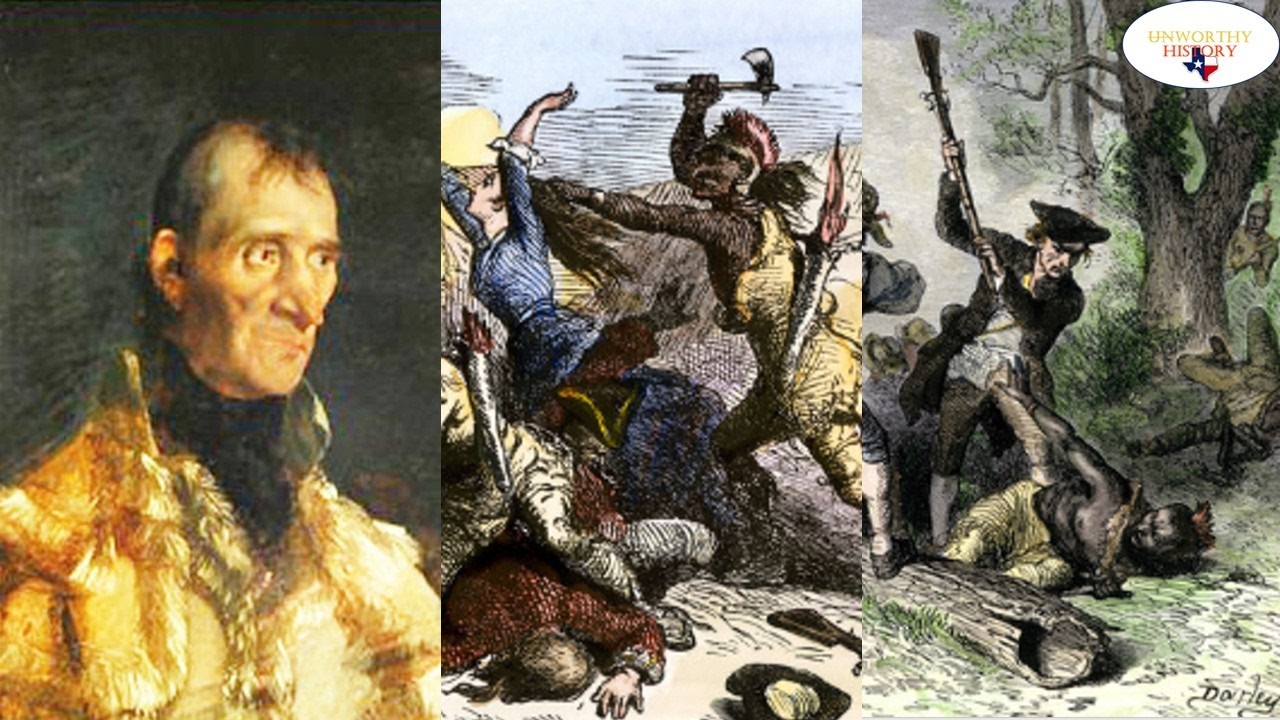
The attack on his family’s home came in 1788 at a small fort on Tick Creek where his father was living. The elder Ballard had moved outside the fort to be near a sugar camp. When Ballard’s younger brother went out to cut wood, hidden Indians shot him and then attacked the cabin.
Those inside barred the door and prepared to defend themselves. The father was the only man in the house, and the fort held only an old man and Bland Ballard. As soon as Ballard heard the gunfire, he moved as close as he could to his father’s cabin and began using his rifle to deadly effect.
The Indians broke into the cabin and killed the elder Ballard, but not before he killed two of them. They also killed Ballard’s young sister, his half-sister, and his stepmother. They struck his youngest sister with a tomahawk, though she later recovered.
An Indian chased the stepmother out the back door, but before his tomahawk could fall, a bullet from Ballard’s rifle dropped him. The Indians numbered fifteen, but before they left with their plunder, they had lost six or seven of their number.
Ballard was captured on another occasion by five Indians north of Louisville and taken to their camp. He was treated well but left unbound. The next day, while the Indians were occupied with a horse race, his guards left him to watch. A fine black horse, recently stolen from the Bluegrass region, stood nearby. Ballard leaped onto its back and fled.
The chase became a matter of life and death. He was pursued for more than twenty miles to the river but managed to escape. The brave horse that saved him died shortly afterward from exhaustion.

On another occasion, Indians stole his horse at night. Ballard heard them clearly as they took the animal from where it was tied. His energy and cunning allowed him to take a shortcut across the countryside and get ahead of the thieves before they reached the Ohio River. He set up an ambush near the path they were likely to take. Soon a group of three appeared. He aimed carefully at the Indian riding his horse and killed him. Ballard not only recovered the frightened animal but escaped without injury.
Later in life, Major Ballard represented Shelby County repeatedly in the legislature. He led a company under Harrison in 1812 and 1813, and was wounded and captured at the Battle of the River Raisin. In 1847, he was still alive, a remarkable example of the old Kentucky pioneers.
Bland Ballard was born near Fredericksburg, Virginia, on October 16, 1761. He came to Kentucky in 1779 and joined the regular militia for the defense of the country. During the expedition against the Piqua towns in 1781, he was badly wounded in the hip and nearly bled to death before receiving surgical help. He still suffered from the effects of that wound in his old age.
During one scouting mission to the salt springs, Ballard and a companion suddenly came upon a large party of Indians pitching their tents. They immediately attacked, firing their rifles and raising war cries. This drove the Indians into a temporary retreat while they assessed the strength of their attackers. During the confusion, Ballard and his companion seized two of the best horses they could find and rode for two days and nights until they reached the Ohio River. They crossed on a raft while their horses swam. As they climbed the Kentucky bank, the Indians reached the opposite shore.
At the time of the defeats at Long Run, Ballard was living at Linn’s Station on the Bluegrass. He came to help families move from Squire Boone’s Station near present-day Shelbyville. The settlers there were panicked by signs of Indians in the area and decided to move to more fortified stations.
They traveled safely until they neared Long Run, where they were attacked from front and rear. The Indians fired their rifles and then charged with tomahawks. Some men fled at the first shot. Others saved part of their families or died with them after brave resistance.

Ballard helped several women onto horses during the initial attack and fought off Indians in one or two encounters by himself. Seeing his party about to be defeated, he managed to break through the Indian line. He used his rifle effectively until he saw they were completely overwhelmed. He then made for the station, pursued by Indians. When he stopped at Floyd’s Fork in the bushes on the bank, he saw an Indian on horseback chasing the fugitives and entering the river. As the Indian climbed the bank near where Ballard stood, Ballard shot him, seized the horse, and escaped to the station.
Many were killed that day, some were taken prisoner, and others escaped to the station. The settlers later learned from prisoners taken on this occasion that the Indians had been on their way to attack the station the settlers had just abandoned. But after learning from their spies that the settlers were moving, the Indians changed course and headed toward Long Run.
News of this defeat led Colonel Floyd to gather a force of thirty-seven men to punish the Indians. Floyd led one division and Captain Holden led the other, with Ballard in the latter. They marched cautiously but did not discover the Indians until they received the first fire, which killed or fatally wounded sixteen of their men. Despite the loss, Floyd’s detachment stood firm and fought bravely until overwhelmed by a force three times their size. The retreat was made without further heavy losses.
The occasion was remembered for the bravery of young Wells, later Colonel Wells at the Battle of Tippecanoe, who saved the life of his enemy Floyd by giving him his horse at a critical moment while Floyd was retreating on foot and exhausted.
Ballard later led the advance of the force that fought the first Battle of the River Raisin. He was slightly wounded that day, then severely wounded by a stray bullet on January 22. That wound continued to trouble him in his old age. On that disastrous occasion, he was taken prisoner and suffered greatly during the march through snow and ice from Malden to Fort George.
According to accounts, Ballard killed between three and seven Indians on the day of the Tick Creek massacre, but not before his father, stepmother, brother, and two sisters were killed. His youngest sister was scalped in that attack but recovered remarkably and lived to an old age.
Ballard had such a reputation for killing Indians that he displayed some of the scalps he had taken over his fireplace. Historian Vince Acker described Ballard as one of the most courageous and daring spirits in early Kentucky history. Both Blandville and Ballard County in Kentucky were named in his honor.
By the time Bland Williams Ballard died in 1853, no native inhabitants remained in the region.