In February 1676, Mary Rowlandson and her children were captured by Wampanoag Indians after a raid on Lancaster, Massachusetts. Many settlers were killed during the attack, including her daughter. The raid was part of King Philip’s War, a conflict led by Metacom, also known as King Philip, against the colonists of Massachusetts and Rhode Island.
The war began in 1675, breaking more than 50 years of peace between his tribe and the English. King Philip’s father, Massasoit, was the chief who had sent Squanto to help the English colonists in 1621, an act that led to the first Thanksgiving. But after Massasoit’s death in 1662, his son began planning for war against the English.
Rowlandson’s account of her captivity was published in 1682 under the title *The Sovereignty and Goodness of God: Being a Narrative of the Captivity and Restoration of Mrs. Mary Rowlandson*. Her story follows her forced journey through western Massachusetts and north toward the borders of Vermont and New Hampshire.
During the fifth remove, the Indians moved quickly because the English army was nearby. They marched as if fleeing for their lives, then chose their bravest men to go back and delay the English while the rest escaped. The group carried their elderly and young, with some bearing a heavy Indian man on a litter until they reached the Paquaug River.
Rowlandson was weakened by her wound and carried only her sewing work and two quarts of dried flour. She asked her mistress for a spoonful of flour but was refused. The group quickly cut dry trees to make rafts for crossing the river. She was placed on brush to keep her feet dry, while others waded through cold water up to their legs.
Only part of the group crossed that night, and the rest crossed the following night. On Saturday, they boiled the leg of an old horse, and she drank the broth. During her first week with the Indians, she ate almost nothing. By the second week, her stomach was weak from hunger, and she found their dirty food hard to swallow. By the third week, the same food seemed sweet and tasty to her.
On the Sabbath, she was ordered to work. She told them it was the Sabbath and asked to rest, promising to do twice the work the next day. They replied that they would smash her face. She noted the strange providence of God in preserving the heathen, as hundreds of them, including the sick and lame, crossed the river with all their belongings.
On Monday, they burned their wigwams and left. That same day, the English army reached the river and saw the smoke, but the river stopped them. Rowlandson reflected that God had not yet prepared them for victory and deliverance.
During the sixth remove, they faced a cold morning and a large brook covered with ice. Some waded through it, while others crossed at a beaver dam, and her feet stayed dry. She walked that day weeping and mourning, moving farther from her home into a vast and desolate wilderness.
They reached a large swamp and camped beside it. From a hilltop, she thought they had arrived at a great Indian town, but it was only their own company. The Indians were as thick as trees, with hundreds of axes working at once. She was in the middle, with no Christian soul near her.
The next day was hard. The swamp was like a deep dungeon, and before her was a steep hill. She thought her heart and legs would break before she reached the top. Later, she saw a place where English cattle had been, which comforted her. Then they came to an English road, and she wished she could lie down and die in peace.
They reached Squakeag, where the Indians spread out through abandoned English fields. Some picked up wheat, others found Indian corn ears, and some found black beans. She obtained two ears of Indian corn, but one was stolen from her. An Indian came by with a basket containing a horse’s liver, and she asked for a piece. He was surprised she would eat it but gave her some. She roasted it on the coals, but before it was half cooked, half was taken from her. She ate the rest raw, with blood in her mouth, and it was a sweet morsel to her.
During the eighth remove, they had to cross the Connecticut River to meet King Philip. As she was about to board the boat, sudden cries arose, and she was forced to retreat. They marched four or five miles north instead. The disturbance was likely caused by English scouts in the area.
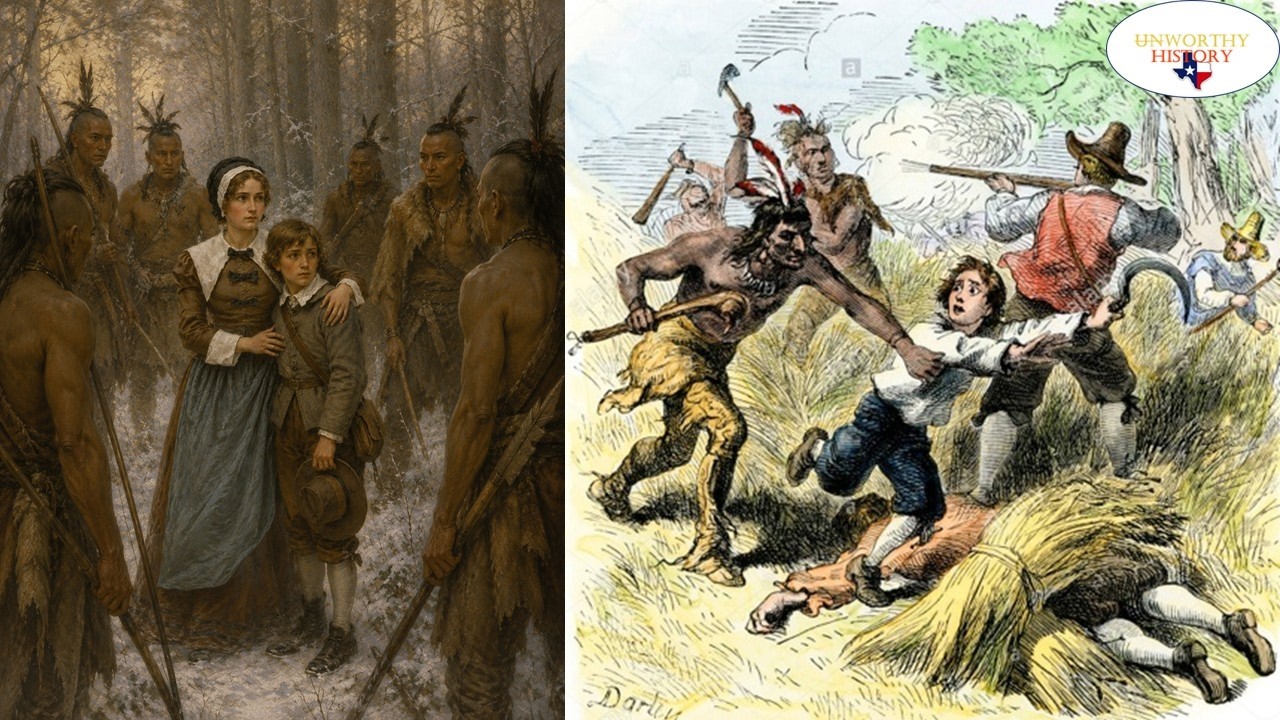
At noon, the group stopped to rest. Her son Joseph came to her unexpectedly, and they mourned their changed condition together. She asked if he could read, and he said he wanted to. She gave him her Bible, and he found the verse: “I shall not die, but live, and declare the works of the Lord.” He said, “Look here, mother, have you read this?”
They traveled until night, and in the morning they crossed the river to Philip’s company. When she reached the shore, the Indians gathered around her, laughing and rejoicing over their gains. Her heart weakened, and she burst into tears, the first time she had wept before them. One of them asked why she was crying, and she said they would kill her. He told her no one would hurt her.
She went to see King Philip, who invited her to sit and asked if she would smoke. She had used tobacco before but had given it up since her captivity. She called it a bait of the devil to waste precious time. Philip asked her to sew a shirt for his child, and she did, receiving a shilling for it. She bought a piece of horse flesh with the money.
Later, Philip asked her to make a cap for his child and invited her to dinner. She was given a pancake the size of two fingers, made from parched wheat and fried in bear grease. She thought she had never tasted anything more delicious.
A woman asked her to sew a shirt for her husband and gave her a piece of bear meat. Another asked her to knit a pair of stockings and gave her a quart of peas. She boiled the peas and bear meat together and invited her master and mistress to dinner, but the proud woman would not eat because it was served in one dish.
She learned her son had arrived at the place and went to see him. She found him lying on the ground, not sleeping but praying, so the Indians would not notice. She prayed that God would remember these things.
The Indians returned from Northampton with horses, sheep, and other goods. She begged them to take her to Albany on one of the horses and sell her for gunpowder. She had no hope of walking home the way she had come.
During the ninth remove, they traveled five miles along the river and crossed it. A poor Indian asked her to sew a shirt for him, and when she finished, he paid her nothing. But since he lived by the river where she fetched water, she kept asking for her wages. He finally told her that if she made another shirt for an unborn child, he would give her a knife, and he did.
Her master’s servant returned from Narragansett country with about a peck and a half of corn. This was around the time their great leader Nenant was killed. Her son was about a mile away, and she asked permission to see him. She got lost among the hills and swamps and could not reach him. She marveled at God’s power and goodness, for though she met many strange Indians, none of them abused her.
When she finally found her son, he was sick with a boil on his side. They mourned together for a while. She returned, but her mind was troubled. Her son was sick, and she could not stop thinking of his sad looks. Her daughter was somewhere unknown, and she did not know if she was sick or well, alive or dead.
She opened her Bible and found the verse: “Cast thy burden upon the Lord, and he shall sustain thee.” She went searching for food and found a woman who gave her a piece of bear meat. She kept it in her pockets all day and night, afraid they would take it from her. In the morning, she boiled it with ground nuts, and it tasted delicious to her.
On a very cold day, she had no place by the fire. She entered another wigwam, and a woman spread a skin for her to sit on, gave her ground nuts, and asked her to come again. The woman said they would buy her if they could. These were strangers to her.
A small part of the group moved about three-quarters of a mile, intending to go farther the next day. Hungry, she went back to the previous place to get food. An Indian came looking for her, and when he found her, he kicked her all the way back. That night, venison was roasting, but they gave her not one piece.

During the eleventh remove, they set out to travel a full day along the river. She carried her load on her back and crossed the river, climbing weary hills. One hill was so steep she had to go up on her knees, holding onto branches to keep from falling backward. Her head was so light she staggered as she walked.
During the twelfth remove, on a Saturday morning, she asked her master if he would sell her to her husband. He answered yes, which greatly cheered her spirit. But her mistress, before they left, snatched her Bible from her hands and threw it out the door. She ran out, picked it up, and put it in her pocket, never letting her see it again.
They packed up to leave and gave her a heavy load. She complained it was too heavy, and her mistress slapped her face and ordered her to move. The thought of going home made the burden seem light. But to her great surprise, her mistress suddenly stopped and refused to go forward. She turned back and said Rowlandson must return with her.
Her mistress called for her son to come back, but he refused, saying he would continue and return in three days. Rowlandson’s soul was in great distress. She thought death was better than going back. She opened her Bible and found the verse: “Be still, and know that I am God.” Her spirit quieted, but she knew hard times were coming.
Her master, who had seemed her best friend among the Indians, left. She sat down with a heavy heart but was so hungry she went out to search for food. She found six acorns and two chestnuts. At night, she gathered wood to warm herself, but they ordered her out, saying they had too many guests. When she asked where to go, one of them drew his sword and said he would stab her if she did not leave.
She went from wigwam to wigwam, but no one had room. Finally, an old Indian invited her in, and his wife gave her ground nuts and a place to sleep. She had a comfortable night by God’s providence.
They were about two miles from the Connecticut River, going each morning to gather ground nuts and returning at night. She walked with a heavy load on her back. When she told them her back was raw, they said it did not matter if she lost her head too.
Instead of heading toward the Bay as she hoped, she was forced to go five or six miles down the river into a thick wood, where they stayed about two weeks. A woman asked her to make a shirt for her child and gave her a bowl of broth thickened with bark flour, with peas and ground nuts added.
She had not seen her son for a while, and she asked an Indian about him. He told her that her son’s master had roasted him and that he himself had eaten a piece of him the size of two fingers, saying it was good meat. But the Lord strengthened her spirit, and she reflected on their horrible addiction to lying.
One cold night, she moved a branch that was blocking the fire’s heat. A woman put it back, and when Rowlandson looked at her, the woman threw a handful of ashes into her eyes. She thought she would be blinded, but her tears washed the dust away, and by morning her sight was restored.
She often forgot where she was and would run outside as if at home, only to see wilderness and savage Indians, which brought her back to her senses. She began to think all hope of returning was gone. The English army did not come. The plan to go to Albany failed. Her master left her. Her soul was ready to sink.
She asked permission to gather wood so she could be alone and pour out her heart before the Lord. She opened her Bible but found no comfort in it. She knew God had dealt with her less than she deserved. She found some relief in Isaiah 55:8: “For my thoughts are not your thoughts, neither are your ways my ways, saith the Lord.”
Around this time, the Indians came from Hadley, where they had killed three Englishmen and taken a prisoner named Thomas Reed. The Indians gathered around him, asking many questions. She went to see him, and he was weeping bitterly, thinking they would kill him. She asked if they intended to kill him, and they said no.

She asked him about her husband. He told her he had seen him at the Bay, that he was well but very melancholy. This confirmed that what the Indians had told her about her husband was false. Some had said he was dead, and others said he had remarried, believing she was dead.
One day, Philip’s maid came in with a child and asked for a piece of her apron to make a cap. Rowlandson refused. Her mistress ordered her to give it, but she refused again. The maid said she would tear a piece off. Rowlandson said she would tear her coat. Her mistress rose and took a stick big enough to kill her, but it stuck in the mat. Rowlandson ran and gave the maid her whole apron.
When she learned her son had come to the place, she went to see him and told him his father was well but melancholy. Her son said he was as sorry for his father as for himself. He told her that his master and other Indians had been going toward the French for gunpowder, but the Mohawks intercepted them and killed four of their company, so they turned back.
She visited a young Englishman named John Gilbert of Springfield. He was very sick with dysentery from eating too much blood. He had been turned out of the wigwam with a dying Indian child, with no fire or clothes. He wore only a shirt and waistcoat. The child’s eyes, nose, and mouth were full of dirt, yet it was still alive and groaning.
She urged John to get to a fire, and with much difficulty, she helped him there. When she returned home, her master’s daughter followed her to see what she had done with the Englishman. A rumor spread that she was running away and taking the young man with her. They accused her of lying, and one took a hatchet and threatened to hit her if she went out again. She was kept inside the wigwam.
She could say with David, “I am in a great strait.” If she stayed inside, she would starve. If she went out, she would be hit on the head. This miserable condition lasted that day and half the next.
Then an Indian came with a pair of stockings too big for him and asked her to unravel and knit them to fit. She asked her mistress if she could go with him a short way, and she said yes. He gave her roasted ground nuts, which revived her weak stomach. Once out of sight, she had time and liberty to read her Bible.
She found the comforting verse: “For a small moment have I forsaken thee, but with great mercies will I gather thee.” Her son came to see her, and she asked his master to let him stay so she could comb his head, which was full of lice. When she finished, her son said he was very hungry. She had nothing to give him, so she told him to go into the wigwams and see if he could get something.
He was gone a little too long, and his master was angry and beat him, then sold him. Her son came running to tell her he had a new master who had already given him some ground nuts. She went with him to his new master, who said he loved him and would lack nothing. His master took him away, and she did not see him again during her captivity until she met him at Piscataqua, in Portsmouth.
That night, she was turned out of the wigwam again. Her mistress’s child was sick and died that night, which made more room. She went to another wigwam, where they gave her a skin to lie on and a meal of venison and ground nuts. The next day, they buried the child, and people came morning and evening to mourn with her mother.
Rowlandson spent many sorrowful days in that place. She often withdrew by herself, mourning like a dove. She remembered the Sabbaths at home, when her family and neighbors gathered to pray and sing, and she slept on a comfortable bed. Now she had little food and slept on the ground like a swine.
She could not express the sorrow that lay upon her soul. Only the Lord knew it. Yet the comforting verse often came to mind: “For a small moment have I forsaken thee, but with great mercies will I gather thee.”
The Indians had told her they had eaten her son. They mocked her with the claim that his master had roasted him and that one of them had eaten a piece of him. The boy was beaten, sold, and taken away from her, and she did not see him again for the rest of her captivity.