The official narrative of the League of German Girls has long been one of wholesome camaraderie, patriotic song, and physical fitness. Yet, declassified testimonies and historical analyses reveal a far more sinister reality behind the crisp navy skirts and white blouses. The organization, which swelled to a staggering 4.
5 million members by 1944, was not merely a social club but a brutal indoctrination machine designed to strip young women of their individuality and repurpose them as biological weapons for the Third Reich.
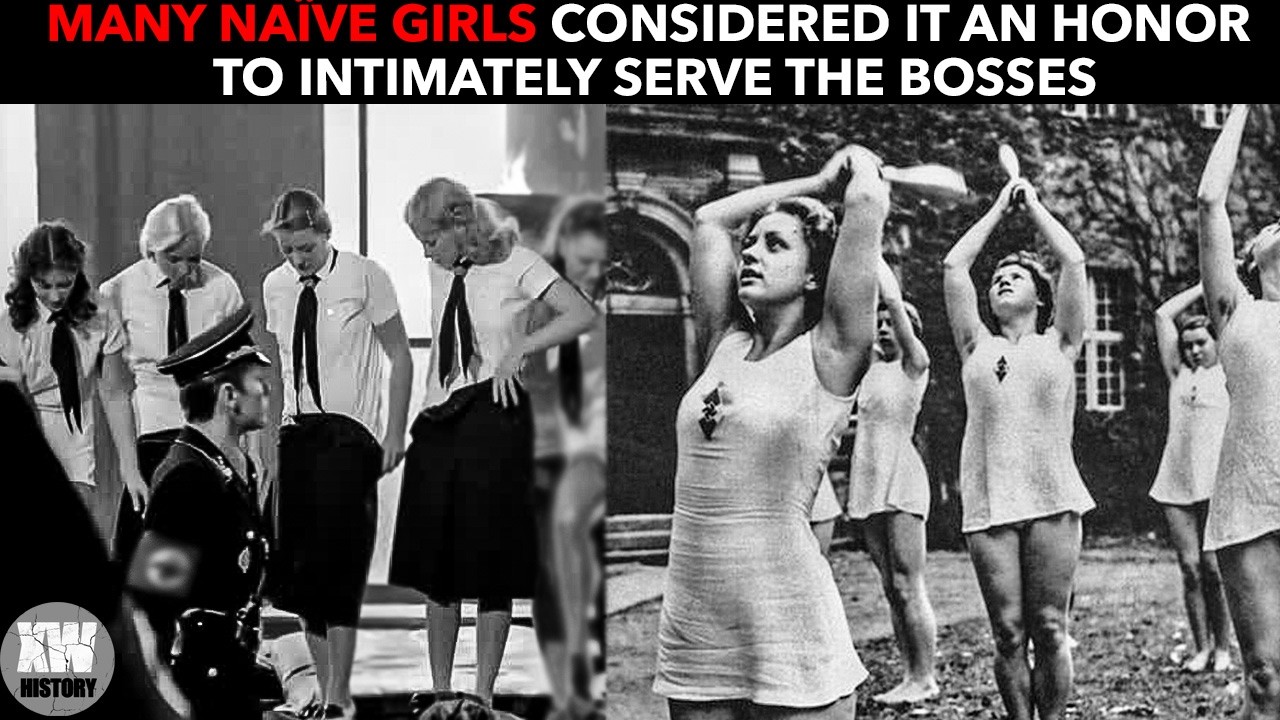 From the earliest days of the Nazi regime, the leadership understood that the future of the Reich depended not on the battlefield alone but on the wombs of its women. The League of German Girls, officially established as the female branch of the Hitler Youth, was tasked with a single, overriding mission: the production of racially pure Aryans. To achieve this, the state implemented a system of psychological manipulation that began with the recruitment of impoverished children, promising them summer camps, nutritious food, and a sense of belonging that had been decimated by the economic collapse following World War I.
The bait was effective. For girls aged 10 to 14, membership in the Young Girls’ League was presented as an escape from the squalor of post-war Germany. By the time they turned 14, they were transferred to the League of German Girls proper, where the indoctrination intensified.
The curriculum was a paradox of contradictions: they were taught to be chaste wives and devoted mothers, yet simultaneously encouraged to view themselves as property of the state, available for the demographic expansion of the Aryan race. The result was a generation of young women subjected to extreme cognitive dissonance, torn between traditional family values and the radical demands of Nazi ideology.
The physical regimentation was relentless. Girls were forced to endure hours of military-style marching, standing for extended periods with their arms raised in the Nazi salute under the blazing sun. Fainting was not treated as a medical issue but as a sign of personal weakness, leading to public ridicule.
Uniforms were strictly regulated to erase any hint of individuality; hairstyles were dictated, cosmetics and jewelry were forbidden, and even the cleanliness of a girl’s home was subject to inspection by League officials. A single stain on a blouse could result in the removal of the uniform tie, a public mark of shame that authorized other members to torment the offender without consequence.
This environment of constant surveillance bred a culture of betrayal that extended into the most intimate sphere of life: the family. Girls were actively encouraged to spy on their parents and report any deviation from Nazi doctrine. Listening to foreign radio broadcasts, expressing doubt about the war, or making critical remarks about the Führer were all grounds for denunciation.
One former member recalled that children did not report their parents out of malice but out of a profound, naively instilled belief that they were protecting the Reich from internal enemies. The Gestapo welcomed these reports, and many parents were sent to concentration camps based on the testimony of their own daughters, who were then praised for their vigilance.
 The most harrowing aspect of the League’s legacy, however, lies in its explicit focus on sexuality and reproduction. While the official line preached that a true Aryan girl must marry as a virgin, the practical realities of war created a desperate shortage of men. In response, the Nazi state began to promote increasingly radical solutions.
The marriageable age was lowered to 16, and girls were subjected to joint lectures with Hitler Youth members on “family building,” which served as a de facto permission slip for early sexual experimentation. The result was a wave of teenage pregnancies, which paradoxically led to expulsion from the League, forcing these young mothers into the shadows of a society that simultaneously demanded they produce children but shamed them for doing so outside of marriage.
For those who could not find a living husband, the state offered macabre alternatives. German women were legally permitted to marry soldiers remotely, even if the groom was stationed hundreds of miles away on the Eastern Front. More disturbingly, they could register marriages with men who had already been declared dead.
This posthumous matrimony was not a matter of romantic sentiment but a bureaucratic tool to grant the woman the honorary status of a war widow, legitimize any potential offspring, and secure a state pension. The psychological toll on 16 and 17-year-old girls, who were encouraged to view themselves as brides of corpses, was immense and has been largely overlooked by historians.
Beyond the legal perversions of marriage, the League served as a recruitment ground for the Lebensborn program, a secret initiative designed to increase the birth rate of “racially valuable” children. Young women with the ideal Nordic features—blonde hair, blue eyes, and a tall, athletic build—were selected to mate with SS officers in comfortable maternity homes. The children born from these unions were often taken from their mothers and placed in state-run orphanages, where they were raised without knowledge of their parents, indoctrinated from birth to serve the state.
An estimated 20,000 babies were processed through these facilities across Germany, Norway, and other occupied territories, their lives reduced to mere cogs in the Nazi demographic machine.
 The obsession with racial purity also manifested in the treatment of girls who did not meet the physical standards. While the propaganda films showcased only the most “harmonious” faces, those who were deemed less attractive or who showed signs of hereditary disease were marginalized. The League’s leadership, under the direction of figures like Gertrud Scholtz-Klink, emphasized that the primary duty of a woman was to be “a friend, wife, and mother,” but the reality was that they were being trained for a far more brutal role.
As the war dragged on, these young women were funneled into auxiliary military service, working as signal operators, anti-aircraft gun crews, and hospital nurses. Some were even assigned to guard duties in concentration camps, where the moral conditioning of the League was put to its most horrific test.
The case of Irma Grese, one of the most notorious female war criminals, illustrates the deadly culmination of this indoctrination. Grese, who served as a guard at Auschwitz and Bergen-Belsen, was a product of the Nazi youth system. Her willingness to commit atrocities was not an anomaly but a reflection of the dehumanizing ideology she had absorbed since childhood.
The League did not explicitly teach cruelty, but it taught a worldview in which certain lives were deemed unworthy of existence. This moral vacuum, combined with the constant pressure to conform, allowed ordinary girls to become complicit in extraordinary evil.
The psychological damage inflicted on these girls did not end with the fall of the Reich in 1945. The League was officially dissolved, but its former members were left to grapple with the shattered remnants of their identities. Many had been stripped of their education, their families, and their moral compass.
The post-war “denazification” process was inconsistent, and many former members slipped back into civilian life without facing any consequences for their roles. However, the internal scars remained. Survivors have spoken of the difficulty of reconciling the fond memories of campfires and hiking trips with the knowledge that the same organization had prepared them to accept mass murder as a civic duty.
 The propaganda machine of the League was so effective that it managed to convince young women that their own parents were the enemy. This inversion of the natural family hierarchy was a deliberate strategy to ensure that the state, and not the family, held ultimate authority over the individual. The result was a generation of women who were alienated from their own history and culture, taught to despise the Christian values of compassion and charity in favor of a paganistic worship of strength and racial superiority.
The torchlight marches and pagan rituals were not mere pageantry; they were tools to replace one belief system with another, to create a new type of human being who would unthinkingly obey the Führer.
Even the most intimate aspects of a girl’s life were not her own. The League’s obsession with hygiene extended to the point of absurdity, with officials inspecting the cleanliness of a girl’s home and body. This was not about health but about control.
By regulating every detail of their appearance and behavior, the state ensured that the girls would never develop a sense of self that was independent of the Nazi worldview. The uniform was a cage, and the constant drills were a way to exhaust the body so that the mind would be too tired to resist the ideological onslaught.
The story of the League of German Girls is a stark warning about the dangers of totalitarian education. It demonstrates how a state can weaponize the innocence of youth to achieve its darkest goals. The girls who marched in those orderly ranks were not monsters; they were victims of a system that deliberately destroyed their capacity for critical thought.
Yet, their victimhood does not absolve them of the choices they made, particularly those who volunteered for service in the SS or the concentration camp system. The line between victim and perpetrator is blurred, but the historical record is clear: the League of German Girls was an instrument of mass psychological manipulation that left a permanent stain on the lives of millions.
As we look back on this dark chapter, it is essential to remember that the ideologies that drove these girls to marry dead men and denounce their parents did not die with the Third Reich. The tactics of mass indoctrination, the use of youth movements to break family bonds, and the subordination of individual rights to the demands of the state are not relics of the past. They are tools that remain available to any regime willing to use them.
The tragedy of the League of German Girls is not just a historical footnote but a living lesson in the fragility of human morality when subjected to the relentless pressure of a totalitarian state. The echoes of those marching boots can still be heard today, a reminder that the fight for the minds of the young is the most critical battle of all.