On the morning of July 3, 1863, a man who had never lost a major battle he personally commanded stood on a ridge in Pennsylvania and ordered 12,000 soldiers to walk across a mile of open farmland into the mouth of Union artillery.
He watched almost all of them die.
The decision wasn’t a moment of madness. It was the natural, almost inevitable end point of a way of thinking that had defined Robert E. Lee’s entire military career. A way of thinking that had already been quietly bleeding the Confederacy to death for over a year.
Lee is remembered as a genius, a gentleman, the finest general the South ever produced. But look closer at the math of his campaigns, the casualty numbers his own officers tried to warn him about, and a very different picture starts to emerge.
Something was deeply, structurally wrong with how Lee fought the war. By the time anyone with real power was willing to say it out loud, it was already too late.
Lee arrived in command of what would become the Army of Northern Virginia in June of 1862. Almost immediately, he did something that alarmed even his own side.
The Confederacy was outnumbered, out manufactured, and cut off from the outside world by a tightening naval blockade. It needed time. It needed to wear the Union down, avoid catastrophic losses, and hope that northern voters would eventually grow tired of an expensive, bloody war.
That was the math. A defensive war fought patiently on southern soil gave the Confederacy its best mathematical chance of outlasting Washington’s political will.
Lee looked at that math and rejected it almost entirely.
Within weeks of taking command, he launched the Seven Days Battles, driving Union General McClellan away from Richmond through a series of brutal, costly frontal assaults. He won. The capital was saved.
But the casualty numbers told a story that should have terrified anyone paying close attention. Lee’s army suffered roughly 20,000 casualties in that campaign, notably higher than the Union losses he inflicted, even though he was the one attacking.
This was not a fluke. It was the beginning of a pattern that would repeat itself again and again over the next three years.
The Confederacy had around 9 million people to draw soldiers from, and nearly four of those were enslaved people. The Union had roughly 22 million. Every Confederate soldier who fell in battle was harder to replace than his Union counterpart.
Southern newspapers even began publishing casualty comparisons, quietly horrified editors doing the grim math on how many more victories the Confederacy could actually survive.
Lee kept fighting like the numbers didn’t apply to him.
By the late summer of 1862, Lee pushed his army north into Maryland in an invasion that culminated at Antietam Creek, the single bloodiest day in American history. Roughly 23,000 men fell in a matter of hours.
Lee’s outnumbered force fought Union General McClellan to a tactical standstill. But a standstill was, for Lee, effectively a strategic defeat.
He had crossed into enemy territory hoping to win a decisive victory that might tip European powers toward recognizing the Confederacy. Instead, he retreated back across the Potomac, having gained nothing and lost thousands of men he could not replace.
He had also handed Abraham Lincoln the opening he needed to issue the Emancipation Proclamation, transforming the entire moral and political framing of the war.
One invasion. Enormous losses. Almost no strategic gain. And a devastating unintended political consequence.
Lee commanded an army that had marched into Maryland thin on supplies, thousands of men straggling behind because their shoes had disintegrated on the march. He still chose to stand and fight a battle he could have avoided entirely by withdrawing back into Virginia.
He chose the fight because retreating without a battle felt like conceding the initiative. And conceding the initiative was the one thing his entire military philosophy could not tolerate.
That instinct, prioritizing the initiative over the arithmetic, is the thread that runs through nearly every questionable decision of his career.
A few months later, Lee did something spectacular enough to bury the warning signs completely.
At Chancellorsville in May of 1863, facing a Union army nearly twice his own, Lee split his forces in the presence of the enemy. Stonewall Jackson’s flanking march crushed the Union right, and Lee walked away with what is still considered his single greatest tactical masterpiece.
It was brilliant. It was also dangerous.
It cemented the idea that boldness itself was the answer. That daring maneuvers and aggressive attacks could consistently overcome the crushing weight of Union numbers and Union industry.
Chancellorsville taught Lee exactly the wrong lesson at exactly the wrong time. The price of that lesson came due two months later on a ridge outside a small Pennsylvania town called Gettysburg.
Lee split an already outnumbered army not once but twice in the face of the enemy, leaving barely 14,000 men to hold off the bulk of the Union force while Jackson marched 12 miles around the Union flank in broad daylight.
It worked because of a specific non-repeatable failure of enemy judgment, not because the underlying gamble was sound. Union commander Joseph Hooker dismissed the reports of the movement as a retreat rather than a flanking maneuver.
The victory was so complete that it quietly convinced Lee and everyone around him that his army could outfight and outmaneuver any Union force regardless of the number stacked against it.
That confidence walked north into Pennsylvania a month later and walked straight into a very different kind of battlefield.
Lee’s most trusted core commander, a gruff, methodical Georgian named James Longstreet, argued forcefully against attacking the strong Union position at the high ground at Gettysburg.
Longstreet wanted to swing around the Union left, find defensible terrain, and force the Army of the Potomac to attack them instead.
Lee refused.
Over three days, he ordered assault after assault against increasingly fortified Union lines, culminating in that catastrophic charge across open ground on July 3rd that broke the back of his army.
The Confederacy lost around 28,000 men at Gettysburg, nearly a third of Lee’s entire force, in a battle he did not need to fight on terms he chose himself.
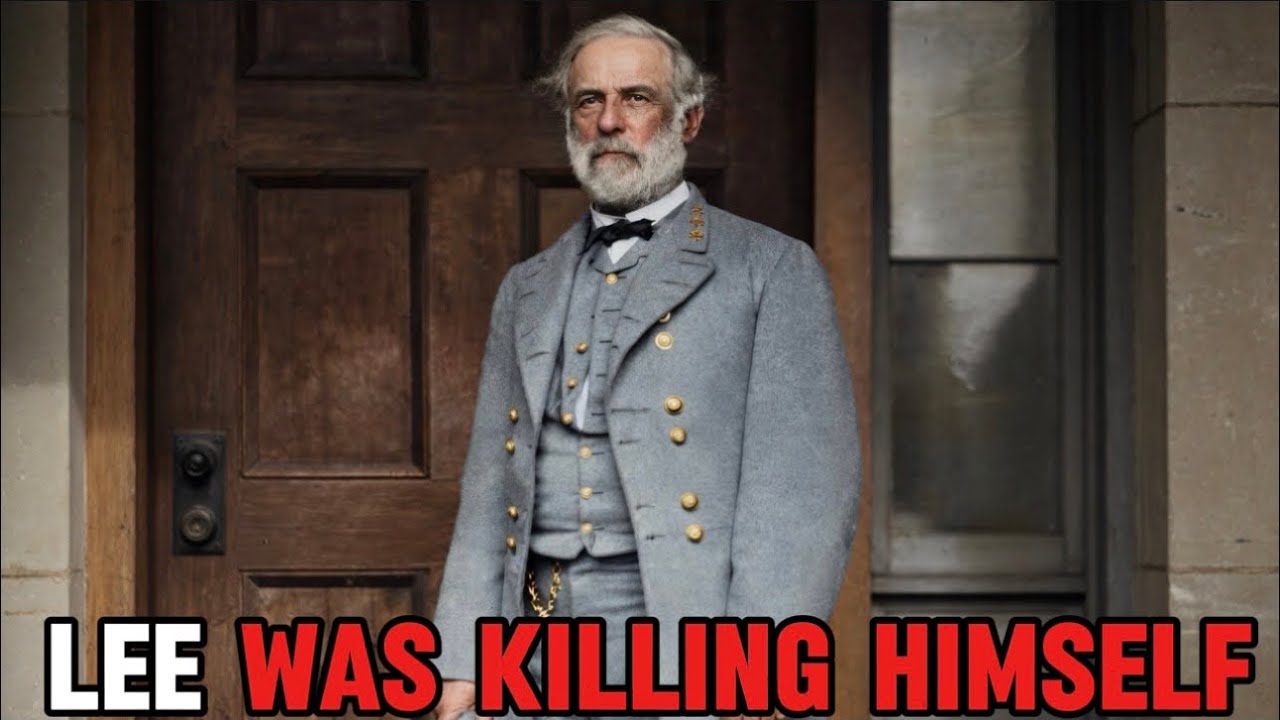
On day one, Confederate forces pushed Union troops back through the town itself, a genuine tactical success that reinforced exactly the wrong conclusion. On day two, assaults against Little Round Top and the Peach Orchard came agonizingly close to breaking the Union line.
A clean defeat on day two might have forced a change of approach. A near victory instead convinced Lee that the Union line was one hard shove away from collapse.
That conviction is what sent Pickett’s, Pettigrew’s, and Trimble’s divisions walking across the field on day three directly into a Union position that had spent two full days reinforcing itself and ranging its artillery on the exact ground those men would have to cross.
What makes this genuinely strange is that Lee already possessed first-hand overwhelming proof of exactly how this would end.
Seven months earlier, he had watched Union General Ambrose Burnside hurl his own men against entrenched Confederate positions at Fredericksburg. Lee watched those Union soldiers get slaughtered in almost exactly the same way his own men would be slaughtered at Gettysburg.
He had seen with his own eyes what happens when an army attacks a well-defended ridge held by determined riflemen and artillery. And somehow, when the roles reversed, he made the same catastrophic choice.
This wasn’t a lack of information. It was a blind spot baked directly into how Lee understood war itself.
Historians have circled this question for over a century. The most convincing answer traces back to Lee’s formative experience decades earlier in Mexico serving under General Winfield Scott.
Scott’s campaign against Mexico City was a master class in aggressive maneuver, daring flanking attacks, and relentless offensive pressure against a numerically superior defending force. It worked spectacularly.
A young Robert E. Lee absorbed those lessons at exactly the age when a soldier’s instincts get permanently wired. He came out of that war believing that boldness and offensive maneuver were the tools that won wars.
That philosophy made him a genuinely brilliant tactician on individual battlefields. It also made him structurally, temperamentally, unsuited to the one strategic posture that actually gave the Confederacy a mathematical chance of winning a long war.
Patient, grinding defense.
The pattern hides in plain sight once you start looking for it.
At the Seven Days, he attacked and it cost him more men than the Union lost, even in victory. At Second Manassas, aggressive maneuver won the day, but the follow-up invasion at Antietam led his army for nothing.
At Chancellorsville, boldness produced a masterpiece, but it also cost him Stonewall Jackson, his most irreplaceable subordinate, killed by friendly fire during that very flanking maneuver.
And then, at Gettysburg, the same offensive instinct finally produced catastrophe on a scale the Confederacy could not absorb.
Each individual decision can be defended on its own tactical merits. But look at the pattern across years instead of individual afternoons, and a different story emerges.
A general whose greatest strength, aggressive offensive genius, was fundamentally mismatched with his side’s actual strategic needs. And nobody with the authority to stop him was willing to challenge that mismatch until it was catastrophically too late.
Confederate President Jefferson Davis trusted Lee almost completely. That trust was in its own way rational. Lee had saved Richmond in 1862. He had humiliated superior Union armies at Second Manassas and Chancellorsville.
But that reputation created a dangerous feedback loop. The more Lee’s aggression succeeded on individual battlefields, the more political cover he earned to keep repeating the exact strategic pattern that was slowly draining the Confederacy of the one resource it could never replace.
Fighting-age men.
By the time Gettysburg made the cost of that pattern undeniable, the war was already, in the cold arithmetic of manpower and industrial output, functionally unwinnable.
Even after Gettysburg, even after losing nearly a third of his army in three days, Lee’s fundamental instincts barely changed.
In the spring of 1864, facing a new Union commander named Ulysses S. Grant, the pattern reasserted itself almost immediately. Grant launched the Overland Campaign, a relentless grinding series of engagements at the Wilderness, Spotsylvania Courthouse, and Cold Harbor.
Grant deliberately traded Union casualties for Confederate ones, because he knew with brutal clarity that the Union could replace its losses and the Confederacy could not.
Lee fought brilliantly on the defensive during much of this campaign, inflicting horrific losses on Grant’s advancing forces at Cold Harbor in particular. For a moment, it looked like Lee might have finally embraced the patient defensive posture that had eluded him for two years.
But the damage from the earlier years was already irreversible.
The Army of Northern Virginia that fought the Overland Campaign was a shell of the force that had marched into Pennsylvania a year earlier. Its ranks thinned by exactly the kind of offensive losses Lee himself had inflicted on it at places like Antietam and Gettysburg.
Grant could lose 60,000 men in six weeks and still have an army large enough to keep advancing. Lee lost a fraction of that number and could barely field an army capable of holding a defensive line by the time both forces reached Petersburg.
The siege that followed was the final proof of everything the earlier pattern had cost the Confederacy. Lee was finally fighting the defensive war he should have fought from the beginning. It was too late for defense to matter.
There simply weren’t enough Confederate soldiers left to hold the lines.
Some of Lee’s own contemporaries saw this coming in real time and said so on the record. They were ignored.
Longstreet’s objections at Gettysburg weren’t some invention of later historians. They were documented contemporaneous warnings from Lee’s own senior commander, warnings that turned out to be almost eerily accurate about how the battle would unfold.
After the war, Longstreet became one of the most controversial figures in former Confederate circles, precisely because he was willing to say publicly what almost nobody else would. That Lee’s aggressive instincts, however brilliant in isolated moments, had helped doom the Confederate war effort.
That opinion made Longstreet deeply unpopular in the post-war South, where the Lost Cause narrative was already busy transforming Lee into an untouchable, almost saintly figure whose judgment could not be questioned.
Confederate artillery officer Edward Porter Alexander, who personally coordinated the bombardment meant to soften the Union line before Pickett’s Charge, wrote decades later with unusual candor that he doubted the assault had ever carried a real chance of success.
The artillery simply couldn’t do what it needed to do against a position that strong.
The man who had never lost a major battle he personally commanded finally lost the war itself. And the strategy that made him a legend was the same strategy that destroyed the cause he was fighting for.