The year is 1570. Elizabeth Tudor has ruled England for twelve years. She is 36 years old, brilliant, unmarried, and absolutely certain she is the most important person in any room she enters. Her court has settled into something extraordinary and strange, a place where culture and paranoia coexist within the same gilded walls. Poets and spies share the same corridors. The same man who composes a sonnet in the morning might carry a state secret to a foreign embassy in the afternoon.
The court moves constantly, from Whitehall to Hampton Court, to Greenwich, to Richmond. This constant motion serves a practical need: letting each palace air out and be cleaned after hundreds of people have spent weeks eating, sweating, and relieving themselves within its walls. Wherever Elizabeth goes, her court follows. Hundreds of courtiers, servants, guards, cooks, laundresses, musicians, physicians, and chaplains orbit around the woman in the pearl-trimmed gown.
At the center of this orbit, the feast is both ritual and spectacle, both nourishment and theater. You are not simply invited to dinner. You are invited to participate in one of the most carefully choreographed exercises of political power in the Tudor world. If you walk into that hall thinking you are simply there to eat, you have already made your first mistake.
The palace itself is an argument about power. The gates say most of you stop here. The courtyards say you may proceed, but carefully. The great hall says you may enter, but know your place. The deeper rooms, the presence chamber, the privy chamber, the bed chamber, say almost none of you will ever stand here. The distance between where you are allowed to be and where she is tells you exactly how much you matter.
The Tudor court operated through a spatial hierarchy of power. Physical proximity to the queen was the currency. To eat near her was influence. To eat in the same room was distinction. To be permitted into the rooms beyond the great hall was something that careers were built on, maintained with exhausting vigilance, and lost with a single wrong word at the wrong moment.
Imagine you are a moderately important man. A gentleman from a reasonably good family. You have been granted access to the great watching chamber, not the queen’s own dining table. You are close enough to feel the gravitational pull of the queen’s presence, far enough away that you can breathe a little more freely.
Look around. Notice the tapestries. Notice the silver plate displayed on the sideboards, not there to be used, but there to be seen. Proof of wealth so staggering it can afford to simply sit and be admired. Notice how every person in this room is watching every other person with a kind of careful horizontal attention, cataloging who is speaking to whom, who has been recently favored, who looks slightly less confident than they did last week.
Now, notice the smell. The smell of an Elizabethan palace in 1570 is an extraordinary thing. Roasting meat and wood smoke from fires large enough to heat a barn. The sweet heavy weight of spit dripping fat and spiced sauces. Rushes on the floor, sometimes layered over older rushes that have not been changed in longer than anyone would like to admit, releasing a complex, slightly decomposing fragrance underfoot. Hundreds of bodies in heavy layered clothing. Pomanders and perfumed gloves deployed heroically against the above. And beneath all of it, the faint persistent smell of the Thames.
Here is the first thing that would do serious long-term damage: the kitchen itself. The kitchens at Hampton Court are one of the most impressive food production facilities in the world at this moment in history. They span 55 rooms and roughly 3,000 square feet of working space. 200 staff members operate within them, producing somewhere between 600 and 800 meals twice a day. Six massive fireplaces dominate the great kitchen, fed by approximately 1.3 million logs every single year.
A Spanish ambassador who visited the kitchens during the Tudor period reportedly described them as a hellish place, hot beyond anything reasonable, smoky, loud, and run on enormous quantities of beer because the heat was so extreme and the labor so constant that water alone was not enough to keep the staff functioning. Boys as young as seven or eight turned the spits by hand over open fires for hours at a time.
The food that emerged from this inferno was technically impressive, but the process of getting it from the kitchen to your plate involved a journey through multiple rooms, corridors, courtyards, and serving stations that took time. There was no refrigeration. There were no antibiotics. The concept of bacterial contamination as a specific, identifiable danger was completely unknown. Food that had traveled too far or sat too long arrived at the table still smelling good, still looking impressive, and still potentially harboring things that would make you violently ill within hours.
This was not negligence. It was simply the limit of what anyone knew. The Tudor court employed sophisticated food storage techniques. The courtyard at Hampton Court was deliberately designed to stay cool, acting as a kind of architectural refrigerator for fish and perishable goods. Salting, smoking, and pickling preserved meats for winter. And still, food poisoning was a regular and unremarkable feature of life at every level of English society, including the very top.
Let us talk about what is actually in front of you. The first course arrives in a procession that is itself a kind of performance. The tablecloths are three layers deep. Forks are a novelty still regarded with some suspicion in England in 1570. Most people at this table will be using a knife and their fingers for the majority of what arrives. You were expected to bring your own knife.
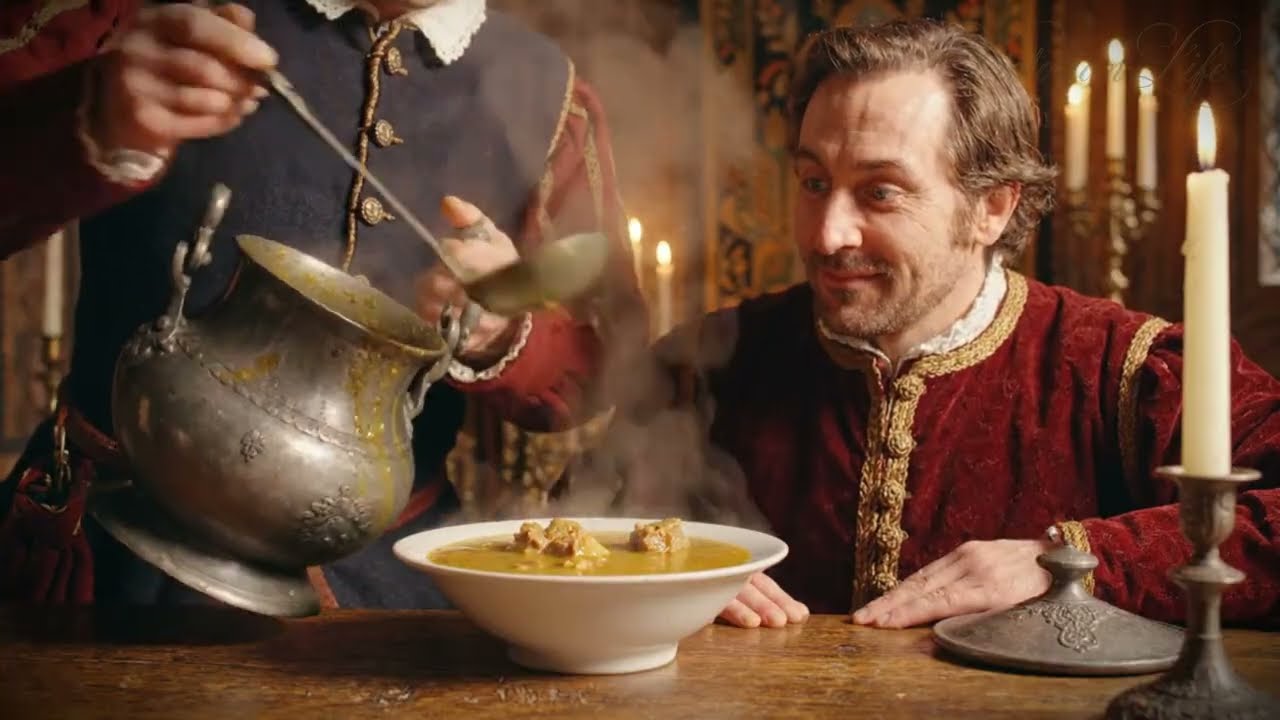
The first course might bring you manchet, small, perfectly white bread rolls made from the finest, most finely sifted wheat flour. Brown bread is for people who cannot afford better. Alongside it, pottage, a rich, thick broth made with meat, spiced with ginger and pepper and saffron. Then the meat begins. Beef, mutton, veal, then game. Venison pasty, haunch of deer served in a pastry shell thick enough to be lifted with both hands. Then fowl. Capon, pheasant, partridge, then something you were not expecting: heron.
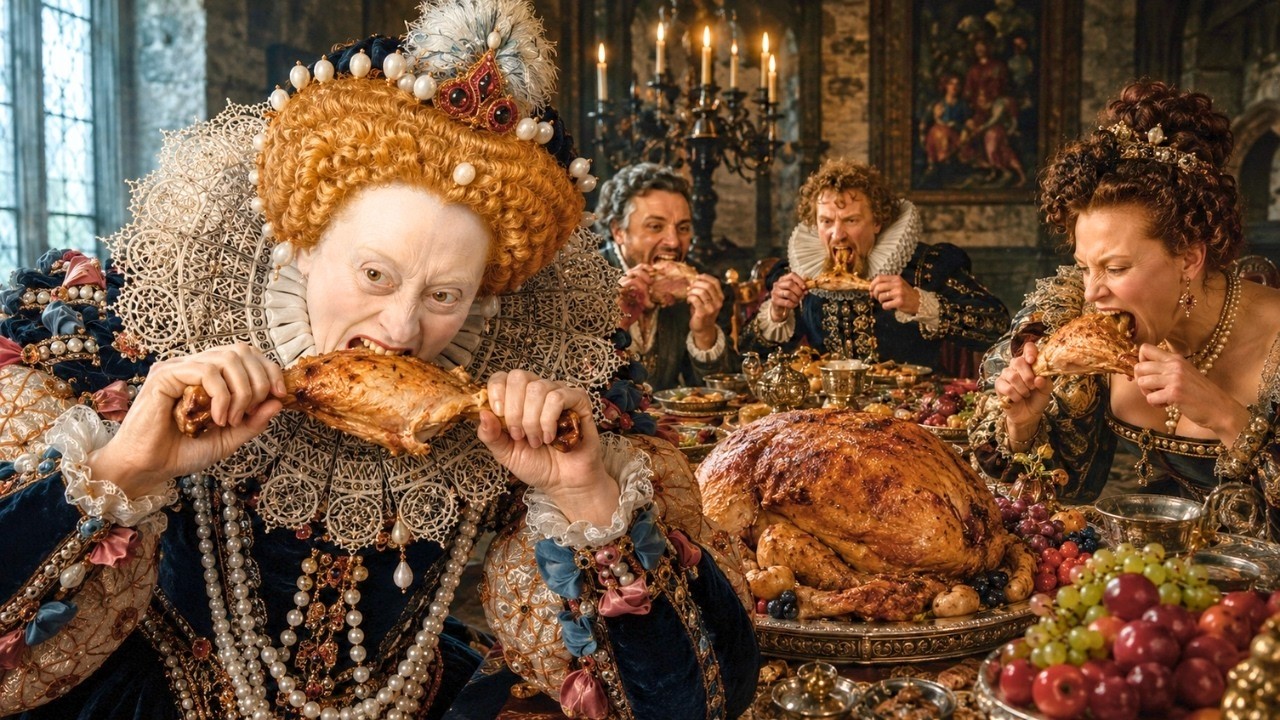
Swan served decorated with its own feathers reattached after roasting so that it appears at a glance to be resting on the platter rather than dead on it. This is not a joke. This is artistry. The presentation of noble birds, swan, peacock, heron, re-feathered after cooking and arranged as though still alive is a genuine and celebrated technique of Elizabethan high tablecraft.
You are sitting far enough from the Queen’s table that you are eating from shared dishes called messes, shared between groups of four diners. The closer to the Queen’s own table, the better the mess. The further you sit, the more the quality of what arrives in your shared dishes diminishes by small but measurable degrees. This is not accidental. The feast is a map of power written in food.
Now, about the pewter. Your drinking vessel, and possibly some of the serving dishes around you, are made of pewter, a tin-lead alloy used throughout the Tudor period for tableware. It is durable. It holds a shape. It is also slowly leaching low levels of lead into the acidic liquids that sit in it. Wine, ale, the vinegar-rich sauces that the Elizabethans love.
This is not a dramatic, immediate danger. This is the quiet, cumulative kind. Lead poisoning in the 16th century was an extremely common and almost entirely unrecognized problem. It contributed to a range of health difficulties, neurological, reproductive, skeletal, that Elizabethan physicians noticed but could not explain. Elizabeth herself, according to some historians, showed symptoms over her lifetime that scholars have retrospectively connected to lead exposure.
Before we get to the sweet course, we need to talk about the rules. Because survival at an Elizabethan royal feast is not only a matter of your stomach. It is a matter of your career, your reputation, and in extreme cases, your liberty. The etiquette of this table is a minefield that has been carefully and deliberately constructed over decades.
The first thing you must understand is that you are always being observed. By other courtiers who will report your behavior if it is useful to do so. By servants who see everything and are seen by no one. By the Queen’s gentlemen ushers, whose entire professional function is to maintain order and protocol in the spaces around the Queen.
The rules begin before you sit. Washing your hands is not optional and not private. You wash them openly so that others can see that you have washed them, because several people will be sharing your mess dishes. You do not reach across the table. You do not pick through a dish looking for a better piece of food. You do not blow your nose with the napkin. You do not scratch. You do not put your hands on your head. You do not throw bones on the floor. The proper place for bones is your trencher, the bread or wooden plate beneath your food.
You speak to your neighbors because silence at a feast is strange and marks you as either arrogant or frightened. But you speak carefully because everything said at this table can travel. The intimacy of the feast is an illusion. These are not friends, most of them. They are rivals and allies and watchers and aspirants.
The deepest rule: whatever happens, do not draw attention to yourself in the wrong way. Do not spill. Do not stumble. Do not laugh too loudly at the wrong thing. Do not look at the queen’s table with undisguised longing. There is a documented case of a man who accidentally passed wind loudly in the presence of the queen and was so mortified that he left England and traveled abroad for years. Embarrassment at the royal court was not a private experience. It was public, witnessed, remembered, and retold.
Now, the sweet course. If there is a single element of the Elizabethan royal feast that best encapsulates the gap between what it looked like from the outside and what it was actually doing to everyone inside, it is sugar. Sugar arrived in England in meaningful quantities during the 16th century, carried by expanding trade networks and colonial supply chains. In 1570, sugar is still expensive enough that its presence on your table is a statement.
The sweet course, or the banquet as the Elizabethans called it, is essentially sugar performing as status. What arrives is extraordinary. Marchpane, Tudor marzipan made from almonds and sugar molded into elaborate shapes. Suckets, candied fruits preserved in thick sugar syrup eaten from long forks called sucket forks. Gingerbread, wafers, candied violets, which Elizabeth herself is documented to have favored. Hippocras, sweet spiced wine served in cups. And then the centerpieces: the subtleties.
These are sculptures made entirely from sugar and marzipan. Castles, animals, heraldic devices, copies of famous buildings. There are documented accounts of Elizabeth receiving sugar sculptures of St. Paul’s Cathedral and of entire chessboards with edible pieces. The earliest known gingerbread men in English history were created for one of Elizabeth’s state dinners, shaped to resemble her honored guests so that she and they could eat their own likenesses.
Here is the problem. Nobody in 1570 knows what sugar does to teeth. They know that teeth go bad. Physicians and barber surgeons of the period understand tooth decay in the sense that they can see it and attempt to address it, usually by pulling the affected tooth without anesthetic. What they do not understand is the mechanism. They do not know that sugar feeds oral bacteria that produce acid that dissolves enamel.
And so, the people who can afford the most sugar, the wealthy, the courtiers, the queen herself, are the people whose teeth are suffering the most severely from it. Elizabeth I’s teeth were, by multiple contemporary accounts, extremely black. A German traveler named Paul Hentzner, who saw her at age 65, described her teeth as black and added that this seemed to be a fault common among the English generally because of their great use of sugar.

Because the Queen’s blackened teeth were visible and known, and because everything the Queen did became fashionable, some among the lower classes who could not afford enough sugar to actually rot their teeth naturally reportedly blackened their own teeth deliberately to signal wealth and closeness to the Queen’s manner of living. The Queen’s damage became desirable. Her decay became imitated. Her suffering reframed as style.
There is a medicine cabinet at this feast, and it is everywhere, hidden inside the food. The Elizabethan understanding of health and food was built on Galenic medicine, the classical system that explained the human body as governed by four humors: blood, phlegm, yellow bile, and black bile. Health was the balance of these four forces. Illness was their imbalance. Food was understood as one of the primary mechanisms by which the balance could be maintained or disrupted.
Spices were not merely flavor in this context. They were medicine. Pepper was warming and drying. Ginger was similarly warming. Saffron was believed to cheer the spirits and strengthen the heart. Cinnamon was thought to aid digestion and fortify the liver. The complex spiced sauces of the Elizabethan table were attempts to create food that was simultaneously nourishing and therapeutically calibrated.
The sweet spiced wine called hippocras was classified not as a mere indulgence, but as a digestive medicine, traditionally consumed after the main meal to help the body process what it had eaten. The banquet course was described in period texts as a repast of sugared medicines. You were not eating dessert. You were taking your medicine in the most delicious form available to you.
Some of it actually worked in ways that no one at the table would have understood. Spices with genuine antibacterial or antifungal properties helped preserve food during an era without refrigeration. The insistence on wine over water was not mere snobbery. Water in the 16th century was genuinely dangerous in many urban and palace settings. Alcohol, even at the relatively low levels present in ale and wine, genuinely reduced the risk of waterborne illness.
What was wrong, completely and consequentially wrong, was the understanding of raw fruits and vegetables. Tudor nutritional theory held that raw produce was dangerous. Raw food was cold and wet, and introducing too much of it into the body would disrupt the warm, balanced state that constituted health. This was reinforced by the very real fact that fresh produce arriving to palace kitchens sometimes arrived already past its best.
The result was that the Elizabethan royal table in 1570 was spectacularly heavy in cooked meat and spectacularly light in fresh vegetables. The court’s official dietary records show enormous quantities of meat, thousands of deer, sheep, pigs, and poultry consumed annually, alongside comparatively small amounts of fresh produce. You would eat almost no fresh vegetables tonight. You would eat enormous quantities of protein and fat and sugar.
Let us talk about the drinks. The Tudor court consumed approximately 600,000 gallons of beer annually. This number is so large it strains credulity, until you remember what it was replacing. Water. The water available in and around the palace was understood to be dangerous. People who drank unboiled water got sick more frequently than people who drank ale. Ale and beer, brewed with water that had been boiled as part of the brewing process, were genuinely safer in many circumstances than the raw water supply.
Drinking ale from morning to night at the Tudor court was not decadence. It was a reasonable adaptive strategy, calibrated to the real conditions of a world without sanitation infrastructure or germ theory. The wine at your table tonight, if you were at a level high enough to receive it, is French or Rhenish or Spanish, imported through the palace wine cellar with considerable expense and care.
The Queen herself drank with notable moderation, according to contemporary accounts. She was described by historians as generally preferring not to indulge in the heavy drinking that characterized some of her court. But the court around her drank freely, generously, and with the full institutional support of a household that had figured out how to procure 600,000 gallons of beer a year and still leave room in the cellar for the good Bordeaux.
There is something happening at the Queen’s table tonight that you cannot see from where you are sitting. Elizabeth is eating, or rather, she is performing eating. The ritual of the Queen’s meal was one of the most elaborate and heavily regulated ceremonies in the entire English court. Food brought to her table was carried by servants in a formal procession, presented on bended knee, tasted by a designated taster for poison before it reached her lips.
By the time a dish had passed through all the required ceremonial stations, inspection, tasting, covering, transport, presentation, it was often substantially less hot and arguably less appetizing than when it left the kitchen. The ritual was not designed for gastronomic efficiency. It was designed for security and spectacle.
Elizabeth herself, according to multiple historians and the accounts of people who observed her closely, ate with notable restraint by the standards of her court. She favored fish. What she required was the performance, the dishes, the procession, the tasting, the table setting, the conversation, the music from the gallery overhead, the entire elaborate theater of the royal meal.
The queen, for all the ceremony around her, was not seated behind a curtain. She ate where she could be seen. Her table manners were observed. Her preferences were noted. The food she chose to take and the food she left was itself a kind of communication, a daily, legible signal to everyone in the room about her mood, her favor, her attention.
And she watched you. That part is not a figure of speech. Elizabeth I was legendarily attentive to the people around her. Courtiers describe her as having a quality of presence that was almost overwhelming. Flattery pleased her enormously, as did wit, intelligence, loyalty, and the ability to dance well. What she did not forgive easily was sloppiness, stupidity, or the kind of social clumsiness that suggested a person had not taken the trouble to understand where they were and what was required of them.
Here is a thing that almost no modern account of Elizabethan court dining mentions: the noise. A great hall feast in 1570 was loud. Not modern dinner party loud. Loud in the way that a large indoor space full of hundreds of people, an open fire burning hot enough to roast an ox, musicians playing from the gallery, servants moving constantly across stone floors, and dogs wandering underfoot sounds loud.
The musicians in the gallery were not background ambiance. They were a functional necessity in the sense that music gave the chaos of the room a frame. The pacing of the feast was partly regulated by the music. Serving processions happened to specific rhythms. Certain moments in the meal were marked by specific pieces. Elizabeth herself was a talented musician who played the lute and the virginals.
Beneath and around the music, conversation was constant. The manners books of the period are emphatic that silence at a feast was inappropriate for a person of quality. You were expected to be witty, engaged, and charming. This was where the real performance happened. Not the food, not the clothes, though the clothes were a performance too. The real performance was the conversation. What you said, how you said it, who you said it to, whether you made someone powerful laugh, whether you deferred at the right moment and asserted at the right moment.
Let us come back, one more time, to the matter of survival. By modern nutritional standards, the Elizabethan royal feast was a significant health event. The average person at that table was consuming quantities of meat that vastly exceeded any guideline that modern medicine would recommend. The sugar was catastrophic for dental health. The pewter cup was adding a thin, continuous stream of lead to an already challenging chemical environment. The vegetables were mostly absent.
And yet, the people who ate at this table regularly were not, on the whole, dropping dead in large numbers from the feast itself. They were living lives that were shorter than modern lives, full of diseases that no amount of good nutrition could have prevented in the absence of antibiotics and vaccination and germ theory. They were living with pain, with dental decay, with the quiet accumulation of lead in their bones.
But they were also living, by many accounts, with enormous vitality. Elizabeth herself was famously energetic well into her 60s, dancing, riding, walking briskly through palace gardens, governing one of the most complicated political environments in Europe with a sustained intelligence that never seems to have faltered.
The body, it turns out, is more resilient than any individual assault on it. It absorbs the sugar and the lead and the undercooked meat and the absence of fresh vegetables and the daily ale and it keeps going. What feels most real at this table is the roasted venison arriving on its platter, the white bread impossibly soft, the rich spiced wine doing its gentle work, the musicians above playing something that moves the air in the great hall in a way that is almost physical.
The danger is real. The wonder is also real. And in this room in 1570, they cannot be separated from each other.
There is one last thing to understand before you leave this hall. Everything you experience tonight, the hierarchy, the danger, the spectacle, the performance, the sugar, the pewter, the music, the fear of doing the wrong thing in the wrong moment, all of it was intentional. Not every specific detail was consciously designed, but the overall system, the system that organized every element of this feast into a single coherent exercise of power, that was designed.
The feast was a technology. The feast was a machine for producing and maintaining social order. It did this by making the hierarchy visible and edible simultaneously. By making status something you tasted and touched and swallowed. By making the distance between you and the queen measurable in courses, in dish quality, in room access. By making the whole magnificent, dangerous, beautiful thing feel natural. Feel like simply the way that important people eat.
This is what made it work. Not the food, not the music, the invisibility of the mechanism. The way it made power feel like pleasure. The way it made hierarchy feel like hospitality.
You ate the venison. You drank the wine. You spoke to your neighbors with the carefully calibrated charm of someone who understood what room they were in. You consumed your share of the sugar without knowing what it would cost you over the following years. You drank from the pewter cup without knowing the same thing.
And when the feast was over and the candles burned low and the musicians in the gallery fell silent and you stepped out into the cold night air of the palace courtyard, you were different. Not dramatically different. Not obviously different. But the machine had processed you. The feast had placed you one more time in your exact position within the order of things. It had fed you and assessed you and reminded you who you were relative to everyone else in the room.
Elizabeth the First’s royal feast was one of the most extraordinary culinary experiences in human history. It was also quietly catastrophic in a dozen measurable ways. Both of those things are true. Both of those things were always true. The wonder and the danger lived in the same dishes, ate from the same table, drank from the same lead-tinged cup. The only difference between them and us is that we can see it now.