In the spring of 1945, as Soviet artillery rumbled within earshot of his underground bunker in Berlin, Adolf Hitler was still being fed a steady stream of fabricated reports of German victories by his propaganda minister, Joseph Goebbels. The Reich was collapsing, but the Führer had retreated into a world of delusion. His generals came and went, unable to stop the massacre of their own troops as the Red Army pushed closer to the capital. The dream of a universal Reich was over, and the German people were left to face the consequences of a war their leadership had unleashed.
The cracks within the Nazi leadership appeared in the final week of April. On the 23rd, Hermann Göring sent Hitler a telegram asking to assume leadership of the regime, an act that infuriated the Führer, who declared him a traitor. Göring fled south, hoping to negotiate a separate surrender with the Allies. Heinrich Himmler, head of the SS, attempted to make contact with the Western Allies behind Hitler’s back, but he was ultimately captured and took his own life by biting into a capsule of arsenic.
At dawn on April 29, a desperate Hitler married Eva Braun and dictated his last will and testament. The following afternoon, at 3:30 p. m. , a loud explosion was heard in the bunker.
SS troops found Hitler and Eva dead in their study. Their bodies were burned according to his specific instructions, so that the Allies could never find them. On May 2, with Berlin surrounded, Soviet forces stormed the Reichstag and raised the red flag over the German capital. Fighting continued for a few days, but on May 7, Grand Admiral Karl Dönitz, the newly appointed president of the Reich, signed an unconditional surrender, formally ending the war in Europe.
The Third Reich had ceased to exist, but for the German people, the ordeal was far from over. The Allies began a race against time to hunt down Nazi war criminals, while many of the most loyal officials—Martin Bormann, Heinrich Himmler, Robert Ley—chose suicide over standing trial at Nuremberg. The Battle of Berlin itself was the bloodiest chapter of the collapse. The city’s defense was left to General Helmuth Weidling’s depleted and disorganized reserve divisions, made up almost entirely of elderly men from the national militia and children from the Hitler Youth, many of them girls with no fighting experience.
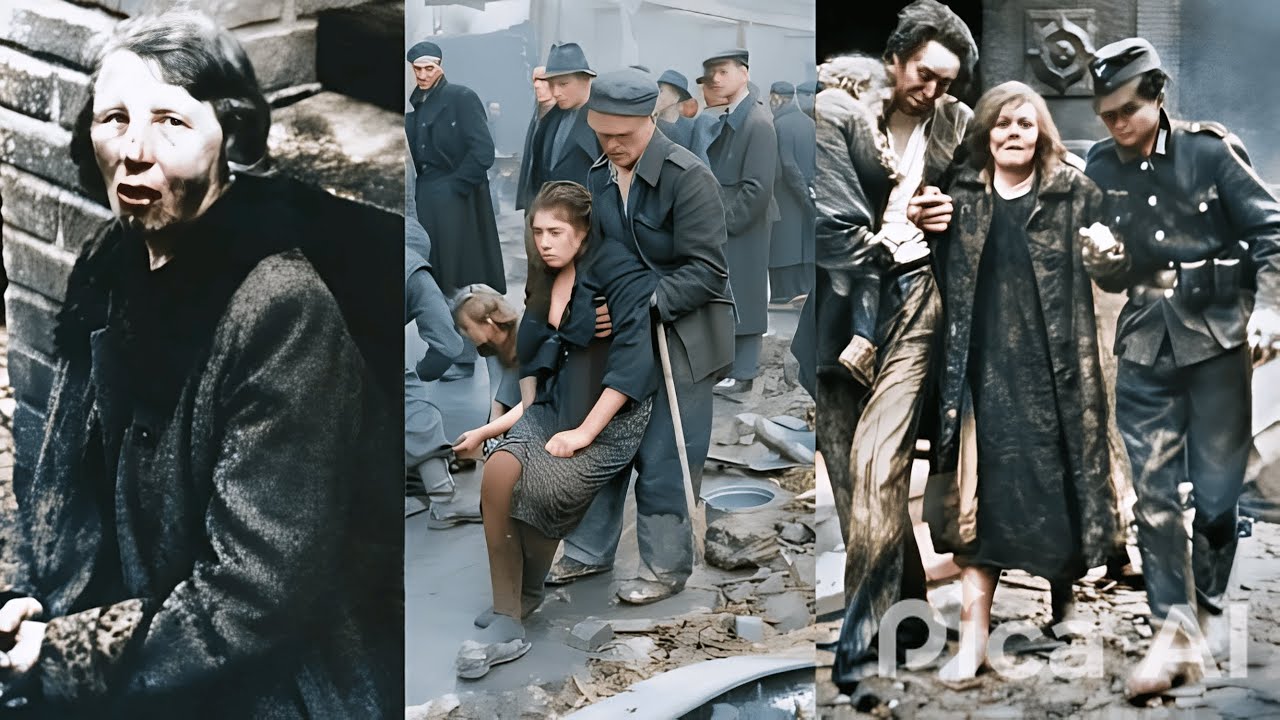
They faced starved, battle-hardened Soviet troops eager to end the war. Official casualties for the battle exceeded 900,000 Germans and 360,000 Polish and Soviet soldiers. In the city, an estimated 1. 5 million women and girls lived without food, water, or basic services.
Experts have calculated that one in three of them suffered some form of sexual assault during the week of April 24 to May 5, as Soviet soldiers swarmed the streets. Berlin was not the only German city reduced to ruin. Dresden, spared from Allied air raids throughout the war, was nearly destroyed on February 13 and 14, 1945, when incendiary bombs unleashed a firestorm. In total, 2,000 British and American planes dropped almost four thousand tons of explosive and incendiary bombs, killing an estimated 25,000 people.
The first wave, a group of 240 Royal Air Force Lancaster heavy bombers, appeared over the city around 10 p. m. and faced practically no opposition. In a 15-minute window, they released 880 tons of bombs on the city center, shattering windows, gouging craters in the streets, and flattening walls.
The incendiaries ignited small fires that merged into a firestorm, one of the most dreadful outcomes of high-tech warfare. A second wave of 550 Lancasters followed between 1:20 and 2:40 a. m. , inundating a city already in flames.
At noon the following day, more than 300 American B-17 Flying Fortresses struck Dresden again, and further raids followed on February 15, March 2, and April 17. The city remained a blaze for weeks, and as survivors fled, it became a ghost city. Hamburg suffered an even deadlier fate over a longer period. The bombing campaign, named Operation Gomorrah, was perhaps the most devastating of the war.
On the night of July 23, 1943, Allied aircraft dropped 2,300 tons of bombs, including 8,000 blockbusters and over 350,000 individual incendiary bombs. It was the incendiary bombs that caused most of the havoc. The resulting fires, combined with high-explosive bombs fitted with delayed-action fuses that prevented firefighters from reacting, turned the city into an inferno. A United States survey released on October 30, 1945, gave German estimates of 60,000 to 100,000 deaths in the Hamburg bombings, perhaps four times the death toll of Dresden.
The cruelty endured by German citizens was not confined to the homeland. Hitler’s policy of populating conquered lands with ethnic Germans had placed entire communities in Poland, France, and Latvia, where they lived in homes confiscated from local populations. When the Allies liberated these territories, the settlers were left to face the fury of those they had displaced. In Poland alone, the German state had killed around 5 to 6 million Polish citizens during the war, and Polish communists began suppressing the German population west of the Oder River.
The Allies passed a resolution recommending the orderly transfer of Germans back to their original country, but it effectively legitimated mass expulsions. Millions of ethnic Germans fled westward ahead of the advancing Red Army, and those who did not were killed, robbed, or expelled. Refugee columns were attacked by low-flying aircraft and brutalized when caught by Soviet troops. In January 1945, a ship carrying 9,000 civilians and military personnel escaping East Prussia was sunk by a Soviet submarine, resulting in the greatest loss of life in a single shipwreck in history.
The savagery of the Eastern Front set the stage for much of this suffering. Hitler’s invasion of the Soviet Union in June 1941 had been a war of extermination, with orders to eliminate all Slavic peoples and to scorch the earth during retreat. Nazi soldiers massacred entire villages, and the atrocities left a deep and permanent hatred in the Soviet collective imagination. When the Red Army began to retaliate, the violence returned with devastating force.
Soviet propaganda demonized all Germans, and the brutality was not punished but often encouraged. Of the 90,000 Germans captured at Stalingrad, only 5,000 ever returned home. The Red Army rarely took prisoners in battle, and captives were often killed on the spot. Soviet authorities, while sometimes trying to limit the killing to gain intelligence, largely failed to stop it.
One of the most tragic episodes of this retribution occurred in the Pomeranian town of Demmin. In late April 1945, as the Red Army approached, Nazi party functionaries and military units fled the town after demolishing the bridges across the Peene River and its tributaries, trapping the residents and hundreds of refugees with no route westward. On April 30, the same day Hitler died in Berlin, Soviet tank brigades reached the town’s edge. After two brief gun battles, Demmin was fully in Soviet hands.
That night, marauding, often drunk soldiers burned buildings, assaulted hundreds of women and girls, murdered several residents, and plundered homes. What followed was a mass suicide of extraordinary dimensions. Families ended their own lives, drowning themselves in the river with their hands tied to their children’s, taking poison, or hanging themselves. Weeks later, corpses were still floating in the waters.
Estimates of the number of suicides in Demmin range from 700 to 1,000, an event that exceeded anything else in Germany in the final days of the war. The collapse of the Thousand-Year Reich happened with devastating speed. Germany lost a quarter of its pre-war territory, was forced to pay reparations to the United Kingdom, France, and the Soviet Union, and was divided into zones of influence controlled by the Allied powers. American policy from April 1945 until July 1947 offered no help in rebuilding the nation except the minimum required to prevent starvation.
An industrial disarmament plan signed in 1946 required the destruction of 1,500 manufacturing plants, lowering German heavy industry output to roughly 50% of its 1938 level. West Germany was officially established in May 1949, followed by East Germany in October of the same year, and the two states followed entirely different paths—one capitalist and allied with the West, the other communist and controlled by the Soviet Union. Between 1933 and 1945, the German people had been told they were racially superior, enjoying benefits sustained by plunder. That fever dream ended catastrophically.
In the aftermath, millions lost their lives, their houses, and their families. Cities were turned to dust, and minds were permanently poisoned with memories of hunger, suffering, and pain. This was the only heritage the German population received from the Nazi criminals who governed them.