In 1930, Asbury Park, New Jersey, spent $4. 5 million in Depression-era dollars on a convention hall designed by the architects of Grand Central Terminal and built out over the Atlantic on concrete pilings. Forty years later, on the Fourth of July, the city burned. The destruction was not along the oceanfront that tourists knew, but in the neighborhood behind the railroad tracks where the city’s Black residents lived.
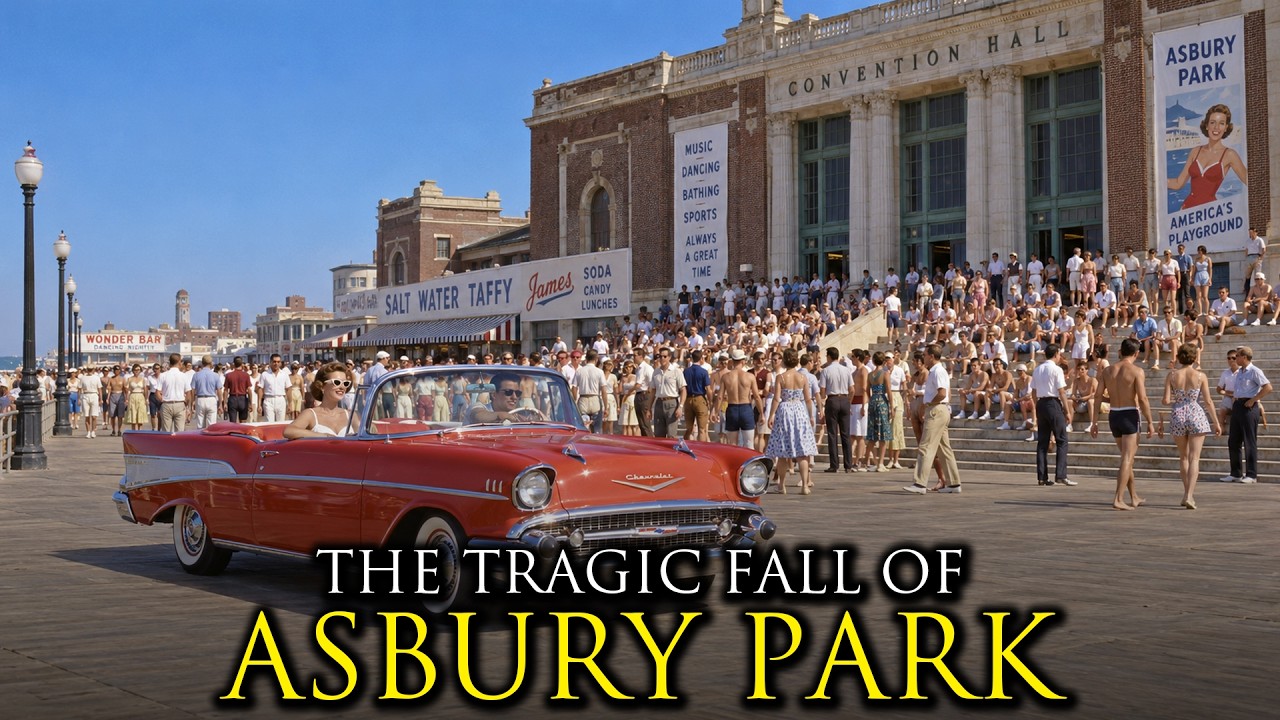
Damage topped $5 million, and nobody rebuilt it. Asbury Park became known as the most famous ruin in New Jersey, with a mile of beachfront nobody wanted. The story of what Asbury Park lost begins in 1871, when James A. Bradley, a brush manufacturer from New York City who had recently converted to Methodism, bought 500 acres of scrubland and low brush on the Jersey Shore for $90,000.
He named the community after Francis Asbury, one of the first two bishops of the Methodist Episcopal Church in North America, and laid out the streets with the names of prominent Methodist ministers, as if the grid itself could enforce piety. His vision was explicit: a temperance resort, a clean and orderly moral alternative to the rougher pleasures available elsewhere on the shore. Bradley personally built a boardwalk, an orchestra pavilion, public changing rooms, and a fishing pier. He controlled the beachfront as his private property and made a decision that would echo across the next century and a half: Black residents could not use the beach.
He framed it as a business calculation. A Black civic leader named William Robinson organized indignation meetings and invented a form of protest called the “wade-in,” in which Black residents walked into the ocean in defiance of Bradley’s restrictions. This was in the 1880s, decades before the civil rights sit-ins that made national news. Bradley held firm.
The railroad made Asbury Park possible. The New York and Long Branch line connected the town to both New York City and Philadelphia. Within a few years, as many as 600,000 vacationers arrived in a single summer season. By 1912, the New York Times estimated the summer population reached 200,000, roughly 20 times the number of people who actually lived there year-round.
The grand hotels, restaurants, amusement arcades, and shops along Cookman and Madison Avenues all existed to serve a seasonal crowd that departed every autumn. The people who cleaned the hotel rooms and ran the rides needed somewhere to live. Because of the way Bradley had designed the city, the answer was the West Side, the neighborhood behind the railroad tracks. The tracks ran roughly north-south through the center of the city and became the dividing line between two completely different worlds.
East of the tracks stood the boardwalk, the grand hotels, the shopping avenues, and the ocean. West of the tracks stood the modest homes and gathering places of the people who served the resort. Two cities shared one name. Springwood Avenue became the spine of the West Side, and what happened there from roughly 1910 to 1970 was extraordinary.
In 1918, a Black entrepreneur named Rhys Dri turned Lafayette Hall into a popular nightclub that later became Roseland Hall, a venue important enough that both Marcus Garvey and W. E. B. Du Bois came to speak there.
The West Side became one of the most important corridors for Black music on the East Coast. The Turf Club, Cuba’s, the Smile Awhile, and Gypsy George’s were venues where Count Basie, Billy Holiday, Tina Turner, Little Richard, and the Four Tops performed. In 1928, Fats Waller visited the West Side and, along with lyricist Andy Razaf, wrote “Honeysuckle Rose” at a building on Atkins Avenue that still stands. The song became one of the most recorded jazz standards in history, born out of Asbury Park’s West Side.
The Springwood Avenue scene lasted for six decades, producing and hosting talent that shaped the development of jazz, gospel, rhythm and blues, and eventually rock and roll. Yet for all those decades, it existed a few hundred yards from a beachfront economy that pretended it didn’t exist. Segregation created the audience, the audience created the scene, and the scene created a cultural legacy the city would spend the next 50 years ignoring. Meanwhile, east of the tracks, the resort kept building.
In 1888, Ernest Schnitzler built the Palace Merry-Go-Round, the cornerstone of what would become Palace Amusements, famous for its painted funhouse face known as Tillie. Grand hotels went up along the oceanfront, and downtown thrived. The 1920s brought the second boom, and competition with Atlantic City produced the building that would become Asbury Park’s defining monument, greatest liability, and most painful symbol all at once. Mayor Clarence Hetrick had been trying to build a convention center since 1916, when he hired the architectural firm McKim, Mead, and White to draw up plans for a 5,000-seat venue costing $75,000.
But James Bradley, still alive at 86, owned the block Hetrick needed and refused to sell. Bradley died in 1921, three weeks before a statue of him was erected to celebrate the city’s 50th anniversary. A department store owner named Arthur Steinbach bought the block from Bradley’s estate and built the Berkeley Carteret Hotel on it instead. Hetrick watched Atlantic City’s new convention hall go up and told the Asbury Park Press, “While we have hesitated, Atlantic City has added $100 million in valuations.
” After a mysterious fire destroyed the Fifth Avenue arcade on the boardwalk in 1927, voters approved a bond referendum to build on the cleared site. Hetrick hired Warren and Wetmore, the firm behind Grand Central Terminal. Their design was genuinely magnificent: a 3,200-seat convention hall offering 60,000 square feet of exhibition space, connected by an enclosed arcade spanning the boardwalk to a 1,600-seat theater christened the Paramount. Convention Hall extended 215 feet out over the beach, cantilevered on pilings driven into the ocean floor.
Italian Renaissance detailing blended with art deco geometry and nautical motifs, with dolphins and seashells cast into the brickwork and stone. Construction ran from 1928 to 1930 and cost approximately $4. 5 million, part of a $5 million redevelopment program that also included the Paramount Theater and new pavilions. For a small resort city with a year-round population of about 15,000, it was an almost reckless bet.
The building had no heating and no air conditioning, and it was financed entirely with bonds. That debt mattered more than anything else in the story. In 1935, the newly formed Securities and Exchange Commission called Mayor Hetrick to Washington to explain $6 million in beach improvement bonds that had defaulted. The inquiry spiraled into state politics, and a state senator slipped an amendment into a municipal debt bill giving the governor and a special commission temporary control over Asbury Park’s beach, the only beach in New Jersey to be seized this way.
Asbury Park sued to get it back, and the state’s highest court upheld the law. By December 1938, the beach was returned on the condition that a bond repayment plan was established. The city had mortgaged its oceanfront to build a building designed to compete with Atlantic City, and the debt followed it for decades. Then, on September 8, 1934, before the bond crisis was even resolved, a burning cruise ship drifted out of the fog and grounded itself right next to Convention Hall.
The SS Morro Castle was a luxury liner that ran weekly between New York and Havana. On the evening of September 7, heading back to New York, the ship was trying to outrun a brewing nor’easter. That night, Captain Robert Wilmott died suddenly, possibly of a heart attack, though suspicion lingered for decades. Around 3:00 a.
m. , a fire was detected on board. The crew had virtually no fire training, and within 15 minutes the entire ship was engulfed. Lifeboats were inaccessible, and passengers jumped into the rough Atlantic.
The Morro Castle drifted before grounding about 200 feet off the Asbury Park beach, positioned directly beside the convention hall pier. One hundred thirty-seven passengers and crew died. Neither the cause of the fire nor the circumstances of the captain’s death were ever definitively resolved. Within hours, while bodies were still washing up along the Jersey coast, vendors appeared on the boardwalk selling postcards and souvenirs of the wreck.
The Morro Castle became the biggest tourist attraction Asbury Park had ever hosted. Hotels that normally emptied after Labor Day stayed full through autumn and into winter. The city turned a maritime catastrophe that killed 137 people into its most profitable off-season in memory. The wreck sat there for six months before it was towed to Baltimore and sold for scrap in March 1935.
The thing that was coming next couldn’t be sold on postcards. In 1947, the Garden State Parkway began opening, and this single piece of infrastructure did more damage to Asbury Park than the riots, the corruption, the debt, and the drugs combined, because it simply made the city optional. Before the Parkway, the railroad was the primary way for New Yorkers and Philadelphians to reach the Jersey Shore, and Asbury Park sat on that line like a gate. After the Parkway, drivers in new post-war automobiles could reach Long Beach Island, Seaside Heights, Wildwood, and Cape May.
An Asbury Park exit opened in 1956, but by then exits were multiplying further south, and each one peeled away potential visitors toward newer, less expensive beaches. On June 20, 1956, the same year the Parkway exit opened, a Venezuelan airliner crashed into the ocean off Asbury Park, killing all 74 people on board, then the deadliest commercial aviation accident in the world. The suburbs did the rest. Surrounding farmland gave way to housing tracts, and middle-class families, Black and white alike, moved into new houses with spacious yards.
Monmouth Mall opened in 1960, 10 miles away, and Asbury Park’s downtown shopping district began to lose customers. Six Flags Great Adventure opened in 1974, offering families a theme park that made a mile of aging boardwalk rides feel like yesterday’s entertainment. The tax base shrank, and the year-round economy, already fatally dependent on summer visitors, began to buckle. Through all of this, the West Side got nothing: no new investment, no infrastructure improvements, no recreational programs for young people.
The neighborhood center received around 700 job applications from teenagers in the summer of 1970. The jobs didn’t come. On the evening of July 4, 1970, a group of teenagers leaving a dance at the Westside Community Center on Springwood Avenue began throwing bottles and rocks at each other and at passing cars. Two police officers arrived, and their presence made the situation worse.
Windows shattered along Springwood Avenue. What began as what one historian later called a “rock and bottle festival” became a sustained uprising over the following days, with fires, looting, and Molotov cocktails hurled at fire trucks. By July 6, the city declared a state of emergency, imposed a curfew from 8:30 p. m.
to 6:00 a. m. , and called in the National Guard and state police. Police were reportedly given orders to shoot looters on sight.
On July 7, community leaders presented a formal list of 20 demands, including employment for Black youth, fair representation on the board of education, and a civilian police review board. That same day, as crowds moved from the West Side toward the railroad tracks, state police opened fire. The rounds were intended as warning shots. They ricocheted off concrete.
Forty-four civilians were hit, 14 of them minors. By July 11, it was over: more than 180 people injured, including 15 state troopers, 167 arrests, and property damage estimated between $4 and $5. 5 million. Governor Cahill asked President Nixon to declare the West Side a federal disaster area.
Nixon refused. The physical destruction centered on Springwood Avenue, the same street where Billy Holiday had sung and Fats Waller had composed. The businesses that served the West Side for decades were gone. And nobody rebuilt Springwood Avenue, not in the 1970s, not in the 1980s, not in the 1990s.
Many of those blocks remained empty lots for over 30 years. The city turned its attention entirely to the waterfront and let the wound sit open. What filled the vacuum was worse than emptiness. When New Jersey began closing its state mental hospitals in the mid-1970s, thousands of former patients were released with nowhere to go.
They drifted toward the cheapest housing they could find, and Asbury Park had plenty of it: vacant motels along the waterfront, boarding houses that once served railroad-era tourists, and residential hotels no vacationer would touch. Vandalism, prostitution, drug dealing, and gang activity moved into the vacuum left by the departed middle class and vanished tourists. The boardwalk that once drew 600,000 visitors became a place people actively avoided. Corruption didn’t cause the collapse, but it ensured that nobody competent was managing it.
City government through the 1970s, 1980s, and 1990s was plagued by bribery, drug scandals, and political dysfunction. In 2007, the state attorney general’s office investigated the board of education on allegations of corruption and misuse of funds. The schools were spending more per student than any other district in New Jersey, over $18,000 a year, according to the New York Times. Yet the high school had failed to meet standards set by the No Child Left Behind Act for six consecutive years.
Eight of the 17 homicides in all of Monmouth County in 2006 took place in a city of barely 16,000 people. But even in the worst years, one thing kept the name alive in a way no other ruined resort town in America could claim. On February 8, 1974, two bouncers from Seaside Heights named Jack Roig and Butch Tielka bought a bar at 913 Ocean Avenue without ever walking through the door first. They opened it as the Stone Pony.
A bar-band scene had been growing along the Jersey Shore for years, and the Stone Pony caught that energy at precisely the right moment. Southside Johnny Lyon and Steve Van Zandt put together a group called the Asbury Jukes and played three nights a week at the Pony, packing the room with a horn-driven, soul-soaked R&B sound. A young songwriter from Freehold named Bruce Springsteen started showing up, and his first documented performance there was about seven months after the club opened. The Pony didn’t launch Springsteen, but it became the place that fused his name to the city permanently, so completely that many people still assume he was born there.
In 1976, Epic Records broadcast a live Memorial Day concert from the Stone Pony across a network of radio stations reaching the East Coast and Midwest. Their performance of Sam Cooke’s “Having a Party” became the unofficial anthem of both the Pony and of Asbury Park itself, a song about joy performed in a city running out of reasons for it. As Southside Johnny later put it, “It was worth your life to walk the streets at night. But on Friday and Saturday nights, the cops would be there helping people park and there’d be a police presence.
And for a few hours, it was almost like a real city again. ”
Music, though, doesn’t pay municipal bonds or fill empty hotels year-round. Several state-led redevelopment plans came and went in the 1980s. The most serious attempt came from brothers Henry and Sebastian Vaccaro, who invested heavily in the waterfront in the mid-1980s.
They restored the Berkeley Carteret Hotel and signed a contract to build 2,400 residential condominium units along the oceanfront. Then, in 1989, their construction contractor filed for bankruptcy. Everything stopped. Half-finished condominium buildings stood along the oceanfront like concrete ribs, filling slowly with graffiti and pigeons.
They became the most photographed symbols of Asbury Park’s failure, skeletons visible from the boardwalk. Palace Amusements, the funhouse complex with the famous Tillie face and a place on the National Register of Historic Places, closed in 1988 despite its protected status. Preservationists fought for 16 years to save it. In 2004, the building was demolished anyway, and the wrecking ball punched through the Tillie mural while cameras rolled.
The carousel from the casino pier had already been sold in 1990 and shipped to Myrtle Beach, South Carolina, where it still operates. Asbury Park’s past was being auctioned off piece by piece. The census told a deceptively stable story, with the population hovering near 17,000 for decades. But the composition shifted dramatically.
White middle-class families left for the suburbs. By the 2000 census, Asbury Park was roughly 60% Black, the median household income was $23,000, and nearly half of all children lived below the poverty line. Then, in the late 1990s, something started that nobody in 1990 would have predicted, and it began with people buying houses that other people wouldn’t touch. LGBTQ residents, many from New York City an hour north on the train, discovered that Asbury Park’s collapsed real estate market meant beautiful Victorian houses near the ocean could be purchased for startlingly little money.
Asbury Park had a documented gay presence going back decades, and by the 1980s, locals recalled the city had 10 to 12 gay bars. In 1999, Madonna’s producer Shep Pettibone opened Paradise, a gay nightclub near the beach, and later the Empress Hotel, one of the state’s only gay-oriented resorts. Jersey Pride, the state’s oldest and largest Pride parade, had been held in Asbury Park since 1972, drawing tens of thousands annually. The city was positioned organically as a destination for LGBTQ tourism.
Block by block, storefronts started to reopen. By the 2010s, the revival was tangible but uneven. The boardwalk partially reopened. New restaurants, bars, and boutiques filled Cookman Avenue downtown.
The Asbury Hotel opened in 2017, the city’s first new hotel in decades, built inside the shell of a former Salvation Army boarding house. After Hurricane Sandy battered the Jersey Shore in October 2012, Asbury Park was one of the few communities to reopen successfully for the 2013 summer season. On Memorial Day weekend 2013, Governor Christie and President Obama stood before a crowd of 4,000 for an official reopening ceremony. Convention Hall still stood, still hosted concerts, still pushed out over the Atlantic on its original pilings.
But walk 10 blocks west from the boardwalk, cross the old railroad line, and the revival vanishes. The West Side, where Springwood Avenue once hummed with jazz until dawn, still carries the marks of July 1970. Many of those burned-out lots remained undeveloped into the 21st century. A park called Springwood Park was established in 2016, and a small urban farm called Kula grows produce for local restaurants.
Music Mondays brings live performances in the summer. These are good things, but they are not what was lost. The residents who stayed on the West Side through 30 years of abandonment now face a new problem. The East Side’s resurgence is pushing property values and taxes up across the entire city.
The gentrification that arguably saved Asbury Park’s waterfront threatens to price out the people who held the city together when nobody else wanted it. Between 2000 and 2020, the Black population dropped from roughly 10,000 to about 5,000. The white population climbed from 3,000 to more than 5,000. The 2020 census counted 15,188 people.
The poverty rate still hovers above 20%, and the city is still fundamentally two cities divided by the same line that divided it in 1871. For the better part of 40 years, from roughly 1970 to 2010, the question of why nobody wanted to visit Asbury Park was real. The city had been designed from its very first day as two separate cities stacked inside one small square mile, connected by need and divided by everything else. When the tourists stopped coming, the side that served them had nothing, and the side that entertained them pretended the other side didn’t exist.
The whole thing was a stage set built on sand, financed with bonds, sustained by a railroad, and killed by a highway. Convention Hall still extends over the ocean. You can stand on the boardwalk and look south toward the spot where the Morro Castle came to rest in 1934. A black marble monument marks the spot now, installed in 2009 for the 75th anniversary.
Most people walk past it without reading a word. Across the street in Bradley Park, the statue of James Bradley faces the water, the man who bought the sand, drew the grid, built the boardwalk, and decided who belonged on which side of the tracks. His city burned and emptied and filled with ghosts and slowly, expensively, came partway back to life.
And his statue never moved.