On the morning of June 27, 1876, General Alfred Terry’s column approached the valley of the Little Bighorn River under a silence that felt wrong. No courier had arrived from Custer, no distant gunfire had been heard, no signal flags had broken the horizon. What the soldiers found when they reached the ridgeline defied language. More than two hundred men of the 7th United States Cavalry lay scattered across the slopes, stripped, mutilated, and bloating in the Montana sun.
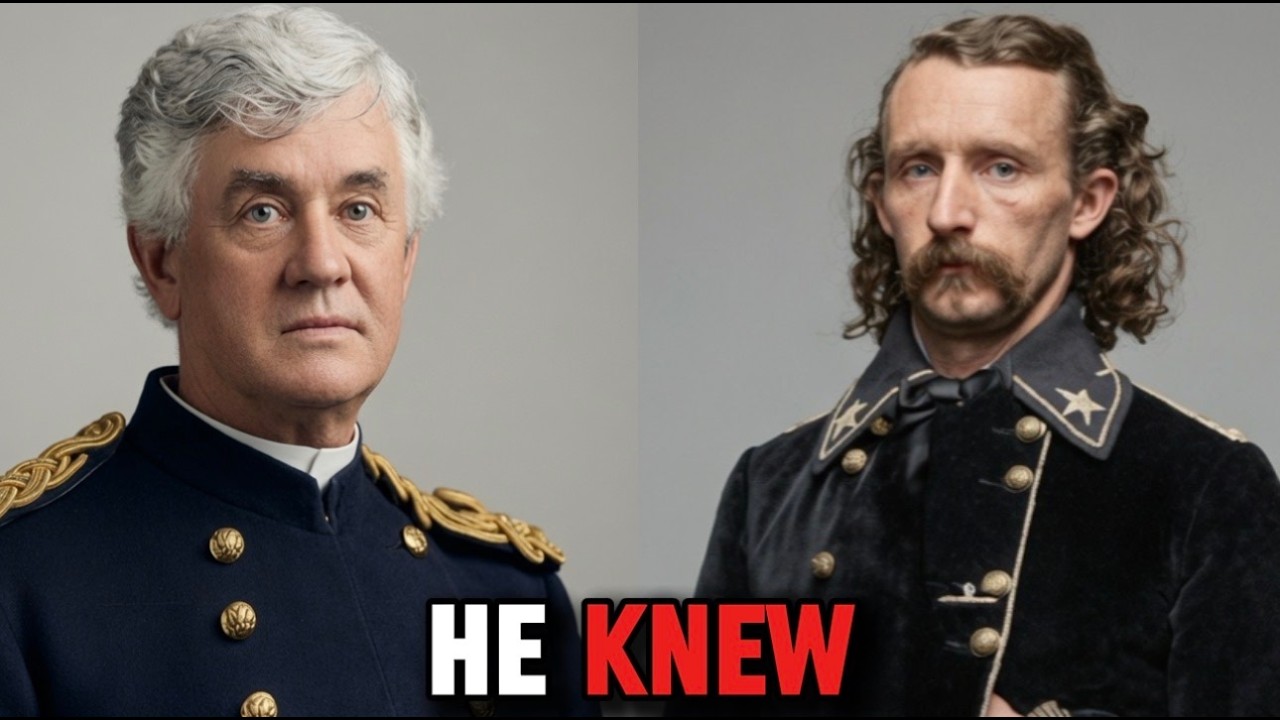
At the crest of the hill, among the dead, was Lieutenant Colonel George Armstrong Custer. The army reeled. The nation reeled harder. Custer had been one of America’s most famous soldiers, a Civil War hero and a golden-haired Indian fighter whose legend had been fed steadily by his own pen.
His death seemed impossible. But one man was not surprised. Frederick William Benteen had been saying something was wrong with George Armstrong Custer for years. Benteen had earned his opinion the hard way.
In the winter campaign of 1868 along the Washita River in what is now Oklahoma, Custer attacked a Cheyenne village at dawn, a village led by Black Kettle, a chief who had spent years seeking peace with the United States government. The attack was swift, chaotic, and technically successful. What followed was less celebrated. Major Joel Elliott, leading a detachment of soldiers, rode in pursuit of escaping warriors and disappeared downstream.
When the sound of gunfire from Elliott’s direction grew heavy and then stopped altogether, Custer made a decision. He gathered his command, destroyed the village, and withdrew without searching for Elliott’s men. Nineteen soldiers, including Elliott, had ridden into that riverbank timber and never came back. Their frozen, mutilated bodies were discovered weeks later by another column.
Custer’s official report treated the matter as a minor ambiguity. The withdrawal was tactically sound. The engagement was a success. Army brass largely accepted this framing, and Custer moved on.
Benteen could not. He wrote an anonymous letter to a Missouri newspaper describing the Washita fight in damning detail, asking how a commanding officer could abandon soldiers in the field. When Custer traced the letter back to him, he confronted Benteen directly and demanded to know if he had written it. Benteen admitted it and stood by every word.
No court-martial followed. The army absorbed the friction and kept moving. But the incident locked something between the two men permanently. Benteen’s position was unusual not because he disliked Custer, but because his dislike was built entirely on what he considered a matter of military character.
He was not jealous of Custer’s fame. He was a competent, unsentimental soldier who expected the men he served with to hold themselves to a standard. He believed Custer was a man who would sacrifice the men under him for personal advantage, and he believed this not from rumor, but from direct observation. By the spring of 1876, the situation on the northern plains had become impossible to ignore.
The Great Sioux War had opened along the Powder River country, fueled by the government’s failure to honor treaty boundaries after gold was discovered in the Black Hills. Sitting Bull had drawn together one of the largest concentrations of Lakota, Northern Cheyenne, and Arapaho warriors the plains had seen in a generation. The army organized three converging columns to force the hostile bands back onto the reservation. Custer and the 7th Cavalry were assigned to the column under General Terry, moving westward from Fort Abraham Lincoln.
The scale of what was gathering in the valley was not well understood by the officers riding toward it. Scouts had detected signs of a large village, some estimates suggesting thousands of warriors. Custer reportedly dismissed the higher figures, not because he had evidence they were wrong, but because he fundamentally did not believe that any concentration of Indian warriors could stop a charge by his regiment. On the morning of June 25, Custer’s Crow scouts spotted the village from a high point called the Crow’s Nest.
They told him the village was enormous, unlike anything they had guided soldiers toward before. Custer pushed forward anyway, partly because he believed the regiment had been spotted and feared the village would scatter before he could engage it, and partly because that was who he was. He divided the 7th Cavalry into three columns. He assigned Major Marcus Reno to attack the southern end of the village, kept five companies for himself to strike what he believed would be the flank, and directed Benteen with three companies to sweep the bluffs to the left, a mission that accomplished nothing except keeping Benteen’s companies away from wherever the main fight developed.
Benteen carried out the order because it was an order, riding through broken terrain that showed no signs of village or warriors, then turning back toward the river when the ground yielded nothing. He was returning when he encountered the regiment’s pack train and was handed a note scrawled in pencil and sent back by a courier. It read: “Benteen, come on. Big village.
Be quick. Bring packs. ” It was the last communication anyone outside Custer’s command received from him. What Benteen rode toward was a disaster already in motion.
Reno’s battalion had attacked the village from the south, been met by a warrior counterattack of a size that stunned every man who survived it, and had retreated back across the river and up the bluffs in a rout that cost him a third of his men in a matter of minutes. When Benteen arrived, Reno’s survivors were on the bluff line, disorganized and shaken, and the firing from the direction Custer had ridden was already fading. Benteen consolidated with Reno and organized a defensive perimeter. He held through the rest of June 25 and all of June 26, fighting off attacks that at several points threatened to overrun the position entirely.
The men who survived that siege, and most of them did survive, largely credited Benteen with keeping them alive. He moved along the line under fire and steadied men close to breaking. Whether he could have saved Custer is a question that has no honest answer. By most military assessments, Custer’s command was gone before Benteen’s companies could have reached him regardless of when they moved.
The village was too large, the terrain too broken, the timing too compressed. But the question was asked anyway, loudly and persistently, because someone had to be responsible for what had happened on that ridge, and Custer was dead, which made him inconvenient to blame. The army’s reckoning with Little Bighorn was partly about military failure and partly about reputation management. Custer’s widow, Elizabeth Bacon Custer, spent the next fifty years constructing a version of her husband that placed the blame for the battle’s outcome anywhere other than with him.
Reno was her primary target. Benteen was close behind. The Reno Court of Inquiry in 1879, convened at Reno’s own request, produced a finding that technically exonerated him of misconduct but did little to clear the air. Benteen testified in his characteristically direct manner, describing Custer’s orders, the terrain, and the decisions that were made.
He did not perform grief over Custer’s death because he did not feel it. History has gradually come to accept that Benteen was right. Not in the tactical sense of having a superior plan that was ignored. He had no plan to offer before the battle, only a dark foreboding.
He was right in the deeper sense. He had watched a man make decisions that were fundamentally about personal glory, decisions that treated the men in his command as instruments rather than as soldiers with lives that had value independent of what they could contribute to his next victory. The abandonment of Elliott at the Washita was not an anomaly. It was a pattern.
Custer had a history of pushing forward when caution was warranted, of discounting intelligence that complicated his preferred version of a situation, of dividing his force when concentration was the sound choice, and of assuming that he personally would survive his risks. That refusal to applaud cost Benteen professionally, socially, and reputationally for most of his career. The army did not promote him to Brigadier General until 1890, fourteen years after Little Bighorn, and the promotion came with a forced retirement. He spent his later years in Atlanta, poor and occasionally in trouble.
He was court-martialed in 1887 for drunkenness and conduct unbecoming. He died in 1898. He was never given a medal for Little Bighorn despite commanding the force that held the bluff position and kept the largest portion of the 7th Cavalry alive through two days of siege. There was no national monument to his steadiness, no popular biography, no gilded reputation built from his widow’s pen.
The tragedy embedded in Benteen’s story is not that he was ignored. Men with uncomfortable opinions frequently are. The real tragedy is what the ignoring cost. The soldiers who died at Little Bighorn were not killed by superior numbers alone.
They were killed in part by a command structure that had tolerated, enabled, and actively promoted a man whose approach to risk was built on the assumption that he personally would survive it. The reassessment of Custer that gathered momentum through the latter half of the twentieth century has steadily moved toward the conclusion Benteen reached decades before anyone else. Custer was reckless. Custer put his ambitions ahead of his men.
On June 25, 1876, he made a series of decisions that a more careful officer would not have made. And the men who died on that ridge paid the price. The man who said so first, loudest, and earliest paid a different kind of price. He paid it in a career that moved too slowly, in a reputation shaded by association with a defeat no one wanted to analyze honestly, and in the specific loneliness of a man who is right about something important and cannot get anyone to listen.
Frederick Benteen was not a sympathetic figure in the easy sense. He was sharp-tongued, difficult, openly contemptuous of men he considered inferior. But he was honest. In a command culture that ran on flattery and the careful management of powerful reputations, Benteen said what he saw.
He said it in 1868 along the Washita. He said it in the years between. He said it on the bluffs above the Little Bighorn while the dead were still being counted. Nobody believed him until the evidence was impossible to bury.
And even then, the monuments went to someone else.