On the morning of November 9, 1971, John List drove his three children to school in Westfield, New Jersey, as he did every morning. He was an accountant, a Sunday school teacher, and a model father, living in a nineteen-room Victorian mansion called Breeze Knoll. That morning, on his way home, he stopped to buy two guns. His wife, Helen, was shot once in the back of the head in the kitchen.
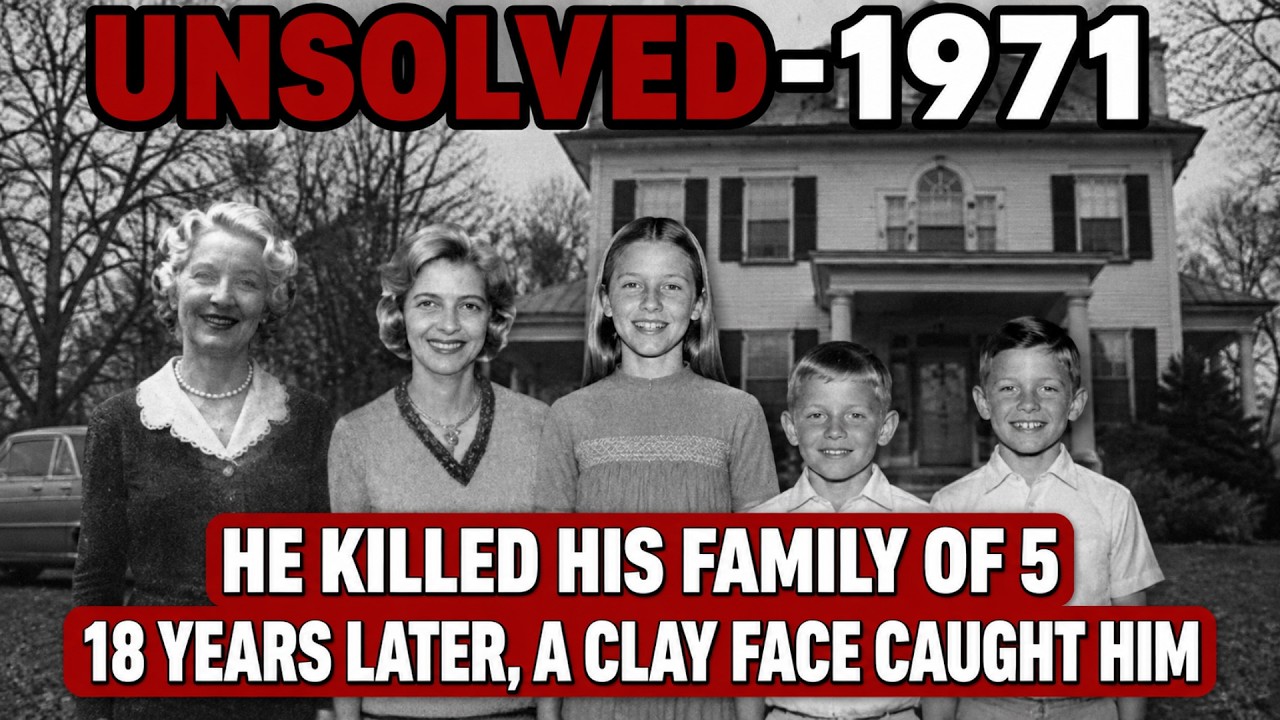
His eighty-four-year-old mother, Alma, was shot in her third-floor apartment. That afternoon he watched his fifteen-year-old son play football, drove him home, and shot him dead. The two younger children were killed the moment they walked through the door. Five people, one day.
He carried the bodies into the ballroom, laid them on sleeping bags, cut his own face out of every family photograph, lowered the heat to slow decomposition, played hymns over the intercom, wrote a five-page confession to his pastor explaining that he had sent his family to heaven, and then walked out the front door. He vanished without a trace. For eighteen years, he was a ghost. A forensic sculptor shaping clay based on old photographs, a fledgling television show airing at the right moment, and a phone call from a former neighbor finally broke the case open.
John Emil List was born on September 17, 1925, in Bay City, Michigan, the only son of a deeply religious German Lutheran family. His father drilled two things into him above all else: discipline and appearance. Failure was not an option. Welfare was a disgrace.
Whatever happened behind closed doors, the outside world must always see perfection. In 1943, at eighteen, List enlisted in the U. S. Army and served on the European front, surviving some of the war’s fiercest battles.
He was honorably discharged as a sergeant in 1945. He used the G. I. Bill to earn degrees in business administration and accounting from the University of Michigan, married Helen Morris Taylor in 1951, and built the picture-perfect postwar family.
They had three children: Patricia, born 1955; John Frederick Jr. , born 1956; and Frederick Michael, born 1958. Behind closed doors, things were less perfect. Helen began drinking heavily and suffered growing mental instability.
Medical records later revealed she had late-stage syphilis, which affected her brain and her behavior. John List knew, but told no one. Image was everything. In 1965, he became vice president and controller of a bank in Jersey City, New Jersey.
Then he made what in hindsight was the first step toward tragedy: he bought Breeze Knoll. The nineteen-room Victorian at 431 Hillside Avenue had a grand ballroom with a stained-glass ceiling, wide grounds, servants’ quarters, and a third floor large enough to convert into an apartment for his mother. He did not need nineteen rooms. He bought the house so the world would see him succeeding.
It was the physical proof that John List was not a failure. By the end of the 1960s, he was drowning. He lost his bank job in 1970. The reason, according to a former colleague, was brutally simple: no one at the bank liked him.
He applied for jobs everywhere and was hired nowhere. He told no one. Every morning he put on his suit, took his briefcase, and drove away from Breeze Knoll as if going to work. He was going nowhere.
He parked at the Westfield train station, read the newspaper, watched trains pass, sometimes sat in a parking lot for eight hours, then drove home for dinner. He secretly drained his mother Alma’s roughly $200,000 in life savings to pay the mortgage. By 1971, it was almost gone. Debt piled on debt.
The bank was preparing to foreclose. John List, the man who could not accept failure in front of anyone, faced a prospect he considered worse than death: the whole community of Westfield watching him fail. He did not ask for help. He prayed.
In those prayers, through a religious logic twisted beyond recognition, he found what he believed was the answer. His reasoning was simple and terrifying. He saw his family as five souls sliding toward damnation. Helen was drinking, lost.
Patricia wanted to act, and he feared for her Christian faith. The world of the 1970s, with its anti-war movement, drugs, and sexual freedom, was corrupt. If his family kept living in that world, they would lose their souls forever. The solution, in his mind, was to kill them now while they were still Christians, guaranteeing their salvation.
He wrote in the confession letter that he was not sure they would keep their faith if they lived, but if he killed them, he knew they would be saved. He saw it not as murder, but as an act of love. He did not kill himself because suicide was an unforgivable sin. If he killed himself, he could never meet his family in heaven.
He had to live. In the days before November 9, he executed his plan with the precision of a business operation. He canceled the newspaper, the milk, and the mail. He called the children’s school and said the family was visiting a sick relative in North Carolina.
He calculated everything: the temperature of the house, the lights, the music, even the smell. If he lowered the heat enough, decomposition would slow and no one outside would notice. On the morning of the 9th, he dressed in his suit, ate breakfast with his family, drove the three children to school, and stopped to retrieve the guns. Helen died in the kitchen, shot from behind.
He wiped up the blood, then climbed to the third floor and shot Alma once above her left eye. She never knew her daughter-in-law lay dead below, or that the man with the gun was her only son. He judged Alma too heavy and the stairs too steep to move her, and left her where she fell. He made himself lunch and ate in a house with two bodies.
After lunch he went to the bank and closed accounts. Then he drove to his son’s football game and watched his boy play, knowing it was his last. After the game, John Jr. walked home and his father shot him.
The boy did not die instantly. Forensic evidence showed he had fought, that shots missed, that he tried to run or grab the gun. List fired multiple times into his chest and face before the boy stopped breathing. It was the only moment that day his perfect plan met resistance.
Patricia came home from school and was shot dead at the door. Frederick, the youngest, came through the door and was shot dead. Five people, one day. Then came the stage criminologists consider more horrifying than the murders themselves.
He dragged the four bodies to the ground-floor ballroom, laid them on sleeping bags, side by side, neatly, as if they were asleep. He walked through all nineteen rooms, cut his own face from every family photograph, one after another, leaving the rest of each picture intact. He lowered the heat. He played hymns over the intercom.
He kept the lights on. From the outside, Breeze Knoll still looked lived-in. Then he sat down in the study and wrote the five-page letter to his pastor, Eugene A. Rehwinkel.
He admitted the killings, described his financial ruin, explained his fear for his family’s souls, gave funeral instructions, and ended: “I commit myself to the justice and mercy of God, not the justice of the law, but the justice of God. ” He left the letter on the desk with a note directing whoever found it to important documents. Then he locked the front door, drove to Kennedy Airport, left his car in the long-term lot, and took a bus, then a train. Destination: Denver, Colorado.
He applied for a new Social Security card under the name Robert Peter Clark. The case went cold quickly after that. Because the List family was so closed off, no one raised questions for nearly a month. Then Patricia’s drama teacher grew worried, the lights in the mansion burned out one by one, and police were called.
On December 7, 1971, they entered Breeze Knoll to find four bodies on sleeping bags in the ballroom, Alma’s body on the third floor, the confession letter on the desk, and hymns still playing over the speakers. The FBI identified John List as the suspect, found his car at the airport, and then found nothing. In an era before the internet, national databases, and cameras everywhere, a quiet middle-aged white man with a valid Social Security card could simply disappear. List had, by the FBI’s own later admission, committed the perfect crime—not the perfect murders, but the perfect vanishing.
In Denver, as Robert Clark, he returned to accounting, joined a Lutheran church, and lived quietly and reliably. No drinking, no smoking, no close friends, no past. He was John List minus the family, minus the mansion, minus the murders. In 1985, he married Dolores Miller, a kind, churchgoing woman who knew nothing of his past.
In February 1987, a neighbor, Wanda Flannery, read a magazine article about the List family murders. She looked at the old photograph and felt her blood run cold: the man looked exactly like her neighbor, Bob Clark, just younger. She told Dolores, who dismissed it completely. Her husband went to church every Sunday.
He was the most upright man she knew. Flannery let it go, but she did not forget. In 1988, America’s Most Wanted premiered on Fox. When producers took on the List case, they faced a problem: the most recent photograph of John List was eighteen years old.
They needed a way to show what he might look like now. They turned to Frank Bender, a self-taught forensic sculptor in Philadelphia who had launched his career by reconstructing the face of a decomposed murder victim from clay. Working with forensic psychologist Richard Walter, Bender built a profile: List would still go to church, still work as an accountant, still dress in suits, still live by his old patterns. Bender modeled the clay bust accordingly: balding, aging, wearing old-fashioned round-rimmed glasses he bought from an antique store.
Three months of work went into the sculpture. On May 21, 1989, the clay bust appeared on America’s Most Wanted. In Aurora, Colorado, Wanda Flannery and her daughter were watching. They leapt out of their chairs.
It was Bob Clark. Not similar. It was him. This time, Flannery did not tell Dolores.
She called the show directly. Within hours of the broadcast, about twenty callers from Richmond, Virginia, where Bob Clark now lived and worked, identified the same man. Frank Bender, the self-taught sculptor, had been right with chilling accuracy. Eleven days later, on June 1, 1989, FBI agents arrived at the accounting office where Robert Clark worked.
He stood exactly like the clay bust: bald, round glasses, a face so ordinary it would go unnoticed in any crowd. Asked if he was Bob Clark, he said yes. Asked if he was John List, he said no and claimed he did not know who that was. But fingerprints taken on the spot matched the records John List had left when he applied for a gun permit in New Jersey in 1971.
Ten fingers, no margin for error. Robert Peter Clark was John Emil List. His second wife, Dolores, was the sixth victim—not by bullet, but by a lie that endured four years of marriage and thousands of nights sleeping beside a man who had murdered his entire first family. They divorced in 1989.
For months, List refused to give up the Robert Clark identity. Finally, on February 16, 1990, facing military records, gun-permit fingerprints, physical evidence from the crime scene, and his own handwriting in the confession letter, John List admitted who he was. Robert Clark disappeared for the last time. The trial began on April 2, 1990, in Elizabeth, New Jersey.
The defense did not deny that List had killed five family members; the confession letter made denial impossible. Instead, it argued he was mentally broken, obsessive-compulsive, genuinely believing he was saving his family, and asked for second-degree murder convictions rather than first-degree. The prosecution countered with the letter itself, reading it piece by piece: the canceled newspaper, the call to the school, the closed bank accounts, the funeral instructions, the escape route. Did that look like the behavior of a man who had lost control, or the plan of a man who had calculated everything, down to the temperature of the house and the hymns over the intercom, before calmly walking out the door?
A court-appointed psychiatrist testified List had an obsessive personality but showed no evidence of genuine remorse, calling him cold. The judge later described him in six words: “No remorse and devoid of honor. ” The trial lasted seven days. The jury convicted John Emil List of all five counts of first-degree murder on April 12, 1990.
He received five consecutive life sentences, one for each victim: Helen, Alma, Patricia, John Jr. , and Frederick. List appealed. He argued PTSD from his World War II service had impaired his judgment, and that the confession letter was privileged communication with his pastor.
The federal appeals court rejected both claims. No clinical evidence showed List lost his ability to understand his actions; the meticulous planning proved he was in full control. The letter, left voluntarily at the crime scene with a note for whoever found it, was not confidential communication. It was a confession.
The U. S. Supreme Court declined to hear the case. In prison, List lived by the same patterns as always: disciplined, quiet, rule-following, attending the prison church every Sunday, reading the Bible, and waiting, as he told one journalist, for the day he would reunite with his family in heaven.
In a rare 2002 interview with Connie Chung, he said, “I wish I had not done what I did. I have been sorry for my actions and I have been praying for forgiveness. ” When asked why he didn’t kill himself instead, he repeated the same twisted logic from thirty-one years earlier: suicide would send him to hell, and he would never see his family again. Then he said something Chung later described as the most frightening moment of her interviewing career: “I feel that when we get to heaven, we won’t be interested in these earthly matters.
They will forgive me or not even realize what happened. ” In his mind, Helen would not remember the bullet in the back of her head. Patricia would not remember her father waiting with a gun when she came home from school. His son would not remember fighting for his life.
If they did not remember, there was nothing to forgive. John Emil List died on March 21, 2008, in Trenton, New Jersey, of complications from pneumonia. He was eighty-two. He spent eighteen years as a fugitive and eighteen years in prison.
He never publicly admitted that what he did was morally wrong. He only said he wished he had chosen a different path. The case left a lasting mark beyond the graves of five people in Westfield. Frank Bender’s clay bust became the symbol of age-progression technology, now a standard tool in law enforcement worldwide.
America’s Most Wanted, which credited the List episode as one of its first major successes, ran for twenty-five seasons and claimed to help capture more than a thousand fugitives. John List became a classic case study in criminology, the archetype of the respectable family annihilator, the man who treats his family as a social symbol and destroys it when the image collapses. He inspired books, documentaries, podcasts, and the fictional character John Graff in the Netflix series The Watcher. In Westfield, he became the town ghost, the story parents tell their children, the name whispered when passing 431 Hillside Avenue, even though the old mansion has been gone since 1972.
A new house now stands on the old ground. Five people, one bullet each. Eighteen years of flight, eighteen years in prison, and a clay bust that pulled justice out of the dark.