On a small island in the Aegean, in the spring of 1970, a maid opened a bedroom door and found the lady of the house unconscious. An empty bottle of sleeping tablets stood nearby. A doctor was flown in by helicopter through the dark, but by two in the morning Eugenia Livanos was dead at forty-three. She was the wife of one of the richest men alive, the mistress of that island, and the mother of his four children.
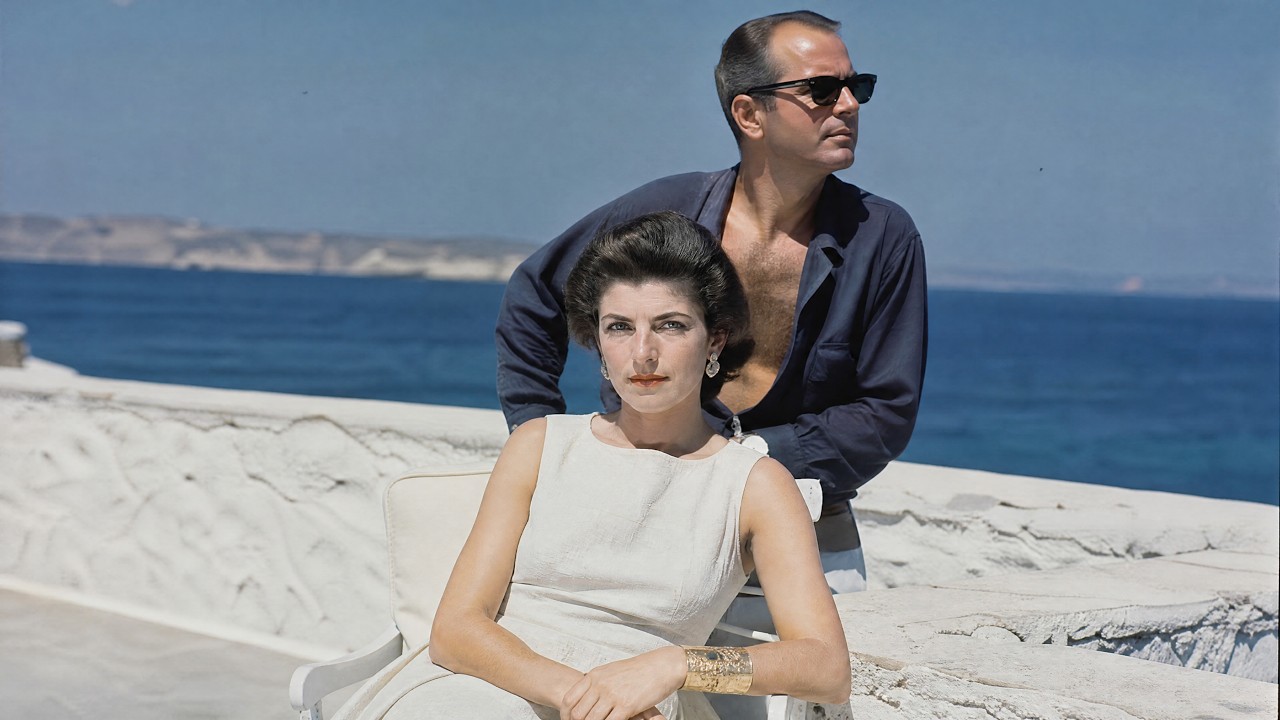
Within days her death would be examined and questioned, and within months quietly closed. Almost no one reading the headlines could have said a single thing about the woman herself. Eugenia Livanos was born in London on the 11th of August 1926, the elder daughter of Stavros Livanos and his wife Arieta. Her father was a ship owner of the old Greek shipping aristocracy, a careful, quiet man who believed the safest fortunes were those nobody read about.
In that closed world, the great shipping families married one another again and again to keep their fleets consolidated inside the same few houses. A daughter was not only a child but an alliance waiting to be arranged, and the daughters of a man like Stavros Livanos were among the most valuable pieces on the board. Two men came looking to marry into the house of Livanos, and both would become legends of the century: Aristotle Onassis and Stavros Niarchos. They were the two most ambitious shipping men of their generation, rivals fated to stay rivals for their whole lives.
According to the accounts that survive, it was Niarchos who came first, and the daughter he asked for was not Eugenia at all, but her younger sister Tina, a girl of about fourteen. Her father did not refuse him because his daughter was a child; he refused him on a rule of custom. The elder daughter must marry first. Told he could not yet have the younger sister, Niarchos turned to the elder, and that is how Eugenia was matched to a man who had walked into her family’s house wanting somebody else.
In November of 1947, she married him, and two of the largest fortunes in the world were joined in a single afternoon. About a year earlier, Tina had married Onassis. Within the space of about a year, the two Livanos daughters had been married to the two greatest rivals in world shipping, binding the houses of Livanos, Onassis, and Niarchos into a single family that would spend the next thirty years feuding across the same ocean. Stavros Niarchos had been born in Athens in 1909 and built one of the largest tanker fleets in the world, profiting from the enormous tanker booms that followed the war.
He was a hard, restless, driven man of huge appetite and iron will. Eugenia was a woman of twenty-one, married to a man already in the full stride of his power. For a time the marriage did what such marriages were built to do. It produced heirs: first the sons Philip and Spyros, then a daughter, Maria Isabella, and at last a youngest son, Constantinos.
From the outside it had the convincing shape of a strong family. Of the two Livanos sisters, Eugenia was the one who had made the solid match, the marriage that lasted. Tina had the glamour and the fame. Eugenia had the children, the respectability, and the quiet.
Her husband bought an island to answer his rival. Niarchos acquired Spetsopoula, a small island off the coast of the Peloponnese, and turned it into one of the most lavish private domains in Europe, thousands of acres with its own harbor, its own game, its own staff, and a great house. Onassis had bought the island of Scorpios and made it a monument to himself, and Niarchos bought Spetsopoula and set out to make a bigger one. The two richest rivals each acquired a private kingdom in the same sea, partly to live in and partly so the other would have to look across the water and see it there.
Eugenia was installed as the lady of one of them. Life on Spetsopoula had the quality of a private world with its own rules. There were shooting parties, boats in the private harbor, and an invisible machinery of extreme wealth humming in the background. Eugenia was the hostess, the woman who received the guests and gave the island its human face.
But she did not own the island and did not command it. She was its lady in the way a figurehead is the face of a ship: decorative, dignified, essential to the picture, and powerless over the course. Her husband’s rivalry with Onassis shaped the geography of their lives. The two sisters, who had shared a childhood in the same house, were stationed on opposite sides of a feud that would outlast almost everything else.
Tina’s tragedy was loud. Onassis fell into an affair with Maria Callas that ended his marriage, and the whole world watched it happen in the glare of the newspapers. Eugenia’s tragedy was silent. It happened on a private island behind walls of water with no famous rival for the cameras to chase, and the world never noticed it at all.
Behind the dignified image of the settled matriarch was a union under grinding strain. Niarchos was by every account a hard, restless, and unfaithful husband, a man of enormous appetites who treated the world as a set of things to be acquired. The marriage that the society pages filed under safe was inside its own walls a cold and lonely place. Eugenia had been handed no say in her marriage, no escape from it, and no real intimacy inside it.
What she had been handed in return was position. The world had a name for her. It called her fortunate. In 1965, that position was simply taken back.
Niarchos divorced Eugenia and married almost at once Charlotte Ford, the young daughter of the American motor dynasty, a woman more than thirty years his junior. Eugenia had given this man four children and two decades and the oldest respectability that shipping money could buy, and she was set aside for a bride young enough to be his own daughter, in a match written up as the marriage of the season. The permanence she had been promised turned out to be conditional all along. Her entire life had been lived as a surface, and now the surface was shattered in public.
The men who arranged her marriage had promised each other a great deal; nobody appears to have promised Eugenia anything except the position, which was only ever on loan. The marriage to Charlotte Ford barely lasted. It began in 1965, produced a daughter, and by 1967 was over. And then Niarchos turned around and went back to the wife he had cast aside.
To the outside world it looked like a reconciliation. Some accounts describe it as a straightforward remarriage; others record that under Greek law the divorce had never been recognized. Whichever is true, the human reality was the same. Eugenia had been set aside so her husband could marry a younger woman, and when he had finished with the younger woman, she was picked up again and put back in her place.
She had been the second choice at the start, when Niarchos asked for her sister; no choice at all in the middle, when he traded her for Charlotte Ford; and a convenience at the end. The sleeping tablets enter the record of her life in these last years. The 1960s were the great age of the barbiturate. Drugs like Seconal were the common prescriptions of the era, handed out freely for sleeplessness and for nerves.
For a woman of great fortune with private doctors, they were as available as she cared to make them. The same pattern repeated across glamour culture: a wealthy woman is unhappy for reasons that are usually structural and rarely her fault, and the answer the world offers her is not freedom or power but a prescription. The barbiturate let women sleep and kept them quiet, and every so often, in a home no ordinary person could enter, it killed one of them. On the evening of the 3rd of May 1970, the household on Spetsopoula sat down to a late dinner.
At some point that night, Niarchos made a telephone call to Charlotte Ford in Paris, and within about an hour of that call, a maid went to Eugenia’s room and found her mistress unconscious. It was around eleven at night. A doctor had to be summoned across the water and through the dark by helicopter, and he did not reach her until around two in the morning, some three hours after she had been found. It was already far too late.
Eugenia Livanos Niarchos was pronounced dead in the early hours of the 4th of May 1970. She was forty-three. The autopsy, carried out by a chief medical examiner, found death from an overdose of barbiturates. Near the body was an empty bottle of Seconal, and the toxicological account that reached the newspapers indicated she had taken around twenty-five tablets.
There was also said to be a note described in some accounts as a message to her husband, quoted in one account with the words: “For the first time in all our life together, I have begged you to help me. ”
The story did not end there, because those who examined the body also noted bruising. The accounts differ on exactly where, with one contemporary report describing bruises on the throat and abdomen, and other retellings placing them on the head, throat, and chest. The fact of the bruising is in the record, and it is the fact that changed everything.
Bruising on the body of a woman found dead of an overdose demands an explanation. An inquiry was opened, and for a period the husband was prevented from leaving the country. Niarchos gave his own account. He said the bruising on his wife’s body had been caused by his own efforts to revive her, the desperate handling of a man trying to bring back someone he had just found unconscious.
Of the death itself, he said all the witnesses agreed it was a simple suicide. What the law did came in two stages. In the first stage, the public prosecutor in Piraeus reviewed the findings and recommended that Niarchos be charged under the article of the Greek penal code covering the causing of death, which carried a maximum penalty reported at eighteen years. In the second stage, the decision belonged to a panel of three magistrates.
In September of 1970, that panel rejected the indictment. The magistrates concluded the medical evidence did not support a criminal charge, that the bruising was insignificant and consistent with explanations other than foul play, and that the death should be regarded as accidental. Niarchos was cleared. The case was closed.
No court ever found that anyone killed Eugenia Livanos. A prosecutor thought the questions worth a trial; a panel of magistrates weighed the same evidence and disagreed, ruling the death an accident. In the public imagination, however, the suspicion outlived the verdict. It did not help that during the inquiry the Greek government ratified a major expansion of Niarchos’s shipbuilding interests, a shipyard deal reported at around two hundred million dollars, a reminder of how much power the man at the center of the questions actually held.
The verdict said accident; the whisper said otherwise. Eugenia was buried in May of 1970 in a family vault in the Bois de Vaux cemetery in Lausanne, Switzerland. Seventeen months after Eugenia was buried, her husband married again. In October of 1971, Stavros Niarchos married Tina, her sister.
The younger Livanos daughter, the one he had wanted first all those years ago when she was fourteen, had become at last his wife. A woman had married the man on whose island her own sister had just died. To the closed logic of the shipping dynasties, it was almost a return to type: the circle of families rich enough to intermarry was so small that the same few people simply married and remarried one another around and around. Then the machine took the second sister too.
Tina Livanos was found dead in a hotel in Paris in October of 1974 at the age of forty-five, officially recorded as a lung condition but widely attributed to an overdose of barbiturates. She was buried beside her sister in the same cemetery in Lausanne. The two Livanos daughters, who had shared a childhood in one careful, quiet house and had both in the end been the wife of Stavros Niarchos, lay side by side, dead within four years of each other. Tina’s daughter, Christina Onassis, would die in 1988 at thirty-seven, again with sedatives in the story of her end.
Three women of one family, dead young, with the same class of drug threaded through all three deaths. The word curse attached itself to the family, but a curse is supernatural and asks nothing of the world that produced these deaths. The harder truth is that these were wealthy, unhappy women living inside arrangements they had not chosen, in an age that answered a woman’s distress with a bottle of sedatives rather than a way out. The drug that recurs in three deaths was the ordinary medicine of their class and their time.
What looks like a curse is really a pattern, and the pattern has a name: neglect. Eugenia’s four children grew up and became figures in their own right. Her eldest son, Philip, became one of the most significant private art collectors in the world. Another son, Spyros, took his place in the family’s affairs.
The youngest son, Constantinos, died in 1999. The Niarchos name endures chiefly as a great charitable foundation that has funded, among much else, a vast cultural center, carrying the fortune forward into a present in which the marriage that made it and the woman who died inside it are almost entirely forgotten. The world saw the glamorous sister and pitied her, and decided the quiet one must be the lucky one, and never checked. It read a death as a mystery of bruises and islands and a closed case, and forgot there had been a living woman at the center of it.
At every stage there was a photograph the world preferred to the person. Eugenia Livanos was worth a fortune and she was invisible. She had everything the century taught people to want, and she could not get the world to see her until she was dead. She has been in Swiss ground for more than fifty years now beside the sister who married the same man.
The fortune she married into has become a foundation, and the island is still there in its warm blue sea, still private, still keeping the world out. We will never know what Eugenia Livanos wanted from her one life, because no one asked her while there was still time to answer, and she was too well trained to say it unasked.