On May 6, 1864, Robert E. Lee had Ulysses S. Grant exactly where he wanted him. The Union Army of the Potomac, roughly 102,000 to 118,000 strong, was disoriented in a 70-square-mile patch of tangled Virginia forest called the Wilderness. Their artillery couldn’t maneuver. Their cavalry couldn’t scout. Their formations had broken apart.
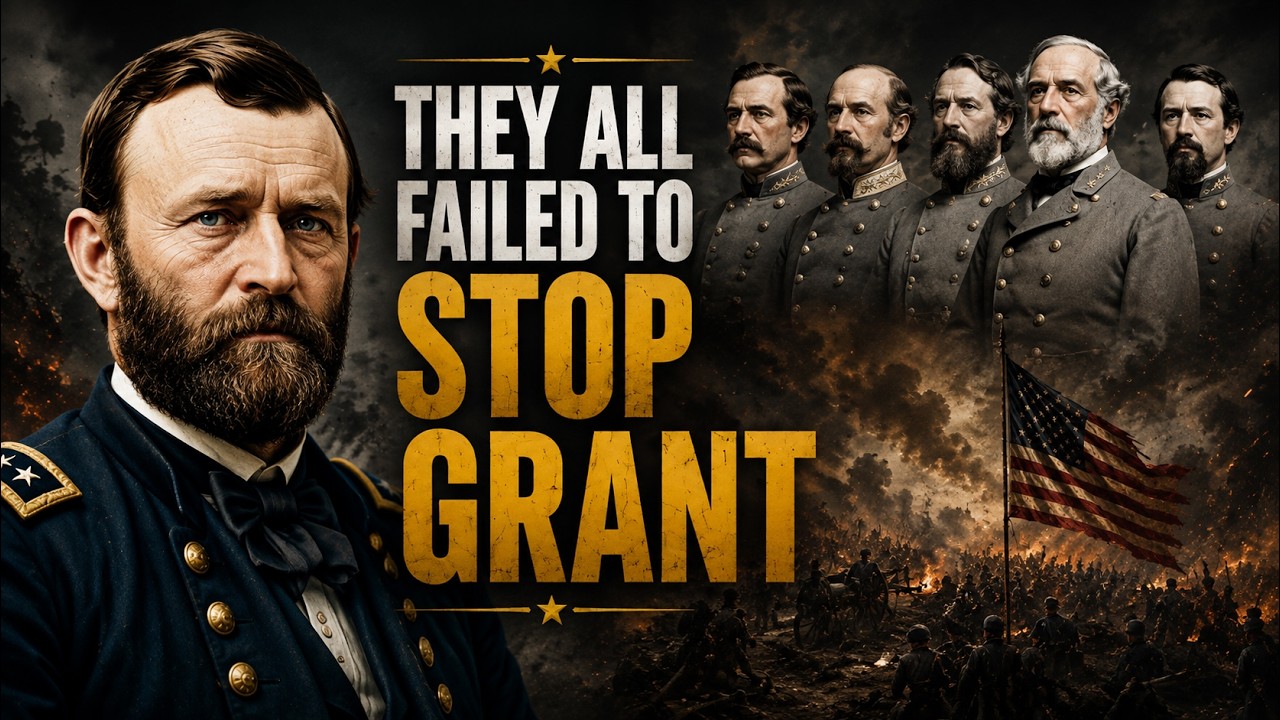
Lee had five of his best generals positioned to crush them. Richard Ewell commanded the Second Corps on the Orange Turnpike to the north. Ambrose P. Hill held the Orange Plank Road to the south with the Third Corps. James Longstreet, Lee’s most reliable general, was rushing from Gordonsville with the First Corps. John B. Gordon was maneuvering for a devastating flank attack. Above them all, Lee was orchestrating what should have been the perfect tactical encirclement.
By dawn on May 6, Hancock’s Union Second Corps was being pushed back in confusion. Union generals were shouting contradictory orders. Soldiers were falling back. The Confederate attack was working exactly as planned. But then something went wrong. Not just wrong, but catastrophically wrong. The kind of wrong that would echo through the rest of the war and change its outcome.
On May 2, 1864, Lee stood atop Clark Mountain with his senior commanders. Grant had crossed the Rapidan River. The Union Army was moving. Grant had 120,000 men. Lee had 61,000. It wasn’t a fair fight, and it never would be again. But Lee wasn’t worried. He had beaten larger Union armies before. He had outmaneuvered Hooker on this very ground the previous year at Chancellorsville.
Lee’s strategy was elegant in its simplicity. He would let Grant cross the Rapidan uncontested. Then, as the Union Army advanced through the Wilderness, Lee would attack on two parallel roads. Ewell’s Second Corps and Hill’s Third Corps would strike first. They were outnumbered three to one against Hancock’s corps alone. But Lee was counting on Longstreet’s First Corps racing to the battlefield from Gordonsville.
Longstreet had approximately 27 miles to travel. If he arrived within the critical first day or two, before Grant fully concentrated his forces, Lee would have the strength to deliver a knockout blow. It was a dangerous plan. But it was the only kind of strategy Lee could afford anymore.
On May 4, Union cavalry splashed across the Rapidan at Germanna Ford. Engineers laid pontoon bridges. The Army of the Potomac began its crossing. Grant had ordered his army to move fast, but Lee was already reacting. On the morning of May 5, Ewell’s Corps marched east on the Orange Turnpike. Hill’s Corps moved on the parallel Orange Plank Road.
The two corps were separated by miles of impenetrable forest. If the Union Army exploited that gap, Grant could smash one corps while the other watched helplessly. But Lee was betting that the Wilderness itself would prevent Grant from doing that. The forest was too thick. Communications would be impossible.
At midday on May 5, Union V Corps under Gouverneur K. Warren emerged from the forest onto Saunders Field and ran directly into Ewell’s Corps. Warren was shocked. He hadn’t expected to encounter organized Confederate forces this deep in the Wilderness. Ewell’s men were dug in. Warren’s attack was repulsed. Bodies fell across the open ground. The Union advance stopped cold.
Meanwhile, three miles to the south on the Orange Plank Road, another fight was developing. A.P. Hill’s Third Corps was moving to seize the Brock Road, a crucial north-south avenue through the Wilderness. If Hill could control it before Hancock’s corps reached it, he could separate the Union Army into fragments. But Hancock was moving faster than Hill anticipated.
Getty’s division from Sedgwick’s VI Corps reached the Brock Road just as Hill’s men approached. They collided in confused fighting. Hill’s men were tired. They had been marching all night. But they pressed forward. By nightfall, the Union line on the Plank Road was stabilizing.
Lee knew what was happening. He had stopped Warren. Hill was fighting hard but was getting pushed back. And Longstreet still wasn’t there. As darkness fell, Lee passed along orders for the night. Don’t entrench. Don’t strengthen your positions. Hill said his men needed rest. Longstreet would be here by dawn. They could attack again with fresh forces tomorrow. This decision would prove disastrous.
At dawn on May 6, Hancock attacked. He came forward with 20,000 men of his Second Corps, the best fighting unit in the Union Army. They advanced along the Orange Plank Road toward Hill’s exhausted, unentrenched troops. Hill’s men tried to hold. They fought hard, throwing back the first attacks. But Hancock was relentless.
Within an hour, Hill’s Third Corps was in complete rout. Men were running. Officers couldn’t stop them. Entire regiments collapsed. Hill himself was on horseback trying desperately to rally his men. For a moment, Grant had the breakthrough he’d been dreaming of. The Confederate center had collapsed. If Hancock could just push forward hard enough, he could split Lee’s army in two.
But then something happened that would define the entire day. Through the smoke and confusion, a column of fresh troops appeared. Longstreet’s First Corps had arrived. The Texas Brigade, 800 tough soldiers under General John Gregg, came charging into the gap in Hill’s line. They weren’t enough to stop Hancock. But they were enough to buy time.
Lee, recognizing the critical moment, tried to join the countercharge himself. He rode forward on his horse, Traveler, intent on leading the Texas Brigade into battle. But his own soldiers wouldn’t have it. They shouted, “Go back, General Lee.” Other soldiers grabbed the reins of his horse. They physically prevented Lee from charging into the fight.
Lee relented. He pulled Traveler back. And the Texas Brigade, now joined by other units of Longstreet’s corps, crashed into Hancock’s advance. Longstreet took command with characteristic decisiveness. He recognized there was an unfinished railroad grade running through the forest. It was cleared land, a hidden road that wasn’t on most maps. Longstreet sent four brigades through this hidden corridor.
At 11:00 a.m., as Hancock continued his assault forward, Longstreet’s flank attack emerged from the forest. The impact was devastating. Hancock’s advancing columns were suddenly caught in a crossfire. Union soldiers described it as a wet blanket being rolled up by Confederate fire. In minutes, Hancock’s breakthrough evaporated.
For a moment, it appeared Lee had actually achieved his dream. The Union Army was being broken apart. Longstreet had delivered the knockout blow. But then the unthinkable happened. As Longstreet rode forward with his staff, shots rang out from the south side of the Orange Plank Road. Confederate troops, confused in the dense forest, mistook Longstreet’s column for Union cavalry and opened fire.
Longstreet was hit. A minie bullet passed through his neck and right shoulder. He reeled in his saddle, blood pouring from the wound. His injury was severe. He would survive, but he wouldn’t return to command until October 1864. The damage was catastrophic, not just to Longstreet personally, but to the entire Confederate campaign.
Longstreet was removed from the battlefield and rushed to the rear. His corps, suddenly leaderless, lost momentum. The pursuit bogged down. The breakthrough was no longer a breakthrough. Richard H. Anderson, a competent but uninspired officer, took command of the First Corps. He was a fine battlefield commander, but he was not Longstreet.
Lee shifted his focus. If he couldn’t break through the center, perhaps he could break through the flank. On the Union right, John B. Gordon had spent the day watching the Union right flank and reporting that it was vulnerable. The Union VI Corps under John Sedgwick was positioned on a rise called High Ground, but to its rear and right, there seemed to be an opening.

Gordon had been pressing Ewell all day to let him attack. Ewell had been hesitant. At 4:00 p.m., as dusk was falling, Lee finally authorized Ewell to attack the Union right. Gordon’s division charged forward. The attack caught the Union VI Corps by surprise. Gordon’s men broke through Union lines. The 6th Alabama, already decimated in earlier fighting, lost 80% of its remaining strength as it seized Union guns and captured nearly 2,500 prisoners.
Two Union generals, James S. Wadsworth and Alexander Hays, were killed or mortally wounded in the assault. It was, for a moment, another Confederate breakthrough. But Gordon, like Longstreet before him, couldn’t deliver the final blow. The Union VI Corps rallied. Sedgwick brought forward reserves. Union batteries opened fire and broke up Gordon’s advance. The attack sputtered out.
By nightfall on May 6, 1864, after two days of intense fighting, the Battle of the Wilderness had reached a stalemate. But the real disaster wasn’t just tactical miscalculation. It was the horror of the terrain itself. Fires from the May 5 fighting still smoldered. Dry brush ignited from cannon fire and musket flashes. Wounded soldiers, unable to move, burned to death where they fell. Nearly 200 men from both armies perished in the flames.
So what went wrong? Lee had five generals of significant rank working in concert. He had Grant’s army trapped in the worst possible terrain. He had nearly broken the Union center. He had struck the Union right flank and nearly broken through. He had done everything right up until the moment it all collapsed.
Official records show the Union Army suffered approximately 17,666 casualties. The Confederate Army suffered approximately 11,033 casualties. In total, the two days of fighting claimed nearly 30,000 casualties across both armies. But casualty numbers don’t tell the full story. To understand why Lee’s plan failed, you have to understand the men executing it.
Richard Ewell was recovering from the psychological and physical effects of losing his leg at Second Manassas two years earlier. Unlike Stonewall Jackson, who had commanded with aggressive decisiveness before his death, Ewell showed greater caution and hesitation. When Gordon reported that the Union right flank was vulnerable, Ewell didn’t attack immediately. He waited for explicit authorization from Lee. By the time Lee authorized it, hours had passed. The element of surprise was diminished.
Ambrose P. Hill was a good division commander, but corps command had overwhelmed him. He suffered from chronic health issues. And Hill made a critical decision that nearly cost Lee everything. He told his men not to entrench on the night of May 5. Longstreet would be here by dawn, he reasoned. Let the men rest instead of digging fortifications. That decision was a catastrophe. When Hancock attacked at dawn on May 6, Hill’s men had nowhere to fall back to.
James Longstreet arrived exactly when he needed to. His attack with the hidden railroad corridor was brilliant. He nearly broke the Union Army. But then came the friendly fire. In an instant, Lee had lost his best commander. With Longstreet down, Confederate momentum immediately slowed. “I have lost my old warhorse,” Lee reportedly said.
John B. Gordon was one of the finest combat division commanders in Lee’s army. His attack on the Union right at dusk on May 6 was perfectly executed and nearly succeeded. But Gordon had no support. The other divisions in Ewell’s corps didn’t coordinate with his attack. If three or four Confederate brigades had attacked simultaneously with Gordon, the Union right flank might have collapsed entirely.
And finally, there’s Lee himself. Lee’s plan was nearly perfect. His ability to read the terrain and understand Grant’s movements were the attributes of a military genius. But Lee had a fundamental problem. He couldn’t execute his own plans because he lacked the subordinates to carry them out. Stonewall Jackson was dead. Longstreet was wounded. Ewell was hesitant. Hill was sick. Gordon was brave but lacked support.
The Confederate Army in May 1864 was not the same army it had been in 1862 and 1863. The best officers had been killed or wounded. The ones who survived were aging, sick, and traumatized by three years of brutal warfare. Lee was trying to fight the war as if he still had the perfect subordinates. But he didn’t. He was trying to execute intricate maneuvers with tools that were broken.

On the morning of May 7, Grant did something that shocked the Confederate Army. Instead of retreating, he sidestepped Lee’s army and continued south toward Richmond, as if the brutal two-day battle had been nothing more than a minor inconvenience. Grant sat calmly on his horse chewing a cigar as his bloodied army streamed past him, marching south. Soldiers shouted. They waved their hats. They cheered.
Lee had won the Wilderness tactically. His men held the field at the end of the battle. But he had not broken Grant’s army. And more importantly, Grant had shown something that shocked the Confederate leadership. He would not retreat. Every Union general before Grant, after suffering a tactical defeat, had retreated across the Rappahannock River to regroup. McClellan had done it. Burnside had done it. Even Hooker had done it. But Grant didn’t retreat. He continued forward.
Grant reportedly told a reporter, “If you see the president, tell him from me that whatever happens, there will be no turning back.” That phrase would define the rest of the war. Over the following weeks, as the campaign continued through Spotsylvania, the North Anna River, and into the grinding siege at Petersburg, the casualty toll mounted. By the end of the Overland Campaign in June 1864, the Union had suffered approximately 55,000 casualties. The Confederacy had suffered approximately 33,000.
Grant had bled Lee white, trading Union lives for Confederate ones, knowing the North had more men to spare. It was brutal. It was costly. But it was working.
The Wilderness was the moment where five Confederate generals came closest to stopping Grant’s offensive. If Longstreet hadn’t been wounded, if Hill’s center had held longer, if Ewell had attacked earlier, if Gordon’s attack on the right had been supported by other divisions, any of these things might have been different. But they weren’t. And Grant continued forward.
From the Wilderness, Grant moved to Spotsylvania, more casualties, then to the North Anna River, more casualties, then to Cold Harbor, the worst battle of the campaign. But in all of these battles, Grant never retreated. He kept pressing forward. He kept pushing Lee south, toward Richmond, toward Petersburg, toward the inevitable siege that would end in Confederate surrender.
The Wilderness was the crossroads. It was the moment when five Confederate generals came closer to winning than they would ever come again. If they had broken Grant’s army, the whole course of the war might have changed. Lincoln’s re-election campaign in November 1864 might have failed. Peace might have been negotiated from a position of Confederate strength rather than weakness.
But they didn’t break Grant. And the fundamental reason is that they were fighting with broken tools. Ewell lacked Jackson’s aggressiveness. Hill was overwhelmed by command responsibility. Longstreet was brilliant for a few hours before a stray bullet from his own men cut him down. And Gordon, for all his courage and skill, was just one division without the support of the larger corps structure.
Lee understood this even in the moment. He expressed his longing for Stonewall Jackson. He worried about the health of Ewell and Hill. He recognized that the officers leading his army in 1864 were not the same men who had made the Confederate Army legendary in 1862.
The Wilderness was where that worn-out Confederate Army came closest to stopping an unstoppable force. And when they failed, not dramatically, but just barely failed, the momentum of the war shifted forever. Grant learned something from the Wilderness. He learned that Lee’s army, despite all its skill and aggression, could be pushed. It could be hurt. And if you pushed hard enough, long enough, without flinching or retreating, eventually it would break.
Five generals came to that crossroads in May 1864. They failed by the narrowest of margins. And that failure, that barely-there, almost-invisible failure, cost the Confederacy everything.