In late September of 52 BC, a young farmer of the Senones tribe stood on a slope in central Gaul, staring at something that should not have existed. Before him rose a wall of timber and earth, higher than three men, stretching into the mist in both directions. Behind that wall, he could see another. And beyond it, on the summit of the hill, lay the town they had come to save.
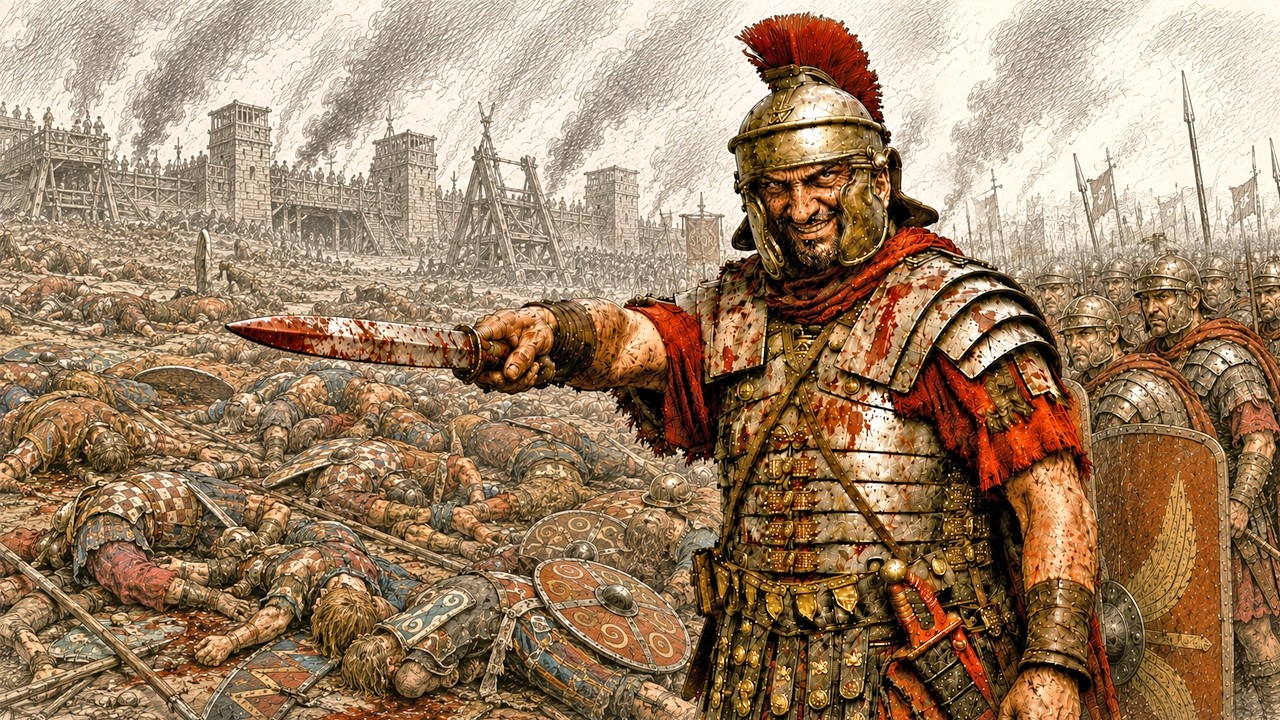
Between him and that town stretched twenty miles of Roman engineering built to destroy him. Around him, a quarter of a million warriors of the Gallic relief army were forming up for the largest coordinated attack in the history of the Celtic world. Inside Alesia, on the hilltop, eighty thousand warriors and their leader, Vercingetorix, prepared to strike the Romans from within. Between the two Gallic armies stood fifty thousand Romans commanded by a middle-aged politician from an aristocratic Roman family who had decided he would not lose this day.
The siege of Alesia was the climax of the Gallic Wars, a conflict that had consumed six years and would decide whether Rome or the tribes of Gaul controlled the land between the Rhine, the Alps, and the Pyrenees. It was also a personal gamble. Julius Caesar, fifty years old, deeply in debt and politically vulnerable in Rome, had staked his entire future on this campaign. He presented himself as a bringer of civilization imposing order on barbarians.
In truth, he was running one of the largest mass enslavement operations in Roman history. Now, with the war hanging in the balance, he had trapped the entire Gallic rebellion inside a single hilltop town. Vercingetorix was young, in his late twenties, and had achieved something no Gallic leader had done before. He had united tribes who had hated each other for generations under a single command.
His strategy had been to deny the Romans supplies by burning every town he could not defend. For a time, it had worked. By late summer, however, the campaign had exhausted him, and he withdrew to what he believed was the safest ground in all of Gaul: a steep, defensible hilltop town called Alesia. It was the worst decision of his life.
Alesia was high, defendable, and immovable, and a man who had spent months avoiding pitched battle had now pinned his entire army to one position. The numbers involved were staggering. Vercingetorix brought with him, according to Caesar’s own account, eighty thousand infantry and twelve thousand cavalry, figures modern historians suspect were exaggerated for political purposes, but even the lowest academic estimates place the defending force at sixty to eighty thousand warriors, plus the town’s civilian population. Against them, Caesar commanded ten legions, roughly forty to fifty thousand professional soldiers hardened by six years of campaigning, supported by auxiliary infantry and, crucially, German cavalry turned into some of the most effective mounted troops in the ancient world.
The full Roman force numbered around fifty to sixty thousand men. Caesar chose not to attack the hilltop fortress. That would have cost enormous losses. Instead, he decided to build.
His men had already built a bridge across the Rhine in ten days, a structure so imposing that the Germanic tribes on the far bank fled at the sight of it. Now he ordered something even bolder. He would build two walls. A sixteen-kilometer inner line facing Alesia would contain Vercingetorix.
A twenty-one-kilometer outer line, facing outward, would hold off the Gallic relief army when it arrived. Two rings of fortifications, with the Roman army in the space between them. The specifications were terrifying: two parallel ditches, each fifteen feet wide and deep, the nearest one flooded by diverted rivers; an earthen rampart topped with a wooden palisade and parapets; watchtowers every eighty feet; twenty-three fortified camps; and, in front of the walls, three rows of hidden traps. First came pits three feet deep with sharpened stakes fixed in their bottoms and covered with branches.
Then rows of pointed stakes driven into the ground. Then iron spurs designed to pierce the foot of any man running toward the wall. Forty thousand Roman soldiers worked in shifts, digging night and day for weeks, stripping the surrounding forests and redirecting the rivers. Two thousand years later, archaeologists would find the remains of those ditches, the trap fields, and the iron spurs still there.
While the Romans dug, Vercingetorix made his decision. He was running out of food. Alesia had been provisioned for defense, not for a siege, not for eighty thousand warriors, twelve thousand horses, and a civilian population all consuming grain at once. He ordered twelve thousand Gallic cavalry to ride out at night, break through the incomplete Roman lines, and ride across Gaul summoning every tribe to raise an army.
They succeeded. Caesar, in an uncharacteristically brief passage, noted their escape. Over the following weeks, the riders reached the Aedui, once Rome’s closest allies, the Sequani, the Senones, the Parisii, and dozens of smaller tribes. Everywhere, the message was the same: Alesia was dying.
Bring every man you can gather. Left inside Alesia, Vercingetorix faced a terrible choice. He had no cavalry left, no mobile force for raiding, and a dwindling food supply now feeding noncombatants who could not fight. He imposed strict rationing, then stricter.
The civilians suffered first. Then he made the decision that history has all but forgotten. The noncombatants of Alesia, women, children, and old men, were pushed out of the gates toward the Roman lines. Caesar ordered that they be refused entry, refused food, refused enslavement, refused killing.
They were simply left between the two armies. They could not go forward; the Romans had closed the lines. They could not go back; the gates had been shut. There are no numbers for these people, no names, no single line in Caesar’s account acknowledging what happened to them.
No historical record ever recorded a single survivor. Meanwhile, the relief army gathered. Caesar recorded its strength as roughly two hundred fifty thousand infantry and eight thousand cavalry. Modern historians believe the figure was inflated for propaganda, but even reduced by half, it was the largest army ever assembled in the Celtic world.
By late September, the Gallic relief force arrived on the plain beyond the outer wall. The commanders, too numerous for a single leader to be chosen, did not attack immediately. They studied the Roman fortifications, walked the fortifications, looking for weaknesses. Vercingetorix, watching from the walls of Alesia, prepared his own attack.
The plan was simple. The relief army would strike the outer wall while the defenders inside struck the inner wall, crushing the Romans from both sides. At dawn, the coordinated attack began. Relief warriors advanced in formation, tribes fighting side by side who had hated each other for centuries.
Inside Alesia, Vercingetorix’s warriors rushed toward the inner Roman wall. They hit the trap fields. Hundreds fell into pits lined with sharpened stakes, collided with rows of hidden stakes, and tore their feet on iron spurs. From the tower platforms, Roman heavy bolts, stones from catapults, and lead pellets fired from slings rained down on the mass of men, who could neither advance nor flee.
The first day ended not in Gallic defeat but in withdrawal. With nightfall, the relief army pulled back to regroup and prepare another attempt. That night, the Gallic commanders made a decision. They had learned from the first attack.
There had to be a weakness somewhere along the twenty-one-kilometer wall, a section where difficult terrain had forced incomplete construction and a thinner garrison. Their scouts found it: a sector on steep, uneven ground where the outer wall met terrain the Romans had not been able to fully develop. At dawn, the second attack began, more organized, more concentrated than the first. The Gauls threw their strongest forces against the weak sector.
Inside Alesia, Vercingetorix launched a coordinated assault on the corresponding section of the inner wall. Roman units moved quickly between the walls, pulling cohorts from quieter sectors to the point of pressure. Mark Antony, the thirty-year-old officer who would later make his name in Roman politics, moved troops into the threatened sector. The reserves ran out.
The Gallic flow continued. Then, in the middle of the afternoon of that second day, the outer wall collapsed. The breach was catastrophic. Gallic warriors poured through a gap in the outer rampart.
Roman defenders were killed in hand-to-hand fighting inside the corridor. Reports raced along the lines to Caesar’s command post: one of the fortifications had been broken on the right flank; the enemy was inside the fortifications. If the gap widened, the entire Roman position would collapse. The relief force would flood into the space between the walls and hit the inner wall from behind while Vercingetorix’s men hit it from the front, trapping the Romans between two armies outnumbering them five to one.
Caesar did what historians still argue about. He did not send an officer. He went himself. He walked along the lines, pulling cohorts from every position that could spare them, gathering, by modern estimates, about sixty-five hundred men into an improvised reserve.
Then, according to later Roman accounts, he did something a commander of his rank was not supposed to do. He took up a shield, placed himself at the head of that reserve, and led them into the breach. His red cloak, the uniform of a Roman commander, worn deliberately so his soldiers could always see him, was visible in the thick of the fighting. The line held, then advanced.
While his improvised infantry sealed the breach, Caesar ordered his German cavalry, his best-equipped troops, to ride around his own fortifications. They appeared behind the Gallic relief army, still pressing against the wall, and hit it from the rear. The relief army, more than one hundred fifty thousand strong, was caught against the outer wall and attacked from behind. There was no line to retreat to, no formation to withdraw into.
The relief army collapsed. Warriors from a dozen tribes fled. Some threw down their weapons. Others tried to organize a fighting withdrawal and were cut down by pursuing Roman and German cavalry.
The cavalry chased them across the plain for miles, capturing and overwhelming them. The Roman camp was sacked. The wagons of grain, the food intended to save Alesia, fell into Roman hands. From the walls of Alesia, Vercingetorix watched.
He could see the flames of the camps that had held the relief army, now being looted. He could see his allies, his last hope, dying or fleeing in every direction. His soldiers, climbing ladders against the inner wall, stopped and looked as the relief force dissolved on the horizon. The men beyond would not come.
They would never come. The relief force gathered from every tribe in Gaul collapsed within hours. Vercingetorix withdrew his men into the town. The gates were closed.
The alliance was finished. The siege of Alesia ended six days later. The town held out, not because it could fight, but because there was nothing left to do. The relief army was gone.
The food was gone. Vercingetorix called his final council. The chiefs debated three options: fight to the last man in a desperate battle, take their own lives to avoid capture, or surrender. Surrender was Vercingetorix’s decision.
It took place on October 3, 52 BC. In the account passed down through Roman tradition, Vercingetorix came out of the gates of Alesia in full armor, rode directly to Caesar’s command post, dismounted, and laid his weapons and his shield at Caesar’s feet. He did not speak a single recorded word. Caesar did not embrace him and did not offer clemency.
He ordered him bound. The aftermath was brutal. According to Caesar’s own account, each Roman soldier was given one captive of the Gallic warriors as a personal slave. Some forty to fifty thousand men were sold or distributed as slaves to Caesar’s troops alone.
Thousands more were killed in the attacks following the collapse of the relief army. The relief force ceased to exist. The survivors returned to villages that had lost fathers, sons, brothers. Entire generations of men were gone in some tribes.
Vercingetorix was taken to Rome and imprisoned in the Tullianum, an underground stone cell reserved for high-status prisoners. He remained there for six years. In 46 BC, Julius Caesar, now dictator of Rome, celebrated his victory over Gaul and paraded Vercingetorix through the streets of Rome in chains. That same day, in the darkness of the Tullianum, he was executed by strangulation.
He was still in his early thirties. Caesar returned to Rome as the most famous general in the history of the Republic. The Senate voted twenty days of public thanksgiving, the longest in Roman history, to celebrate his victory. Three years after Alesia, Caesar crossed the Rubicon and plunged Rome into civil war.
Six years later, in 44 BC, he was assassinated in the Senate by men who feared the power Alesia had given him. Mark Antony, the officer who helped hold the line at Alesia, spent the next decade rising in Roman politics before losing to Octavian, who became Augustus, and dying in Egypt in 30 BC with Cleopatra. But the reputation he built at places like Alesia was the foundation of everything he became. The fall of Alesia effectively ended organized resistance to Rome in Gaul.
The following years saw scattered disturbances, but nothing matched the scale of the alliance that had gathered there. Within a generation, Gaul was a Roman province. Within a century, it was entirely Latinized. The tribes that marched to Alesia, the Aedui, the Arverni, the Senones, the Parisii, became administrative districts of Rome.
Paris, the capital of modern France, takes its name from the Parisii. The story of Alesia was told and retold by Roman readers as proof of Caesar’s genius. In the nineteenth century, Napoleon III, seeking to build a national legend, ordered excavations at Mount Auxois and erected a statue of Vercingetorix on the site. The Arvernian nobleman was reborn as the first national hero of France.
Archaeological work confirmed the physical reality of Caesar’s fortifications: the double wall, the trap fields, the ditches, all there exactly as he described. Caesar inflated the numbers, but he did not lie about the engineering. The people who died in the narrow strip of ground between the walls, the women, children, and old men of Alesia, appear in no Roman monument, no French statue, no popular retelling of the battle. But they were there.
They died between two civilizations fighting over the inheritance of a land, and neither civilization remembered them. Alesia was not just a battle. It was a warning about how history gets written.