In the early hours of Halloween 1955, two shotgun blasts shattered the quiet of one of Long Island’s richest estates. Standing in the smoke was Anne Woodward, a former showgirl turned society wife, and at her feet lay the shattered body of her husband, William Woodward Jr. , heir to one of America’s great banking fortunes. Her defense was a hysterical scream: she had mistaken him for a prowler.
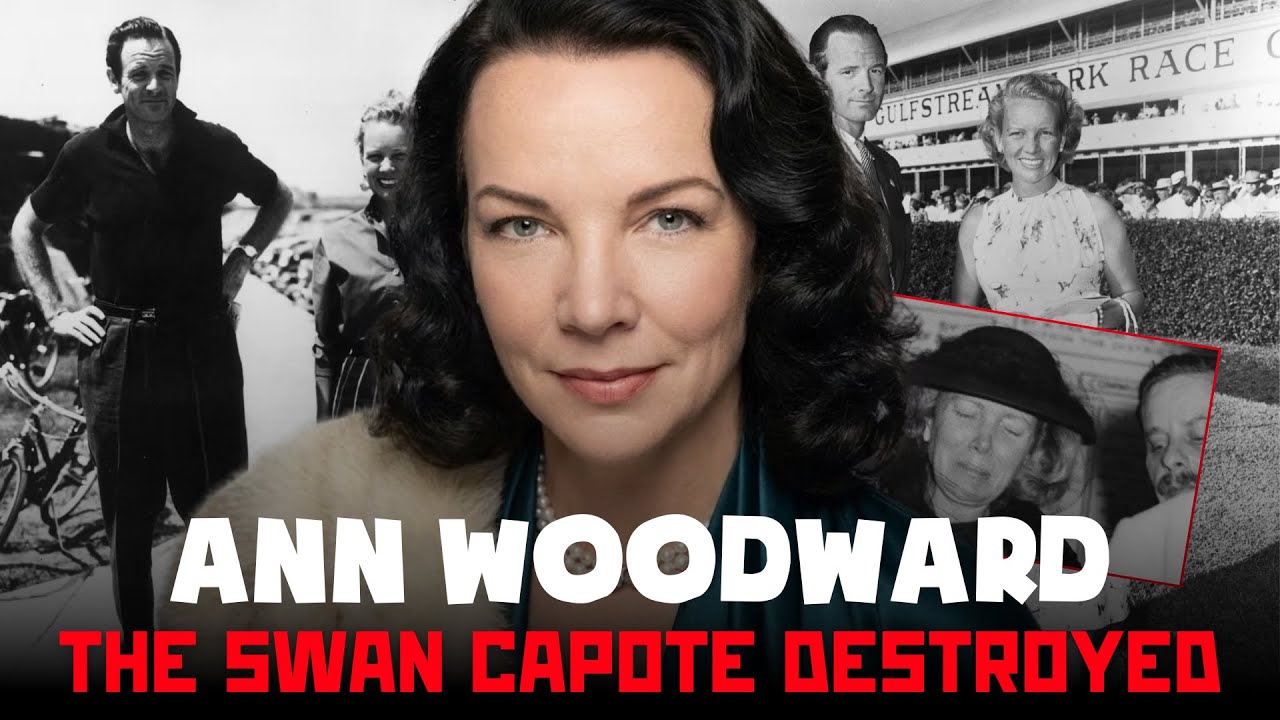
It was a story that money and power protected, allowing her to walk free from what the tabloids called the crime of the century. But Anne Woodward had not escaped the executioner. He simply had not arrived yet. Twenty years later, he would come not with handcuffs but with a typewriter.
The path to that hallway began decades earlier in the dusty towns of the Midwest. Anne was born Angeline Crowell into a fractured household. Her father’s influence evaporated early, and her mother, Ethel, a small-town beauty convinced life had cheated her, raised her daughter with a single lesson: beauty was currency, and a woman without money was nothing. Ethel remarried and divorced, dragging the girl through a nomadic childhood of rented rooms and boarding houses, always one step ahead of the landlord.
For the young Angeline, home was a fragile idea, and men were temporary sources of income to be charmed until the money ran out. By her teens, she had become a striking, restless beauty with a hunger that set her apart from the local girls destined for farms and early aging. In 1937, with the Depression still gripping the country, she packed a suitcase and boarded a train for New York City. Somewhere between the cornfields and the skyline, Angeline Crowell ceased to exist.
In her place was Anne Eden, a name built for a marquee or an engraved invitation. She found work as a model and then in radio, where her voice could purr and seduce. In 1940, she was voted the most beautiful girl in radio. The war that would define her life began when she met William Woodward Jr.
Billy, as he was known, was the only son of William Woodward Sr. , chairman of the Hanover Bank and owner of the famous Belair Stud Farm, whose horses had won the Kentucky Derby. The Woodwards were old New York, a family whose name carried the weight of scripture. Billy was tall, handsome, and profoundly lost, a man with no career and no ambition, entirely dependent on his mother, Elsie.
Elsie, one of the famed Cryder triplets, ruled her family with an iron whim. When she learned her son was consorting with a radio actress from Kansas with a suspicious amount of nightclub experience, she declared war. She launched a private investigation into Anne’s past and presented the findings to Billy like a prosecutor: the poverty, the divorce, the nomadic childhood. She called Anne a gold digger and a nobody.
But Elsie underestimated her son’s resentment. Billy had spent his life being told who to be and who to marry, and Anne’s very wrongness for the role of a Woodward wife was precisely what attracted him. Marrying her was his ultimate act of rebellion against the mother who had suffocated him. Sensing his hesitation, Anne withdrew, letting him feel the cold wind of a life without her.
Billy buckled. In 1943, amid the chaos of wartime, he proposed. The wedding was a small affair in Tacoma, Washington. Elsie did not attend, sending a cold telegram instead.
The message was clear: you may have his name, but you will never have us. Anne imagined the hard part was over, that the ring on her finger was a talisman against insecurity forever. She was wrong. She had not won a prize; she had entered a battlefield.
Billy used her to hurt his mother, and the family viewed her as a contaminant. Elsie’s weapon of choice was the checkbook. Billy had no fortune of his own; every dollar flowed from Elsie’s accounts. She installed the couple in a dreary apartment at the Waldorf Towers, just floors from her own residence, turning their marriage into a supervised visitation.
Anne found herself living under a microscope, her every laugh and outfit judged against standards of breeding she could never meet. To the old guard, she was a caricature, too loud, too hungry. She fought back with a campaign of self-reinvention, hiring speech coaches, starving herself to achieve the fashionable silhouette, and dressing in Chanel, Dior, and Balenciaga. She learned to navigate the social calendar and, by the late 1940s, was undeniably one of the most striking women in New York, chronicled breathlessly by gossip columnists.
But she remained trapped in the glittering world of cafe society, courted but never admitted to the inner sanctum of the true aristocracy. And Billy was rotting. The rebellion that had fueled the marriage burned out, leaving behind a cycle of drunken fights and sullen silences. He mocked her in public, reminding her that without him she was nothing.
He cheated on her openly, often with the very type of woman she used to be. The birth of two sons, Woody in 1944 and Jimmy in 1947, did not heal the marriage. Anne treated the boys as anchors and insurance, while Elsie doted on them as heirs to be rescued from their mother’s influence. Anne’s growing paranoia and heavy drinking turned their home into a war zone.
By the mid-1950s, divorce was no longer a rumor but a threat. Billy had consulted lawyers and told his mistress he would be free by Christmas. For Anne, divorce was not a legal term; it was a death sentence. A divorced woman of her background would be destroyed, stripped of her lifestyle and cast out of the social register.
The terror of returning to nothing drove her to prepare for a threat she could control. She began complaining constantly of prowlers, insisting the windows be locked and re-locked, demanding that loaded shotguns be kept close at hand. One was placed in Billy’s bedroom, another in hers. The stage was set on October 30, 1955.
That Sunday night, the Woodwards attended a dinner at the home of Florence Tucker Baker, held in honor of the Duke and Duchess of Windsor. For Anne, dining with the former king of England was the ultimate social coup, proof she belonged. But the evening was a study in tension. Witnesses recalled she laughed too loudly and drank too much, flirting desperately with the Duke.
Billy was sullen and withdrawn, and at one point a guest overheard him make a cutting remark about her so cruel it left her pale. The ride home was silent. They arrived past midnight, went to their separate bedrooms, and did not speak. Around 2 a.
m. , the dog began to bark. Anne later claimed she was jolted awake, seized by the fear she had rehearsed. She grabbed the shotgun beside her bed and stepped into the darkened hallway.
She claimed she saw a figure near Billy’s door. She raised the gun and fired. The buckshot hit the figure squarely in the face. It was not a prowler.
It was Billy, naked, unarmed, and sleepy, perhaps stepping out to quiet the dog. He crumpled to the floor and died. Anne fired a second shot that went wild into the wall. The range had been less than ten feet, close enough that a wife would know her husband’s silhouette.
The immediate aftermath was chaos. Servants found Anne screaming, sobbing, throwing herself onto the body: I shot him. I shot him. I thought he was a prowler.
The police, deferential to the Woodward name, did not handcuff her. They called a doctor to sedate her and treated her as a patient rather than a suspect. But the discrepancies were obvious: no forced entry, a naked victim, a history of domestic strife. In a tenement in the Bronx, Anne would have been booked for murder before sunrise.
In Oyster Bay, the machinery of wealth was already grinding. The most important call that night was placed by family retainers to Elsie Woodward. Elsie, asleep at the Waldorf, entered crisis management mode. She calculated that a dead son was a tragedy, but a murderer for a daughter-in-law was a disgrace.
To save the family name, she had to save the killer. By morning, the best lawyers and public relations men in New York were shaping the accident narrative, and the police were gently reminded of who the Woodwards were. A twist gave the lie its needed grain of truth. A petty criminal named Paul Wirths, known for break-ins, was arrested in the area and admitted to prowling the neighborhood that night.
He had not entered the Woodward house, but his presence was enough. The prowler was real; Anne’s terror was justified. The grand jury, guided by the invisible hand of influence, returned a no bill. There would be no trial.
Anne Woodward walked out of the courthouse a free woman, hidden behind dark glasses and a veil of black crepe. But freedom was relative. Elsie had done her duty to the family crest and now discarded the rag. She cut Anne off completely.
Anne was left with her settlement, her Fifth Avenue apartment, and a name that became a scarlet letter. Society convicted her where the law had acquitted her. The cruel nickname Bang Bang was born, reducing the most traumatic moment of her life to a punchline. She became a specter, radioactive, crossed off guest lists and shunned by former friends.
She fled to Europe, drifting through grand hotels with younger, titled but penniless lovers, waking in silk sheets entirely alone. Her sons were sent to elite boarding schools, exiled from the house of horrors, growing up in the shadow of the accident. Anne, medicating her pain with alcohol, was unable to be the mother they needed. In this vacuum of loneliness, she made her second fatal mistake.
She bought a friendship. Truman Capote, the celebrated author of Breakfast at Tiffany’s and In Cold Blood, approached her with warmth and hypnotic charm. A gay man from the South who had clawed his way into the citadel of power, he understood what it meant to be an impostor in the palace. He saw Anne not as a monster but as a mirror.
He befriended her loudly, defended her to the swans, and took her to lunches that made her feel worthy. Late at night, fueled by drink, Anne talked. She told him about the poverty, the humiliations, and the night of the shooting. She gave him the keys to her soul, believing he would keep them in a velvet box.
Capote harvested secrets. He did not drink blood; he drank tragedy. By the early 1970s, Capote had not published a major work in years and felt the literary world whispering that he was finished. He needed a masterpiece.
He called it Answered Prayers, a novel that would strip the masks off the very society that had embraced him. For its centerpiece, he turned to Anne Woodward, barely changing her name. In the chapter titled La Côte Basque, 1965, he told a chilling story: the wife, facing divorce and poverty, deliberately fires a shot into the wall to establish an alibi, then executes her husband when he rushes in. Capote was asserting in print that Anne was a cold-blooded murderer, using the intimate details she had confided to give the story the ring of absolute truth.
In October 1975, Esquire magazine published the excerpt. Anne obtained an advanced copy and read her friend’s words, the description of herself as a vulgar murderer, the betrayal in black and white. The story would be read by everyone, including her sons. The walls she had built for twenty years crumbled.
She had survived the police, the grand jury, and the whispers, but she could not survive the mockery of her only friend. Sometime in the quiet hours, she swallowed a cyanide pill she had reportedly kept for twenty years as a just-in-case measure. Her housekeeper found her gone. The shooting of the century had claimed its second victim.
Initially, the family claimed Anne had died of a heart attack, but the autopsy revealed cyanide. The connection to Capote’s story was undeniable. The news hit Capote like a physical blow. He went into frantic denial, claiming she was unstable, that the character was a composite.
But the swans understood the lesson. They realized everything they had ever told him sat in his notebooks, waiting to be sold. They closed ranks and excommunicated him. Babe Paley, dying of lung cancer and the great love of his life, refused to speak to him again.
Capote never recovered. He spiraled into drugs and alcohol, never finished Answered Prayers, and died in 1984. The tragedy did not end there. Jimmy Woodward, the younger son, returned from Vietnam damaged, drifted into heroin addiction, and in 1976, a year after his mother’s suicide, jumped from a hotel window.
He was 29. Woody Woodward, the older son, tried to outrun the shadow. He married and had a daughter, but struggled with severe depression. In 1999, he also jumped to his death from a Manhattan window.
He was 54. The Woodward line, the dynasty Elsie had sacrificed her soul to protect, was extinguished. Elsie herself died in 1981 at age 98, outliving her son, her daughter-in-law, and one of her grandsons. Anne Woodward wanted to be safe.
She climbed from the dusty streets of Kansas to the bedroom of a king and the pages of Esquire. She got what she wanted: fame, wealth, and a kind of immortality. But the higher she climbed, the thinner the air became, and the longer the fall. In the end, there were no victors, only survivors, and eventually none of those either.
The prowler at the heart of her story was the ambition that lived inside her, and in the end, it was the only thing she could not shoot.