In the autumn of 1852, Sarah Hayes arrived at the Grantham plantation in Burke County, Georgia. She was nineteen, visibly pregnant, and had just been purchased at auction in Savannah for four hundred dollars. The estate sprawled across eight hundred acres of red clay, producing cotton and corn that made Charles Grantham one of the wealthier landowners in the region. The widower, whose wife had died in childbirth three years earlier, had grown reclusive, spending most evenings alone in his study.
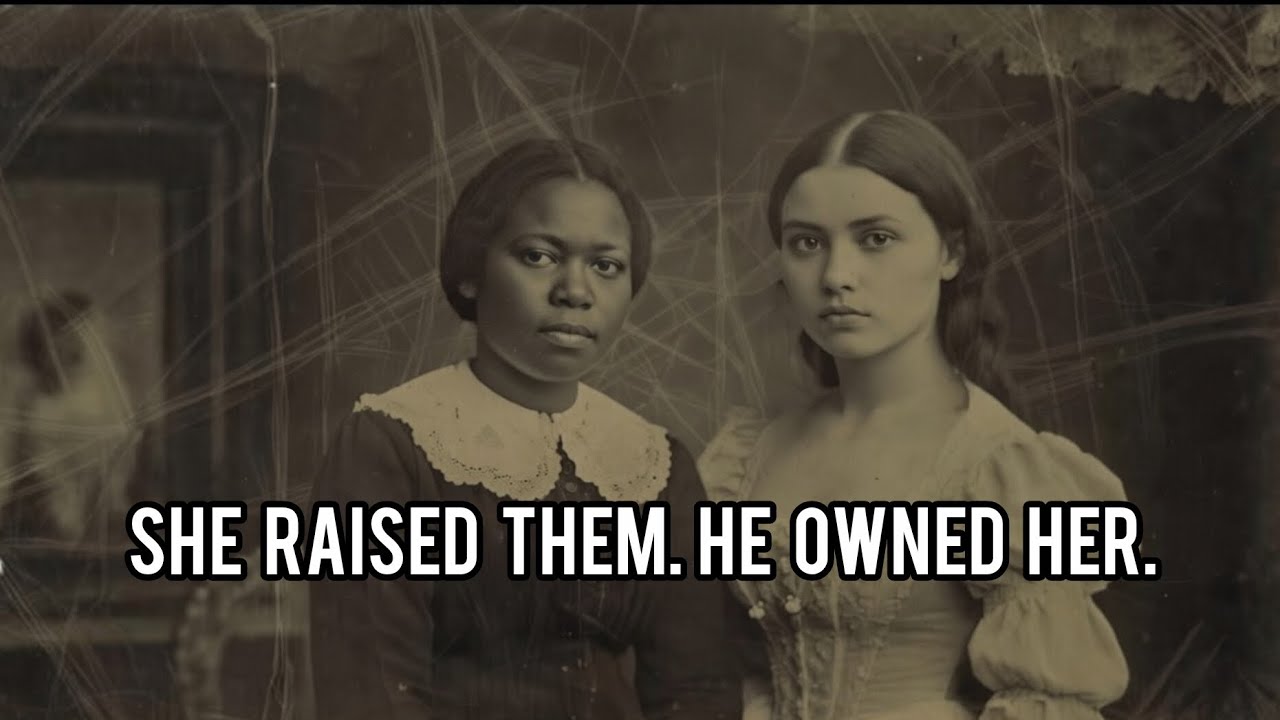
Sarah was assigned to housework under the supervision of Dinina, the head of household staff, and given light duties suited to her condition. In January 1853, she gave birth to a son she named Thomas. She returned to work within weeks, strapping the infant to her back while she labored. In the spring of 1855, Grantham remarried.
His new wife, Margaret Yancy, was the twenty-eight-year-old daughter of a prominent Augusta judge. She arrived with fourteen trunks, two personal maids, and an air of brittle distance. She never addressed Sarah by name, referring to her only as the girl. A year later, Margaret announced she was pregnant.
The pregnancy was difficult, marked by constant nausea, severe headaches, and fainting spells. In March 1857, she went into labor that lasted twenty-three hours. A baby girl was born and named Caroline, but Margaret refused to hold her, refused to nurse her, and asked that the infant be removed from her sight. The doctor declared her suffering from nervous exhaustion and prescribed laudanum and complete separation from the child.
The wet nurse that had been arranged had died two weeks earlier from pneumonia. Dinina solved the problem. Sarah was still nursing Thomas, who was four years old, which meant she had milk. She was summoned to the main house and told to feed the screaming infant.
Within a week, Grantham decided it was inefficient for Sarah to travel back and forth, so she was moved into a small room adjacent to the nursery. Thomas was left in the care of an elderly woman in the cabins, seeing his mother only briefly each day. Each visit, he seemed smaller to her, more distant. The arrangement continued for months, then years.
Sarah nursed Caroline around the clock, slept upright in a rocking chair with the baby against her chest, and learned to quiet her through colic, rashes, and sleepless nights. Grantham visited the nursery daily, but seldom spoke. He never acknowledged that Sarah had a child of her own. Margaret never came to the nursery.
She spent her days in bed, drifting in and out of laudanum dreams, and died eighteen months after Caroline’s birth, apparently from an overdose no one could say whether intentional or accidental. Grantham remarried again, this time to a practical widow named Helen Bradford, who bore twins two years later. When the hired wet nurse fell ill, Grantham made the obvious decision. Sarah would nurse all three children.
Caroline was four and refused to be weaned. Thomas, now nine, watched from the doorway and told his mother that she had three children now, white children who mattered. She had no answer. The war came and ended.
In April 1865, Grantham gathered the sixty-three enslaved people on the estate and told them they were free. Most stayed, including Sarah, who had no family connections, no money, and nowhere to go. She accepted seven dollars a month plus room and board to continue caring for the children. Thomas left for Savannah in June of that year, sixteen years old and literate from years of secret study.
He found work at the shipyards, then as a clerk for a shipping company. He wrote occasionally, brief letters that arrived every few months. Sarah learned to fold them carefully and store them in her apron pocket. Caroline grew into a clever, affectionate young woman.
At fourteen, she began asking Sarah questions about her life before the plantation, about her parents, about Thomas. In 1868, she left for a female seminary in Macon. She returned the following summer. That same year, in August of 1869, two federal agents arrived at the plantation.
They were part of a Bureau of Refugees, Freedmen, and Abandoned Lands effort to help formerly enslaved people locate separated family members and establish legal documentation of birth and parentage. Grantham complied reluctantly. On the third day, they asked to speak with Sarah. Agent Freeman showed her the plantation ledger entry from March 1857.
It recorded the delivery of a female child, Caroline Margaret Grantham, born to Margaret Yancy Grantham. Then he showed her the birth certificate filed with Burke County. In a section at the bottom, a note in the doctor’s handwriting described an infant bearing a visible birthmark on her left shoulder, resembling a dark star. The wet nurse, Sarah Hayes, had inquired about the marking.
Sarah’s hands began to shake. Thomas had the same birthmark, in the exact same place. The agents had found letters between Grantham and Dr. Patterson, who had attended the plantation for years.
The correspondence revealed that Margaret had suffered multiple miscarriages and was likely infertile. In February 1857, Grantham wrote that Sarah was nearing her time and that, if the child was fair-skinned and healthy, it might solve his predicament. Margaret need never know the full truth. Arrangements were made, and a price was paid.
Sarah delivered her child, was told the baby had died, and was given no chance to see the body. Three weeks later, she was brought to the nursery to nurse a stranger, her own daughter. When confronted in his study, Grantham did not deny it. He explained that Margaret could not have children, that he needed an heir, and that Sarah had been compensated after the war.
Sarah asked how he could have done such a thing. He answered that the child had been well cared for, fed, clothed, educated, made his legal heir. He argued that this was better than the life she would have had as his daughter. Sarah understood then that he believed the theft justified by the outcome.
The agents explained the legal situation. Caroline was legally an adult, documented as Grantham’s daughter. If she chose to reject the information, no one could force her to acknowledge it. If she accepted it, there was a path forward.
Sarah wrote to Thomas and asked him to come home. When he arrived, he listened to the full story in silence. He noted that he had spent years hating his mother for favoring the white children, and that some part of her must have recognized her own child all along. He agreed to stay and help her speak with Caroline.
Three days later, in the plantation office, Agent Freeman laid out the evidence. Caroline’s face moved through confusion, disbelief, and horror. She asked who Thomas was. He answered plainly that he was her brother, that they shared the same mother, and that he had been raised in a slave cabin while she had been raised in the big house.
Caroline wept and asked what she was supposed to do. Sarah told her she would survive, that she would decide who she wanted to be. Caroline refused to speak to anyone for three days. When she emerged, she asked Sarah to tell her everything.
They sat together in the small room by the nursery, and Sarah told her about being sold at auction, about Thomas’s birth, about being summoned to nurse a baby she did not know was her own. Caroline asked to see the birthmark. They compared the marks on their left shoulders, identical in size and shape. Caroline said she could not build a life on a lie that had hurt her mother so badly.
She asked if it was all right to call her Mama. Sarah nodded. The legal proceedings took place in September 1869 in the Burke County Courthouse. Sarah testified about the labor, the exhaustion, and being told her baby had died.
Dr. Patterson’s widow testified from her late husband’s journals, describing the arrangement and the five-hundred-dollar payment. Thomas testified about the birthmark and about watching his mother care for the Grantham children while he was left with little attention. Caroline testified last.
She acknowledged that Sarah Hayes was her mother by birth, that she had been stolen as an infant and raised under a false identity, and that she could not undo the years but could tell the truth. In October, the court ruled that Caroline Margaret Grantham was in fact Caroline Hayes, biological daughter of Sarah Hayes. The birth certificate was corrected. Grantham was fined two thousand dollars for fraud and ordered to pay five thousand in restitution to Sarah.
He was not charged criminally, because the statute of limitations had expired. Under Georgia’s one-drop rule, Caroline was now legally a person of African descent, entitled to none of the Grantham estate. She lost her name, her inheritance, and her social position. Sarah, Caroline, and Thomas left Burke County together that November and traveled to Savannah.
They used the settlement money to buy a small house near the shipyards. Thomas found Caroline work as a clerk in the shipping office where he was employed. Sarah started a laundry business and employed other women from the neighborhood. They built a life together, not the life any of them had imagined, but a life grounded in truth.
Caroline never spoke to Grantham again. He wrote once, explaining his motivations and asking for understanding. She burned the letter without reading it fully. Some apologies, she told Sarah, are not worth hearing.
Years later, after Sarah had died and been buried in the colored cemetery in Savannah, Caroline told the story to her own children. She had married a teacher named James Reed, who did not care about her complicated past. She told them about their grandmother, about the years of unknowing, about the moment when the truth broke through decades of deception. The slave forced to raise her master’s children had, in the end, raised her own daughter.
It had taken eighteen years and a war and federal agents and a public trial to make it so. But truth, once revealed, changes everything, even when it comes too late to undo the harm.