Before the roar of artillery or the rumble of tank treads, German soldiers on the Eastern Front learned to dread another sound. It was a short, brutal mechanical burst, echoing through ruined streets and frozen trenches. They called the weapon that made it the Papa. The Red Army called it the PPSh-41.
To the German infantry, that distinctive chatter meant one thing: the Soviets were already too close. There was no time for artillery support and no room to retreat. Only seconds remained before a storm of bullets tore through the rubble.
The PPSh-41 was not a masterpiece of engineering. It was made from stamped metal, welded by untrained hands in freezing, makeshift factories. Yet it became one of the most feared weapons of the entire war. It was so effective that German forces began capturing and converting the Soviet gun for their own use.
The irony was chilling. Soldiers who once mocked Soviet industry came to trust this weapon more than their own. The story of the PPSh-41 is not just about steel and firepower. It is a story of desperation, innovation, and survival, forged in a war where mass production meant the difference between endurance and extinction.
The weapon’s origins trace back to the Winter War of 1939. The Soviet Union invaded Finland expecting a quick victory but faced humiliation instead. Though outnumbered, Finnish troops fought with agility and discipline. They wielded a weapon the Soviets had not taken seriously: the Suomi KP-31 submachine gun.
The Red Army’s standard rifle, the Mosin-Nagant, was powerful but slow. Each shot required a bolt cycle, and every reload cost precious seconds. The Suomi, with its 71-round drum magazine, could unleash a continuous storm of bullets at close range. Finnish soldiers used it for lightning ambushes in snowy forests, striking Soviet columns and vanishing into the white.
The results were devastating. In dense terrain and urban ruins, the bolt-action rifle became obsolete the moment the Suomi appeared. Soviet officers studying the aftermath concluded that firepower density, not accuracy, decided survival. The failure in Finland sparked a quiet revolution inside Soviet ordnance bureaus.
Designer Georgy Shpagin stepped forward with a radical idea. Instead of refining the costly PPD-40, a Soviet copy of the Suomi, he proposed simplifying everything. No milled parts, no complex machining. Only stamped steel and wood.
The result was the Pistolet-pulemyot Shpagina, model of 1941, or PPSh-41. Each gun took barely 5.6 man-hours to make. Old Mosin-Nagant barrels were cut in half and rechambered for the 7.62x25mm Tokarev round. The entire process could be done in makeshift workshops far from the front.
Workers without formal training, sometimes women, sometimes teenagers, assembled them under candlelight while German bombers droned overhead. This industrial pragmatism was wartime genius. The PPSh was not just a weapon; it was an ideology of mass survival.
While Germany obsessed over mechanical precision, the Soviets built for endurance. By late 1942, over five million units had been produced. That number dwarfed the one million MP-40s fielded by Germany. The Soviet strategy was brutally simple: every platoon would saturate the battlefield with automatic fire.
Before the PPSh, submachine guns were reserved for officers, tank crews, or elite assault units. The Soviet command inverted that logic. If close-quarters combat defined the Eastern Front, then every soldier should wield the weapon built for it.
By mid-1942, entire companies of hundreds of men were armed solely with PPSh-41s. Training films showed recruits firing in synchronized bursts, moving like a wave of thunder through ruined cities. The doctrine emphasized speed over precision: fire first, overwhelm, advance.
This shift rewrote the character of infantry warfare. Instead of disciplined rifle lines, battles devolved into chaotic brawls fought at 50 meters or less. The PPSh’s 900-round-per-minute rate of fire made it an instrument of suppression, not marksmanship.
Soviet divisions learned to hug the enemy, fighting so close that German artillery could not be used without hitting their own men. It was brutal, costly, and effective. The PPSh-41 became both a symbol and a survival tool for a nation that refused to die.
Stalingrad was not just a battlefield; it was a labyrinth of steel and concrete designed by accident for the PPSh-41’s brutal efficiency. Sight lines vanished after 20 meters. Snipers had no fields of fire, and machine guns jammed with dust and debris. The war devolved into an endless maze of stairwells, hallways, and shattered rooms.
General Vasily Chuikov of the 62nd Army understood this instinctively. He introduced a strategy the Germans would come to fear: hugging the enemy. Soviet troops fought at such close distance that artillery and air strikes became useless.
The PPSh-41 was a perfect instrument for this tactic. It was compact, rugged, and capable of drowning an entire floor in bullets before an MG-42 could even pivot. Eyewitness reports describe storm groups of six to eight soldiers, each carrying a PPSh, grenades, and a knife, slipping through walls and rubble.
They attacked at night, bursting into rooms and spraying 70 rounds in seconds. The noise was deafening. The effect was psychological annihilation. To the Germans, this was not combat; it was chaos in human form.
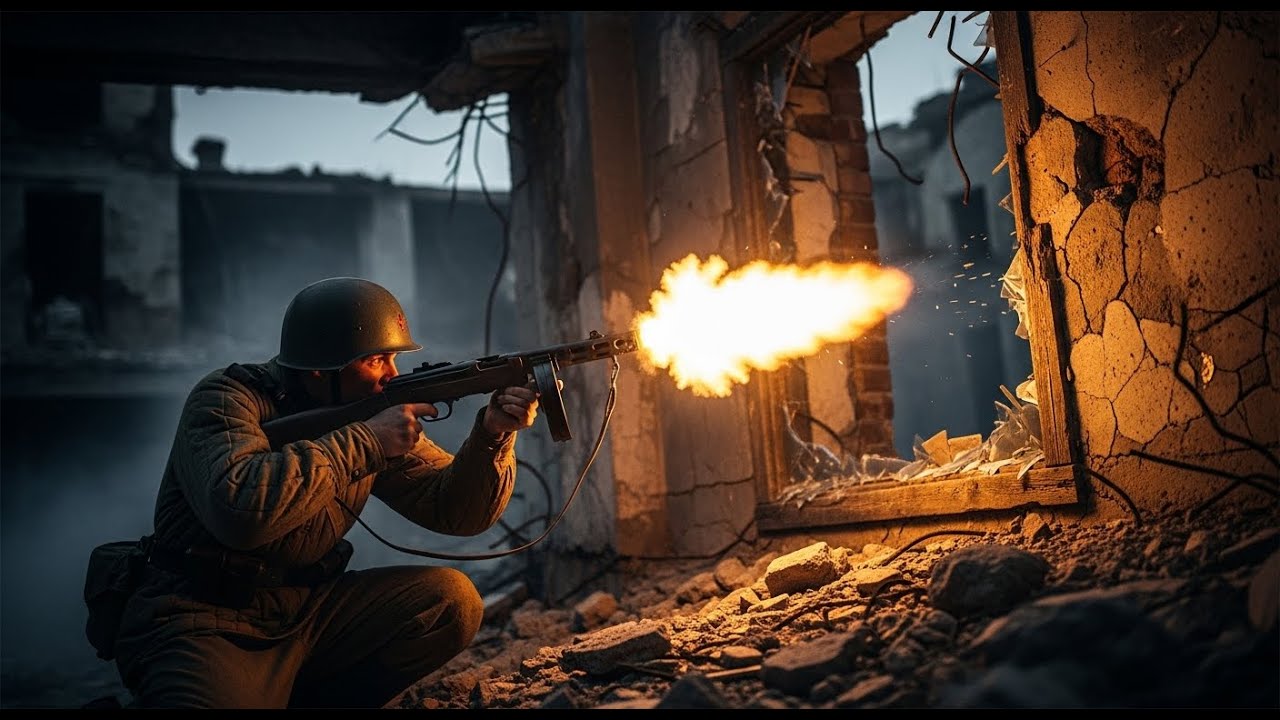
Among German veterans, the PPSh-41 gained a grim nickname: Rachender Tod, or Raging Death. Its firing signature was unmistakable, a rolling thunder of rapid metallic bursts that echoed through ruins and across trenches. Soldiers could tell instantly when a Soviet assault was imminent.
Unlike the sharper crack of rifles or the heavy rhythm of the MG-42, the PPSh’s chatter was wild and almost mechanical. It never came alone. A single burst meant dozens more. Entire Soviet platoons fired simultaneously, filling the air with shock waves that made it impossible to locate the source.
German field diaries recorded that when the PPSh spoke, the street belonged to them. Units caught in these urban ambushes often panicked, abandoning their positions before physical contact even occurred. The fear was not irrational.
In less than four seconds, one PPSh could empty its 71-round drum, enough to turn a confined basement into a death trap. Veterans remembered the sound before the faces. The PPSh’s voice became synonymous with Soviet ferocity, a crude but perfect instrument of psychological warfare.
By late 1942, the German 6th Army’s attitude toward the PPSh shifted from horror to grudging admiration. They began capturing and using the weapon themselves. Thousands were rechambered to fire the 9x19mm Parabellum round, compatible with MP-40 magazines.
The Wehrmacht even issued conversion kits under the designation MP-41(r). But many soldiers preferred the original Soviet version. The 7.62mm Tokarev cartridge had higher muzzle velocity, greater penetration, and astonishing reliability. It could punch through brick walls, helmets, and light cover at ranges the MP-40 could not match.
The PPSh itself, ugly, heavy, and imprecise, almost never failed to fire. In the freezing mud of the Eastern Front, where lubricants froze and mechanisms jammed, precision machining was a liability. Rugged simplicity became superiority.
German engineering had produced elegance. The Soviets had produced endurance. Frontline soldiers joked bitterly that they had the better designers, but the Soviets had the better weapon for hell.
When Berlin finally fell, millions of PPSh-41s still lined Soviet depots. Unlike many wartime weapons that vanished with the peace treaties, the Papasha endured. It required no upkeep beyond a rag and oil, and ammunition was abundant.
Within months, it was reissued to satellite armies across Eastern Europe. From Korea to Vietnam, it reappeared in new hands. Chinese volunteers crossing the Yalu River carried it, as did Viet Minh fighters ambushing French columns in jungle valleys.
In those wars, the PPSh-41 served the same role it had in Stalingrad: overwhelming fire at close range in terrain where visibility was measured in meters. American troops in Korea recalled night assaults lit by muzzle flashes, a triple-pronged jet of flame identical to what German soldiers once feared.
Even as assault rifles like the AK-47 replaced it, the PPSh remained symbolic. It was a relic of total war’s industrial philosophy. It was the sound of a nation proving that mass production could be as decisive as strategy.
The PPSh-41 blurred the line between technology and psychology. It was not a better gun in the technical sense. Its accuracy was poor, recoil harsh, and safety design primitive. Yet it achieved what few weapons ever do: it reshaped behavior.
Soviet doctrine changed around it. German tactics adapted to counter it. Entire urban engagements were rewritten in its rhythm. Its story reflects the brutal logic of industrial warfare, where quantity becomes its own form of quality.
The gun’s real legacy is not in its statistics but in what it revealed. Fear can be manufactured just as efficiently as steel. Every round fired from a PPSh was not only a bullet but a message that the Soviet Union could replace every man, every weapon, and every loss faster than its enemy could respond.
Today, surviving PPSh-41s rest behind museum glass. Their wooden stocks are worn smooth by a thousand hands. Visitors see a crude submachine gun with stamped metal, dented drums, and faded serial numbers.
Behind that simplicity lies an uncomfortable truth about the 20th century. Progress in war often came from desperation, not genius. For the Germans, it was the weapon that shattered the myth of technological superiority. For the Soviets, it became proof that survival could be engineered.
Historians often speak of tanks, planes, and generals. The PPSh rarely takes center stage. Yet in the alleys of Stalingrad, in the frozen forests of Karelia, and later in the jungles of Asia, it was this unassuming machine that turned the tide of battles fought face to face.
The PPSh-41 was never meant to last forever, but its echo still lingers. It remains a mechanical heartbeat from an era when fear had a sound.