In September 1943, over the jungle-choked island of Bougainville in the Solomon Islands, American Marine fighter squadrons were losing a war of attrition they should have been winning by a landslide. The F4U Corsair was a masterpiece of naval aviation: faster, heavier, and harder-hitting than the Japanese Zero it was built to destroy. It carried six heavy Browning machine guns, any one of which could saw through an enemy airframe in seconds. On paper, the Corsair was a predator.
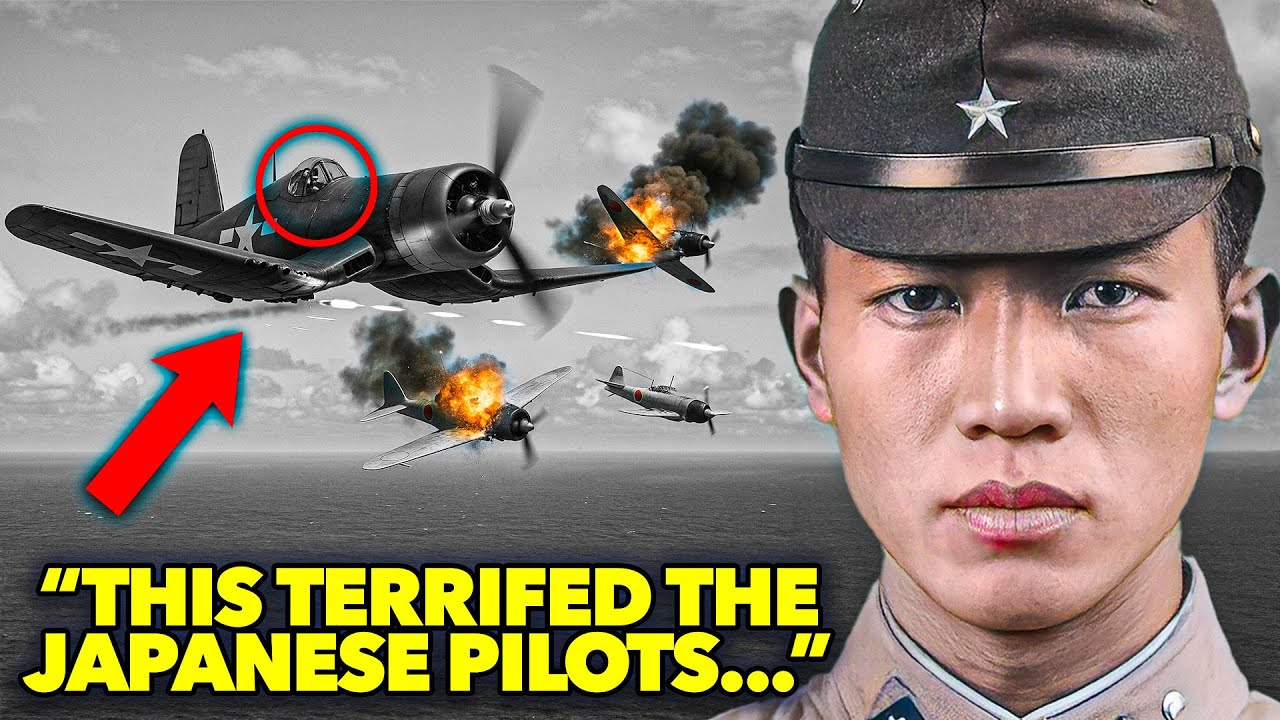
In the sky, it was dying. Gun camera footage told the real story. When pilots returned from missions, the film revealed a maddening pattern. Tracers swirled in wide circles around Japanese fighters, outlining the enemy in a hollow cage of lead but rarely striking the center.
Every attack pass looked perfect. Every result was a miss. Officers blamed pilot discipline and demanded shorter, more accurate bursts. Pilots knew better from the cockpit, where the blur of a Zero flashing across the windscreen lasted less than a second.
Aiming was not the problem. Something deeper was broken. The flaw was hidden in the geometry of the guns themselves. Engineers had set the Corsair’s wing-mounted machine guns to converge far downrange, roughly five hundred feet ahead of the aircraft.
That made sense in calm test conditions, where pilots could line up a steady shot at distance. But Pacific combat was not a clean whiteboard. Dogfights dissolved into knife-fighting range, where enemy aircraft twisted and turned in tight spirals almost point-blank in front of the pilot. At those distances, the Corsair’s streams had already crossed and spread apart again, producing a ring of fire around the target rather than through it.
The bullets were always missing not because the pilot was bad, but because the guns were built for a fight that never happened. Japanese pilots noticed. Radio intercepts mocked American shooting, claiming the bullets spread like rain. They began baiting Corsairs into opening fire early, then circling behind the empty guns like wolves closing on wounded prey.
Friendly pilots burned entire belts for a handful of weak hits, then limped home with smoking barrels and frustration. Morale sagged. Officers repeated regulations. The manuals stayed unchanged.
Every dead pilot was buried with the same unanswered question: why do our guns feel useless? Far from the briefing tents, a quiet Marine Ordnance sergeant was asking the same question. Staff Sergeant Michael “Mickey” McCarthy was not a decorated aviator. He was a mechanic from Boston who had learned his trade in his father’s garage, fixing cars through the Depression, and listening to machines the way other men listened to sermons.
He loaded ammunition belts, cleaned barrels, and repaired jammed firing systems, and after every mission he watched the gun camera reels like a doctor studying X-rays. What he saw was a pattern everyone else had refused to notice. The bullet streams converged too far out. The Corsair’s deadliest zone existed where no real fight ever stayed.
McCarthy measured gun mounts under the cover of darkness, scribbled calculations on scrap cardboard, and ran the numbers again and again until they burned into his mind. He did not have rank. He did not have permission. He had a wrench, some scrap steel, and the stubborn belief that the manual was wrong.
He decided the guns needed to cross at three hundred feet, and he decided to do it alone. The flight line went quiet. Engines cooled, pilots disappeared into their tents, and McCarthy pulled two trusted crewmen aside. They rolled one Corsair into the maintenance hangar, the aircraft belonging to Captain James Swett, a pilot who had recently watched his wingman vanish into jungle smoke.
McCarthy stripped damaged wing panels, cut reinforcement plates by hand, welded them to the gun mounts, and used a wooden jig to shift the barrels inward until their paths would converge at three hundred feet. Sparks lit the hangar like lightning in a cave. The angle looked wrong, almost crooked. But the geometry was perfect.
At dawn, he test-fired into the ocean. The braces held. No cracks, no bending. The metal surrendered to his math.
When Swett saw his airplane that morning, he froze at the sight of the barrels angled inward like clenched fists. “What did you do to my guns? ” he asked. McCarthy swallowed hard.
“I brought the fight closer. ”
The test came faster than anyone expected. Late that morning, spotters reported Japanese fighters and dive bombers sweeping toward Allied positions. Swett climbed into his bird with three wingmen, the only Corsair on the island carrying McCarthy’s forbidden modification.
They flew into thick Pacific haze and found the enemy formation over Empress Augusta Bay: a dozen Zeros weaving protectively around bomb-laden Betty bombers. Swett pushed the nose down and went to work. At four hundred yards, he held his fire. At three hundred fifty, he waited still.
Then, with the Zero filling his windscreen at just under three hundred feet, he squeezed the trigger for exactly one second. Instead of scattered sparks, a single solid beam of tracers slammed into the enemy tail. Metal shredded, the fuselage snapped, fuel erupted into flame. Swett rolled, lined up the next target, and struck again at the same brutal distance.
Another brief burst, and the Zero’s wing separated cleanly. A third enemy tried to dodge, but at that range there was no escape. All of it happened in less than a minute, and Swett’s ammunition counters showed more than half his belt still remaining. Back at the airfield, the mood was electric.
Swett climbed out of the cockpit and described what he had seen with shaking voice. “I barely touched the trigger,” he said. “They fell apart. ” Pilots pointed at the angled barrels.
Mechanics traded nervous glances. But the celebration did not last. Senior officers marched toward the hangar, led by Lieutenant Colonel Millington, the very officer who had issued the memo forbidding close convergence. He lectured McCarthy on cracked mounts, stressed wings, dangerous recoil, and every regulation in the book.
McCarthy stood quietly and took the blast. Then Swett stepped forward. He described watching enemy aircraft disintegrate in single bursts, and he showed the ammunition he still had left. Pilot after pilot added his voice, carrying the weight of recent funerals into the argument.
Lieutenant Hansen requested the same modification for his guns. Denied. Another pilot tried. Denied again.
Paper was fighting proof. Major Britt cut through the noise and turned to McCarthy. “Sergeant, can you modify every Corsair in this squadron by morning? ” McCarthy answered without hesitation.
“Yes, sir. ” Millington threatened investigations and courts-martial. Britt did not flinch. “If it works, we live.
If it doesn’t, the enemy will handle the punishment. ”
Night fell, and welders lit the hangar like a forge. Mechanics reinforced mounts and adjusted angles while pilots fetched tools and held lamps. By sunrise, every flyable Corsair in the squadron pointed its guns inward like sharpened claws.
The very next day, radar operators called out another inbound wave. Eight modified Corsairs climbed into the humid blue and met the enemy formation head-on. Lieutenant Hanson dove first, waiting until the bomber nearly filled his sight. A two-second burst ripped through an engine and snapped off the wing.
Around him, Zeros tried to dodge the concentrated beam of fire, but it bit too fast. One-second taps tore cockpits apart. Wings separated mid-turn. In minutes, the Japanese formation unraveled.
When the pilots returned, the gun camera footage stunned the briefing tents. No more wide halos of tracers drifting harmlessly around targets. Every burst was a poured stream, thick, focused, brutal. For the first time in months, pilots landed with ammunition to spare.
The fear was gone. Word spread beyond the island. Nearby squadrons requested the same adjustment. Japanese radio intercepts changed tone, warning pilots to avoid close engagements with Corsairs, calling their fire instant death.
Engineering officers eventually inspected the reinforced mounts and found something they did not expect. The added braces did not fail. They actually reduced stress. The manuals were quietly updated, and headquarters took the credit.
McCarthy’s name stayed buried in paperwork. When the war ended, no spotlight found him. He went home, fixed cars, raised a family, and died without medals or headlines. But the pilots remembered.
In memoirs and letters, they described how concentrated fire turned desperation into dominance, and they credited one man for it. Modern fighter cannons still follow his principle: aim where real combat happens, not where the charts say it should. Sometimes heroism does not sit in the cockpit.
Sometimes it stands in a hangar at midnight, tightening bolts no one else believed in.