When Ambrose Burnside resigned his army commission in 1853, he seemed destined for a life far removed from the great conflict that would define his name. A West Point graduate from the class of 1847, he had served in the Mexican-American War, though mostly in garrison duty around Mexico City, and afterward spent a quiet period in the southwestern United States. He left the army to pursue a private venture: designing a breech-loading rifle. The weapon eventually failed, and with the outbreak of the Civil War, Burnside found a new path back into military service when he organized the First Rhode Island Infantry.
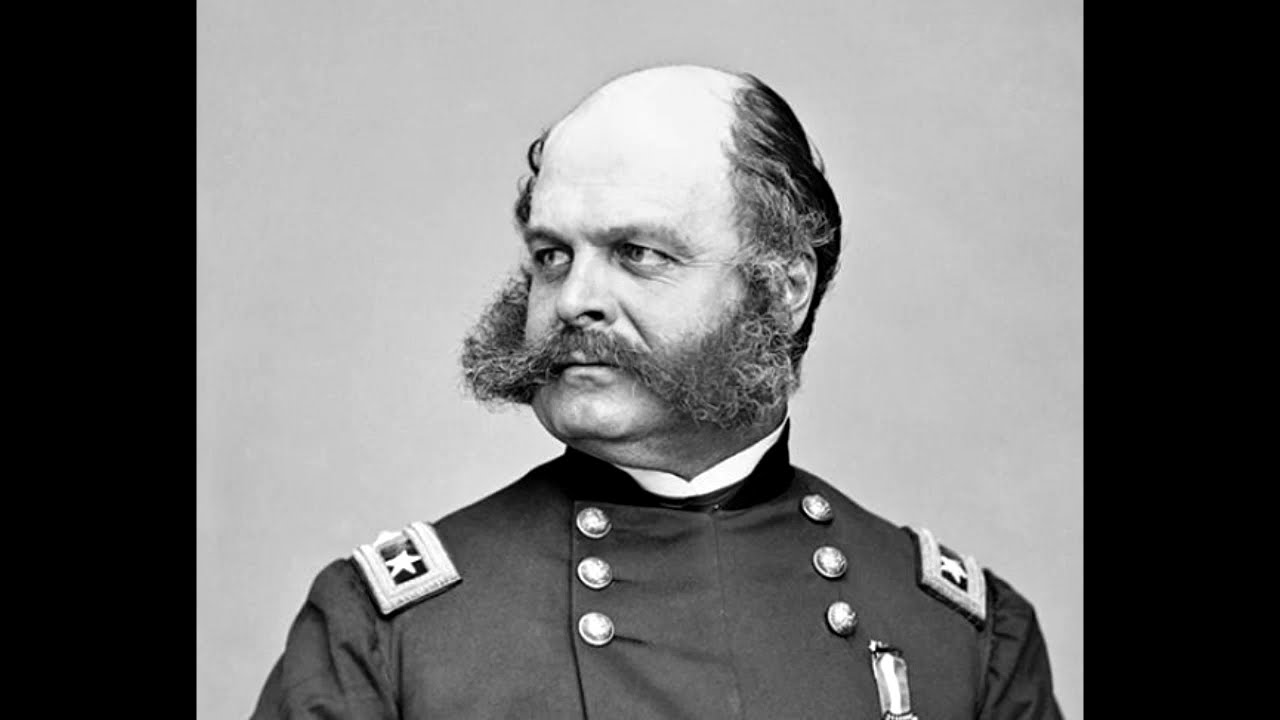
His regiment was among the first to arrive in Washington, offering protection to the capital in its vulnerable early days, and his service at the First Battle of Manassas earned him a promotion to brigadier general of volunteers in August 1861. In September of that year, Burnside received command of three brigades, organized as the North Carolina Expeditionary Force, and launched an operation against the Confederate coastline. The campaign succeeded in securing a foothold in North Carolina, an accomplishment that led to his promotion to major general of volunteers in March 1862. By the time of the Battle of Antietam, Burnside commanded the Ninth Corps, and during the fighting he was ordered to cross a stone bridge over Antietam Creek and attack the Confederate right flank.
His orders were famously precise but painfully slow in execution, and the confusion and delays that followed turned the crossing into a costly struggle for a bridge that would forever carry his name. Burnside’s men eventually took the position, but the lost hours and heavy casualties contributed to the day’s grim outcome, and the opportunity to destroy Robert E. Lee’s army slipped away. George B.
McClellan had failed to press his advantage after Antietam, and President Abraham Lincoln finally lost patience. On November 7, 1862, Burnside was elevated to command of the Army of the Potomac. He understood the political pressure upon him and decided on a bold, rapid move toward Richmond. His plan required a quick crossing of the Rappahannock River at Fredericksburg, but delays in the arrival of pontoon bridges allowed the Confederates to entrench on the heights behind the town.
On December 13, Burnside launched a series of frontal assaults against the fortified Confederate position. Wave after wave of Union infantry advanced into murderous fire, and by the end of the day the army had suffered roughly thirteen thousand casualties. The defeat at Fredericksburg was one of the war’s most devastating Union losses, and Burnside sought to redeem himself with a winter maneuver meant to outflank Lee’s army. The operation, remembered as the Mud March, dissolved in torrential rain and impassable roads, stranding the army in the mud with no progress made.
His command had lost all confidence, and in January 1863, Lincoln removed him and replaced him with Joseph Hooker. Rather than fading from the war entirely, Burnside was given command of the Department of Ohio. His time there was marked by controversy when he ordered the arrest of an ex-congressman for making what were deemed inflammatory statements, an act that drew sharp public criticism. Yet in the autumn of 1863 he returned to active campaigning in a more meaningful role.
Confederate General James Longstreet was laying siege to the vital city of Knoxville, Tennessee, and Burnside was sent to hold it. His defense proved determined and clever; he managed to outmaneuver Longstreet and keep the city firmly in Union hands even as Confederate forces pressed their attacks. The siege dragged on, but reinforcements under William Sherman eventually marched to relieve the city, and Longstreet was forced to withdraw. Burnside’s successful defense of Knoxville was one of the most solid achievements of his career, a performance that steadied his reputation after the disaster in Virginia.
The quiet interlude did not last long. Burnside was ordered back to the eastern theater to take command of the Ninth Corps in support of the Army of the Potomac. Under the overall direction of General Ulysses S. Grant, he participated in most of the terrible Overland Campaign of 1864, including the battles of the Wilderness, Spotsylvania Court House, North Anna, and Cold Harbor.
Each engagement bled the army further, and the campaign ground toward the siege of Petersburg. There Burnside was given responsibility for one of the war’s most ambitious engineering schemes: a mine dug beneath the Confederate fortifications, packed with explosives, and intended to blow a hole straight through the rebel lines. On July 30, 1864, the powder was detonated and the explosion tore a fifty-yard gap in the Confederate defenses. The moment was ripe for a breakthrough, but the opportunity was squandered.
Burnside failed to exploit the gap quickly, his assault divisions became tangled in the crater itself, and Confederate troops regrouped and poured fire into the trapped Union soldiers. The Battle of the Crater became a slaughter, a catastrophic miss that erased whatever credit his earlier service had earned him. The failure ended his active career. On April 15, 1865, just days after the Confederate surrender at Appomattox, Burnside resigned his commission.
After the war, he returned to Rhode Island and served briefly as a United States senator. He carried a distinctive style of facial hair throughout his life, and the public so closely associated the look with him that the term sideburns was eventually coined from his name. His legacy, however, remained tangled in the defeats that marked his highest commands.
A man who once defended Knoxville with skill and organized one of the first regiments to safeguard Washington was remembered instead for the bloody slopes of Fredericksburg and the tragic crater at Petersburg, fitting monuments to a career of varied success and enormous consequence.