In Elmira, New York, a man went to work every day, returned home to his wife and children, watched his sons grow up, became a grandfather, served in the Korean War, and was buried with a respectful obituary in his city newspaper. All of that happened while he hid a secret the city police had been trying to uncover for 61 straight years. Three hundred people were interrogated. Thousands of pages were archived.
Investigators worked the case, retired, and handed it to the next generation, which did the same. His name never appeared. Not once. Not in 1964, or 1972, or 2003, or 2014.
He died in 2004. Even after his death, no one knew. It took an invisible trace of DNA, a sister who refused to stop calling, and almost unbelievably, a winter storm at a FedEx hub in Memphis to finally link his name to hers. This is the story of Mary Theresa Simpson and the 61 years it took to answer the only question that mattered: who did this to her?
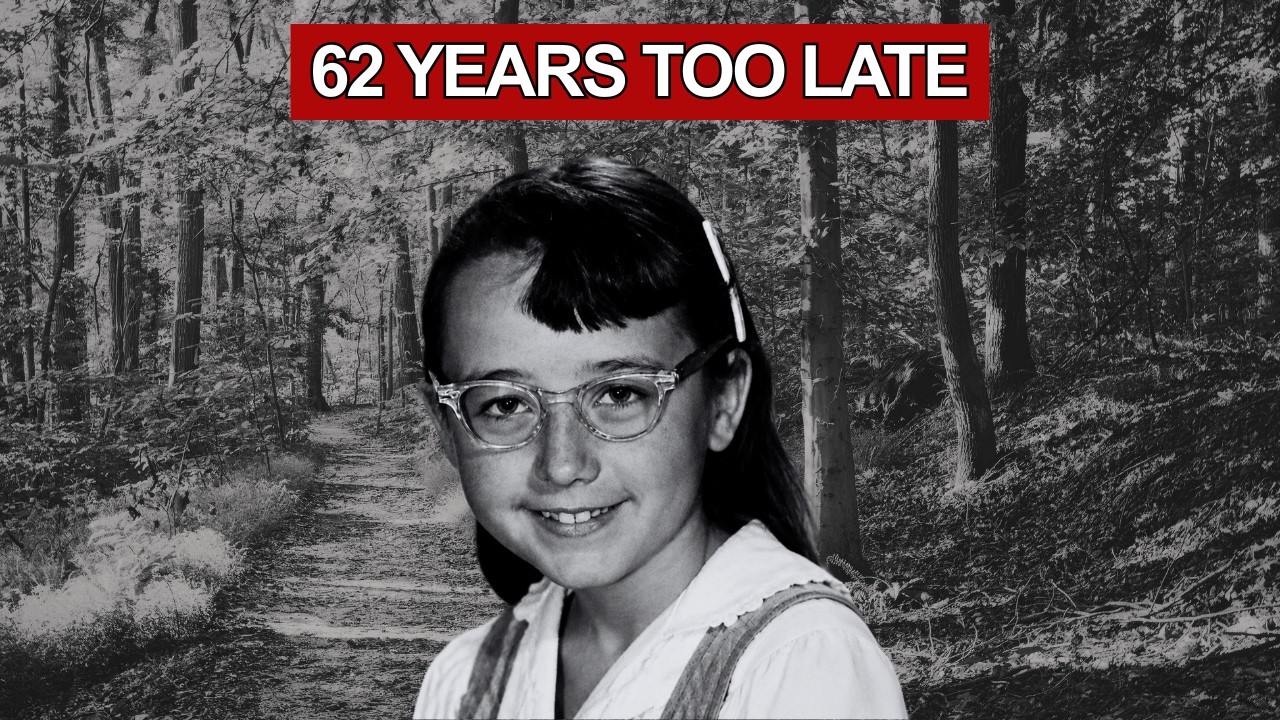
Mary Theresa Simpson was 12 years old, born in 1951 in Elmira, New York, a small working-class city in the southern part of the state near the Pennsylvania border. In 1964, Elmira was the kind of place where people knew their neighbors, where children walked to and from school, and where a Sunday evening in March meant families gathered indoors. Mary Theresa was the youngest of four children, with an older brother, an older sister, and an older half-brother. By most accounts, she was a shy girl.
Her family had moved so often that friendships never had time to take root. She wore cat-eye glasses. She carried a fan club membership card, a small piece of identity meaning something larger than her daily life. Her parents, Ellsworth and Rose, had separated in May 1963, less than a year earlier.
After the separation, Mary Theresa lived with her father. They moved at least once, then returned to Elmira, where her mother and older sister Linda still lived. Sunday, March 15, 1964, began like any ordinary afternoon. Mary Theresa left her father’s apartment around 3 p.
m. , telling him she was going to visit her cousin. But she stopped somewhere first. She went to see her mother without warning.
Rose was delighted to see her daughter. Mary Theresa stayed about an hour, then left to see her cousin as she had told her father. Around 6:30 that evening, she said goodbye to her relatives and began walking back toward her father’s apartment on the east side of Elmira. A friend remembered seeing her near a store at about the same time, saying she was on her way home.
That was the last confirmed sighting of her. A 12-year-old girl walking home on a Sunday evening in March. In upstate New York that time of year, darkness came early. By 6:30 the sky was already dimming.
The sidewalks were mostly empty as families sat down to dinner. Mary Theresa never arrived home. Her father waited. As hours passed, he made calls.
He called Rose. He called relatives. He called anyone who might know where his daughter was. No one had seen her.
No one remembered a girl walking alone on that road that evening. By 10:30 that night, the Elmira Police Department was contacted and an official report was filed. What followed was four days of searching. Police and volunteers combed the area between her mother’s home and her father’s apartment first.
Every block, every yard, every place a 12-year-old might have wandered or been taken. Officers knocked on doors. They searched basements and garages. The search then expanded.
Volunteers spread out along the Chemung River, checking parks and vacant lots on its banks. Search teams headed into the wooded hills and logging trails at the southern and western edges of the city, terrain that in mid-March still held patches of snow and ice in the shadows. It was rough ground. Hills, forest, old logging trails known to locals but not precisely mapped or maintained.
For four days this continued. Linda waited. Ellsworth and Rose waited, and Rose was pregnant at the time, carrying another child while the city searched for the daughter she had kissed goodbye days earlier. On the morning of March 19, 1964, the fourth day, a man out walking with his two young sons found something.
He was in a wooded area off Cole’s Hill Road in the Southport section on the outskirts of the city, about seven miles from where Mary Theresa had last been seen. It was the kind of place familiar to locals, where children played and teenagers parked their cars. Not hidden in the sense of being unknown, just far enough and wooded enough that something could be left there and not be found immediately unless someone happened to wander by. Mary Theresa’s body was hidden under branches, dirt, leaves, and heavy stones.
About 320 pounds of rocks had been piled on top of her. According to the original Star-Gazette report, only part of her hand and one sneaker were visible above the ground. Whoever did this had not been in a hurry. Moving and stacking that many stones and arranging branches and debris over them takes time.
The cause of death was strangulation. There was also evidence of sexual assault. At the crime scene, investigators collected what they could find: her cat-eye glasses, the fan club card she had kept in her pocket, and several buttons from her blouse, presumably torn off during what happened in her final hours. In 1964, there was no scientific method that could extract anything meaningful from such clothing beyond what could be seen with the naked eye.
DNA analysis did not exist as a forensic tool and would not for another two decades. Yet according to multiple accounts, this evidence was preserved and stored in conditions that protected it from further degradation. Year after year, decade after decade, by a department with no way of knowing whether it would ever become important again. The investigation immediately shifted from a missing person search to a full murder investigation the moment the body was found.
About 50 men helped comb the area, looking for footprints, discarded items, tire tracks, anything that might point to who had done this. The Star-Gazette and a local radio station, WELM, offered a reward reported at $1,000 for information leading to the killer’s identity. People who had never met Mary Theresa Simpson contributed to that reward, just because they lived in the same city. The murder shook Elmira in a way nothing had in living memory.
Linda, who was 16 at the time, rushed home when she heard the news. What she found was unbearable. When she saw her younger sister in the coffin, she could not process it, could not believe it, and tried to climb in with her. Someone pulled her back.
The case became the oldest open murder file in the Elmira Police Department. It was passed down from generation to generation of investigators. Each new officer at some point in his career would read the same stack of reports, the same interview notes, and hit the same dead ends, looking for anything the previous investigators might have missed. Every time, the result was the same.
Nothing left to extract. Every thread that could be followed had been followed decades earlier. Why, then, did these extensive investigations, taken seriously and kept alive for 61 years, fail to reach the person responsible? The answer became clear when police finally announced their findings in February 2026.
Police Chief Kristen Thorne was specific on this point. Investigators do not believe Alfred Murray, the man finally identified as the killer, and Mary Theresa knew each other. He did not live in her neighborhood. According to investigators, there was no link between them at all.
Their current theory is that this was a crime of opportunity. As the chief put it, she was in the wrong place at the wrong time. Consider how a murder investigation works, especially one from the 1960s. Working with the tools available then, investigators build outward from the victim: who knew her, who had access to her, who was seen near her in the days and hours before her death, who lived along the route she would have taken, who had any reason at all to have contact with her or her family.
This is not a flaw in methodology. It is the methodology itself. In the vast majority of murders, historically especially, the perpetrator has some connection to the victim: a relationship, a location, an interaction that places them in the same circle at some point. If the killer existed within that network, even at its outer edges, a sufficiently thorough investigation could eventually reach that person.
That is exactly what the 50-person search, the door-to-door canvassing, and years of follow-up were designed to do. Work outward from Mary Theresa and her family until reaching the person responsible. But if the killer had no connection to the victim at all, not even a distant one, there was nothing for the investigation to grasp. It is not that investigators looked at this man and somehow failed to identify him as a suspect.
The path leading to him simply did not exist. He was not a name that had been investigated, cleared, and set aside. He was a name with no reason ever to appear, because there had been no intersection between his life and hers. A stranger abduction of a victim with no connection is the worst-case scenario for relationship-based investigation.
There is no thread to follow because there was no relationship. What is known about the man later identified is this. Chief Thorne described him as someone known to police at the time in connection with other criminal investigations, though she declined to elaborate, citing legal protections. Whatever that record was, it was clearly never matched against the Simpson file.
If nothing pointed from this man to Mary Theresa, and nothing in the Simpson investigation pointed to him, there was no mechanism, list, canvas, or interview that could have connected the two. And so the files sat. The decades passed. Investigators who worked the case in the 1960s retired.
New investigators inherited the file, read it, found nothing new, retired, and handed it on. Ellsworth Simpson died. Rose Simpson died. Both passed without ever learning the killer’s name.
But the case never completely faded. And the reason for that deserves attention, because it may be the most important part of this entire story, in many ways more important than the DNA technology that eventually solved it. Linda, Mary Theresa’s older sister, kept checking in and calling. She contacted the Elmira Police Department periodically over the years, sometimes once a year, sometimes more.
The question was always the same. The answer was always the same. Nothing new. “It affected me badly,” she said, describing those years.
“I lived this for years and cried and had heartache the whole time. I did this for my mother. ” Decades of phone calls that led nowhere. Decades of being told again and again there was nothing new.
Most people would logically stop, not because they stopped caring, but because there comes a point where asking the same question and receiving the same negative answer becomes exhausting in itself. Linda never stopped. And here is the mechanical truth of what that persistence does inside a police department. Even when no single call leads to anything, a case no one asks about becomes administratively dormant, existing only in the archives.
But a case someone keeps calling about year after year remains present in a different way. It is the kind of case mentioned when a new investigator is briefed. It is the kind of case that comes to mind when someone makes a list of unsolved cases that might be worth applying for funding to test. The family is still engaged, still asking, still present.
In September 2025, mere months before the case was finally resolved, a book about it was published: What Happened to Me? Exploring the Mary Theresa Simpson Cold Case, by Christina Finnelli. Sustained public interest after decades is itself part of what kept this case visible. In 2022, the Elmira Police Department, working with the FBI, applied for and received a grant from Season of Justice, a nonprofit that exists specifically to fund advanced forensic testing on cold cases, the kind of testing most police budgets cannot afford.
The grant covered sending the Simpson evidence, carefully preserved since 1964, to a private lab called Othram in The Woodlands, Texas. Othram specializes in building usable genetic profiles from severely degraded biological material. Samples that barely exist by ordinary forensic testing standards. That is exactly what the Simpson evidence was after 58 years.
According to some accounts, the remaining usable genetic material was so small it was practically invisible except with specialized equipment, at the outer limit of what any lab could handle. Routine forensic DNA testing, used in the FBI’s CODIS database, works by examining a relatively small number of specific points in a person’s genetic code. That is enough to say with very high confidence that a sample came from one specific person and not another. CODIS was built on comparing crime-scene samples against the DNA profiles of people previously convicted of certain crimes.
The Simpson evidence had actually been matched against CODIS more than once over the years as the database grew and profiles were periodically resubmitted. Each time the result was the same: no match. The reason is not necessarily that the responsible person had no contact with the criminal justice system. The reason is that CODIS only contains profiles of people convicted of specific qualifying crimes with samples collected under certain conditions.
If a person’s history with police, whatever its content, never led to that kind of sample being collected and entered into that specific database, CODIS would never produce a match, no matter how many times the search was repeated. Forensic genetic genealogy, the method that ultimately solved this case, works completely differently. Instead of looking at a small number of points designed to match against known individuals, it builds a much broader genetic profile covering a far larger portion of the genome, similar in scope to consumer ancestry testing services. This broader profile is not compared against a database of convicts.
It is compared against public genealogy databases, composed of ordinary people with no connection to any crime who voluntarily submitted their genetic information, usually out of curiosity about their family history. The comparison does not produce a direct match with a known criminal. It produces something more like: this anonymous profile shares a measurable amount of genetic material with this other person, who happens to be a distant relative of the sample’s owner. From there the work becomes genealogy in the literal sense.
Investigators in this case began working with students and researchers from the Russell Sage College Investigative Genetic Genealogy Center in 2023. They take those genetic matches and begin building family trees: birth records, marriage certificates, census data, obituaries. Here, those documents are used to work backward from a handful of genetic matches toward one individual who fits the genetic data and what is known about the crime: the right age, the right location, the right time period. This is slow work, not the kind that produces a name in days or weeks.
It took about two years, branch by branch, generation by generation, tracing multiple family lines from the genetic matches and narrowing the possibilities step by step. Alfred Murray Jr. was born in 1931 in Elmira and, according to public records, lived there nearly his entire life. He was 32 years old in March 1964.
He was a Korean War veteran, having served in the U. S. Army. He died in 2004 at age 73, leaving behind his wife, children, and grandchildren.
His obituary in the Star-Gazette described what on paper looked like an ordinary, unremarkable life, the kind of obituary written for thousands of people every year. Family, military service, a long life lived in one place. Nothing linked him in any way to Mary Theresa Simpson. At the time of his death, the two names had never been connected, and there is no indication that anyone at his funeral, his wife, his children, or friends and relatives who came to pay respects, had any reason to suspect such a connection.
To obtain the DNA needed for comparison with the Simpson evidence, investigators obtained a court order to exhume Murray’s remains. This is not a step taken lightly. Exhumation requires going before a judge and demonstrating sufficient cause to violate the sanctity of the grave. By the time investigators reach this stage, the substantive evidence must already be strong.
The exhumation was not itself the moment of discovery. The discovery, in the sense of identifying the person, had already happened through the genetic work and the son’s sample. The exhumation was for confirmation only: obtaining a direct sample from Murray himself to compare against the profile that had been waiting since 1964. The exhumation took place in November 2025.
The DNA extracted directly from Murray’s remains was compared against the profile extracted from Mary Theresa’s clothing, developed from evidence preserved for 61 years, checked against CODIS several times with no result, then finally sent to a specialized lab in Texas as part of a grant-funded cold case initiative. The result of that comparison was that the odds of an unrelated person being the match were less than one in 320 billion. On February 10, 2026, Elmira Police Chief Kristen Thorne stood at a podium in the Chemung County District Attorney’s office. Beside her were Sergeant William Goodwin, representatives of the FBI, District Attorney Weeden Wetmore, and a group of current and retired investigators, some of whom had personally worked this case at different stages over the decades, reading the same file and reaching the same dead end year after year.
Thorne said the name: Alfred Raymond Murray Jr. Sergeant Goodwin also spoke. “The family finally has an answer,” he said. “The case was never forgotten.
” District Attorney Wetmore added, “The wheels of justice move slowly. The Elmira Police Department has done a tremendous job. ” Alfred Murray has been dead since 2004. There is no arrest.
No trial. No conviction. The legal proceedings that normally follow the identification of a murderer simply do not apply because the person responsible is not alive to face them. What this announcement offers is narrower than a conviction, but in itself equally significant.
It is an answer. After 61 years of phone calls that led nowhere, a file that never moved, and parents who died without ever hearing a name, there is now a name. Linda, who spent decades asking the same question and receiving the same answer, finally received something different. It is worth being clear about something else.
This was not a story of an investigation that failed and then was ultimately rescued by better technology. That characterization, however tempting, does not hold up. The 1964 investigation and the decades of follow-up accomplished what was required of the case as it was then understood. They traced every connection related to Mary Theresa.
They interviewed people who knew her, lived near her, or might have crossed paths with her. This is not a flawed approach. It is the approach that solves the vast majority of murders, because in the vast majority of murders, some relationship exists between victim and perpetrator. The problem, as it turned out, was not the investigation itself.
It was that this case was the rare exception to the assumption on which the investigation was built. There was no connection. Murray did not know Mary Theresa. He did not live near her.
By all indications, this was, as Chief Thorne described it, a crime of opportunity. A 12-year-old girl walking alone in the last light of a Sunday evening, and a stranger who happened to be in the right place to take her. No amount of additional interviews, canvassing, or persistence using the methods available in 1964, or even the methods available throughout the next 60 years, could have bridged that gap. Not because no one tried hard enough, but because the entire method depends on a connection existing somewhere.
Here, there simply was none. What forensic genetic genealogy did was not a better version of the same method. It was a fundamentally different approach. It did not ask who Mary Theresa knew and who those people knew.
It started from the DNA itself, the genetic material Murray left at the crime scene in 1964, and moved outward through his family tree, his relatives, his descendants, regardless of whether any of them had any connection to Mary Theresa or her family. It is a method that does not require a connection between victim and perpetrator because it does not look for one. It looks for the perpetrator’s relatives wherever they are. For a case like this, a true stranger crime with no connection between victim and killer, that difference is not a minor improvement.
It is the difference between a method structurally incapable of reaching the answer no matter how much time or effort was invested, and a method that does not care whether a connection ever existed. This case is described in coverage following the February 2026 announcement as one of the oldest cases ever solved using forensic genetic genealogy, nearly 62 years between the crime and the identification. Consider everything that had to happen for that identification to occur. The evidence had to survive, not merely exist, but be carefully preserved in conditions that did not increase its degradation, by a department that for 61 years did not know whether that preservation would ever matter.
Someone, through decades of changing leadership and changing evidence storage locations, had to make the decision not to discard it. The family had to keep asking, not casually, not once, but repeatedly, year after year, decade after decade, keeping the case present in the minds of a department with no reason to reopen it. A grant had to exist, the department had to apply for it, and the application had to be accepted in 2022 from among countless cases that organization receives annually. A lab capable of handling a sample so small and degraded after all that time had to exist and be willing and able to accept it.
Researchers had to devote two years of painstaking genealogical work, tracing the family tree through public records branch by branch, without any guarantee it would lead anywhere. And even after all that, after the genealogy narrowed the possibilities, after Murray’s son voluntarily provided a sample, after a court authorized exhumation, the final confirmation depended on Murray’s remains being well enough preserved after 21 years to yield valid DNA. Had any of these elements been missing, the preserved evidence, the family’s persistence, the grant, the lab, the two years of genealogical research, the cooperation of a relative, the condition of the remains after two decades, this case would almost certainly still be open today. The files still handed from one generation of investigators to the next.
The case no one could close. The case was not closed because it became easier over time. In many ways, it became harder. The evidence degraded further.
Those who lived through 1964 aged or passed away. Any trail went colder. It was closed because all those separate elements after 61 years, preservation, persistence, funding, technology, research, cooperation, and luck, coincided at once. For Mary Theresa Simpson’s family, that convergence finally happened.
For her sister Linda, who spent 61 years asking the same question and hearing the same answer, it finally produced something different. For her parents, who died without knowing the perpetrator’s name, it came too late. And for thousands of other unsolved cases sitting in evidence storage rooms across the country, cases whose evidence may or may not have survived, families who may still be searching or may have stopped, cases no one has yet applied for the right grant in the right year, those favorable circumstances have not yet aligned. Mary Theresa Simpson was 12 years old.
She walked home on a Sunday evening in March 1964 and never arrived. It took 61 years, a preserved piece of evidence, a sister who never stopped demanding, a grant application, a lab in Texas, two years of genealogical research, a voluntary DNA sample from a stranger’s son, and an exhumation of a grave to finally give her a name connected to what happened to her. His name was Alfred Raymond Murray Jr. He lived 73 years in the same city without anyone connecting his name to hers.
Now, they are connected. And after 61 years, that is what this case was able to provide: not a trial, not a verdict, but an answer for a family that had been waiting since March 1964.