By the late 1300s, the sword had a problem: plate armor. A knight in a good suit of steel was nearly invulnerable to a blade. Swords slid off curved pauldrons, skidded across helms, and left scratches where they should have left wounds. Armorers in Milan and Augsburg built suits that articulated at every joint and deflected blades at angles designed by craftsmen whose names were known across Europe.
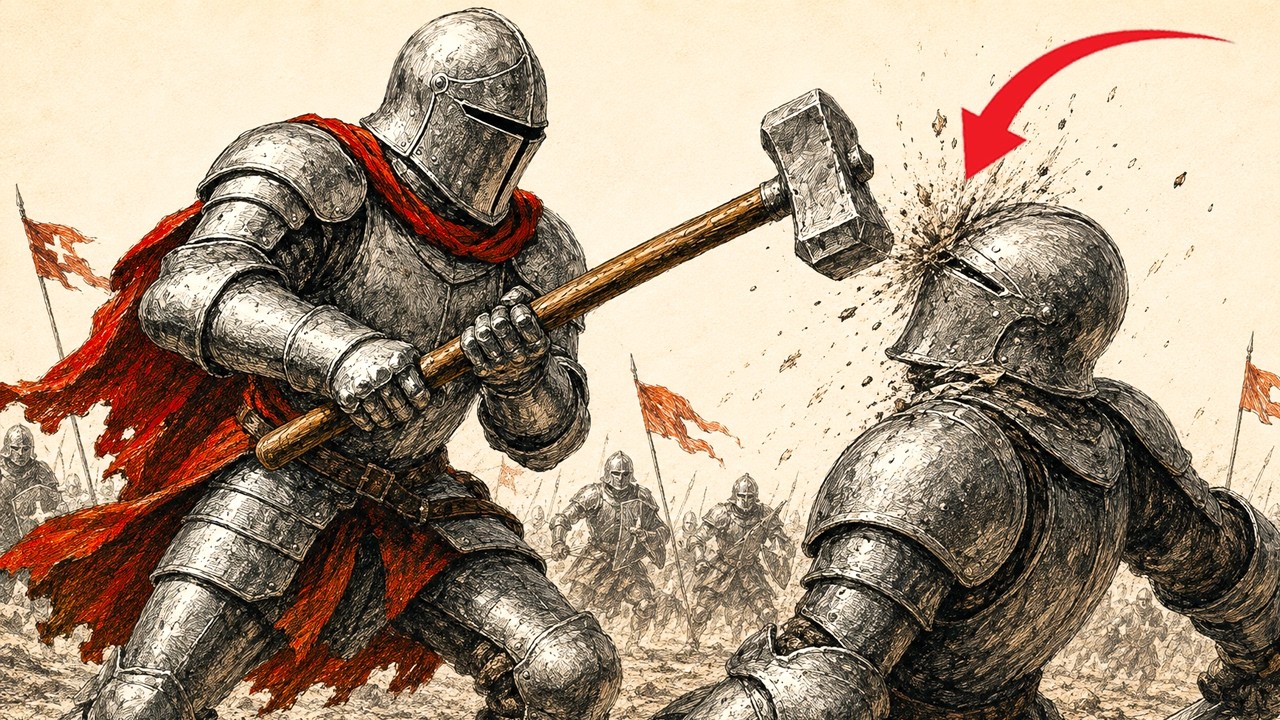
A full harness cost as much as a small farm, and if you could afford it, a sword could almost never kill you. It could still kill you, but it took work. It took getting within arm’s reach of a man who also wanted to kill you. It took finding the gaps: behind the knee, under the armpit, inside the visor.
And it took a weapon that did not care about armor at all. That era produced three weapons that mattered. The war hammer, three feet of forged steel with a flattened striking face on one side and a curved spike on the other. The pollaxe, a five-foot ash shaft fitted with an axe head, a hammer face, and a spear point.
And the rondel dagger, a stiff, narrow blade with a needle point, designed for exactly one purpose: finding the spaces between plates. These were the tools that actually won fights. The sword, by contrast, was a sidearm, the medieval equivalent of a military pistol: useful in the last meters of your life, but rarely what decided a battle against an armored opponent. It was a symbol of status, worn at court, blessed by bishops, polished for ceremonies.
On the field, it failed. The physics were simple. A blade against a hardened curved steel plate did about as much as a butter knife against a bank vault. The fighters understood this.
By the late fourteenth century, professional men-at-arms had abandoned the sword as a primary weapon. In its place they carried the ugly things: hammers, pollaxes, polearms with hooks and spikes. Men trained with them from adolescence. Fencing manuals from the period, like those written by Fiore dei Liberi around 1409 and Hans Talhoffer in the 1440s, are filled with techniques for grappling, dagger work, and defeating a fully armored man by throwing him to the ground.
Roughly half of the content in the great medieval combat manuals concerns wrestling without weapons and killing with the dagger. The masters who trained knights spent as much time teaching them to struggle in steel as to swing a blade. That was what it actually meant to be a knight. The manuals did not describe elegant duels.
They described striking, grabbing, throwing, and finishing a man on the ground. The battle itself did not begin with swords. It began with the charge. A late medieval knight carried a twelve-to-fourteen-foot lance of ash with a steel head, couched under his right arm, with the full weight of horse and rider behind it.
It was the most kinetic weapon on any pre-gunpowder battlefield, and it was a one-use weapon. It shattered on impact by design. That was not a failure. A solid lance driving the momentum of a galloping warhorse into a single steel point could punch through mail and, in some documented cases, plate.
But after that first shock, the lance was a broken stump. The fight then became something else entirely. The horse died first. Any competent infantryman facing a knight aimed for the animal: a dead horse fell on its rider, a wounded horse threw him into the dust.
A knight who had seemed invincible three seconds earlier became a man inside very expensive metal, disoriented. The most valuable noble in Europe was worth exactly as long as his horse stayed standing. When the charge hit, the sound was not a single crash. It was a series of collisions, dozens, then hundreds, of individual lance strikes.
Chroniclers described it as thunder. Survivors said it was the loudest silence they ever heard, because their ears simply stopped processing sound after the first impact. Dust rose instantly. Within a minute of first contact, visibility in the field dropped to about ten feet.
Banners vanished. Formations dissolved. Men who had been part of a hundred-strong cavalry force found themselves alone in a swirl of dust, hooves, and unfamiliar heraldry. A French chronicler describing the aftermath of a Hundred Years’ War battle wrote that the field was so full of dust and the noise of weapons that a man could not see his own hand before his face, and knights struck everything that moved, killing as many friends as enemies in the first press.
In that chaos, a man in full armor was a walking siege engine. Swords slid off him. Arrows bounced off angled steel. Spear thrusts glanced away.
But when he met another fully armored man, the balance reversed. Now his weapons failed too. The fight became wrestling. It became the exploitation of gaps.
It became killing at very close range. And it lasted about ninety seconds. That was how long a duel between two armored men took once they came within weapon range. Not the elegant three-minute exchanges of the movies.
Ninety seconds of the most desperate, brutal physical work two grown men could do to each other. The man who won was almost never the better swordsman. The man who won was the one who closed and grappled first. Consider the kind of action that decided such fights.
A hammer blow to a helm did not need to break the steel. It only needed to move it. Inside the steel, the skull moved with it. Concussion.
A man in full armor staggered for a second, and in that second the hammer found his knee, his back, or his throat. The heavy war hammer, even swung with full force, rarely penetrated a good helm directly, as historical testing on period armor has shown. What it did was worse. It did not need to crack the steel.
It only needed to move it, and the man inside was finished, just not yet dispatched. In the press, this happened dozens of times per minute. A hook caught a knight’s ankle and dragged him down. A hammer struck a helm and the man inside went limp for three seconds he never got back.
A dagger found an armpit. A hammer hit a raised elbow and turned it into a joint that no longer worked. Men who fell in that press were often not killed by weapons at all but suffocated, crushed beneath the weight of other armored men who fell on top of them and could not get up. Exhaustion killed as surely as any blade.
A knight in full harness could fight at full strength for two or three minutes before his arms began to fail. After that, he was a target. The fight between Robert and Guillaume was typical. Robert had fought six campaigns.
He knew the truth. When Guillaume swung his sword in a classic cut at Robert’s neck, the blade landed on the armored shoulder and did exactly what such blades always did against such plates: it slid, it bounced, it left a scratch. Guillaume felt the shock run up his wrist. His body did the calculation his mind had not yet accepted.
The sword had failed. The move he had practiced ten thousand times on a training post had failed. That single second of hesitation was the moment Robert was waiting for. He stepped inside the sword’s reach, brought the hammer in a short, vicious arc against the outside of Guillaume’s knee, and dropped him.
The armored leg collapsed, not necessarily broken, but the shock had traveled through the femur to the hip, and Guillaume could not bear weight on it for four or five seconds. He staggered. In a fight between two armored men, staggering was close to losing. Robert closed the remaining distance and dropped his hammer.
At close range against an off-balance opponent, the hammer was a hindrance. He grabbed Guillaume by the top of his armor with his left hand, by the wrist of his sword arm with his right, and did what the fifteenth-century manuals describe with patient precision: he wrestled. He shifted his weight, drove his hip, and hooked his right foot behind Guillaume’s left leg, which was already failing. It was a grappling move you can find almost unchanged in Talhoffer’s manual from the 1440s.
It was also the move a farmer’s son used to trip his brother. On the battlefield, wearing sixty pounds of steel, it ended a nobleman’s life. Guillaume went down hard, flat on his back in full armor with a man kneeling on his chest. No one in a full suit of plate armor, once on his back with an opponent on top, ever got up again.
Robert reached for the small blade at his waist. Every armed man carried one. The rondel dagger had one purpose: to find the gaps in an opponent’s armor: the visor, the armpit, the groin, the gap between the helm and the gorget. It was the weapon that actually killed armored men.
Every fencing manual from the period treats it with a seriousness that movies reserve for magical swords. Robert’s left hand went to the visor of Guillaume’s helm. He did not try to open it. Good visors were designed not to open from the outside.
He hooked his thumb into the slit. That was enough for leverage. He pulled. Some visors moved; some did not.
The manual authors were explicit about this. Fiore had entire techniques devoted to blinding an armored opponent by controlling his vision slit. If the visor moved, the game was over. If it did not, you went for the armpit.
Guillaume was still fighting, thrashing violently, trying to throw Robert off while wearing full armor, with sixty pounds of his own equipment pinning him to the ground and another armored man on top of him. His struggles accomplished almost nothing. The dagger went into the gap between the visor and the lower plate protecting the face. It did not go deep.
It did not need to. The blade was stiff enough not to bend, narrow enough to enter. It reached soft tissue almost immediately. Whether it pierced the eye, the cheek, and reached the brain, or the throat, the sources describe three different outcomes in different battles and different manuals, but the result was the same.
Guillaume stopped moving after about four seconds. That was what killing an armored man looked like. This was not an isolated scene. At Agincourt in 1415, thousands of French dead were recorded, but many of them were not killed in the charge.
They were killed exactly the way Guillaume was killed: on the ground, in the dust, by English soldiers who walked among the fallen French knights and dispatched them with daggers through the helm openings. Some of those English soldiers were not knights at all. They were common archers. The idea that the noble warriors of France were killed by their social equals in honorable combat is one of the great lies medieval Europe promoted.
The Burgundian chronicler Jean de Wavrin, who witnessed several major battles of the Hundred Years’ War, recorded after one of them that the nobles of France were butchered, a large part of them killed by the basest of the English, who finished them off with knives while they lay on the ground unable to rise. That was not literature. It was a professional soldier trying, and largely failing, to reconcile what he had been raised to believe about war with what he had actually seen. After the fighting ended, the romantic myth collapsed entirely, not in the heat of combat but in the cold calculations that followed.
The first men onto the field were not medics or priests. They were looters. Sometimes soldiers of the winning side, sometimes camp followers, sometimes local peasants who had watched from the woods and now came out with knives to take what the armored men no longer needed. A dead knight in full armor was worth a fortune.
His armor alone could sell for years of a laborer’s wages. His weapons, rings, belt, boots, everything. The wounded who could not prove they were worth a ransom were killed. This was not a rumor.
It is documented in almost every major battle of the era. A man in expensive armor, groaning on the ground, unable to name his family or ask for protection, was finished off by whoever found him. It was not personal. It was economic.
Killing him was faster than finding out whether he was worth keeping alive. Guillaume, the man Robert killed, was stripped of his armor within an hour of his death. His beautiful sword, blessed by a bishop, useless in the fight, was picked up by a common soldier and eventually sold. His body, unrecognizable without the heraldry on his shield, was buried in a mass grave with about sixty other men.
For the survivors taken prisoner, a different, largely bloodless drama began. The ransom system was the real economic engine of medieval chivalric warfare. A captured nobleman was not a prisoner in the modern sense. He was a valuable asset.
His captor became his host. He was treated well, fed, sometimes allowed to move freely while messengers rode to his family with the bill. The bills were enormous. Entire estates were mortgaged to recover one captured son.
Sometimes it took years. Sometimes it bankrupted the family. The most famous ransom of the Middle Ages was paid for King John II of France after the Battle of Poitiers in 1356: three million gold crowns, roughly double the annual royal revenue of France. John died before it was fully paid.
At the lower levels, the logic was the same. If you could afford armor, you were probably worth ransoming. Robert, leaving the field with two captured men, had just secured his income for the next twelve to eighteen months. This was why the war hammer mattered, not only because it killed, but because it crippled an opponent without killing him when a professional wanted that.
A skilled fighter with a hammer could drop an opponent unconscious, paralyzed, or with a broken limb, then decide in that quiet moment after the strike whether the man on the ground was worth more alive or dead. The sword offered no such distinction. It was either a killing tool or a useless one, with almost no middle ground. Robert survived his campaigns.
Men like him usually did, if they were experienced, if they chose the right weapon, if they maintained their armor, and if they were lucky. He died in his fifties, in his own bed, probably of a disease his doctors could not name. His hammer went to his nephew. His sword, which he had barely used in twenty years of combat, was buried with him, because that was what tradition required, and by then tradition mattered more than the truth about what had actually kept him alive.
The myth of the shining knight with the glorious sword was not medieval at all. It was a nineteenth-century invention. A generation of European writers, painters, and amateur antiquarians took the raw material of the Middle Ages and recast it into something the knights themselves would barely have recognized: a world of gleaming blades, elegant courtesies, and moral clarity. Walter Scott, the Pre-Raphaelites, the Gothic Revival: they gave us the knight of our imagination, and they got him almost completely wrong.
The real knight was a professional worker in violence, wearing expensive mechanical engineering. He carried the sword for status and the hammer for work. He fought on foot as much as he fought on horseback. He killed with a nine-inch blade through a two-inch gap in another man’s helm, kneeling on that man’s chest in the dust, with sixty pounds of sweat-soaked steel plates pressing down on his shoulders.
The sword, which we assumed was the center of the story, never was. The hammer was the story. The dagger was the story. That was the war.
Paintings never show the second hour of a battle: men crawling on hands and knees searching for dropped weapons, the wounded choking inside their own helms, unable to lift their arms to undo the straps. The survivors did not speak of the details. There are almost no direct descriptions in the entire medieval archive of what it truly felt like to kill an armored man. The men who knew did not write it down.
And by the time a few of them did begin writing their memoirs, the myth had already taken root. The rondel dagger through the eye slit did not fit the legend, so it was quietly ignored. The opening image, the man in the torn red cloak with the hammer raised, was the truest picture of medieval knightly combat ever offered. Not the elegant duel, not the sword through the heart, but a huge man with a heavy tool working on another huge man in the dust at close range until one of them stopped moving.
Every painting that shows you something prettier is showing you what the survivors wanted to remember, not what they actually did. The sword survived in the paintings, because the paintings were made by men who had never fought. The hammer survived in the ground, in the fencing manuals, in the ransom records, and in the silent knowledge of the men who had actually used it.
That is the version worth trusting.