Janet Norton Lee was not a typical society mother. She was a strategist who viewed love as weakness and marriage as a financial contract. The media later described her as a social climber, but the reality was more complex. She systematically shaped her daughters, Jacqueline and Lee Bouvier, into instruments for conquering the American elite.
Born in Manhattan in 1907, Janet was the daughter of James T. Lee, a real estate mogul who helped build the legendary 998 Fifth Avenue. Despite his wealth, the family lacked the one currency that mattered most in early 20th-century New York: pedigree. Both of her parents were children of Irish Catholic immigrants. In the 1920s, the East Coast elite was a closed fortress, and the Irish were seen as laborers, not aristocrats.
Janet absorbed these hidden slights. She did not rebel against this class discrimination. Instead, she responded with calculated assimilation. She buried her direct lineage entirely and began promoting a new story: that she was a direct descendant of the aristocratic Lee family of Maryland and Virginia, the family of Confederate General Robert E. Lee. She repeated the lie until it became accepted fact.
To make the forgery flawless, she needed the right presentation. She attended Miss Spence’s School in New York, a finishing school designed to train elite girls in high-society mechanics. She studied the postures, accents, and vanities of wealthy girls. She later attended Sweet Briar College and Barnard College but never completed a degree. She was not interested in academics; she was extracting social connections.
She chose the equestrian circuit as her stage. In the 1920s, competitive riding was reserved for a specific class. Janet trained with intense discipline and became a skilled show jumper. She won three major championships at the National Horse Show, embodying the image of the perfect aristocrat while the New York elite watched from the stands.
She secured positions on the boards of the Redwood Library and the Newport Historical Society. She even won a position as honorary director of the Robert E. Lee Memorial Association in Stratford, Virginia. The granddaughter of Irish Catholic immigrants had successfully infiltrated the guardians of Southern aristocratic history.
By 1928, Janet had built an impeccable aristocratic facade. She needed a husband who could cement her fabricated lineage. She found him in John Vernou Bouvier III, known as Black Jack. He was a stockbroker, a ladies' man, and a prominent figure in the finest gentlemen's clubs. His family, the Bouviers, claimed direct descent from French nobility.
Their marriage was a mutual con. She married him because his name was in the Social Register. He married her because her father ran a bank. They were both skilled deceivers, each believing they had caught a superior prize.
The illusion lasted one year. The Wall Street crash of 1929 destroyed Black Jack's finances. He turned to heavy drinking and reckless gambling. During this decline, Janet gave birth to their daughters: Jacqueline in 1929 and Caroline Lee in 1933. Black Jack's behavior became more erratic and cruel. His chronic infidelity was public and humiliating.
The breaking point came when Janet opened a newspaper to find a photo of her husband holding hands with another woman in public. The public humiliation was absolute. In 1936, she took her daughters and left. The divorce was finalized in 1940. In that era, divorce was a social death sentence for a prominent Catholic family, but Janet's survival instinct overrode her fear of the institution.
The divorce left Janet facing a terrifying reality. She was a 33-year-old divorced Catholic mother of two, socially damaged and facing financial distress. The court granted her $1,000 a month in alimony, a huge sum for an average family but barely enough to maintain an aristocratic appearance in her world. She had a pathological fear of poverty.
She took a job as a fashion model in a luxury store, a humiliating step down for a former society queen. She also had to ask her parents for financial help. Behind closed doors, she imposed strict financial discipline, cutting grocery budgets and skipping meals so her daughters could have a live-in maid and a private tutor. She was starving in secret so her daughters could shine in public.
She needed a permanent solution. She began looking for a second husband with the cold eye of a greedy investor. She found Hugh Dudley Auchincloss, known as Hoodie. He was a prominent lawyer, a former intelligence officer, and the heir to the Standard Oil fortune. He owned Merrywood, a sprawling estate in Virginia, and Hammersmith Farm, a 28-room Victorian mansion in Newport.
They married in June 1942. It was a rushed, practical transaction. After the honeymoon, Hoodie made a private confession: he suffered from chronic impotence. Janet did not view this as a romantic tragedy. She saw it as a critical weakness in her contract. She needed children to secure her claim to the Auchincloss fortune.
She turned to artificial insemination, a highly experimental, risky, and taboo medical procedure at the time. It was condemned by the Catholic Church and would have caused a scandal if discovered. She arranged the procedure in absolute secrecy. It worked. She gave birth to Janet Jennings Auchincloss in 1945 and James Lee Auchincloss in 1947. She had successfully tied her lineage to one of the most powerful industrial fortunes in America.
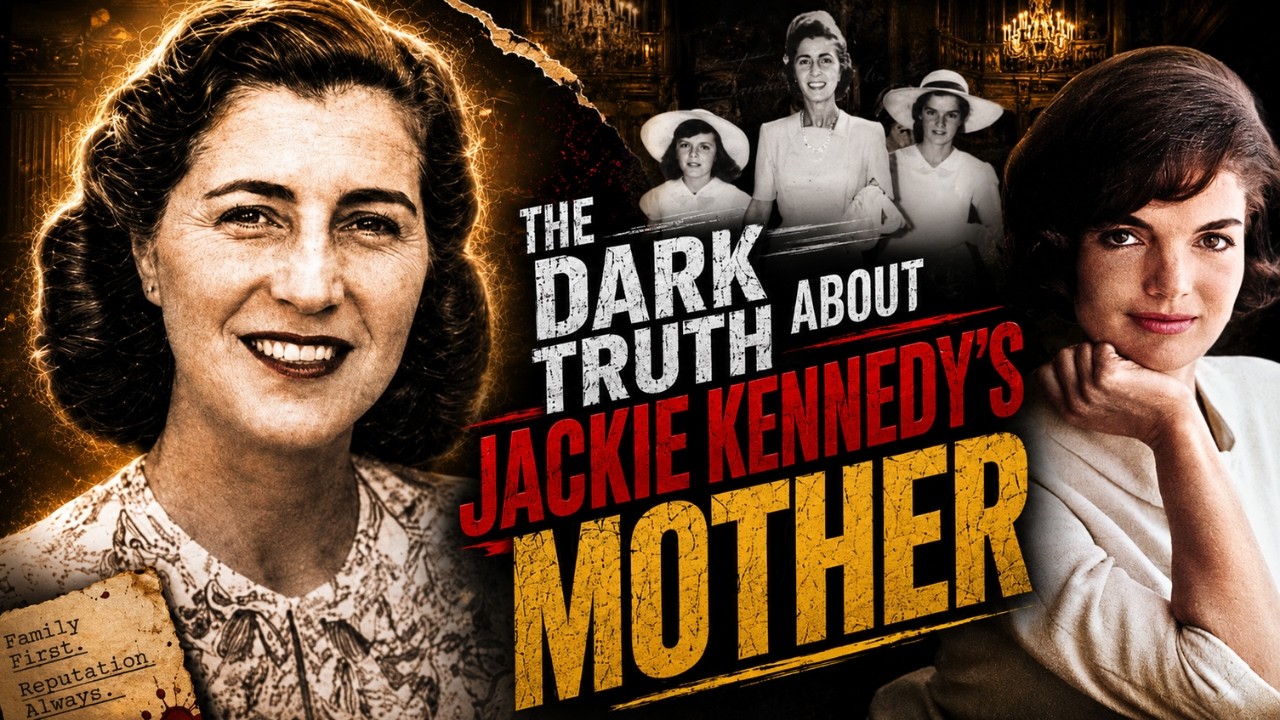
Now secure in her wealth, Janet turned her full attention to her two daughters from her first marriage. She did not view raising them as maternal work but as a military campaign. She imposed what historians later called the "Geisha Curriculum," a rigorous home training program designed to transform Jackie and Lee into mistresses of social manipulation.
Every detail of their daily life was designed for this goal. Dinner at Merrywood was a testing ground where only French was spoken. Fluent French was the language of the international aristocracy. If a daughter made a mistake, Janet's rebuke was swift and harsh. Their intellectual training was carefully monitored, focused on classical literature, Renaissance art, and European history—not for pure knowledge, but as a tactic to attract powerful men.
Physical discipline was equally important. Janet used horseback riding as a psychological test, demanding excellence and ordering Jackie back on the horse immediately after a fall. She wanted her daughters to learn how to fall, absorb blows, and rise without anyone seeing them cry.
Janet also taught her daughters the dark arts of psychological manipulation. She trained them to be composed, elegant, reserved, and never eager. They learned to listen to men with intense focus, making the man feel like the center of the universe. Her final strategic rule was brutally practical: in the world of old money, parents controlled the fortunes. So the primary target was not just the suitor, but his parents.
The atmosphere in the Auchincloss estates was gloomy and suffocating. Janet had an explosive temper, and her primary target was her eldest daughter, Jacqueline. Jackie looked strikingly like her father, Black Jack Bouvier. For Janet, looking at Jackie's face was a daily reminder of the man who had humiliated her. She unleashed her unprocessed trauma and resentment directly onto Jackie.
She subjected her daughter to a cruel campaign of physical criticism. She mocked Jackie's unruly hair, criticized her large hands and wide feet, and shamed her for her broad shoulders and flat chest. Janet made Jackie feel like a monster. This constant bullying caused deep psychological damage. Years later, as First Lady, Jackie created her famous "bouffant" hairstyle to balance her features and wore her signature white gloves to hide the hands her mother had convinced her were ugly.
The abuse was not just verbal. During the 1940 divorce proceedings, a former maid testified under oath that she had witnessed Janet beating her two young daughters. It was a systematic tool to enforce absolute submission.
By the early 1950s, Janet's training program had polished Jackie into a pillar of aristocracy. She was multilingual, sharp, and captivating. The target was identified in May 1952 at a dinner party hosted by journalist Charles Bartlett. Across the table sat John F. Kennedy, the charismatic young congressman from Massachusetts.
On paper, the Kennedys represented a psychological conflict for Janet. They were Irish Catholics with new money, the exact opposite of the old elite Janet had spent her life infiltrating. But Janet was a pragmatist. She saw the unstoppable speed of Jack Kennedy's political trajectory. She realized that merging her carefully constructed Lee dynasty with the Kennedy political machine would create an invincible American dynasty.
At the dinner, Jackie deployed her training with precision. While other women flocked to the handsome congressman, Jackie remained composed. She spoke with sharp intelligence, showed her deep knowledge of history, and then gracefully withdrew, leaving him fascinated. Jack Kennedy was captivated.
When Kennedy proposed with a large emerald and diamond ring, Jackie did something that nearly gave her mother a breakdown. She did not accept immediately. She told him she needed time to think and left for London for a month to cover Queen Elizabeth II's coronation as a photographer. Janet was frantic. She saw Jackie's hesitation as a reckless, catastrophic gamble. When Jackie finally returned and accepted, Janet took control immediately.
The wedding was set for September 12, 1953, in Newport. Janet oversaw every detail to ensure it displayed absolute aristocratic power. She booked St. Mary's Church and prepared the grounds of Hammersmith Farm for over 700 guests. Her cruelty surfaced in her treatment of Ann Lowe, a talented African American fashion designer hired to create Jackie's famous wedding dress. When a flood destroyed the dresses ten days before the wedding, Lowe and her team worked around the clock to remake them at their own expense. When Lowe arrived at Hammersmith Farm to deliver the gowns, she was told to use the back service entrance. She refused and threatened to return the dresses to New York. Lowe won that confrontation. But later, when the press asked Janet about the designer, she coldly refused to name Lowe, saying only that it was done by a colored seamstress.
Janet's ultimate cruelty came on the morning of the wedding. Black Jack Bouvier, Jackie's biological father, was supposed to walk her down the aisle. He had arrived in Newport drunk and emotionally unstable. Janet knew he was a ticking time bomb. Some historical accounts suggest she deliberately supplied him with alcohol the night before, setting a trap. Whether she orchestrated his drunkenness or exploited his addiction, her response was decisive. She barred him from the ceremony. She ordered her current husband, Hugh Auchincloss, to walk Jackie down the aisle instead. Jackie, who adored her father despite his flaws, walked down the aisle hiding immense inner pain behind a practiced smile. Black Jack sat alone in his hotel room, crying, absent from his daughter's triumph.
As Jackie rose to become First Lady in 1961, Janet moved into a new role: the hidden manager behind the scenes. She was consulted on Jackie's wardrobe, ensuring every Oleg Cassini suit and pillbox hat conveyed the perfect mix of modern elegance and aristocratic power. But her most important role was darker. She served as Jackie's emotional support and practical guide through the deepest trauma of her marriage.
Jack Kennedy was a chronic womanizer. His affairs were numerous and reckless, conducted under the roof of the White House. For Jackie, history was repeating itself with painful precision. She had married a man just like her father: charming, powerful, and completely incapable of fidelity. When Jackie turned to her mother, Janet did not offer emotional comfort. She offered the harsh survival tactics she had learned from her own failed marriage. She reminded Jackie that divorcing Black Jack had plunged them into poverty and social exile. Divorcing a president was impossible. Janet trained Jackie to emotionally detach and to exploit her husband's guilt. Whenever Jack's affairs became humiliating, Jackie, guided by her mother's practical approach, demanded enormous concessions, often in the form of precious jewelry or expensive art.

While Janet managed the First Lady, she was also orchestrating an equally ambitious campaign for her second daughter. Lee had always lived in her older sister's shadow. Janet recognized Lee's desperate desire to outshine Jackie and directed it toward the only path she respected: marriage. Lee's first marriage to Michael Canfield, a publishing heir, was respectable but lacked the influence to compete with the White House. In 1959, Lee set her sights on a target that would give her the one thing Jackie didn't have: a royal title. His name was Prince Stanislas Radziwill, a Polish nobleman known as Stas.
There was a massive institutional problem. Both Lee and Stas were divorced, and the Catholic Church did not recognize their civil marriage. With John Kennedy about to become the first Catholic president, having a sister living in an unrecognized marriage was a political liability. Janet refused to let institutional rules impede her family's rise. She mobilized the full power of the Kennedy political machine and the Auchincloss fortune. They successfully pressured the Vatican and obtained a rare, controversial annulment of Lee's first marriage. Once obtained, Janet fully endorsed Lee's new identity. Lee began introducing herself globally as Princess Caroline Lee Radziwill.
It was a masterclass in hypocrisy. Poland had officially abolished all noble titles in 1921. Under international law, the title was completely void. But Janet, the woman who had spent her youth claiming kinship with the Lee family of Maryland, understood that truth mattered less than presentation. If you insist people call you a princess and have the money and clothes to back it up, society will eventually bow.
Janet's support for Lee's romantic pursuits was highly conditional. When Lee's actions threatened to cast a shadow over the Kennedy administration, Janet transformed from supportive mother to ruthless enforcer. The critical clash came in the early 1960s and involved Aristotle Onassis, the Greek shipping magnate. He was a billionaire, a pirate, and a man with a scandal-ridden reputation. While still married to Prince Radziwill, Lee began a passionate, public affair with Onassis. Lee believed he was her golden ticket out of Jackie's shadow. She was ready to divorce Stas and marry the Greek billionaire.
Janet moved with the force of a hurricane. She viewed Onassis not as a romantic partner for her daughter but as a deadly political liability. Jack Kennedy was about to face his 1964 re-election campaign. The last thing the White House needed was the First Lady's sister divorcing a Catholic prince to marry a controversial Greek businessman under investigation by the Justice Department. Janet traveled to Europe and entered into fierce confrontations with Lee. She ordered her daughter to end the relationship immediately. Janet broke the love affair completely, forcing Lee to return to her unhappy marriage to Prince Radziwill. Lee complied, carrying a deep resentment that would poison family dynamics forever.
By 1963, Janet was at the height of her hidden power. She had made a First Lady. She had manufactured a princess. She had successfully hidden the deep dysfunctions of both her daughters' marriages behind a screen of geopolitical glamour. But no amount of money or planning could change the course of events. The final test of Janet's steely character was approaching.
Despite engineering the rise of the most famous First Lady in American history, Janet remained a woman without a country in the public eye. The Kennedy image machine systematically pushed her into the shadows. The White House, managed by experts like Pierre Salinger and funded by Joe Kennedy's fortune, crafted the myth of Camelot. They promoted an image of youthful, spontaneous charm. Janet simply did not fit this image. She was a relic of a bygone elite era. The Kennedy machine made a deliberate decision to minimize her public appearances. The press followed suit, portraying her as a cold, scheming social climber who had sold her daughters to the highest bidder.
Those inside the White House saw a different reality. Letitia Baldrige, Jackie's powerful social secretary, defended Janet fiercely against this narrative. She noted that Janet was intensely loyal, very intelligent, and fiercely protective of her inner circle. She was content to manage logistics and household affairs, serving as a hidden prop to protect Jackie's perfect public image.
The media's bias became clear at a family event. When Lee Radziwill graduated from Concord Academy, the entire family gathered to celebrate. Photographers swarmed, eager to capture images of the glamorous Kennedy family. As the mother of the graduate, Janet made sure to appear in the family photos. But when the newspapers were published the next morning, the editors had literally cropped Janet out of the frame. The published photos focused entirely on John F. Kennedy, Robert Kennedy, and their radiant daughters. Janet, the woman who had dedicated her adult life to the struggle for social visibility, was literally erased from her own family's history. She accepted her role in the shadows, understanding that true power did not require headlines.
By the fall of 1963, the glossy facade of Camelot was cracking. In August, Jackie gave birth prematurely to a son, Patrick Bouvier Kennedy. The infant lived only two days before dying of a respiratory issue. The loss devastated Jackie, plunging her into severe clinical depression. When Jackie accepted an invitation from Aristotle Onassis to recover on his luxury yacht, the Christina O, Janet was reportedly furious. She had already fought a brutal war to keep Lee away from the scandalous Greek billionaire, and now he was surrounding her eldest daughter. But Jackie, the First Lady of the United States, was beyond her mother's direct control.
Then came November 22, 1963. Janet was playing golf at the Chevy Chase Club in Washington, D.C. She was 55, wealthy, and completely unaware that the axis of American history was about to shatter. A club employee rushed onto the course. The president had been shot in Dallas. The severity of the injuries was unknown. The First Lady's condition was uncertain. In that moment, the aristocratic facade Janet had spent fifty years perfecting vanished. She did not faint. She did not succumb to hysteria. Her cruel, practical survival instinct took over. She dropped her golf clubs, rushed back to the clubhouse, and immediately called her husband, Hugh Auchincloss.
When confirmation of the president's death came, Janet and Hugh rushed to Bethesda Naval Hospital in Maryland. The scene was a nightmare of flashing lights, military personnel, and weeping political aides. When Jackie finally arrived at the hospital, she was wearing her famous pink Chanel suit, heavily stained with her husband's blood and brain matter. When Janet saw her daughter covered in assassination blood, she understood immediately what Jackie was doing. Jackie was weaponizing the shock, turning her blood-stained suit into a historical indictment. Janet, who had spent decades teaching her daughter how to control the narrative, recognized the brilliance of this horrifying move. She did not try to force Jackie to change. She stood beside her, a silent, unwavering support in a hospital room full of broken men.
For three days, Janet practically moved into the family quarters of the White House. The Kennedy political operatives controlled the official funeral arrangements. But upstairs, Janet managed the devastating collateral damage. Her most painful responsibility was the children. Caroline was five years old. John Jr. was days away from turning three. Their beloved nanny, Maud Shaw, broke the news to Caroline. But Janet provided the physical and psychological support. The woman who had ruthlessly mocked Jackie's appearance and imposed a harsh curriculum completely abandoned her authoritarian armor. When the children cried, she did not tell them to toughen up. She held them, fed them, and provided the only sense of normalcy left in their shattered world.
Jackie was able to maintain her composed exterior before the cameras only because she knew her mother was defending her behind closed doors. When the cameras stopped rolling, Jackie collapsed, and Janet was there to catch her. The media stereotype of the cold, ambitious stepmother faded. Janet proved that beneath her calculated marriages and fake aristocratic lineage, she possessed a will of steel. When the regime fell, she did not run. She walked into the rubble, gathered her broken family, and carried them through the fire.
The trauma of Dallas had lasting effects. By the mid-1970s, the family dynamic had changed irrevocably. Jacqueline Kennedy shocked the world and her mother by marrying Aristotle Onassis in 1968. It was a move that defied Janet's earlier intervention in Lee's romance with the Greek billionaire, but Jackie now had global influence that made her mother's objections irrelevant. Lee Radziwill was floundering in European high society, struggling to find an identity outside her sister's and mother's shadows.

Janet's marriage to Hugh Auchincloss was also nearing its end. His health had been declining for years. In November 1976, he died. At 69, Janet was a widow. For the first time since her desperate, impoverished days following her divorce from Black Jack Bouvier, she was free from a husband. But this time, she was not a frightened, bankrupt social outcast. She was an extremely wealthy woman of immense influence. Her life's work was complete.
In that moment of total security, Janet made the most surprising and destructive decision of her life. Within one month of Hoodie's death, she remarried. The speed shocked high society. But the choice of groom was more telling. His name was Bingham Willing "Be" Morris. He was not an industrial giant or a political dynasty. He was an investment banker and, most importantly, a childhood friend of Janet's.
To understand this marriage, one must look at Janet's psychological exhaustion. Her first marriage was a mutual con built on a desperate need for pedigree. Her second was a cold, calculated merger designed for financial security. For fifty years, she had treated marriage as a battlefield. She was exhausted. Bingham Morris represented something she had never allowed herself to experience: security without strategy. Because they had known each other since childhood, Morris knew the truth about her origins. She did not have to pretend. For the first time in her life, she lowered her defenses. She married seeking companionship. It was a fatal mistake.
Behind closed doors, Bingham Morris revealed a cruel and toxic nature. The marriage quickly turned into a nightmare of abuse. Morris subjected Janet to severe elder abuse, systematic psychological cruelty, and physical hostility. The tragedy was profound. Janet had once had a terrifying temper capable of controlling senators and billionaires. Now, stripped of her fierce independence by age and misplaced trust, she was trapped as a victim in her own home.
Janet's daughters were no longer the frightened children of the Merrywood dining room. When rumors of Morris's behavior reached Jacqueline, her reaction was swift and decisive. Jackie spent her life learning from her mother how to use power, and now she used those same methods to save her. In 1981, Jackie forced a formal separation, legally wrenching Bingham Morris away from her mother. Janet was physically safe, but the abuse had unleashed a more insidious enemy. By the early 1980s, the brilliant, calculating mind that had engineered the Camelot dynasty began to deteriorate. Janet was diagnosed with Alzheimer's disease.
For a woman like Janet Lee, Alzheimer's was a psychological horror designed specifically for her. Her entire identity was built on absolute control. She controlled her history, her image, her daughters, and her environment. She relied on a razor-sharp memory to navigate the complex social networks of the elite. As the disease ravaged her brain, it systematically dismantled her defenses. The aristocratic facade she had spent seventy years building began to crumble. She forgot the French vocabulary she had forced her daughters to speak. She lost her perfect posture. The carefully constructed identity of the society queen faded, leaving behind a frightened, confused elderly woman.
In one of these moments of terrifying clarity, Janet confronted the greatest failure of her life: the psychological destruction of her second daughter, Lee. Throughout their childhood, Janet had been clear in her preference. She focused her ambition and cruelty on Jackie, making her a masterpiece. Lee was treated as a second choice, a backup asset. Janet had deliberately sabotaged Lee's only chance at independent global influence when she forced her to end her relationship with Aristotle Onassis, then stood silently by as Jackie married him years later. Lee's resentment was toxic and deep-rooted.
Knowing her mind was fading permanently, Janet tried to restore balance. True to the ideology that governed her entire life, she did not attempt to fix an emotional problem with a sincere apology. She tried to fix it with money. She secretly arranged a bank transfer of $750,000 directly to Lee Radziwill. In the late 1980s, this was a massive sum. In Janet's materialistic worldview, this was the ultimate expression of maternal love and regret. It was guilt money, an implicit acknowledgment of her failure toward her younger daughter. But the transaction failed its emotional purpose. Childhood cannot be reclaimed. A check cannot erase decades of neglect and psychological manipulation. Lee accepted the money but not the apology.
As Janet sank into the darkness of Alzheimer's, her illness became the final cruel test of the Geisha Curriculum she had instilled in her daughters. The results were contradictory. Lee Radziwill, clinging to her $750,000 apology, withdrew completely. She refused to participate in the exhausting daily reality of caring for a mother with severe dementia. When family members pressed her, Lee offered a defense that perfectly encapsulated the emotional detachment her mother had taught her. She claimed she was simply too emotionally fragile to handle the stress of the disease. She remained in her glamorous circles in Europe and New York, leaving her mother to the care of nurses and staff.
Jacqueline, however, entered the fray. The irony was profound. Jackie was the primary victim of Janet's rage. She was the one who had been beaten and mocked for her appearance. She had every psychological justification to withdraw. But Jackie possessed a strong sense of duty, a trait she had unintentionally acquired through her mother's strict discipline. Despite being one of the most famous and photographed women in the world, Jackie quietly took over managing Janet's affairs. She visited her mother constantly, sitting in quiet rooms holding the hand of the woman who had once called her ugly and mannish. She dealt with the painful reality of a mother who often no longer recognized her. Lee's refusal to help with Janet's care was the final unforgivable betrayal in Jackie's eyes. The sisters had maintained a tense, competitive relationship for decades, but abandoning their dying mother severed the bond completely. Jackie cut Lee off entirely, and the silence between them became permanent.
On July 22, 1989, at the age of 81, Janet Norton Lee Auchincloss Morris died. Her funeral was held in Newport. The pews of Trinity Church were filled with the remnants of the East Coast elite, political power brokers, and the extended Kennedy and Auchincloss families. It was a solemn, meticulously organized event, exactly the kind of perfect public performance Janet would have wanted.
The defining moment of that day did not occur during the eulogies. It happened in the aftermath, away from the cameras. Bingham Morris, the abusive third husband from whom Janet had been separated, dared to attend the funeral. For years, he had lived comfortably on the margins of the family fortune. His presence at the funeral of the woman he had abused was an insult Jacqueline Kennedy Onassis would not tolerate.
Jackie did not wait for a private moment behind closed doors. She did not delegate the task to a lawyer or male relative. She approached Morris directly, in front of the mourners. The encounter was brief, precise, and completely devoid of emotion. Jackie did not raise her voice or show any grief. She looked directly at the man who had tormented her mother and issued a series of stern commands. She demanded he surrender all of Janet's personal belongings, including jewelry and documents. Then, in a firm, resolute voice, she issued the final eviction order. She informed Morris he was no longer welcome at Hammersmith Farm or any of the Auchincloss properties. She gave him a deadline: pack his belongings and leave the property permanently before sunset. Morris crumbled before Jackie's unyielding focus. He left and was never seen in the family's orbit again.
In that cruel moment of revenge, Janet Lee's ghost was clearly visible in her eldest daughter. Jackie had not only inherited her mother's elegance and beauty but also her capacity for cold, calculated violence when the family barrier was breached. She proved that behind her soft voice, Chanel suits, and literary culture, she was a warrior. She had absorbed the harshest lesson her mother ever taught her: when threatened, do not negotiate, do not cry, eliminate the threat.
Looking at Janet Norton Lee's life is like looking at the secret blueprint of the American elite. History, driven by media obsessed with youth and male political power, has largely erased her. This erasure is a historical error. Without Janet Lee, there would have been no Jacqueline Kennedy. Without Jacqueline Kennedy, there would have been no Camelot myth. Janet was the engineer who designed the cultural icons of the 1960s. The Kennedys had the political ambition and the vast wealth, but they lacked the essential element needed to transition from politicians to legends: polish. Janet Lee, the woman who invented her aristocracy from nothing to escape her Irish Catholic roots, provided that element.
Her life reveals the essential hypocrisy of the American elite. We are raised to believe that aristocratic refinement is a birthright, an innate quality passed down through pure bloodlines. Janet proved it was all a performance. She proved that refinement can be manufactured, lineage can be faked, and the doors of high society can be breached by anyone with enough audacity. She beat the establishment at its own game.
But her legacy is deeply complicated by the human cost of her ambition. The psychological damage she inflicted on her daughters was permanent. She taught them to equate love with financial power. She raised them in an environment where weakness was punished and physical appearance was ruthlessly critiqued. She pitted them in a desperate competition for her approval, a competition that ultimately destroyed their bond. The glamour of the Bouvier women was built on a foundation of deep psychological trauma.
Janet Norton Lee lived a life defined by a refusal to be a victim. From the ashes of a humiliating divorce, staring into the terrifying specter of poverty, she forged a personality of solid steel. She was not a loving mother or a kind woman. But kindness does not build dynasties. She treated the world as a hostile environment to be conquered and controlled. She used every tool available to her—deception, wealth, psychological warfare, and even her own daughters—to build an impenetrable fortress against the weakness she feared above all else. When the true history of the American elite in the twentieth century is understood, Janet Lee will not be remembered as a footnote in the Kennedy saga. She will be known as the mastermind who worked behind the scenes. She demanded perfection, punished weakness, and left behind a legacy proving that the most enduring crowns are always forged in the fire of personal pain. She died knowing the dynasty she built would outlast them all. She had won.