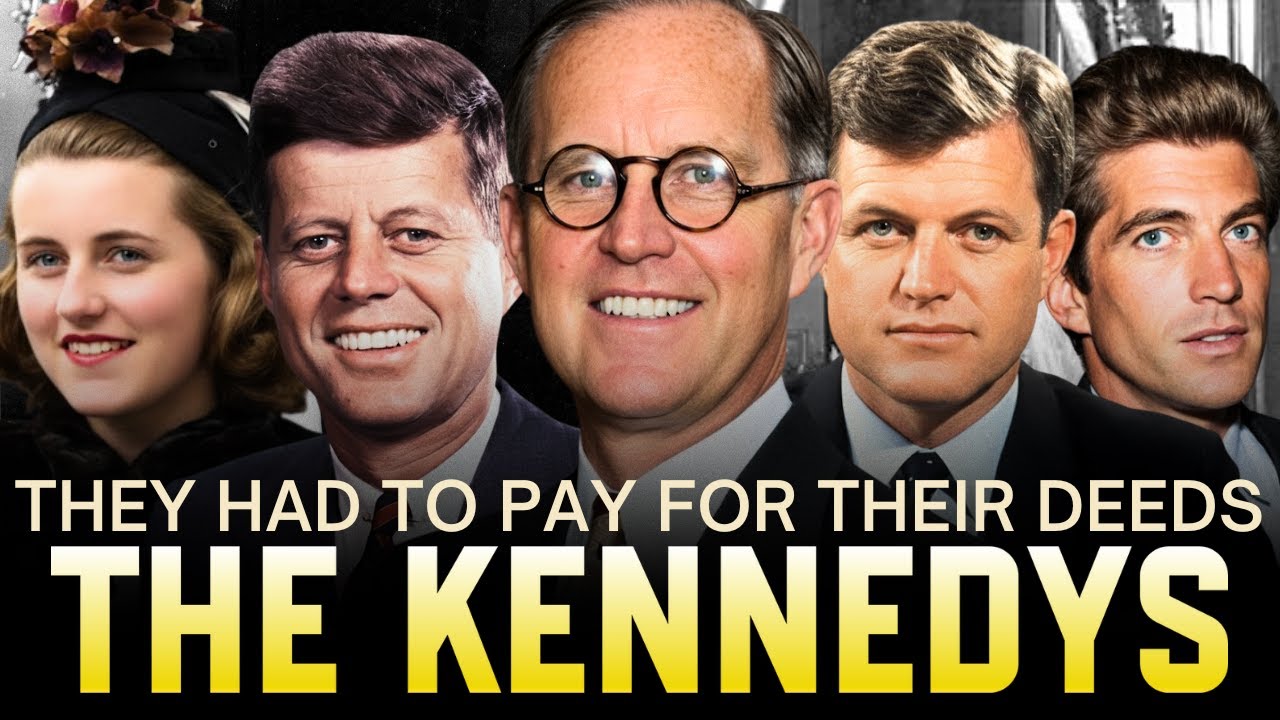
The Kennedy family’s story is often framed through photographs of perfect moments. Images of the family playing football on the lawn at Hyannis Port, or sailing off Cape Cod, helped build a public image of vitality and effortless success. These images were carefully crafted. They promoted a product called “Camelot,” a modern royal court for a democratic nation. But those perfect pictures were designed to bury a more brutal reality.
That reality includes a bullet shattering a skull in Dallas, a pool of blood spreading on a hotel kitchen floor in Los Angeles, and silence under the black water of a tidal pond off Chappaquiddick. The deaths were not random accidents. They were the final bill for a ruthless game the Kennedys started themselves. Every enemy they made, from mob bosses to political rivals, waited for an opening. Every reckless decision and every dirty secret added another stone on the path to those graves.
This is not the story of a dynasty that was assassinated. It is the story of a dynasty that destroyed itself. To understand the tragedies, you must first understand the dream. That dream, with its fierce and uncompromising intensity, began with one man: Joseph Patrick Kennedy.
Born in 1888, he was the son of a Boston politician and a second-generation Irish American who had tasted the bitterness of discrimination from the city’s Protestant elite. From his earliest days, Joe Kennedy was driven by a burning, consuming desire to win. Not just to succeed, but to dominate. He understood how the world worked. Power and money were the weapons you used to protect your family and crush your enemies.
He amassed a vast fortune, first in banking and then in the stock market, manipulating it with predatory genius. He pulled all his money out before the crash of 1929. He moved into Hollywood film production and then liquor importing. He was cunning, ruthless, and staggeringly successful. He married Rose Fitzgerald, the daughter of Boston’s powerful mayor, “Honey Fitz,” uniting the city’s two most prominent Irish Catholic families. Together, they built an empire and raised a clan.
Joe and Rose had nine children, nine beautiful, vibrant, and fiercely competitive children. They were raised to believe that second place was no better than last. Their sprawling compound in Hyannis Port was not just a home. It was a training ground. They learned to debate, to compete in sports, to sail, and to win at any cost. Joe’s ambition was singular and absolute. He had been denied the grand prize of American life because of his Irish Catholic background. But his sons would not be denied. A Kennedy would one day be President of the United States. It was not a wish. It was a decree.
The pressure on his children was immense, an overwhelming burden of expectation that never stopped. The first to carry it was the son named after him, Joe Jr. But the first to break under it was his daughter, Rosemary.
Rosemary Kennedy was born in 1918, the third child and first daughter. Her birth was fraught with tragedy. When Rose went into labor, the doctor was late. A nurse, in a misguided attempt to follow protocol, physically forced Rose to keep her legs closed, delaying the birth for two painful hours. This medical error deprived the infant’s brain of oxygen for too long, causing irreversible damage. Rosemary suffered from developmental disabilities that quietly defined her life and cast the first dark shadow over the Kennedy family.
In an era with little understanding or patience for intellectual disabilities, Rosemary’s condition was a source of deep personal shame for her perfectionist father. The Kennedy family was a brand, an image of vitality, intelligence, and brilliant triumph. Rosemary, with her learning difficulties and volatile moods, did not fit the picture. She was strikingly beautiful, and from a distance, she seemed as bright and charming as her famous sisters, Eunice and Kick. But up close, her struggles were evident.
Joe Kennedy, the master strategist who could bend stock markets and film studios to his will, could not control his daughter. He was haunted by a deep and terrifying fear, not for Rosemary’s safety, but for the potential damage she could do to the family’s reputation. He feared her unpredictable behavior would lead to a public scandal, a sexual slip, or a public outburst that would tarnish the carefully polished Kennedy name and destroy the political future he was building for his sons.
In 1941, behind a wall of secrecy, Joe Kennedy made a unilateral and devastating decision. He had read about a new, radical surgical procedure being touted as a miracle cure for a range of mental illnesses: the lobotomy. It was a crude, brutal, and horrifically imprecise procedure. Without fully consulting his wife Rose, and certainly without his daughter’s consent, he arranged for the 23-year-old Rosemary to undergo the operation.
Doctors Walter Freeman and James Watts performed the surgery while Rosemary was awake on the operating table. They asked her to sing songs, including “God Bless America,” and to recite the Lord’s Prayer. Through two holes drilled in her skull, they inserted a surgical instrument resembling a butter knife and began scraping away at her brain’s frontal lobes. They continued until her speech became unintelligible and her voice fell silent.
The result was not a cure. It was a catastrophe of unimaginable proportions. The surgery did not calm her. It erased her. The vibrant, troubled young woman was gone forever. In her place was someone with the mental capacity of a small child. She could no longer walk properly or speak clearly. She was incontinent. She spent endless hours staring blankly at walls. Her personality, her memories, her very essence, was trapped in an inescapable neurological prison.
In the immediate aftermath, Rosemary Kennedy was quietly and efficiently removed from family life. She was first placed in a psychiatric hospital in upstate New York. Then, in 1949, she was moved to the St. Coletta School for Exceptional Children in Jefferson, Wisconsin. There, she lived for the rest of her life, 56 years, away from the world that was once her home. For decades, her existence was a secret, a black hole in the family’s official history. Most of the Kennedy children were not told the truth about their sister for more than 20 years. She was effectively erased, a living ghost whose vibrant life was sacrificed on the cold altar of political ambition.
While Rosemary’s light was being systematically extinguished, her older brother was preparing to fly straight into the fire. The public facade of the Kennedy family remained a symbol of flawless perfection. The world saw the brilliant, shining sons, not the daughter who had been erased. At the top of this glittering edifice stood Joseph Kennedy Jr., the crown prince of the dynasty. Handsome, athletic, and filled with a confidence bordering on arrogance, he was in every conceivable way a carbon copy of his father.
He was the vessel into which Joe Sr. poured every ounce of his unfulfilled ambition, the heir groomed from birth to seize the one prize that had eluded his father: the presidency. His path was paved with precision. He was sent to the best schools, including the London School of Economics. He attended Harvard Law School. He was prepared not just to learn, but to lead. Unlike his younger, frailer brother, John F. Kennedy, or “Jack,” Joe Jr. was the picture of robust health and effortless superiority. He was the better student, the better athlete, the more natural politician.
When World War II tore Europe apart, the call of duty was a non-negotiable necessity. Both Joe and Jack volunteered for the Navy. Joe chose naval aviation, a prestigious and respected role. Jack, drawn to a less conventional path, took command of a small, fast, and vulnerable patrol torpedo boat in the treacherous waters of the South Pacific.
In August 1943, Jack’s fate took a dramatic turn. His boat, the PT-109, was cut in half by a Japanese destroyer on a dark night. In the fiery chaos, Jack showed exceptional courage and leadership. Despite a serious back injury, he gathered the survivors and towed a badly burned crewman for hours through open water to a nearby island, gripping the man’s life vest strap with his teeth. For days, he risked his life to find food and rescue his men. His survival story became a national sensation, promoted brilliantly by his father.
Suddenly, the sickly second son, who had always lived in the shadow of his formidable brother, was a genuine American hero. For Joe Jr., stationed in England, his brother’s new fame was a source of both pride and intense frustration. The rivalry that was the bedrock of their upbringing surged to the forefront. He had always been the star. Now Jack had a hero’s tale that threatened to overshadow his own steady but less glamorous military career.
After completing his required 25 combat missions, Joe Jr. was eligible to return home as a decorated veteran. But for the Kennedy heir, that was not enough. It was merely ordinary. He needed a final, spectacular act of heroism that would cement his legacy and reassert his place as the family’s primary hero. He found his opportunity in a highly secret, high-risk, and audacious mission known as Operation Aphrodite.
The plan was an early precursor to drone warfare, and it was almost suicidal. The goal was to destroy massive, heavily fortified Nazi V-3 cannon sites in France that were being used to bomb London. The bunkers were so strong they were immune to conventional bombing. The solution was to turn a B-24 Liberator bomber into a flying bomb. The plane was stripped of all non-essential equipment and packed with over 21,000 pounds of Torpex, an explosive 50% more powerful than TNT.
The plan required pilots to take off in the unstable plane, arm the massive payload in flight, and then parachute out over the English Channel. From there, a mother plane would take remote control of the drone-like bomber and guide it to its target. The number of things that could go catastrophically wrong was nearly infinite.
On the afternoon of August 12, 1944, Joe Jr. and his co-pilot, Lieutenant Wilford Willy, climbed into the cockpit of their explosives-laden plane at RAF Fersfield in Norfolk, England. They were fully aware of the risks. A previous mission had failed when the drone went out of control and crashed without causing any damage. But the need for a heroic gesture outweighed any sense of self-preservation. As they flew toward the coast, they began the delicate process of arming the explosives. According to the accompanying aircraft, everything seemed normal.
Then, suddenly and without warning, something went catastrophically wrong. Two massive explosions tore the plane apart in mid-air. The shockwave was so strong it damaged one of the nearby observation planes. Joseph Kennedy Jr., the family heir and the man who was supposed to be president, was vaporized instantly over the English countryside. Nothing was left to recover. No body to bury. He was simply gone, erased from the sky in a ball of fire at the age of 29.
The news shattered the family. Joe Sr. was said to have found no solace, his heart broken by the loss of his namesake son. But in the cold, hard calculations of Kennedy ambition, there was no time for prolonged grief. The dream itself was not allowed to die with its owner. The heavy mantle of expectation, the full weight of the father’s relentless ambition, passed immediately to the next in line. The second son, Jack, the thin and often sickly one, but now a hero. The torch was not passed in a moment of triumph, but in the aftermath of a tragic, fiery explosion.
The war that took Joe Jr. also brought another Kennedy to England, where she found both the greatest love and the deepest sorrow of her life. Kathleen Kennedy, nicknamed “Kick” by the family, was the fourth child and the family’s free spirit. She was vivacious, rebellious, sharp-witted, and possessed a heart-melting charm. In a family that demanded total conformity and absolute loyalty, Kick lived on her own rhythm.
During her father’s tenure as ambassador to the UK before the war, she fell in love with the velvet society of London. And she fell deeply in love with a man named William Cavendish, the Marquess of Hartington. To his friends and to Kick, he was simply Billy. He was the heir to the Duke of Devonshire, a descendant of one of the most powerful, richest, and most established aristocratic families in all of England.
The romance was a fairy tale, a perfect union of New World energy and Old World nobility. But there was one problem, insurmountable in the eyes of her family. Billy was a Protestant. For the Kennedys, especially the deeply devout mother Rose, this was not a minor detail. It was a mortal sin. Marrying outside the Catholic Church was a betrayal of faith, heritage, and everything the family had fought for in Protestant-dominated Boston.
Rose Kennedy fought the marriage with all her might, threatening to disown her favorite daughter. But Kick, possessing a will as strong as any of her brothers, made her choice. She chose love over family duty. In May 1944, she married Billy in a small civil ceremony. The guest list was a painful testament to her family’s rejection. Of her eight siblings and both parents, only her eldest brother, Joe Jr., attended the wedding. The rest of the Kennedys boycotted the ceremony.
Her happiness, so bravely won, was tragically short-lived. Just four months after their wedding, Billy, serving as an officer in the Coldstream Guards, was leading his men in an attack on a German position in Belgium. He was hit by a sniper’s bullet and killed instantly. Kick Kennedy, now the widowed Marchioness of Hartington, was a bride and a widow in the same year. She was only 24 years old.
She remained in England after the war, a celebrated but deeply lonely figure. Four years later, she found love again, this time with Peter Fitzwilliam, a wealthy earl. Their relationship, however, was even more scandalous in her mother’s eyes. Fitzwilliam was not only a Protestant, but a married man in the process of divorce, known as a gambler and a playboy. They planned to marry, a decision that would have meant a permanent and irreversible break with her family.
In May 1948, the couple boarded a small private plane to fly to the south of France for a holiday with Kick’s father, who was there and had given them his blessing. They flew into a violent and unexpected storm over the mountains. The turbulence was severe, and the plane crashed into a mountainside, killing everyone on board. Kathleen “Kick” Kennedy, the rebellious and vibrant heart of the family, was gone at the age of 28. Her mother’s rejection was so deep that she forbade her other children from attending the funeral. Only her father, Joe Sr., who had deeply loved his rebellious daughter, traveled to England to bury her.
By the end of the 1940s, the original plan for the Kennedy dynasty lay in ruins. The chosen heir, Joe Jr., was gone. The rebellious heart of the family, Kick, was buried in foreign soil. For any other family, this string of devastating losses would have been the end of the story. But for the Kennedys, grief was not a signal to stop. It was fuel. With the original plan shattered, the full force of Joe Sr.’s ambition, honed by loss and a desperate need for vindication, focused on the son who remained, the war hero, Jack.
For a brief, shining moment, it seemed the shadows might finally recede. The dream, though scarred, was not dead. It now rested on the shoulders of the second son, John Fitzgerald Kennedy. He was not the chosen one. He was the replacement. But the war had made him a hero, and fate had made him the new vessel for his father’s dynastic decree.
Jack’s rise was a masterclass in political reinvention, engineered by Joe Sr.’s wealth and strategic genius, but powered by Jack’s unique and undeniable charisma. He was a new kind of politician for a new era, adept at navigating the media. Where Joe Jr. was forceful and dominant, Jack was cool, ironic, and understated. He bore the burden of chronic physical illness that would have crushed most men. He secretly suffered from Addison’s disease and constant, often excruciating pain from his back injuries. Yet he projected an image of boundless vitality.
With massive funding from his family, he climbed the political ladder with astonishing speed, from the House of Representatives in 1947 to the Senate in 1953. In 1953, he married Jacqueline Bouvier, a woman of breathtaking elegance, intelligence, and grace. Jackie was not just a politician’s wife. She was his indispensable partner in crafting his public image. Together, they presented a picture of youthful charm, intellectual sophistication, and effortless style that seemed like a fairy tale come to life. This was the dawn of “Camelot.”
In 1960, against the advice of many party elders, Jack announced his candidacy for president. He faced a formidable opponent in Vice President Richard Nixon. The campaign culminated in the first televised presidential debates in history. While Nixon looked pale, sweaty, and exhausted under the hot studio lights, Kennedy appeared bronzed, confident, and calm. Those who listened on the radio thought Nixon had won, but the much larger television audience saw a clear winner in the handsome, composed senator from Massachusetts. He won the presidency, becoming the 35th President of the United States.
For Joe Kennedy Sr., this was the ultimate triumph, the culmination of half a century of relentless pursuit. His son had reached the pinnacle of world power. The sacrifices, the cruelties, the tragedies of the past, all now seemed a terrible but necessary price that had finally been paid in full. The Kennedy dynasty had arrived.
The Kennedy presidency was a vortex of promise and peril, a thousand days of inspiring oratory and frightening brinkmanship. The era was defined by the icy tensions of the Cold War. His administration stumbled badly at the start with the disastrous Bay of Pigs invasion. But he learned from that failure. During the thirteen days of the Cuban Missile Crisis in October 1962, he faced down the Soviet Union and pulled the world back from the brink of nuclear annihilation. It was his finest hour.
He challenged the nation in his inspiring inaugural address, urging Americans to ask not what their country could do for them, but what they could do for their country. He launched the Peace Corps. He committed the nation to the bold goal of landing a man on the moon. He and Jackie transformed the White House into a vibrant cultural center. He was a symbol of a new generation’s hope. He and his family were adored, a modern royal family for a democratic nation.

But beneath the glittering surface of Camelot, shadows were gathering again. The struggle for civil rights was tearing the country apart. The war in Vietnam was a growing quagmire. And a dark undercurrent of political hatred was rising in the most extreme corners of the country.
Then came November 22, 1963. That date is not just a point in history. It is a wound in the American psyche. The president was in Dallas, Texas, on a political trip to mend fences within the state’s divided Democratic Party. The political atmosphere was poisoned. Dallas was a hotbed of right-wing extremism. But the day itself was beautiful. The sun was shining, and the president, against the advice of his security team, insisted on removing the glass bubble from the presidential limousine so the crowds could see him and his wife.
He was passing through Dealey Plaza, waving to the cheering onlookers lining the streets. Beside him was Jackie, radiant in a pink Chanel suit and matching pillbox hat. In front of them sat Texas Governor John Connally and his wife Nellie. As the car made a slow turn onto Elm Street, Nellie Connally turned to the president and said, “Mr. President, you can’t say Dallas doesn’t love you.” He smiled and replied, “No, you certainly can’t.” Those were his last words.
Seconds later, the sharp crack of a rifle shot echoed through the plaza. The president’s hands flew to his throat. Governor Connally collapsed, seriously wounded. A moment later, the second, fatal shot came. The bullet struck the president in the back of the head, causing a horrific, explosive wound. The world watched the nightmare unfold, captured in silent, horrifying color on 8mm film by a dressmaker named Abraham Zapruder.
The images were unforgettable. The frantic rush of Secret Service agent Clint Hill to leap onto the back of the speeding car. The president slumping sideways into his wife’s lap. And Jackie, in her blood-stained pink suit, her face a mask of shock and horror, climbing desperately onto the trunk of the limousine, searching for something that no longer existed. John Fitzgerald Kennedy, the golden boy who had survived war and illness, the heir who had carried his brother’s fate and fulfilled his father’s dream, was dead at 46.
The assassination of a president is always a national tragedy. But this was different. It felt biblical, a shattering of myth. For the Kennedy family, it was a catastrophe beyond words. Joe Sr., who had suffered a debilitating stroke two years earlier that had left him unable to speak and confined to a wheelchair, could only watch the funeral on television, weeping silently, a patriarch imprisoned in his own body, forced to witness the complete destruction of everything he had built.
For five years, the nation and the family mourned. At the heart of this grief was Robert Kennedy, a man torn apart by the loss of the brother he adored. But from the depths of that sorrow, a new leader was born, one with greater empathy and a deeper sense of justice. When he finally stepped forward to carry his fallen brother’s banner in 1968, it was as if the country caught its breath. His campaign was a struggle to reclaim a lost future, to finish the work that had been so brutally cut short.
The ballroom of the Ambassador Hotel in Los Angeles was charged with raw, boundless hope. It was just past midnight on June 5, 1968. Robert F. Kennedy, his face tired but his eyes shining with triumph, had just declared victory in the crucial California Democratic primary. The crowd, a joyful mix of races, ages, and classes, roared its approval. For them, he was more than a candidate. He was a symbol of resurrection.
After a short, moving speech, he ended with a simple, hopeful phrase: “My thanks to all of you.” “And now, on to Chicago, and let’s win there.” He raised a victory sign, and the room erupted. The path to the Democratic nomination, and then the presidency, seemed now to be paved.
To leave the crowded ballroom, he was not led through the crowds but took a supposed shortcut through the hotel’s kitchen. It was a narrow, congested passage lined with stainless steel tables, teeming with hotel staff and campaign aides. Amid the crush of bodies, a 24-year-old Palestinian immigrant named Sirhan Sirhan stepped forward. He was eerily calm. He raised his cheap .22 caliber Iver Johnson revolver and opened fire.
The shots were initially lost in the din of celebration. Chaos erupted in the tight space. Bobby fell backward, his arms outstretched as if to break his fall. He hit the concrete floor hard, his eyes open, searching. Ethel Kennedy, his wife, pregnant with their eleventh child, rushed to his side, her face a mask of indescribable horror. He had been hit by three bullets. One entered behind his right ear, shattering and tearing through his brain tissue.
He was rushed to the hospital, but the surgeons immediately knew his brain injury was catastrophic and inoperable. For 26 agonizing hours, the nation and the world kept vigil. It was a horrifying replay of the nightmare they had all lived through just five years earlier. Another Kennedy, another beacon of hope, falling to an assassin’s bullet at the moment of his greatest triumph.
In the early morning of June 6, Robert F. Kennedy was pronounced dead. He was 42 years old. His death was not just the passing of a man. For many, it was the end of an era. The train that carried his body from New York to his final resting place at Arlington National Cemetery, beside his brother Jack, was met by millions of mourners who lined the tracks for hundreds of miles. The dream of Camelot was not just broken. It was now buried forever.
With Jack and Bobby gone, the terrible burden of the dynasty fell on the last surviving brother, Edward “Ted” Kennedy. He was the youngest, the ninth child, who had spent his entire life in the long, immense shadows of his martyred brothers. At 36, he suddenly became the patriarch of the family. The expectation that he would carry the torch was immense. The question was not if he would run for president, but when.
But Ted’s path to the White House was not derailed by the great tragic forces of history or an assassin’s bullet. It was derailed by a dark night, a narrow wooden bridge, and one catastrophic decision that would haunt him for the rest of his life.
The night was July 18, 1969. It was a moment of great national triumph, in stark contrast to the tragedy about to unfold. The Apollo 11 astronauts were hurtling toward the moon, ready to fulfill the bold promise made by his brother Jack. Ted was on Chappaquiddick Island, a small spit of land off the larger Martha’s Vineyard. He was hosting a barbecue, a reunion for a group of six young women, including 28-year-old Mary Jo Kopechne, who had all worked devotedly on his brother Bobby’s 1968 presidential campaign.
Late that night, around 11:15 p.m., Ted left the party with Kopechne. He claimed he was driving her back to her ferry. Instead, he made a fatal wrong turn onto a dark, bumpy dirt road that led in the opposite direction, toward a secluded beach and the narrow, unlit, unguarded Dike Bridge. The bridge was an old wooden structure set at a sharp angle to the road. In the darkness, Kennedy’s black Oldsmobile veered off the road and plunged into the dark, murky waters of Poucha Pond.
The car flipped over and settled upside down on the bottom. Cold water rushed in. Ted, a strong swimmer, managed to free himself from the submerged car and surface, gasping for air. Mary Jo Kopechne could not. She was trapped inside the overturned vehicle. What happened in the minutes and hours that followed sealed Ted Kennedy’s fate and defined the rest of his public life.
Instead of screaming for help at the nearby houses, instead of running to the nearest phone to alert police and rescue teams, he made a series of inexplicable decisions. He later testified that he made several frantic dives in a desperate attempt to save Kopechne. Then, wet and distraught, he began the long walk back to the cottage where the party was still going on. He passed several houses with lights still on. He did not alert anyone at the party. Instead, he quietly called two of his lawyer friends, Joseph Gargan and Paul Markham. He told them what had happened. They returned with him to the scene and also dove repeatedly into the strong current, but they could not reach the car.
His friends begged and pleaded with him to report the accident immediately. It was the only sane, moral, and legal thing to do. But Kennedy was paralyzed by fear and confusion. He was worried about the scandal, the headlines, and the impact on his family. Instead, in a decision that defied logic, he asked his friends to drive him back to the ferry landing, where he jumped into the channel and swam back to his hotel in Edgartown. He went to his room, changed his clothes, and even called the front desk to complain about noise from a party in the next room.

He did not report the accident, the car, or the woman trapped inside it to the police until nearly 10 hours later, the following morning. By that time, two fishermen had already discovered the submerged car and alerted the authorities. When a diver finally reached the vehicle, he found Mary Jo Kopechne’s body inside. The diver’s report later indicated she had not drowned immediately, but may have survived for some time in a small air pocket before finally succumbing to asphyxiation. The 10-hour delay was not just a political miscalculation. It was a death sentence.
The scandal was immediate, thunderous, and devastating. Kennedy’s actions, from fleeing the scene to the 10-hour delay, were seen as indefensible and unforgivable. He pleaded guilty to a single charge of leaving the scene of an accident causing personal injury and received a two-month suspended sentence. But the real punishment was political, and it was for life. Chappaquiddick destroyed Ted Kennedy’s reputation and destroyed any realistic chance he had of becoming president.
He went on to have a long and remarkably influential career, becoming one of the most effective and impactful senators in American history, known forever as the “Lion of the Senate.” But the ghost of that night, the ghost of Mary Jo Kopechne in the dark waters of Poucha Pond, never left him. The last son had stumbled, not in a hail of gunfire or in an act of war, but in a moment of profound personal failure, ending the first, heroic chapter of the Kennedy dynasty not in martyrdom, but in disgrace.
The story was not over. The curse, as it came to be widely called, was not just about political fate. It had become a psychological inheritance, a poisoned chalice passed to the third generation, who did not choose the spotlight but were born under its glare, forced to live their lives under the weight of their parents’ ghosts.
The children of the fallen heroes, especially the large clan of Robert and Ethel Kennedy, grew up in the shadow of a national trauma that was also their most intimate family wound. They lost their beloved uncle, the president, and then watched in horror as their own father was murdered on national television. The psychological burden of living as a symbol, of growing up in a house haunted by ghosts, was immense. For some, it was insurmountable.
No one embodied this inherited trauma more starkly or tragically than David Kennedy, the fourth son of Robert and Ethel. He was only 12 years old on that terrible night in June 1968. While his father celebrated his victory at the Ambassador Hotel, David was alone in another hotel room in Los Angeles. He watched the entire horrifying event, the speech, the chaos in the pantry, the blood-stained floor, unfold live on television. That moment was a psychological wound from which he never recovered.
He spent the following years in a losing, desperate battle against his own pain. He turned to drugs and alcohol, in a frantic attempt to numb the suffering that never went away. His life became a heartbreaking cycle of addiction, arrests, and stints in rehabilitation centers. In April 1984, after years of struggle, David Kennedy was found dead on the floor of a hotel room in Palm Beach, Florida. The cause of death was an overdose of cocaine, Demerol, and Mellaril. He was 28 years old, the same age as his aunt Kick when her plane crashed into a French mountainside.
The sorrows for Robert Kennedy’s family were not over. Another son, Michael, the sixth child, seemed for a time to have escaped the darker parts of the family legacy. He was handsome, charming, and politically savvy. But his life collapsed in a torrent of scandal in 1997 when it was revealed he had carried on a years-long affair with his family’s teenage babysitter. On New Year’s Eve of that year, the extended Kennedy family was on their annual ski trip in Aspen, Colorado. In a reckless tradition that seemed to embody their athletic spirit and disregard for consequences, some family members were playing football while wearing their skis.
As the afternoon light faded on the mountain, Michael, reportedly not wearing a helmet or goggles, was skiing at high speed, focused on catching a pass. He did not see a tree directly in his path. He collided with it face-first, suffering severe head and neck injuries. He died later that evening. He was 39 years old. It was another Kennedy death that seemed senseless and sudden, a direct result of a high-risk lifestyle that seemed to constantly court danger.
But of all the tragedies that befell the third generation, one in particular seemed to confirm the “curse” in the public’s mind. John F. Kennedy Jr. grew up as America’s prince. The world watched him as a small, earnest child playing under the Oval Office desk. The world grieved with him collectively, their hearts breaking when the 3-year-old boy in his little blue coat raised his hand in a perfect, painful salute to his father’s casket.
He grew into a man who looked hauntingly like his father, with the same charm, intelligence, and charisma. He carried the heaviest expectations of all his cousins, but he deliberately avoided the path of politics, instead working as an assistant district attorney in New York and later founding the glossy magazine “George.” He was a constant subject of media attention, named the “Sexiest Man Alive” by People magazine. In a family story dominated by tragedy, he seemed to represent the possibility of a different ending. A chance for the Kennedy story to finally have a happy chapter.
In 1996, he married the beautiful and elegant Carolyn Bessette. They became an instant global phenomenon, a golden couple, the living embodiment of elegance, glamour, and American hope. On the evening of July 16, 1999, John, a licensed but relatively inexperienced pilot, prepared to take off from an airport in New Jersey. He was flying his own single-engine Piper Saratoga. He was accompanied by his wife Carolyn and her older sister Lauren Bessette. They were on their way to Martha’s Vineyard to attend the wedding of his cousin, Rory Kennedy.
They never arrived. The weather that night was hazy, and as evening fell, visibility over the dark, featureless waters of the Atlantic became dangerously poor. It is believed that Kennedy, flying without a co-pilot or sophisticated instruments, and not qualified to fly solely by instruments, fell victim to a treacherous condition known as spatial disorientation. Without a visible horizon to guide him, the senses can deceive a pilot, making him feel like he is flying straight while the plane is actually banking and descending. The plane entered what is known as a “graveyard spiral,” plunging into the ocean at terrifying speed.
For five agonizing days, the nation held its breath as extensive search and rescue operations combed the waters off the coast. But there was no hope. The wreckage of the plane and the bodies of its three passengers were eventually recovered from the ocean floor. John F. Kennedy Jr., the son of the assassinated president, the little boy who had carried the hopes of a generation on his shoulders, was gone at the age of 38, along with his wife and her sister.
His death was a profound and wounding shock. It seemed like the cruelest, most brutal twist of fate imaginable. The little boy who had lost his father in such a violent way met his own tragic end, not in the line of an assassin’s fire, but in the dark, unforgiving waters of the Atlantic. For many, this was the final, indisputable proof. It was not just a series of bad luck. It was a curse, a malevolent force that would not rest until the dream was completely extinguished. The fairy tale was over, finally, among the twisted wreckage at the bottom of the sea.
So how do we explain this astonishing litany of sorrows? Is there really a Kennedy family curse? Or is there a more rational, though no less tragic, explanation? Skeptics would rightly point out that the Kennedys lived lives fraught with grave, often deliberate, risk. The men of the family were drawn to dangerous pursuits: war, high-stakes politics, flying small planes, reckless skiing. Their immense fame made them targets. They were a very large family, and over a span of more than a century, statistics alone suggest a certain number of tragic events would occur.
However, the sheer concentration of it all is staggering. The pattern of violent, early death, and the strange way tragedy strikes precisely when hope seems to be reborn, is difficult for the human mind to dismiss as mere coincidence. The story seems less like a series of random events and more like the plot of a great tragedy, where flawed characters, driven by ambition and hubris, hurtle toward a fate they seem unable to escape.
Perhaps the curse is not a mystical spell, but something more mundane, and more human. Perhaps the curse was the ambition itself that drove them to such astonishing heights. It was the relentless, crushing pressure from a father who demanded victory at any cost. That pressure led directly to a daughter being subjected to a lobotomy, to sons taking deadly risks in war and politics, and to a culture of entitlement and recklessness that sometimes had fatal consequences. Perhaps the curse was the public’s voracious need to create a royal family, placing an impossible burden on human shoulders.
The Kennedy story forces us to confront uncomfortable questions about power, ambition, and fate. It shows us that wealth and influence are not a shield against the deepest forms of human suffering. Behind the gates of the gleaming compounds, behind the perfect smiles in the photographs, there was a family that grieved like any other. But their grief was amplified, dissected, and turned into a permanent public spectacle.
Their legacy is a paradox of triumph and tragedy. They inspired a nation with calls to public service. They passed historic legislation and fought for the rights of the marginalized. Yet their name is as synonymous with sorrow as it is with success. They are a constant reminder of the fragility of life, and of how quickly a dream can shatter into a million pieces. Their story is the great, unfinished story of American life, a heartbreaking epic of what might have been.
In the end, we return to where we started, with the photographs. Pictures of a family that seemed to have everything, frozen in moments of overwhelming happiness. But now, when we look at them, we cannot help but see the future. We see the ghosts waiting in the wings. We see the impossibly high price of the dream. The Kennedy story is not just history. It is a profound and timeless lesson that even when you fly closest to the sun, the darkest shadows are gathering below. And that the line between dynasty and tragedy can be as thin and fragile as the human heart.