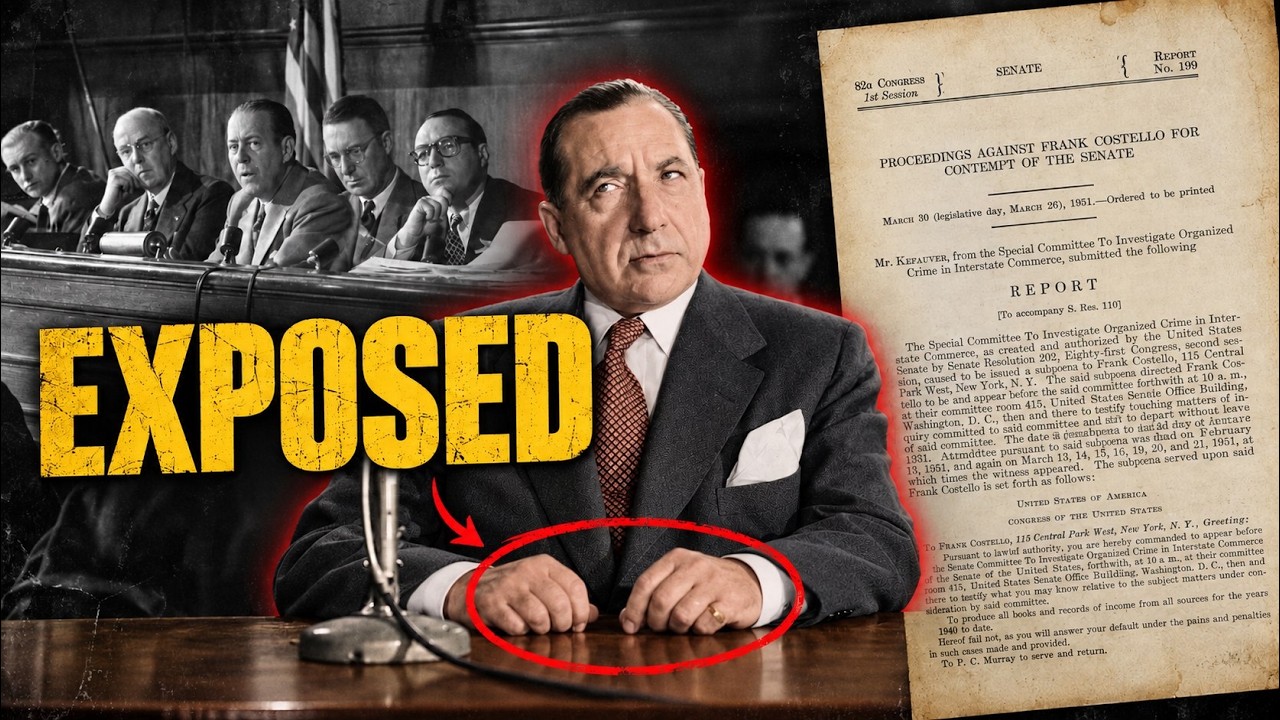
In March 1951, Frank Costello sat down at a Senate witness table in New York, sixty years old and confident the hardest part of the hearing was behind him. His lawyers had already negotiated the terms: the committee chairman agreed to keep the cameras off his face. So the camera crews pushed in on his hands. Costello believed he had set the conditions of the confrontation.
What he could not see was that everything he said in that room, and everything he refused to say, would give the government two separate cases against him. The committee’s chief counsel, Rudolph Halley, opened with a question about a name. Had Costello ever used the alias “Sevrio”? Costello admitted he might have.
Halley pressed: “Did you or did you not use it? ” The raspy voice above the hands answered, “Well, I don’t know. I won’t say I didn’t. ” It seemed a strange place to start, but Halley had a reason.
On Costello’s 1925 naturalization papers, he had sworn he never used an alias and listed his occupation as real estate. In fact, in 1925 Costello was a bootlegger, and the man who vouched for him on that form, a supposed railroad worker named Harry Saucer, was also a bootlegger. When Halley confronted him, Costello claimed the Saucer he knew was a different man from the one on the paper. How many Harry Saucers did he know?
“I don’t know,” Costello said. “I might have known two or three. ” Lying on citizenship papers was something the government could strip a man’s citizenship away for. In ten years, Costello would understand exactly what that opening line of questioning was for.
The man running the room was Senator Estes Kefauver of Tennessee. He had drafted the resolution creating the special Senate committee on organized crime in interstate commerce, a committee that existed only because Vice President Alben Barkley cast the tie-breaking vote. It had opened in Miami in May 1950, and over the next fifteen months it sat in fourteen cities and heard hundreds of witnesses. By the time it reached New York, crime commissions across the country had already named Costello a key figure in the nation’s biggest gambling syndicates.
Kefauver called him “that wire string puller. ”
New York was where the investigation turned into television. The hearing took place in the federal courthouse at Foley Square, and five of the city’s seven stations carried it live, with coaxial cable pushing the feed to twenty-one more cities across the East and Midwest. Stores emptied out during what people began calling “Kefauver hours” and filled back up at the noon recess.
Consolidated Edison put an extra generator on the line to carry all the sets switched on across the city. The Senate’s own history put the audience for the March hearings at around thirty million Americans. What they watched was a pair of hands. George Wolf, Costello’s lawyer, told the committee that his client “doesn’t care to submit himself as a spectacle.
” The committee reluctantly ordered the cameras off his face, and the camera operators took the only shot they had left. They pushed in tight on the hands. For hours, the country watched those hands finger a pair of eyeglasses, lift a handkerchief toward a face nobody could see, fiddle with a watch and a glass of water, and tear a piece of paper into shreds. When the questions got rough, the New York Times reported, he crumpled the handkerchief, rubbed his palms together, or laced his fingers.
The paper called it “video’s first ballet of the hands. ” Millions of people watching a pair of hands twist a handkerchief for hours saw a man with something to hide. Nothing Halley asked did as much damage as that picture. But the detail almost nobody at home paid attention to was the money.
Halley walked Costello through his income. Costello insisted his business was legitimate: oil, real estate, even a company that made Kewpie dolls. He told the committee he was cleaner than 99 percent of New Yorkers. Then came the numbers.
There was $18,000 a year from the Beverly Country Club, a nightclub and casino in New Orleans where he claimed he was just a “goodwill man. ” There was $15,000 a year from a Long Island racetrack for doing what he called “practically nothing” other than keeping bookmakers away. There was $25,000 for promoting a brand of scotch a friend imported. Every one of those income streams was now in a sworn transcript.
When the tax case eventually reached the court of appeals, the judges would point to that racetrack money as a likely source of income he never reported. Senator Charles Tobey of New Hampshire tried a different kind of question. Had Costello ever offered his services to any war effort of this country? No, Costello said.
Tobey asked him to name something, anything, he had done to his credit as an American citizen. Costello answered with three words: “Paid my tax. ” The room laughed, and it became one of the most quoted lines of the hearings. It was also a claim the government was in a position to check.
Eventually, it did. On March 15, 1951, Costello returned to the witness table, and this time his lawyer spoke first. Wolf told the committee his client was too ill to testify and asked for an adjournment. Costello backed him up: “You heard my statement through Mr.
Wolf, and I stand by it, and under no condition will I testify from here in until I am well enough. ” Wolf handed over a physician’s certificate saying Costello had acute laryngotracheitis and ought to be in bed. The committee rejected the certificate and directed him to answer. Costello turned to Halley and asked, “Am I under arrest?
” “No,” Halley told him. “Then I am walking out. ” The committee reminded him he was under subpoena and that leaving was a violation. He got up anyway and walked out with his lawyer.
The next day, March 16, the committee called the same physician who had signed that certificate. Under oath, the doctor said that in his opinion, Costello was capable of testifying for an hour or so a day. Costello showed up with a second doctor’s note. Halley asked whether he had had a meeting with William O’Dwyer, the former Brooklyn district attorney who had gone on to be mayor of New York in 1942.
“I refuse to go further with the questioning,” Costello said. The chairman gave an order: “Let’s cut the cameras off. Let’s not have any noise. ”
Of everything Costello did in New York, his refusals on his net worth and on O’Dwyer made the senators angriest.
He came back and sat at the table again on March 19, 20, and 21, answering what he was asked. At trial, his lawyers would offer those three days as proof that his walkout never really blocked the investigation. The courts ruled that evidence irrelevant: a witness does not have the legal right to dictate the conditions under which he will testify. On March 30, the Senate ordered printed a report titled “Proceedings Against Frank Costello for Contempt of the Senate.
” The case went to the United States Attorney in New York, and a grand jury indicted him for contempt. The first trial in January 1952 ended with a deadlocked jury. The government tried him again. The second jury convicted Costello on ten counts, and the judge gave him eighteen months in federal prison and a $5,000 fine.
But the version commonly heard, that Costello went to prison because he would not tell the Senate what he was worth, is not the full picture. On July 3, 1952, the Second Circuit Court of Appeals took the conviction apart count by count. The counts for refusing to answer what his net worth was, whether he owed more than $10,000 to any person, and what his total indebtedness was, were reversed. The court ruled his privilege against self-incrimination had been validly asserted.
The counts it kept were the walkout on March 15 and the refusal to testify on March 16. The fine dropped to $2,000. If Costello had simply sat in that chair and turned down each money question one at a time on his privilege, he would have stood on solid legal ground. What sent him to prison was walking out, then refusing every question the next day, on live television.
On August 15, 1952, at ten in the morning, Costello walked into the federal courthouse in New York and surrendered to the United States Marshal. “Tell the boys I have come in to do my bit,” he told the reporters. “I don’t want no favors from nobody. ” He was moved through maximum security prisons, including Atlanta, before landing at the minimum security federal prison in Milan, Michigan.
He served about fourteen months of the eighteen-month sentence, walking out on October 29, 1953, where his wife met him. They boarded a train in Detroit and, instead of riding into Grand Central where reporters waited, got off in Westchester County and finished the trip to Manhattan by car. For a little while, it looked like Costello had paid for his walkout and put the hearings behind him. But while he was in Milan, the second case from that hearing room sat in a file at Foley Square.
The previous administration at the United States Attorney’s Office had obtained an indictment for tax evasion but had wrapped up the grand jury without much evidence. In 1953, President Dwight Eisenhower picked J. Edward Lumbard to be the United States Attorney for the Southern District of New York, and Lumbard brought Lloyd F. MacMahon along as chief assistant.
MacMahon inherited a thin tax indictment against Costello and had to put the case together almost from scratch. Costello had something Al Capone never had: a record of filing tax returns. His returns showed large miscellaneous income, and he figured that covered him. When he said “Paid my tax” on live television, he had paid it.
But back in February 1947, he had been forced to hand over more than $21,000 in penalties and interest on taxes left unpaid since 1930. MacMahon went at him with the net worth method. You prove what a man owned at the start of a year and what he owned at the end, add what he spent in between, and set that against what he reported. Whatever is left over is income he never declared.
It was exactly the question Costello had refused to answer in front of the cameras: “What is your net worth? ” Now the government would work out the answer without him. The starting point for the math came from Costello himself. On October 18, 1937, he had given a sworn statement to an official of the tax bureau.
On that day, his net worth was substantially $40,000. By January 1, 1946, a little over eight years later, the government put it at $240,000. The man’s worth had gone up six times over in eight years, and his returns never explained where the money came from. The trial opened in April 1954 and ran six weeks.
The government called 144 witnesses and put 368 exhibits before the jury. There was the Louisiana casino that paid Costello cash profits. There were daily manicures; the hands the whole country watched on television had become a line item in a tax case. There were expensive suits, an account at a florist in the name of “C.
Frank,” and a family mausoleum where another man signed the contract and the first payment came in as $3,000 in $100 bills. Costello’s lawyers answered with one witness, an expert accountant who had once been an FBI agent. MacMahon’s cross-examination took him apart. The summation ran less than an hour, and the jury convicted.
It acquitted Costello on 1946 but found him guilty on 1947, 1948, and 1949. Judge John F. X. McGohey sentenced him to five years on each of the three counts, to be served at the same time, with a $10,000 fine on each count and the costs of prosecution.
That was two convictions out of one hearing, and a five-year sentence on top of the eighteen months. Costello surrendered on May 17, 1954. A month later, Justice Robert Jackson of the Supreme Court admitted him to bail, and his lawyers went after the case. On April 5, 1955, a Second Circuit panel that included Judge Learned Hand cut it down.
On 1947, the court said Costello might have laid aside a cash reserve the government never ruled out, so there was not enough to hold that count. 1948 and 1949 stood. For 1948 alone, the understatement was $35,245. The last argument went to the Supreme Court on a strange question.
The grand jury that indicted Costello had heard exactly three witnesses, all government investigators, none of whom had firsthand knowledge of anything they told it. They had summarized. Costello’s lawyers argued that an indictment built on nothing but hearsay was void. On March 5, 1956, the Supreme Court answered in an opinion by Justice Hugo Black: an indictment based solely on hearsay evidence does not violate the Fifth Amendment.
The grand jury’s job is to decide whether there is enough to go to trial, and it is the trial that tests the evidence. Costello had already had that trial, with 144 witnesses. Costello went back in on May 14, 1956, and served until March 11, 1957, when the Supreme Court admitted him to bail again. He was out for less than two months when somebody tried to kill him.
On May 2, 1957, he stepped out of a cab and into the lobby of his apartment building at 115 Central Park West. A black Cadillac had pulled in behind the cab. A gunman fired a single shot at his head, and the bullet curved around his skull from his right ear to his neck and came out without doing serious damage. Police charged Vincent J.
Gigante with firing the shot, and the orders were reputed to have come from Vito Genovese. When police went through Costello’s coat, they found a handwritten note in the pocket: “Gross casino wins as of April 26th, 1957, $651,284. ” The figures matched, to the decimal point, the win at the Tropicana in Las Vegas, which had opened on April 3. Costello would not explain it.
When Judge Jacob Gould Schurman demanded that he be more forthcoming, Costello politely refused, and the judge gave him thirty days. He served fifteen of them in the Tombs. After the shooting, Costello handed the family over to Genovese and retired. When Gigante went on trial in 1958 for trying to kill him, the building’s doorman identified him as the gunman, but Costello would not identify the man who shot him.
Gigante was acquitted. The government was not finished with Costello. He tried one more time to throw out the tax conviction, claiming it was built on illegal wiretaps, and Judge McGohey turned him down. By the fall of 1958, his last appeal was gone, and he was back in the federal prison in Atlanta, where he stayed until 1961.
And the question Halley had opened with back in 1951 finally came due. The government had filed to strip Costello’s citizenship in 1952 and filed again in 1958, on grounds raised on live television: when he was naturalized in 1925, Costello swore his occupation was real estate, when his true occupation was bootlegging. On February 20, 1961, the Supreme Court upheld the order revoking his citizenship. The government then tried to deport him on the strength of the two tax convictions.
On February 17, 1964, the Supreme Court set that order aside, because the deportation law did not reach a man who was still a citizen when he was convicted. It was the only fight in the whole file that Costello won outright. Most of what the country had watched was said under oath. The contempt case came from the two days he refused to testify at all.
The tax case came from the net worth he would not state, worked out from a sworn statement he had given the tax bureau in 1937. What outlived all of it was the case with his name on it. Costello v. United States is still the rule in federal court: a grand jury can indict a man on an agent’s summary of things the agent never saw for himself.
That was the biggest thing to come out of the Costello file, bigger than either conviction, and a rule that kept a boss like Costello in prison.