In the late 1930s, the establishment feared her more than any conquering queen or foreign empress. The woman who made the palace tremble and the Church of England speak in horrified tones was not a warrior or a revolutionary. She was a divorced American woman from Baltimore, Maryland, with no royal blood, no title, no army, and no institutional power. By every conventional measure, she held nothing.
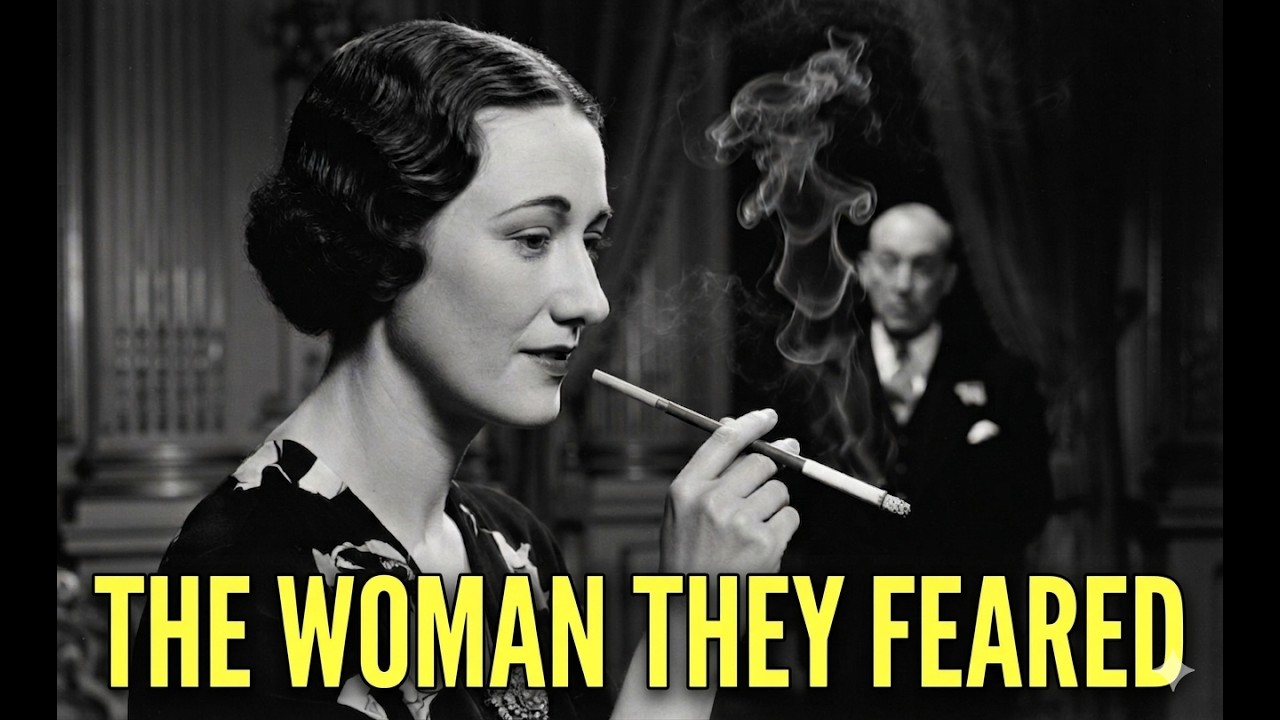
Yet the British royal establishment, with all its centuries of practice in controlling public perception, directed an extraordinary effort at erasing and reshaping her biography. That woman was Wallis Simpson. And to understand why the most powerful institution in Britain feared her, you have to start at the very beginning, before the abdication crisis, before the scandal that made her the most famous and most despised woman in the world. She was born Bessie Wallis Warfield on the 19th of June, 1896, in a small hotel in Blue Ridge Summit, Pennsylvania, where her mother had gone for the summer air.
Her father, Teackle Wallis Warfield, came from an old Maryland family, but by the time of her birth, the money that should have given the name its meaning had largely evaporated. He died in November of 1896, when she was five months old. His absence left her mother, Alice, and the infant Wallis in a precarious position. They were not destitute, but they were dependent on the generosity of wealthier relatives, most notably her uncle Solomon Warfield, who paid for her education but whose support came with an awareness of dependency.
It was the specific and painful gap between what the Warfield name said they were and what their bank account confirmed them to be that shaped Wallis’s earliest years. Her mother performed the concealment of genteel poverty every day, and Wallis absorbed the lesson that appearances were survival. She was sharp, observant, and funny in a way that was not quite appropriate for a well-brought-up girl. She understood that she was interesting rather than pretty, and that interesting was more durable.
After her education at Oldfields School, she was presented to Baltimore society in 1914, at eighteen. Angling for the security her childhood had denied her, she married Earl Winfield Spencer, Jr. , a United States Navy pilot, on the 8th of November, 1916. He appeared to be a glamorous and respectable choice.
He was, in fact, a serious alcoholic, and the marriage became a catastrophe of a specific and destructive kind. Spencer was capable and courageous in the air, but on the ground, the recklessness that made him effective as a pilot translated into something darker. When he drank, the charming man she had married receded and a violent one emerged. The violence escalated over the years, directed at the person closest and most vulnerable: Wallis.
She endured it. She maintained the appearances of a functioning marriage while the deterioration continued beneath the surface. She read, she built friendships, she watched people. She was receiving an education in how power operated between people, about vulnerability and how it could be exploited, that was more thorough than anything a classroom could offer.
The divorce was finalized in 1927, and the court records were subsequently sealed, in a way that has led researchers to conclude the material they contained was significant enough to warrant suppression. In the early months of 1924, still technically married, Wallis boarded a ship for China to join a friend. The treaty port world was a legal and cultural borderland, and in Shanghai, the rules that had governed her entire life were suspended. What mattered there was not pedigree but presence, not a bank balance but the ability to navigate a complex human terrain.
Wallis was formidably equipped. She was one of the most socially successful women in the treaty port world. She learned about money, about men, about the fluid boundaries between the official and the unofficial that characterized that extraordinary environment. The rumors about what she did in China began almost as soon as she left and took their most damaging form in an intelligence document called the China Dossier, allegedly compiled by British intelligence in the 1930s.
The document has never been produced in any authenticated form. It remains an unresolved mystery. The most extreme rumors it supposedly contained are not supported by any verifiable primary source. What the evidence does support is a picture of a woman who lived in a morally complex world on its own terms, survived a genuine illness, and emerged deeper and more fully formed.
She left China in 1925. In July of 1928, at a quiet ceremony in Chelsea, she married Ernest Simpson, a steady and respectable Anglo-American businessman. He represented the possibility of rest, of a life that did not require constant navigation of volatility. The marriage gave her a platform of social credibility in London, and she used it with characteristic skill, becoming an inspired host with a genuine gift for creating environments in which people felt welcome.
It was a cultivated quality that mattered. Among her friends was Thelma Furness, the American-born mistress of Edward, Prince of Wales. Through that friendship, Wallis met the prince in January of 1931, at a house party in Leicestershire. The meeting was unremarkable.
She was simply herself with him, direct, engaged, funny, entirely unawed by his status. Edward Windsor was the most famous man on earth, heir to an empire covering a quarter of the world’s land surface, and one of the loneliest men in Britain. He had spent his adult life surrounded by people who calibrated every word to his position. Wallis looked at him as though he were a person rather than a prince, and she said what she thought rather than what he wanted to hear.
She also made him genuinely laugh, and the release of that laughter was something he came completely to depend on. By 1934, the relationship was the worst-kept secret in upper-class London. Ernest Simpson watched his wife being lost with the patience and dignity that history has never adequately credited. Edward had made a final and complete decision: Wallis was worth whatever it cost.
When King George V died in January of 1936, he had reportedly predicted his son would ruin himself within twelve months. The prediction was disturbingly accurate. Edward ascended the throne on the 20th of January, 1936, and held it for 326 days. The constitutional arguments against the marriage were real: the Church of England, whose supreme governor the king was, could not sanction a marriage to a woman with two living ex-husbands.
But the clean constitutional narrative is not the whole story. Prime Minister Stanley Baldwin opposed the marriage with a certainty that drew on personal contempt as much as constitutional duty. The Archbishop of Canterbury opposed it with a snobbery that went beyond theology. The British press, bound by an unwritten understanding with the palace, said nothing for months while the foreign press reported the relationship in detail.
The story broke in Britain only after a provincial bishop made a speech that was interpreted as a reference to the royal situation. When the story finally broke, the public reaction was mixed. There was genuine hostility, but also considerable sympathy. Wallis herself was frightened, in the way of a genuinely intelligent person who could clearly see the machinery deployed against her and the cost of every possible outcome.
The palace constructed its picture of her: a calculating woman who had systematically exploited a vulnerable man, someone whose past demonstrated not resilience but a pattern of using men for advancement. It was a picture built to serve an institutional need, not truth. It required presenting the relationship as predatory rather than genuine, and manipulation rather than mutual attachment. It protected the monarchy from the far more uncomfortable truth that if she had not manipulated Edward, then the responsibility rested with the king himself.
The story that was constructed and distributed for the world was that she was the woman who stole a king. The versions told for decades were designed to make her invisible. But the deeper story is that the palace did not fear her because she was a scheming temptress; it feared her survival, her resilience, her refusal to disappear. She was the woman from Baltimore who had lost her father before she knew him, who had survived a violent marriage, who had made her own way through the lawless world of Shanghai, who had built herself from almost nothing into someone the most powerful institution on earth could not ignore and could not control.
And when everything was on the line, she chose her path and carried every lesson and every scar with her, all the way to the end.