In the autumn of 1946, eleven men who had once ruled a continent sat shoulder to shoulder in the defendants’ dock at Nuremberg, waiting to learn whether they would live or hang. Most stared at the floor. Most mumbled excuses, blamed absent superiors, or insisted they never knew what was happening in the camps to the east. But one man sat differently.
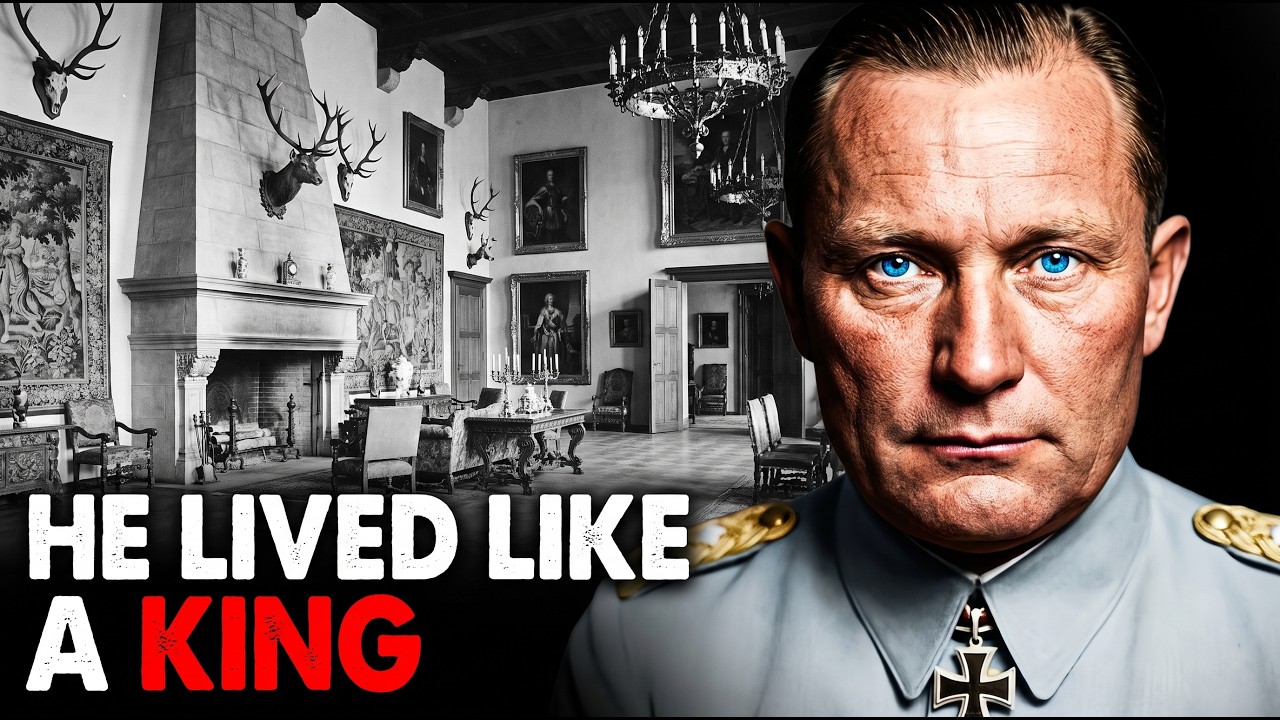
He took notes. He whispered instructions to his co-defendants during recesses. He argued with the prosecution, sometimes even seemed to enjoy himself. When his own attorney finally called him to the stand, he spoke for hours without flinching, defending the Reich, defending Hitler, and above all, defending himself.
That man was Hermann Göring. And by the time he swallowed a cyanide capsule to cheat the hangman’s noose, he had done something almost none of his fellow Nazi leaders managed. He had lived long enough, remained visible enough, and stayed defiant enough to force the entire world to reckon with him in open court. Every other titan of the Third Reich took the opposite path.
Hitler shot himself in a bunker. Goebbels poisoned his six children before killing himself and his wife. Himmler disguised himself as a low-ranking soldier, was caught almost by accident, and bit down on a cyanide capsule within hours. Bormann vanished into the chaos of Berlin’s final days so completely that for decades nobody could say for certain whether he was alive or dead.
Hermann Wilhelm Göring was born on January 12th, 1893 in Rosenheim, Bavaria. Unlike Himmler, Goebbels, and Bormann, who came from modest households, Göring was born into a family of genuine standing. His father, Heinrich Ernst Göring, was a jurist and cavalry officer who had served as the first Reich commissioner of German Southwest Africa, appointed personally by Chancellor Otto von Bismarck. The household revolved around a family friend, Hermann Ritter von Epenstein, a wealthy Austrian Jewish physician and baron who had converted to Catholicism and became young Hermann’s godfather.
Epenstein housed the family for years in castles, and it was wandering those stone corridors that Göring developed his taste for grandeur, costume, and theatrical display. Epenstein was also openly having an affair with Göring’s mother, an arrangement the family tolerated in exchange for his patronage. It was a strange childhood, but it gave young Hermann something his future Nazi colleagues largely lacked: exposure to old European aristocracy and an early education in performance. As a boy, Göring showed little interest in academics and fierce interest in soldiering.
By 1912 he was commissioned in the Prince Wilhelm Regiment, and when the First World War broke out, he served on the Western Front. Chronic rheumatism from trench warfare made him a poor fit for ground combat, and a friend persuaded him to transfer into the German air service. By 1915 he was flying reconnaissance and bombing missions, and he eventually became a genuine ace credited with 22 confirmed victories, awarded the Pour le Mérite, the Blue Max. When Manfred von Richthofen was killed in April 1918, command of his celebrated squadron, the Flying Circus, passed to Göring himself.
He led Germany’s most famous fighter wing through the final desperate months of the war. Unlike Himmler, who never served a day in combat, and unlike Goebbels, who was rejected from military service due to a club foot, Göring entered the 1920s with an authentic, decorated record as a frontline war hero. Germany’s defeat devastated him. He drifted into a restless, wandering existence, and in 1920 met Karin von Fock, a married Swedish baroness.
She divorced her husband, they married in February 1923, and her aristocratic connections opened doors across Scandinavia. In the autumn of 1922, at a rally in Munich, Göring first heard Adolf Hitler speak. He was electrified. He introduced himself after the speech, and Hitler, alert to the propaganda value of a decorated war hero with an aristocratic wife, welcomed him into the still tiny National Socialist movement.
Within weeks Hitler placed Göring in command of the SA, the party’s brown-shirted paramilitary wing. That command led directly to the beer hall putsch of November 9th, 1923. Göring marched near the front of the column, leading his SA contingents through Munich. When police opened fire near the Feldherrnhalle, a bullet struck him in the groin and thigh, shattering his pelvis.
Sympathizers dragged him to safety, and he was smuggled out of Germany. He fled first to Austria, then to Italy, and eventually to Sweden, in desperate pain from wounds that never fully healed. Doctors treated that pain with regular injections of morphine, and Göring developed a dependency that would shadow him for the rest of his life. His addiction grew so severe that Swedish authorities committed him to a mental institution, where he underwent a harrowing detoxification.
At the very moment his future rivals were building their reputations inside Germany, Göring was locked in a foreign psychiatric ward, addicted to narcotics, a fugitive from German justice, seemingly finished as a political force. It was not until 1927, when the Bavarian government issued a general amnesty for participants in the putsch, that Göring returned home. Hitler prizing Göring’s aristocratic connections and charm with wealthy industrialists welcomed him back warmly. By 1928 Göring stood as a Nazi candidate for the Reichstag and won a seat.
As the Great Depression tore through Germany, the Nazi party’s representation exploded, and by August 1932 Göring was elected president of the Reichstag, a position of enormous institutional power that let him control the parliamentary agenda. He cultivated close relationships with powerful businessmen, hosting lavish dinners where he introduced Hitler to bankers and industrialists who would never have granted an audience to the thuggish elements of the party. His bridge between the party’s revolutionary energy and the traditional establishment’s money and influence proved essential to Hitler’s ultimate path to the chancellorship. Tragedy struck his personal life during this ascent.
Karin, who had suffered for years from epilepsy and heart trouble, died in October 1931, and Göring was devastated. He would later build an enormous hunting estate north of Berlin and name it Karinhall in her memory. The critical moment arrived in January 1933. Göring, working alongside the conservative politician Franz von Papen and Hindenburg’s inner circle, helped broker the backroom negotiations that convinced the aging president to appoint Hitler Chancellor on January 30th, 1933.
Göring’s reward was immediate. He was named acting minister of the interior for Prussia, and from this position he moved with breathtaking speed to consolidate Nazi control over the police. In April 1933 he established a new secret political police office, the Geheime Staatspolizei, universally known by its abbreviation, the Gestapo. It was Göring, not Himmler, who founded the Gestapo, staffed its earliest ranks, and used it to crush political opponents and establish some of the first concentration camps on Prussian soil.
Only in 1934 did he hand control of the Gestapo over to Himmler and the SS, part of a broader deal that secured SS support for eliminating the SA leadership in the bloody purge later known as the Night of the Long Knives. The Reichstag fire of February 27th, 1933 gave the new government its pretext to suspend civil liberties, and Göring, as the man who presided over the burning building in his capacity as Reichstag president, seized on the crisis with theatrical energy, publicly blaming a vast communist conspiracy and demanding emergency decrees that gutted freedom of the press, assembly, and habeas corpus almost overnight. In April 1933 Hitler appointed Göring Reich Commissioner for Aviation, and two years later Hitler named him commander-in-chief of the newly unveiled Luftwaffe. Göring threw himself into the task with genuine enthusiasm, recruiting talented engineers and building one of the most formidable air forces in the world.
In 1936 he received control of the Four-Year Plan, an ambitious program designed to prepare the German economy for war, effectively placing him in command of German economic policy. By the late 1930s Göring stood as arguably the second most powerful man in Germany. On September 1st, 1939, the very day German tanks rolled into Poland, Hitler issued a secret decree formally naming Göring as his chosen successor. The opening campaigns of the war seemed at first to vindicate every promise Göring had made.
In Poland and then in the lightning campaigns of 1940, the Luftwaffe performed brilliantly. When France capitulated in June 1940, Hitler rewarded Göring with an entirely new rank invented specifically for him, Reichsmarschall, a title that placed him above every other field marshal. But the failure arrived within weeks in the skies over southern England. The Battle of Britain exposed the strategic limitations beneath Göring’s bluster.
The Luftwaffe had been designed as a tactical support arm, not a strategic bombing force, and it lacked long-range escort fighters. British radar allowed the outnumbered Royal Air Force to concentrate its fighters precisely where German raids were headed. Göring, increasingly frustrated, shifted the bombing campaign’s focus away from RAF airfields, which were being steadily ground down, and toward London instead. That shift gave the battered RAF squadrons breathing room, and by October the Luftwaffe had suffered losses it could not sustain.
Hitler postponed indefinitely the planned invasion of Britain. It was the first major strategic defeat of the war for Nazi Germany, and it fell squarely on Göring’s shoulders. As Germany turned east and launched Operation Barbarossa in June 1941, the Luftwaffe again performed impressively in its tactical role, but the sheer scale of the Eastern Front exposed its overstretched resources and Göring’s growing tendency to overpromise. His old morphine addiction crept back, and he withdrew for long stretches to indulge his other consuming passion: art.
As German armies overran country after country, Göring exploited his authority to become one of history’s greatest art thieves. He established a direct pipeline into the Einsatzstab Reichsleiter Rosenberg, the Nazi organization tasked with looting art from occupied territories, and made repeated personal visits to the Jeu de Paume museum in Paris, where confiscated artworks stolen from French Jewish collectors were sorted and displayed for his personal selection. His collection at Karinhall eventually swelled to more than 1,000 works of art. Postwar Allied investigators cataloged roughly 1,375 paintings along with hundreds of sculptures, tapestries, and antique furniture.
The consequences of his declining attentiveness became catastrophically clear at Stalingrad. In November 1942 the German Sixth Army was encircled by a massive Soviet counteroffensive. Hitler refused to authorize a breakout, and Göring, eager to please his increasingly skeptical Führer, made an extraordinary promise: his air force could supply the trapped army entirely by air. The Luftwaffe never came close to delivering the tonnage required, managing on many days barely a tenth of what the trapped army needed.
The Sixth Army starved, froze, and was eventually crushed, with Field Marshal Friedrich Paulus surrendering in early February 1943. It was unambiguously Göring’s failure, and Hitler never fully forgave him. The decline accelerated as Allied strategic bombing pounded German cities. Göring had once boasted that if a single enemy bomber reached the Ruhr, Germans could call him by another name entirely.
That boast curdled into bitter mocking irony as British and American bombers reduced Hamburg, Berlin, and Cologne to rubble. His once impressive popularity curdled into public ridicule. Rivals sensed the opportunity. Martin Bormann worked tirelessly to isolate Göring from Hitler’s daily briefings.
Joseph Goebbels portrayed him as a lazy, corrupt, morphine-addicted embarrassment. Albert Speer bypassed his Four-Year Plan authority altogether. By 1943 and 1944, Göring, once the second most powerful man in the Reich, was surrounded by rivals who despised him and a Führer who no longer trusted him. He withdrew to Karinhall, dosed heavily on medication, and appeared at official functions in ever more theatrical costumes that struck observers as increasingly absurd.
In July 1941, in his capacity as the Reich’s economic overlord, Göring signed and issued a written directive to SS General Reinhard Heydrich, instructing him to submit a comprehensive plan for what the document chillingly termed the total solution of the Jewish question within Germany’s sphere of influence in Europe. That order, bearing Göring’s signature and issued months before the Wannsee Conference formalized the machinery of industrialized genocide, would later be presented at Nuremberg as damning documentary proof that Göring bore direct personal responsibility for setting in motion the bureaucratic process that culminated in the Holocaust. By the spring of 1945 the Third Reich was collapsing on every front. Recognizing that Berlin would soon be surrounded, Göring left the capital in mid-April for his estate at Obersalzberg.
On April 22nd, Hitler, during a briefing, declared that the war was lost and that he intended to remain in Berlin and take his own life. That evening Göring sent Hitler a carefully worded telegram asking whether, given Hitler’s stated intention to remain in Berlin, Göring should now assume total leadership of the Reich in accordance with the 1941 succession decree. Bormann convinced Hitler that Göring was attempting an outright coup. Hitler, incandescent with fury, stripped Göring of all offices, expelled him from the party, and ordered his arrest on charges of high treason.
SS troops placed Göring under house arrest, and for several days his life hung by a thread. It was a final rupture that distinguished him one last time from every other major figure in Hitler’s inner circle. As American forces advanced through Bavaria, the SS guards holding Göring, unwilling to risk executing a former Reichsmarschall, allowed regular Luftwaffe troops to take over his custody. On May 6th, 1945, Göring surrendered himself to advancing American forces near Radstadt, accompanied by a substantial personal retinue, dozens of pieces of matched luggage, and his own personal chef.
American custody brought him face to face with his morphine addiction, and physicians placed him on a supervised detoxification program. By the time he was transferred to Nuremberg, he was clear-eyed, articulate, and physically lighter. The International Military Tribunal opened on November 20th, 1945, convened to prosecute senior Nazi officials on charges including conspiracy, crimes against peace, war crimes, and crimes against humanity. As the most senior surviving Nazi official in Allied custody, Göring was designated defendant number one.
For the first months, he sat largely in silence, though observers noted him constantly taking notes and whispering strategic advice to his co-defendants. He grew so effective at coordinating them that in February 1946 the tribunal made the unusual decision to isolate him during meal breaks to prevent him from influencing testimony. On March 13th, 1946, Göring left the dock and took the witness stand. For two full days he delivered a sweeping, largely unchallenged account of his own career, presenting himself not as a criminal but as a patriot.
He spoke for hours without notes, displaying an encyclopedic command of dates and decrees. During the ensuing cross-examination conducted primarily by the American chief prosecutor Robert H. Jackson, Göring proved unexpectedly nimble and verbally combative, parrying Jackson’s questions with lengthy discursive answers. Contemporary journalists and even some of the judges privately conceded that Göring had, in the narrow theatrical sense of courtroom performance, gotten the better of these early exchanges.
Yet whatever rhetorical ground he gained evaporated once British prosecutor Sir David Maxwell Fyfe took over, presenting Göring with his own signed directives, including the July 1941 order to Heydrich, and forcing him document by document to acknowledge his personal role. Göring continued to insist he had never personally witnessed the mechanics of mass murder, a defense the judges would ultimately reject entirely. On October 1st, 1946, the tribunal’s president read the verdicts. Göring was found guilty on all four counts.
The tribunal described his guilt as unique in its enormity, finding him the moving force second only to Hitler himself, the leading aggressor, the director of the slave labor program, and the creator of the persecution campaign against Jews and other targeted peoples. That afternoon he received his formal sentence: death by hanging. He had requested execution by firing squad, a request rooted in his conviction that a soldier’s death preserved a measure of dignity that the noose, historically reserved for common criminals, did not. The tribunal refused.
Execution was scheduled for October 16th, 1946. In the hours before, alone in his cell, Göring swallowed a capsule of potassium cyanide he had somehow concealed from his guards throughout more than a year of close confinement. He was found dead shortly before the executions were set to begin, cheating the hangman by mere hours. The mystery of how he obtained that capsule has never been definitively resolved.
He remains the only man condemned to hang at Nuremberg who escaped the noose entirely, dying by his own hand, in his own cell, on his own terms. His body, along with the bodies of the ten men hanged that same night, was cremated, and the ashes scattered into a tributary of the Isar River, so that no grave site could ever become a shrine.