On October 26, 1881, in Tombstone, Arizona Territory, just after three in the afternoon, four men walked down Fremont Street toward a vacant lot beside a photography studio. Three of them were Earps. The fourth was a dentist who had been dying for almost a decade. John Henry Holliday was thirty years old, thin-faced, with lungs scarred by tuberculosis.
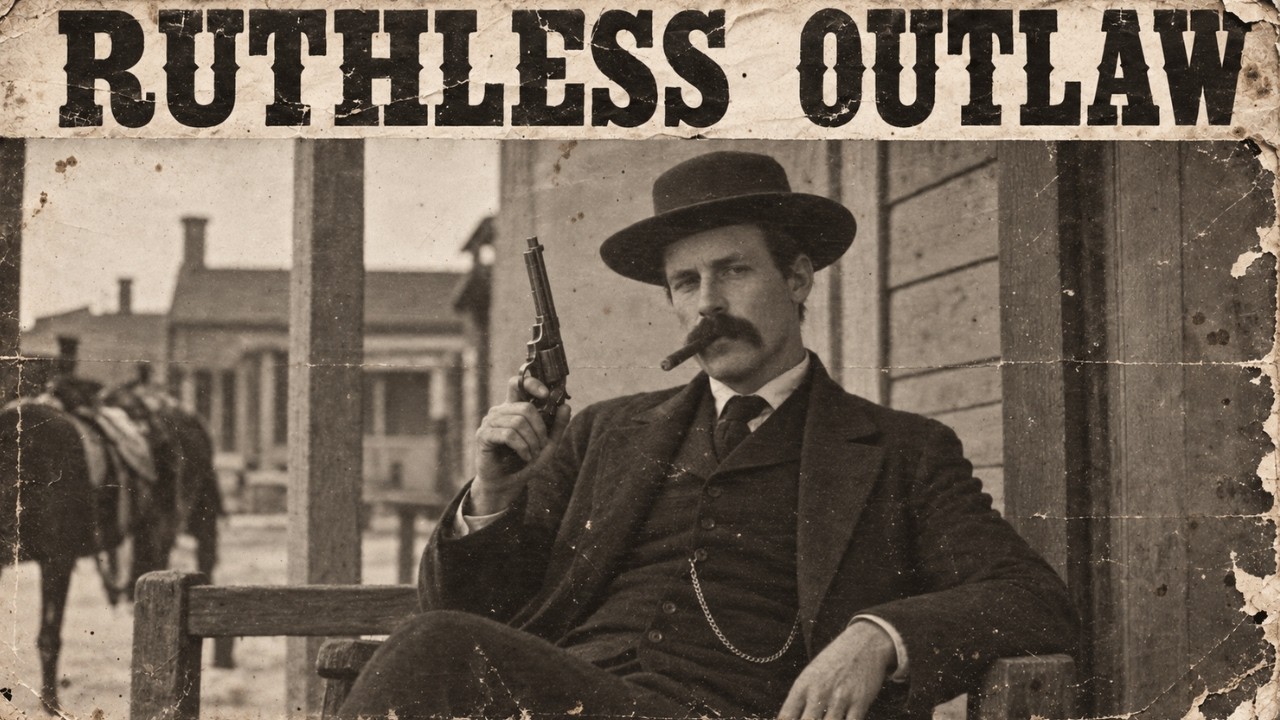
For years he had coughed blood into handkerchiefs, waking each morning knowing the disease that killed his mother was waiting inside his chest. Under his long coat he carried a double-barreled shotgun. Ahead of him stood armed men who, the night before, had threatened to kill him. Virgil Earp ordered the Cowboys to surrender their weapons.
Sheriff Johnny Behan claimed he had already disarmed them. He had not. The distance between the two groups closed. Voices rose, hands moved, and then Tombstone exploded.
In roughly thirty seconds, about thirty shots were fired. Tom McLaury was hit by Holliday’s shotgun. Frank McLaury was mortally wounded. Billy Clanton fell with bullets in his body but kept firing from the ground.
Virgil Earp was wounded. Morgan Earp was wounded. A bullet grazed Doc Holliday’s hip. When the smoke cleared, three Cowboys lay dead, and the man already dying from tuberculosis was still standing.
It would happen again. Holliday would survive the gunfight at the OK Corral, murder charges, ambushes, the Earp Vendetta Ride, a territorial warrant, and an extradition attempt that could have delivered him to his enemies. For years the frontier kept trying to kill Doc Holliday, and for years it failed. The strange truth about one of the most feared gunfighters in the West was that bullets were never what he feared most.
He already knew what was going to kill him. It was inside him the entire time. John Henry Holliday was born on August 14, 1851, in Griffin, Georgia. His father, Henry Burroughs Holliday, had served as an officer in the Civil War and worked as a pharmacist.
His mother was Alice Jane Holliday, and by almost every surviving account, John Henry was deeply attached to her. Then she became sick. Tuberculosis, consumption: the disease had many names, but in the nineteenth century everyone understood what it meant, a slow decline of weight loss, fever, night sweats, blood, and eventually death. Alice Holliday died in September 1866.
John Henry was fifteen. Three months later, his father remarried. The new wife, Rachel Martin, was a young woman only several years older than John Henry himself. The remarriage created tension in the family, disputes over property, arguments with Alice’s relatives.
Whatever relationship had existed between father and son became more distant. For Holliday, death and abandonment arrived almost together. His mother disappeared. His father moved on.
The boy who had watched tuberculosis consume the most important person in his life threw himself into discipline. He studied. He entered dental school in Philadelphia and graduated from the Pennsylvania College of Dental Surgery in March 1872. He was only twenty years old.
For a moment his life looked almost ordinary. He returned south and began practicing dentistry. Then he started coughing. The diagnosis was tuberculosis, the same disease, the same pattern, the same thing that had killed his mother.
Doctors gave the standard advice: go west, the drier climate might slow the disease. It would not cure him. Nothing could. Holliday was barely into his twenties when he was effectively handed a death sentence.
He left Georgia and traveled to Texas. Dallas initially offered him the possibility of continuing the life he had trained for. Holliday practiced dentistry with another dentist and developed a respectable reputation, but tuberculosis does not care about professional ambition. The coughing grew worse.
Patients noticed, and people stopped coming. The career Holliday had spent years building became difficult to maintain, so he found another profession: gambling. Cards did not require healthy lungs. They required concentration, memory, nerve, and control, and Holliday had all four.
He moved through Texas gambling towns, and the respectable dentist slowly disappeared. In his place came Doc Holliday, the gambler, the drinker, the man willing to fight. One of the most famous early stories attached to him involves a gambler named Ed Bailey. In later accounts, Bailey cheated during a card game, Holliday confronted him, Bailey reached for a weapon, and Holliday used a knife.
The exact details are difficult to separate from frontier legend, but the story became part of his reputation. So did what happened next. Holliday was detained, and a mob supposedly began gathering with the intention of lynching him. Then a woman entered the story: Mary Katherine Horony, the woman history would remember as Big Nose Kate.
According to the famous version, Kate set fire to a nearby building to create confusion, entered the place where Holliday was held with weapons in hand, and helped him escape. Whether every detail happened exactly as later retellings describe is difficult to prove. What is much easier to establish is that Kate stayed connected to Holliday for years. Then another relationship formed: Wyatt Earp.
The exact circumstances of their first meeting are disputed, but the friendship itself is not really in doubt. Wyatt Earp trusted Doc Holliday, and Holliday trusted Wyatt. Much of the violence that made him famous did not come from random wandering. It came from loyalty.
When Wyatt moved into danger, Holliday repeatedly followed him. By 1880, both men were in Tombstone. Silver had brought money, money brought influence, and influence brought factions. The Earps aligned with the town’s law enforcement structure and the Republican business interests centered around Tombstone.
Opposing them was the Cochise County Cowboy faction, a network of ranchers, rustlers, smugglers, gamblers, and armed men connected through business, politics, friendship, and family. Sheriff Johnny Behan had relationships inside that network, and he had his own conflict with Wyatt Earp. Both men had political ambitions. Both wanted influence.
The famous gunfight was the visible explosion of a much deeper struggle, and Holliday entered it because Wyatt Earp was already inside it. On the night of October 25, 1881, Ike Clanton and Doc Holliday argued. Both had been drinking. Threats were exchanged.
The next morning Ike was still making threats, walking through Tombstone armed until Virgil Earp arrested and disarmed him. By the afternoon, several Cowboys had gathered near Fremont Street. The Earps decided to confront them. Virgil was acting as the ranking lawman.
Wyatt and Morgan went with him. Doc Holliday joined them. Virgil gave Holliday the shotgun. There was a practical reason: Holliday could hide the weapon beneath his coat, making the group appear less heavily armed.
But there was also something almost symbolic about it. The sickest man in the group was carrying the most destructive weapon. The four men walked toward the lot. Sheriff Behan met them and said he had disarmed the Cowboys.
They kept walking. Commands were shouted. Weapons appeared. Someone fired first, and historians still argue about exactly who.
Holliday brought out the shotgun. Tom McLaury was hit. Gunfire erupted. Billy Clanton kept shooting after being badly wounded.
Frank McLaury was hit and continued fighting. Morgan Earp was struck. Virgil Earp was struck. Holliday was grazed.
Then it stopped. Thirty seconds. Three dead men. A town permanently divided.
And Doc Holliday still alive. The legal system immediately had to decide whether the Earps and Holliday had enforced the law or committed murder. A preliminary hearing followed, and Judge Wells Spicer eventually ruled that the men had acted within their authority, but the ruling solved almost nothing. The violence simply changed form.
On December 28, 1881, Virgil Earp was ambushed at night. A shotgun blast struck him, badly damaging his left arm. He survived but never fully recovered its use. Then came March 18, 1882.
Morgan Earp was playing billiards when a rifle shot came through a rear window. The bullet hit him in the back and passed through his body. He died on the table. That killing changed everything.
After Morgan died, Wyatt stopped believing the courts could contain the conflict, and Doc Holliday followed him. Wyatt assembled an armed posse. Holliday joined, as did Warren Earp and several other men. They claimed federal authority, but the mission quickly became something more personal.
Frank Stillwell was killed near the Tucson train station. He had been suspected in the attacks on the Earps. Wyatt later admitted firing at him. Holliday was almost certainly present.
More killings followed, including at Iron Springs, where Wyatt killed Curly Bill Brocius with a shotgun. The Earp Vendetta Ride entered legend, but underneath the legend was a simpler truth: the distinction between law enforcement and revenge had almost disappeared. Holliday understood that. He rode anyway.
Sheriff Behan formed his own posse. Warrants were issued, and the strange result was almost absurd: one armed group claiming legal authority rode across Arizona hunting another armed group claiming legal authority. Both believed the other side contained murderers. By the spring of 1882, the Earp party left Arizona.
Holliday went to Colorado, but Arizona still wanted him returned. In May he was arrested in Denver, and extradition threatened to send him back to Cochise County, where his political enemies controlled the jurisdiction. Then another old frontier friend intervened: Bat Masterson. Masterson helped create a legal obstacle to extradition by arranging for Colorado to assert its own jurisdiction over Holliday.
Political pressure was applied, arguments were made to Governor Frederick Pitkin, and the extradition effort failed. Once again Doc Holliday survived, not by drawing faster but by having friends. But tuberculosis did not care about friendship. It kept moving.
By the mid-1880s, Holliday’s health was visibly declining. He remained a gambler. He continued drinking. In Leadville, Colorado, in 1884, he shot a man named Billy Allen during a dispute and was arrested.
He survived the legal case too, but by then the violence almost felt secondary. His body was collapsing. The famous cold gunfighter was becoming thinner and weaker, and the cough became constant. Years earlier, doctors had given him little time.
Holliday had somehow stretched that sentence across more than a decade. By 1887, Holliday was desperately sick. He traveled to Glenwood Springs, Colorado, a town known for its mineral hot springs, where people believed the vapors and water might help patients with respiratory illnesses. For a man with advanced tuberculosis, the treatment offered very little.
Holliday checked into the Hotel Glenwood, and he would never leave alive. His condition worsened. He became skeletal. He struggled to stand.
The man who had once walked toward armed Cowboys with a shotgun hidden beneath his coat was now confined to a hotel bed. The frontier had finally found a weapon he could not shoot back at. On November 8, 1887, John Henry Holliday woke in that room. According to the story that survived, he asked for whiskey, drank, and then looked down.
His boots were off. For years, Holliday had apparently believed he would die violently, probably with his boots on. Instead he was in bed, barefoot, too weak to stand. He reportedly looked at the situation and said three words: This is funny.
Then Doc Holliday died. He was thirty-six years old. No gunfight, no revenge killing, no last stand. Just tuberculosis, the same disease that had killed his mother when he was fifteen, the same disease that had driven him away from dentistry, the same disease that had sent him west.
Wyatt Earp lived more than four decades longer. He watched the frontier become history, then entertainment, then mythology. The gunfight at the OK Corral became one of the most famous violent encounters in American history, and Doc Holliday became almost supernatural: the deadly gambler, the sick man with nothing to lose, the loyal friend. Some of that is mythology.
Holliday almost certainly did not kill the enormous number of men later credited to him, and many of his famous confrontations are poorly documented. But correcting the legend does not make the real man boring. It makes him more human. He was a sick man, an educated man, a grieving son, a failed dentist, a professional gambler, a loyal friend, a violent drunk, a man capable of affection and cruelty in the same life.
The gunfight did not defeat him. The Cowboys did not defeat him. Extradition did not defeat him. Even his own appetite for violence failed to finish him.
Tuberculosis did, quietly and patiently, exactly the way it had always promised. Today Holliday is buried in Glenwood Springs, at least where people believe he is buried. The exact location of his body inside the cemetery was never securely recorded. A memorial marks him, and visitors climb the hillside, leaving playing cards, coins, whiskey bottles, and cigarettes as small offerings to a man they know mostly through legend.
Down in Tombstone, the gunfight happens again every day. Actors walk into position, visitors gather, shots are fired, three Cowboys fall, and Doc Holliday survives. Then everyone stands up and prepares to do it again for the next audience. There is something almost perfect about that.
In Tombstone, Doc Holliday never dies. But hundreds of miles away in Colorado is the place where the performance finally stops. A dying man lay in a hotel bed. His revolver could not help him.
His reputation could not help him. Wyatt Earp could not help him. He had spent years expecting death to come through a door with a gun in its hand. Instead it had been riding inside his chest the entire time.
Doc Holliday survived almost everything the West could throw at him. Then, at thirty-six years old, the one enemy he could never outrun finally collected what it had been owed from the beginning.