A Houston businessman named Ted Miller bought 133 cell towers scattered across Harris County, Texas, in 1994. They were unglamorous steel lattice structures, most under 200 feet tall, bolted to small patches of leased land behind strip malls and along highway frontage roads. Each tower rented antenna space to one or two wireless carriers for roughly $20,000 a year per tenant. The math was simple: own the steel, lease the space, collect the check.
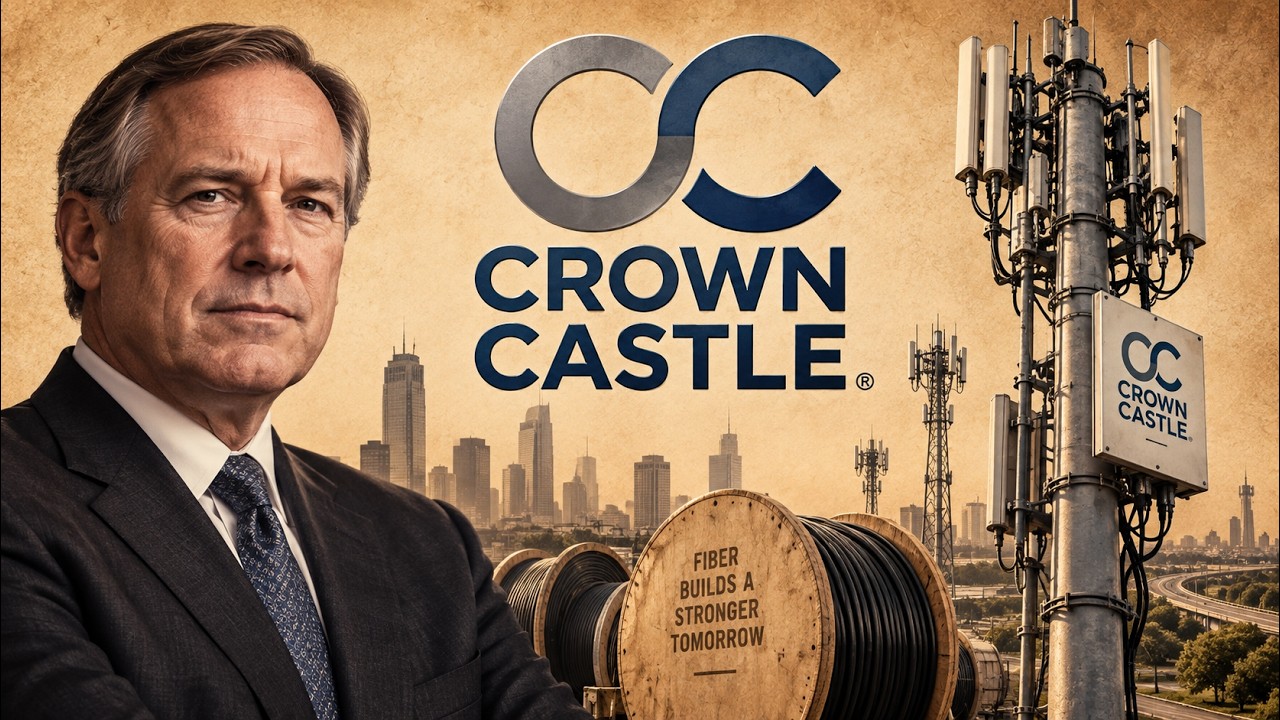
Within a decade, those 133 towers multiplied into 40,000. Crown Castle, the company Miller founded, entered the Fortune 500, and its stock, which once traded below a dollar during the dot-com collapse, climbed past $168 by the end of 2021, making the company worth more than $70 billion. Then Crown Castle decided that towers alone were not enough. Over six years, the company poured close to $19 billion into fiber and small cell networks, convinced it could own the ground beneath American cities with the same economics that had made it rich in the air above them.
In March 2025, under pressure from an activist hedge fund and a board in open revolt, Crown Castle announced it was selling that entire fiber and small cell operation for $8. 5 billion—less than half of what it spent. The deal closed on May 1, 2026. How does a company that proved the cell tower is the perfect business asset spend the next decade and $19 billion trying to prove it wrong?
In the early 1990s, the idea of a company that did nothing but own cell towers did not really exist. Wireless carriers built their own towers. Three carriers in the same city meant three separate towers on three separate parcels of land, each serving the same few square miles, each sitting half empty. The carriers did not care.
Towers were a cost of doing business, not a business in themselves. The people who saw it differently came from two directions. In Pittsburgh, Robert and Barbara Crown had been building and managing communications towers since 1980 under Crown Communications. By the early 90s, they operated several hundred towers across the Eastern United States.
In Houston, Ted Miller, who came from Ernst & Young with a background in law and accounting, recognized the real estate underneath the wireless industry. His insight was that a tower did not care whose antennas hung on it; it was a landlord and the carriers were tenants. In 1994, Miller assembled 133 towers in the Houston area under a company he called Castle Tower. In 1996, Congress passed the Telecommunications Act, opening wireless spectrum to competition, which meant more carriers entering the market and more demand for towers.
In 1997, Miller and the Crowns merged, combining their portfolios into Crown Castle International. Ted Miller became chief executive, and in the summer of 1998, the company filed its IPO on the Nasdaq, raising roughly $300 million. Within two years, the portfolio had swelled past 10,000 towers. In April 2001, the company moved to the New York Stock Exchange under the ticker CCI.
Then the dot-com crash hit. Tower operators, fiber companies, and telecom equipment makers collapsed together. Crown Castle stock, which had traded above $20, began a long slide, falling to 65 cents by August 2002. Ted Miller departed as chief executive that year.
What saved the company was the asset itself. A cell tower, once built, costs almost nothing to maintain, and even in a recession, people keep making phone calls. The revenue slowed, stabilized, then began climbing again as surviving carriers expanded their networks. By 2003, the stock was recovering, and the 65-cent low would become one of the great buying opportunities in infrastructure investing.
The recovery taught the company a lesson that would take two decades to forget: the tower was the asset. Everything else was a distraction. In 2007, the iPhone changed everything. The smartphone filled the towers.
Before June 2007, networks carried voice calls and occasional texts. Data usage was minimal. Suddenly, every subscriber was streaming video, downloading applications, and consuming data at rates the networks had never been designed to handle. By 2010, mobile data traffic in the United States had grown more than eightfold in just three years.
Adding capacity meant building new towers or adding equipment to existing ones. Either way, the tower companies won. Ben Moreland, who became Crown Castle’s chief executive in 2008, executed two massive leasing agreements. In 2012, T-Mobile signed a 28-year deal covering roughly 7,200 towers worth $2.
4 billion. The following year, AT&T signed its own 28-year agreement covering approximately 9,700 towers worth $4. 85 billion. But Moreland also saw something on the horizon.
Carriers were talking about a new wireless architecture built on thousands of small cell nodes mounted on streetlights, utility poles, and building sides, each connected by fiber optic cable to the main network. In December 2011, Crown Castle acquired NextG Networks for approximately $1 billion. It was a modest deal, but it was the first step in a direction that would consume the company for the next 14 years. The logic seemed airtight.
Carriers needed small cells; small cells needed fiber. If Crown Castle owned the fiber, it could lease it the same way it leased tower space. Fiber, the argument went, was just towers underground. For a few years, it looked like genius.
Between 2007 and 2014, American wireless data consumption increased by a factor of more than 50. Crown Castle used this period to consolidate. In 2007, it acquired Global Signal in a deal valued at $5. 8 billion, bringing approximately 11,000 towers and nearly doubling its domestic portfolio to more than 24,000 sites.
It sold its United Kingdom subsidiary in 2004 for more than $2 billion and its Australian assets in 2015 for $1. 6 billion. In January 2014, Crown Castle converted to a real estate investment trust, requiring it to distribute at least 90% of taxable income to shareholders as dividends. By 2020, Crown Castle operated approximately 40,000 towers, entered the Fortune 500, and was worth more than $70 billion.
It was one of the great infrastructure success stories in American capitalism—and it was already spending billions on the strategy that would eventually cut that value in half. The average tower had two to three tenants, each paying between $20,000 and $30,000 per year with annual rent escalators of roughly 3%. A tower that cost $250,000 to build could generate $50,000 to $90,000 in annual revenue within a few years. Gross margins on a mature multi-tenant tower regularly exceeded 80%.
A cell tower is steel bolted to a concrete foundation. It stands. The antennas change, but the tower simply holds the weight and collects the rent. Jay Brown, who joined Crown Castle in 1999 and became chief executive in June 2016, made the fiber thesis the centerpiece of his strategy.
The spending began in earnest. In 2015, Crown Castle acquired Sunesys for approximately $1 billion. In 2016, it bought FPL FiberNet for $1. 5 billion.
In 2017, it acquired Wilcon for roughly $600 million. Then came Lightower. In July 2017, Crown Castle announced it would acquire Lightower Fiber Networks for $7. 1 billion, the largest fiber acquisition in the industry’s history at the time.
When the deal closed, Crown Castle had assembled roughly 60,000 route miles of fiber and committed more than $10 billion in acquisitions alone. By the time the spending was finished, the total investment approached $19 billion. The problem was the assumption underneath the thesis. A cell tower is a natural monopoly.
Zoning restrictions make building a second tower near an existing one almost impossible. Fiber is different. Fiber routes can be overbuilt by competitors. Municipal networks can undercut private ones.
Maintaining a fiber network requires constant capital. Crown Castle was taking an asset class with 80% margins and investing the profits into an asset class where margins ran closer to 30 or 40% and the competitive moat was far shallower. The first people to say so out loud were not analysts or journalists. They were an activist hedge fund with $2 billion in Crown Castle stock.
Elliott Investment Management, founded by Paul Singer in 1977, took a position worth approximately $1 billion in 2020 and launched a campaign titled Reclaiming the Crown. Management pushed back, and the campaign ended without dramatic change. Three years later, Elliott returned with a $2 billion stake and a campaign titled Restoring the Castle. Elliott’s November 2023 letter to the board was unsparing.
Under Jay Brown’s leadership, Crown Castle had underperformed its peers, American Tower and SBA Communications, by an average of 85% in total shareholder returns. The fiber and small cell investment had generated a cumulative return on invested capital of just 5. 8%, well below the company’s weighted average cost of capital of 9. 1%.
In the plainest terms, Crown Castle was spending money to lose money. Jay Brown announced his retirement in December 2023 and departed on January 16, 2024, after nearly 25 years at Crown Castle. He left behind a stock that had fallen more than 40% from its 2021 high and a board that had granted two seats to Elliott’s nominees. Anthony Melone, a board member, was named interim chief executive.
Crown Castle hired Steven Moskowitz from American Tower as its new permanent chief executive in 2024. He was a tower industry veteran with no sentimental attachment to fiber. Moskowitz lasted less than a year. In late March 2025, the board terminated him, stating only that it was the right time for a leadership transition.
Dan Schlanger, the company’s chief financial officer, was named interim chief executive. Four leaders in roughly 18 months. The financial reckoning arrived in the 2024 annual results. Crown Castle reported a net loss of $3.
9 billion, driven by a $5 billion goodwill impairment charge against the fiber segment—an accounting acknowledgment that the assets were now worth billions less than what the company had paid. On March 13, 2025, Crown Castle announced the sale. The fiber solutions business would go to Zayo Group Holdings for $4. 25 billion.
The small cell business would go to a newly formed entity called Area Networks, backed by EQT’s Active Core Infrastructure Fund, for another $4. 25 billion. The total enterprise value came to $8. 5 billion.
The value destruction is worth stating plainly. Crown Castle invested close to $19 billion in fiber and small cells over 14 years. It sold those combined assets for $8. 5 billion.
The gap, more than $10 billion, represents one of the largest value-destroying strategic bets in American infrastructure history. The proceeds went toward paying down debt, stock buybacks, and a 32% dividend cut in May 2025, from $1. 57 per share to $1. 06—a second wound for a REIT built around a steady, growing income stream.
The deal closed on May 1, 2026. Crown Castle emerged as a pure-play tower company with 40,000 American towers, roughly 1,500 employees, down from 5,000 at its peak, and a stock price hovering near $80, less than half its 2021 high. In August 2025, the company announced Christian Hillabrant, a 30-year telecom veteran and former chief executive of Vantage Towers in Europe, as permanent chief executive. In early 2024, Ted Miller, at 72 years old, had assembled a slate of four director nominees and disclosed a $100 million economic position in Crown Castle stock, arguing the company he founded needed to return to its roots.
His thesis was the same one he had carried into Harris County in 1994: own the towers, lease the space, collect the rent. The 40,000 towers still stand. There is no bankruptcy filing, no shuttered factory. The core business remains intact and operating.
The T-Mobile lease is still running. The AT&T lease is still running. The tower economics that made Crown Castle great have not changed. 5G requires denser networks, but it also requires height, and height still means towers.
The fiber Crown Castle sold may prove enormously valuable in the age of artificial intelligence, where data center interconnection has become one of the most sought-after infrastructure categories. Zayo reportedly had $3 billion in AI-related deals in its pipeline at the time of the acquisition. Crown Castle was either a decade too early on fiber, or it was fundamentally wrong about whether a tower company should own fiber at all. The market, by paying less than half of what Crown Castle spent, rendered its verdict.
Roughly 3,500 employees went with the fiber and small cell businesses to their new owners. They did not lose their jobs. They lost their company. The name on the hard hat changed; the work for most of them did not.
Crown Castle proved that owning towers was the business. Then it spent $19 billion forgetting its own lesson. The steel in the ground does not care who owns the fiber beside it. It stands, it leases, it collects.
That is the business Ted Miller saw in 1994, and it is the business Christian Hillabrant inherited in 2025.