In 1906, the most famous young woman in America married the most eligible bachelor in Congress in the East Room of the White House. More than a thousand guests packed the mansion, gifts arrived from royalty across the globe, and newspapers from London to Tokyo carried the ceremony. The bride, Alice Roosevelt, daughter of President Theodore Roosevelt, wore a blue-gray gown that swept the nation and launched a color craze called Alice blue. When handed the enormous wedding cake, she borrowed a sword from a nearby military aide and hacked into it as though storming a fortress wall.
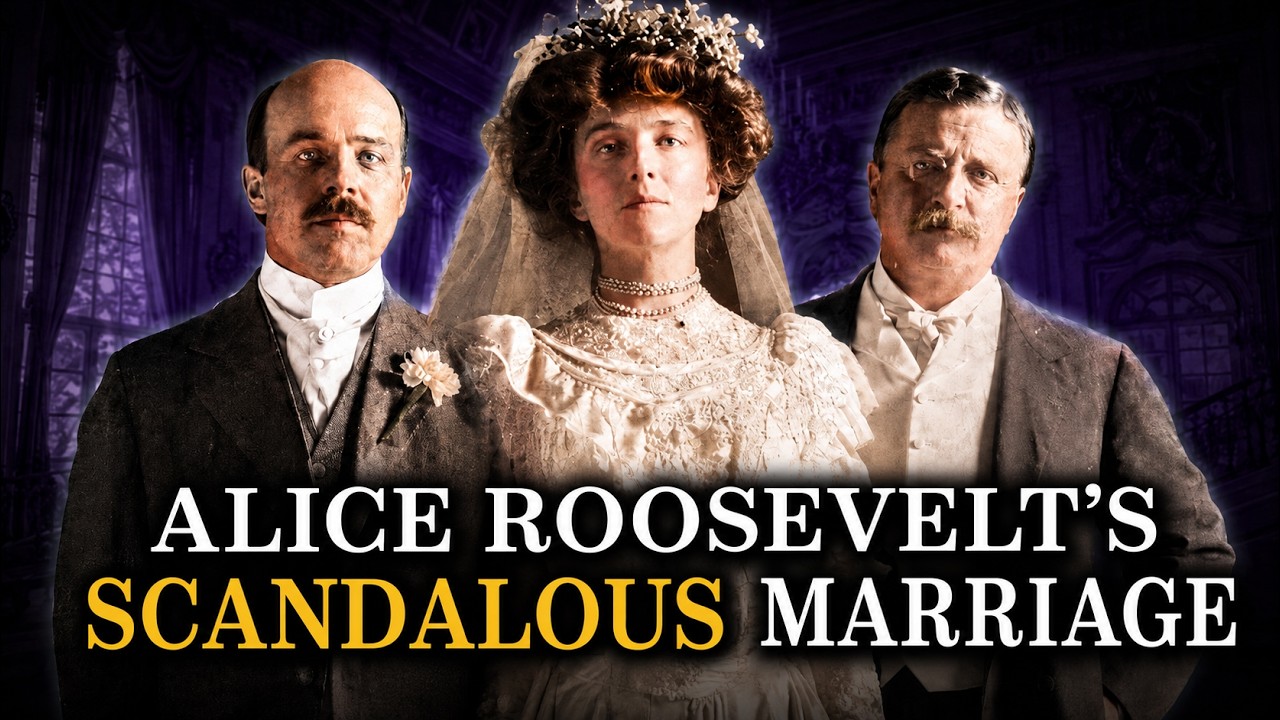
The gesture told the country everything it needed to know about the new Mrs. Nicholas Longworth. She would not soften by a single degree. Alice had entered the world on February 12, 1884, and two days later her mother, Alice Hathaway Lee Roosevelt, died of undiagnosed kidney failure.
On the same afternoon, Theodore Roosevelt’s mother died of typhoid. Two women he loved gone within twelve hours. Theodore scrawled a black X in his diary, handed the infant to his sister, and rode west to the Dakota badlands to grieve. Alice grew up raised by her aunt Bamie, rejoining her father’s household only after he remarried his childhood sweetheart, Edith Carow, and started a second family of five more children.
She was the odd one out, the daughter of the dead first wife. The family rarely spoke her mother’s name aloud. Out of that wound grew a personality engineered for maximum disruption. By her teens, Alice had turned celebrity into a weapon.
She drove automobiles without a chaperone, placed bets with bookies, kept a green garter snake named Emily Spinach coiled around her arm at parties, and packed a small pistol in her purse because she found the idea funny. Washington society clutched its pearls. Newspapers crowned her Princess Alice, a nickname she adored and her father despised. When Theodore’s friend, novelist Owen Wister, asked why the most powerful man in the country could not control his own daughter, the president threw up his hands.
He could run the United States, he told Wister, or he could attend to Alice. He could not do both. Nicholas Longworth came from Ohio money that never needed to announce itself. Born in Cincinnati in November 1869, fourteen years older than Alice, Nick belonged to one of the state’s founding families, a clan of bankers, art collectors, and vineyard owners wealthy since before the Civil War.
He sailed through Harvard, picked up a law degree, and fell hard for two things: Republican politics and the violin. He played a Stradivarius beautifully. At parties he tucked the instrument under his bald, shining head and hushed whole rooms. Beneath the polish ran a serious appetite for whiskey and women, pursued with the confidence of a man who took no for an answer from no one.
Washington dismissed him as a lightweight. Washington misjudged him completely. Longworth won his House seat in 1902, and over the following decades he hardened into one of the sharpest operators ever to walk the floor of Congress, a man who could count votes in his sleep and charm sworn enemies into allies between cocktails. The romance caught fire on a boat.
In 1905, Theodore dispatched a diplomatic delegation across the Pacific to Japan, China, and the Philippines, sending his ungovernable daughter along as a goodwill ambassador. The press dubbed it the Imperial Cruise. Alice scandalized the delegation, leaping fully clothed into the ship’s pool and daring a congressman to jump in after her. Nick Longworth claimed a berth on that ship.
By the time it steamed home, the most eligible bachelor in Congress and the most famous young woman in America had reached an understanding. Stripped of the celebrity, the marriage ran like a business merger. The early years carried a genuine spark, a shared humor sharp enough to draw blood, a taste for late nights, and a contempt for stuffed shirts. The cracks showed up fast.
Nick never stopped drinking or chasing women, conducting his affairs with a casualness that suggested he barely regarded his vows as binding. Alice, raised cold by a family that never taught her warmth, answered with ice, withholding affection like a tactical weapon and sharpening her wit on her own husband in public. Need held the contraption together. Longworth required the Roosevelt name, which opened doors no amount of Cincinnati money could unlock.
Alice required his congressional seat and fortune because in 1910 no road into the rooms where power lived existed for a woman except through a husband. Divorce promised to ruin them both. So they stayed bolted together, two iron-willed people who stopped loving each other and never stopped using each other. The Roosevelt family then tore itself apart on a national stage, and Alice stood ready to pick her father over her husband in the loudest fashion imaginable.
Theodore walked away from the presidency in 1909, handed the keys to his handpicked successor William Howard Taft, and sailed off to shoot lions in Africa, certain he left a loyal protégé behind. He came home furious, convinced Taft had betrayed the progressive cause. In 1912 he tried to take his old job back, lost the Republican nomination to Taft in a bare-knuckle convention fight, stormed out, and founded his own party on the spot. The press called it the Bull Moose Party.
The election became a three-way brawl between a sitting president, a former president, and the Democrat Woodrow Wilson, who watched the Republicans devour each other. That left the Longworths on opposite sides of a war. Nick represented Cincinnati, Ohio, Taft’s home state, and his entire career rested on the regular Republican machine that backed Taft. Alice chose blood.
She flung herself into her father’s insurgent campaign, then crossed the line that turned a political quarrel into a marital execution. She campaigned against her own husband in his own district, stumping for the Bull Moose Progressives who were openly fighting to unseat him. The voters delivered a verdict almost too cruel to credit. Nick Longworth lost his re-election to a Democrat named Stanley Bowdle by one hundred and five votes.
He clawed the seat back two years later, but the damage to the marriage never reversed. Whatever romance survived the drinking, the affairs, and the public mockery died in that election. Both of them knew it. They stayed married for nineteen more years anyway, and simply quit pretending the thing meant anything at all.
Alice looked elsewhere for love and landed in the one place guaranteed to make the arrangement combustible. He answered to the name William Borah, the lion of Idaho, a progressive Republican senator, a thunderous orator with a mane of wild hair and a reputation as the moral conscience of the Senate, the incorruptible Westerner everyone trusted. The lion of Idaho also wore a wedding ring, and he carried on a love affair with Theodore Roosevelt’s daughter for the better part of two decades while both stayed wed to other people. Borah engaged Alice on the level she always craved, intellect against intellect.
The affair amounted to more than rumor because Alice told us herself. Her private diaries, now in the Library of Congress, lay the thing bare. Biographer Stacy Cordery, digging through those pages, found Alice quietly tracking her own monthly cycles right alongside her private appointments with the senator. The affair produced a consequence no diary keeping could explain away.
On February 14, 1925, at the age of forty-one, Alice gave birth to her only child, a daughter she named Paulina. Forty-one years earlier, that exact date had stolen her mother and grandmother in a single afternoon. Nick Longworth claimed the baby as his own without hesitation, doted on the girl, and played the beaming proud father. Paulina belonged to another man.
Alice’s diaries supplied the timeline, and late in her life Alice told her own granddaughter, Joanna Sturm, in plain words that Borah fathered Paulina. The rumor that Alice meant to name the baby Deborah as a coded confession, or privately called her Aurora Borah Alice, she flatly denied in old age, pointing out that she would never stoop to turning her own daughter’s paternity into a pun. The funniest line about the scandal, the one everybody still repeats, remains the one Alice never actually uttered. The 1920s found the Longworths perched at the summit of their strange partnership.
In 1925 Nick’s colleagues elected him Speaker of the House, and he proved magnificent at the job, restoring real muscle to a position gutted years earlier. The capital that once dismissed the bald playboy now took its marching orders from him. Alice ran the other half of the empire, reigning as the undisputed queen of Washington society. On her sofa she kept a pillow embroidered with her personal motto: If you haven’t got anything nice to say about anybody, come and sit next to me.
Presidents genuinely feared her wit. Under the same roof, husband and wife lived entirely separate lives, sharing the house, the surname, and the polished public performance while sleeping, dreaming, and loving elsewhere. Partners now, not spouses. A brittle, brilliant business of mutual advantage the whole city could see plainly and could not stop watching.
It ended without warning. In the spring of 1931 Nick Longworth caught pneumonia while visiting friends in South Carolina and died on April 9, sixty-one years old. Alice wore black for a full year, mourning a husband she had betrayed, mocked, and openly campaigned against, proof that what stood between them never amounted to anything as simple as hatred. Alice lived another forty-nine years.
Her later decades carried real tragedy underneath the famous wit. Paulina, the Valentine baby with the hidden father, grew into a fragile woman crushed beneath depression, substance abuse, and the weight of a mother who devoured nearly everything in her orbit. Paulina married a man named Alexander Sturm and bore a daughter, Joanna, before her own troubles closed over her. In January 1957 she swallowed a fatal dose of sleeping pills and died at thirty-one.
Alice took in young Joanna Sturm, won full custody, and poured the back half of her life into the girl, and the truth about Borah passed from grandmother to granddaughter somewhere in those years, the only reason the historical record knows it at all. Alice died in 1980, ninety-six years old, the daughter of one president and the scourge of the men who came after him. She outlived her father, her husband, her lover, her only daughter, and nearly everyone who could remember why she mattered. Right to the end she gave no ground and asked no pardon.
A motherless girl turned herself into a national obsession. The brilliant drunk who married her for a name lost her over a single primary. A married senator fathered her only child and never breathed a word of it.
And a republic that swore it would never bow to royalty spent eight decades hanging on every word of a princess it never officially crowned.