On 14 October 1944, a black Mercedes pulled up to a modest house in Herrlingen, a small village in southern Germany. Inside, Field Marshal Erwin Rommel, once the most celebrated general in the Wehrmacht, sat with his wife and son. Two generals had arrived from Berlin. They did not come to arrest him.
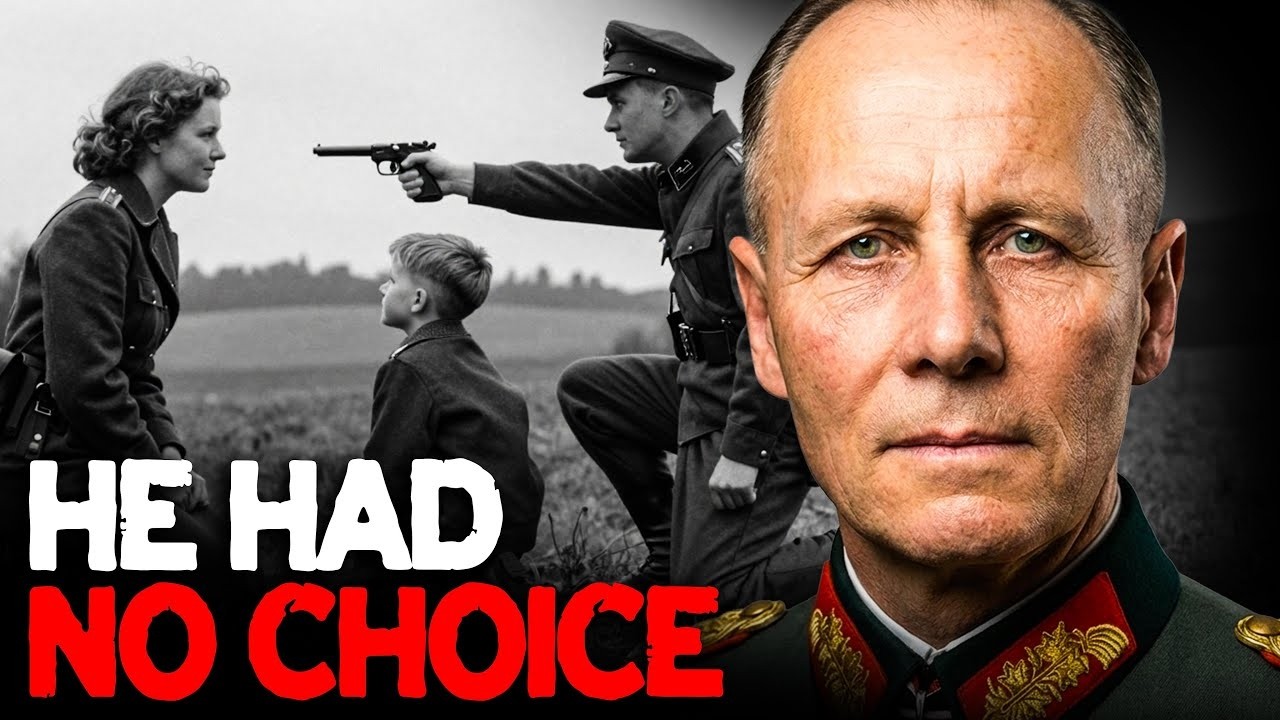
They came to offer him a choice: stand trial for treason with all the consequences that would follow for his family, or take his own life and receive a hero’s funeral. Ninety minutes later, Rommel climbed into the car. He never returned. Within the hour, the Desert Fox was dead.
How did one of Hitler’s most trusted commanders end up with a cyanide capsule in his hand, choosing death to protect his family from the regime he had served? Erwin Johannes Eugen Rommel was born on 15 November 1891 in Heidenheim an der Brenz, a small town in the Kingdom of Württemberg in the German Empire. His father was a schoolmaster, a man of modest means but solid respectability who taught mathematics. His mother came from a family with minor local standing.
The Rommels were not military people. There were no generals in the family tree, no ancestral estates, no long tradition of martial service. Young Erwin was described as a small, pale child, often quiet and dreamy. He showed an early aptitude for mathematics and engineering, interests that would later shape his approach to warfare.
As a teenager, he built a full-scale glider with a friend. In 1910, at age 18, Rommel applied to join the army. His first choice had been to study engineering, but his father encouraged a military career as more practical. His application to the artillery and engineers was rejected, but the 124th Württemberg Infantry Regiment accepted him as an officer cadet.
It was not the most prestigious path into the officer corps, which was dominated by Prussian nobles and old military families. A Swabian schoolmaster’s son had to prove himself through merit alone. By January 1912, Rommel had earned his commission as a lieutenant. That same year, he met Lucia Maria Mollin, known as Lucy, a young woman studying languages in Danzig.
They married in November 1916 during a brief leave from the front. She would remain his closest confidant for the rest of his life. When the Great War began in August 1914, Rommel was 22 and eager for action. His war began on the Western Front near Verdun, where he quickly distinguished himself through aggressive small-unit tactics.
In September 1914, during an early engagement near Varennes, Rommel led a patrol that stumbled into French positions at dawn. He had only three men with him, having outpaced the rest of his platoon. Rather than withdraw, he charged. The French soldiers, surprised by the sudden attack, scattered.
Rommel’s patrol captured prisoners and a strategic position. It was reckless, some said foolish, but it worked. He was wounded in the thigh, and while recovering in a field hospital, he received the Iron Cross, Second Class. The pattern that would define his career was already emerging: personal bravery, unconventional tactics, and a willingness to lead from the front.
The static warfare of the Western Front frustrated him. He found trench life tedious and wasteful, a grinding attrition that favored numbers over skill. In September 1915, he transferred to the Württemberg Mountain Battalion, an elite unit trained for mobile warfare in difficult terrain. The mountains of Romania, Italy, and the Balkans offered what the trenches denied: room to maneuver, opportunities for surprise, and rewards for initiative.
The Romanian campaign of 1916 provided early lessons. Rommel led his company through the Carpathian passes, learning to read terrain and exploit enemy hesitation. He developed a habit of personal reconnaissance, climbing to observation points himself rather than relying on reports from subordinates. In January 1917, during fighting near the Oituz Pass, Rommel was shot through the forearm but continued directing his men until the position was secured.
The Italian campaign of 1917 provided the stage for his greatest early triumph. In late October, during the Battle of Caporetto, German and Austro-Hungarian forces launched a devastating offensive against the Italian line along the Isonzo River. The attack employed new infiltration tactics, bypassing strong points and striking deep into enemy rear areas. Rommel led his company in a series of audacious maneuvers through the Julian Alps that would become legendary in military circles.
Over 52 hours of continuous fighting beginning on 24 October 1917, Rommel’s small force achieved remarkable results. At one point, his company found itself behind Italian lines, surrounded by enemy units that had no idea German soldiers were among them. Rather than fight his way out, Rommel advanced further, capturing supply dumps and headquarters. His force captured Mount Matajur, a key position defended by far superior numbers, through speed, surprise, and sheer audacity.
By the time the offensive concluded, Rommel’s men had taken over 9,000 Italian prisoners and seized 81 guns, suffering relatively few casualties themselves. The feat earned Rommel the Pour le Mérite, Imperial Germany’s highest military decoration for bravery, commonly known as the Blue Max. He was 25 years old, a captain with a reputation that extended far beyond his regiment. Yet even in triumph, there were hints of tension.
A dispute arose with another officer, Lieutenant Ferdinand Schörner, over credit for the capture of Mount Matajur. It was resolved in Rommel’s favor, but it left him wary of rivals and determined to control his own narrative. After the armistice in November 1918, Rommel faced an uncertain future. The German Empire had collapsed, replaced by the unstable Weimar Republic.
The army was reduced to 100,000 men under the Treaty of Versailles, and many officers found themselves unemployed. Rommel was retained, but promotions came slowly. He spent years as an instructor at infantry schools in Dresden and Potsdam, where he developed his tactical theories and cultivated a reputation as an exceptional teacher of warfare. He studied the lessons of the Great War with characteristic intensity, becoming convinced that modern warfare favored speed and mobility over defensive fortifications.
In 1937, Rommel published Infantry Attacks, a memoir of his First World War experiences. The book was part tactical manual, part adventure story. It sold well and caught the attention of Adolf Hitler, who admired its celebration of aggressive mobile warfare. In 1938, Rommel was assigned to command Hitler’s headquarters guard battalion during the annexation of Austria and later during the occupation of Czechoslovakia.
He was now part of the Führer’s inner circle. In February 1940, just before the invasion of France, Hitler gave Rommel command of the 7th Panzer Division. It was an extraordinary appointment. Rommel had no prior experience with tanks.
But he threw himself into the role, studying armor tactics and drilling his crews. When the attack began on 10 May 1940, Rommel led the 7th Panzer in a drive that earned them the nickname the Ghost Division. They moved so fast that even German high command sometimes lost track of their position. At the crossing of the Meuse River on 13 May, Rommel personally led his motorcycle battalion across under fire.
At the Battle of Arras on 21 May, British forces counterattacked with heavily armored Matilda tanks. The standard German anti-tank guns proved ineffective. Rommel personally directed the defense, ordering 88-millimeter anti-aircraft guns to be used against the tanks. It was an improvisation born of desperation, but it worked brilliantly.
The technique became standard doctrine. By the time France surrendered in June 1940, the 7th Panzer had captured nearly 100,000 prisoners. In February 1941, Hitler sent Rommel to North Africa. The Italian army had suffered a series of humiliating defeats against the British in Libya and Egypt.
Germany’s ally needed reinforcement, and Hitler chose Rommel to provide it. He was given command of a small force, initially just two divisions, designated the Deutsches Afrikakorps. His orders were defensive: stabilize the front and prevent an Italian collapse. Rommel ignored them almost immediately.
Within weeks of his arrival in Tripoli on 12 February 1941, he launched an offensive that drove the British back across Cyrenaica. The British, unprepared for such audacity, fell back in confusion. Rommel captured Benghazi on 4 April, besieged the fortress of Tobruk, and pushed the British to the Egyptian frontier. The campaign turned him into a legend.
British newspapers called him the Desert Fox, a tribute to his cunning and mobility. Even Churchill, in a speech to the House of Commons on 27 January 1942, acknowledged Rommel as a daring and skillful opponent. Rommel understood the desert as a naval theater where movement mattered more than fixed positions. He used deception relentlessly, employing dummy tanks made of canvas and wood and broadcasting false radio traffic.
He led from the front, often flying ahead in a Fieseler Storch reconnaissance aircraft. The Afrikakorps developed a distinctive culture under Rommel. Officers were expected to exercise initiative and act without waiting for orders. By late 1941, Rommel faced a new British commander, General Claude Auchinleck, who launched Operation Crusader in November.
Logistical problems began to tell. British naval and air forces based on Malta intercepted supply convoys crossing the Mediterranean. By Christmas 1941, Rommel was forced to retreat. But in January 1942, a fresh convoy reached Tripoli with reinforcements.
Rommel launched another offensive, recapturing much of Cyrenaica. By May 1942, he was preparing his greatest gamble, an attack on the fortified Gazala line. On the night of 26 May, Rommel led his armor in a wide flanking maneuver, swinging south around the British line and then turning north to strike from behind. The plan went wrong almost immediately.
Rommel’s advanced units ran into unexpected resistance from the Free French garrison at Bir Hakeim. The Afrikakorps found itself trapped in an area called the Cauldron, with supply lines cut. For days, Rommel’s forces were in mortal danger. His staff urged retreat.
He refused. Instead, he attacked, smashing through British positions to reopen his logistics. By mid-June, the British were retreating in disorder. On 21 June 1942, Tobruk fell, yielding over 33,000 prisoners.
Hitler promoted Rommel to field marshal, the youngest in the German army. He was 50 years old. The capture of Tobruk marked the zenith of his career. But his triumph contained the seeds of disaster.
Rommel wanted to press into Egypt to seize the Suez Canal. The British fell back to El Alamein, a narrow front between the Mediterranean and the impassable Qattara Depression. Geography favored defense. Rommel attacked in July, then again in late August, but each time the British held.
His supplies trickled across the Mediterranean. On 23 October 1942, Lieutenant General Bernard Montgomery launched the Second Battle of El Alamein with a massive artillery barrage. Rommel was on sick leave in Germany. He flew back immediately, but there was little he could do.
After twelve days of brutal fighting, with his army reduced to a handful of operational tanks and his fuel exhausted, Rommel ordered a retreat. Hitler forbade it. A signal arrived on 3 November. Rommel was to hold his positions to the last man.
He obeyed for one day, watching his remaining forces be destroyed. Then, on 4 November, he ignored the order and withdrew anyway. The decision saved what remained of his army, but marked a turning point in his relationship with Hitler. The field marshal who had been the Führer’s favorite was now suspect.
The retreat from El Alamein was a masterpiece of defensive warfare. Rommel extracted his forces across 1,500 miles of desert. By February 1943, he reached Tunisia. He launched one last offensive at Kasserine Pass, inflicting a defeat on inexperienced American troops.
But the strategic situation was hopeless. In March 1943, Rommel was recalled to Germany. He never returned to Africa. The Afrikakorps surrendered in May; over 230,000 soldiers went into captivity.
Back in Germany, Rommel found himself increasingly alienated from the regime. By late 1943, Hitler gave him a new assignment: improving the Atlantic Wall against Allied invasion. Rommel threw himself into the task. He believed the invasion had to be stopped on the beaches.
His views brought him into conflict with Field Marshal Gerd von Rundstedt, who favored holding armor inland for a decisive counterattack. Hitler compromised, dividing the armor in a way that satisfied no one. When the Allies landed on 6 June 1944, Rommel was not in Normandy. He had driven home to celebrate Lucy’s birthday.
When news of the landings reached him early that morning, he raced back to his headquarters. The next weeks were a grinding struggle. Allied fighter-bombers made daylight movement nearly suicidal. Privately, Rommel began to believe the war was lost.
He told his chief of staff, General Hans Speidel, that Germany must seek peace before the situation became catastrophic. On 17 July 1944, Rommel’s staff car was attacked by British Spitfires near Sainte-Foy-de-Montgomery. The driver was killed instantly. Rommel was thrown from the vehicle, suffering severe skull fractures and injuries to his left eye.
He was rushed to a hospital unconscious and not expected to survive. Three days later, on 20 July 1944, a bomb exploded at Hitler’s Wolf’s Lair headquarters. Colonel Claus von Stauffenberg had placed explosives under a conference table, hoping to kill Hitler and trigger a coup. The bomb failed to kill its target, and the coup collapsed within hours.
What followed was a purge of unprecedented ferocity. Under torture, prisoners named names. Among them, repeatedly, was Erwin Rommel. The extent of Rommel’s involvement in the July 20 conspiracy remains debated.
He had met with some plotters and shared their pessimism. General Carl-Heinrich von Stülpnagel, the military governor of France, was a close associate. Several conspirators believed Rommel could be persuaded to support a change of government. But there is no conclusive evidence that Rommel knew of the assassination plan or approved of killing Hitler.
He seems to have favored a negotiated end to the war, possibly including Hitler’s arrest and trial, but not murder. The distinction mattered little to the Gestapo. As Rommel recovered at home through August and September 1944, the investigation closed around him. Stülpnagel, arrested after the coup failed, attempted suicide, and in his delirium called out repeatedly for Rommel.
Speidel was arrested on 7 September. Circumstantial evidence accumulated. Martin Bormann pushed for arrest and trial. Others hesitated.
Rommel was a national hero. Hitler resolved the dilemma with characteristic brutality. Rommel would choose trial or suicide. If he chose suicide, his death would be attributed to his wounds, he would receive a state funeral with full military honors, and his family would be protected.
If he refused, he would be arrested, tried, and certainly convicted, and his wife and son would share his disgrace. On 14 October 1944, Generals Wilhelm Burgdorf and Ernst Maisel arrived at Herrlingen. Lucy and Manfred, fifteen years old, were in the house. Rommel received the generals in his study.
The conversation lasted 90 minutes. Then Rommel emerged to speak with his family. He told them what had been offered. He would not give the regime the spectacle of a trial.
He would not allow his family to suffer. Shortly after noon, Erwin Rommel walked out of his house for the last time. He wore his Africa jacket, the one he had worn through the desert campaigns. He said goodbye to his wife and son.
He climbed into the waiting Mercedes. Burgdorf sat beside him. A few hundred meters down the road, in a quiet spot among the trees, the car stopped. Burgdorf handed Rommel a cyanide capsule.
The field marshal bit down on it. Within seconds, he was dead. He was 52 years old. The official announcement reported that Rommel had died of his wounds from the July air attack.
A state funeral was held at Ulm on 18 October. Field Marshal von Rundstedt delivered the eulogy. Hitler sent a wreath. Thousands lined the streets.
The lie was maintained throughout the war. Only after Germany’s defeat did the truth emerge, revealed by Lucy and Manfred Rommel to occupation authorities. The circumstances of his death shaped his legacy in complex ways. To some, he was a martyr, a soldier who opposed Hitler and paid with his life.
But that portrait does not survive serious scrutiny. He owed his career to Hitler’s patronage and served the regime loyally for years. His opposition came late and remained hesitant to the end. He never joined the active conspirators, never took concrete action against the regime.
His doubts about Hitler arose from military defeat, not moral awakening. Rommel’s final choice was not an act of resistance but an act of protection. He died to save his family, to preserve their pension, their home, their place in society. It was a tactical decision calculated for effect, executed with precision.
He did not die for a cause. He died to control the outcome, as he had always tried to do, from Mount Matajur to El Alamein. The black Mercedes drove only a short distance before it stopped. What passed between the field marshal and Burgdorf in those final moments remains unknown.
Rommel left no last words, no final testament. He simply took the capsule and died. The regime that killed him praised him in death.
The lie outlasted the Reich itself.