In December 1988, a company bearing an American family’s name was sold for $5. 68 billion to a British corporation, and the family that built it had no power to stop the sale. George S. Pillsbury, the founder’s own grandson, sat in the boardroom as a director while it happened.
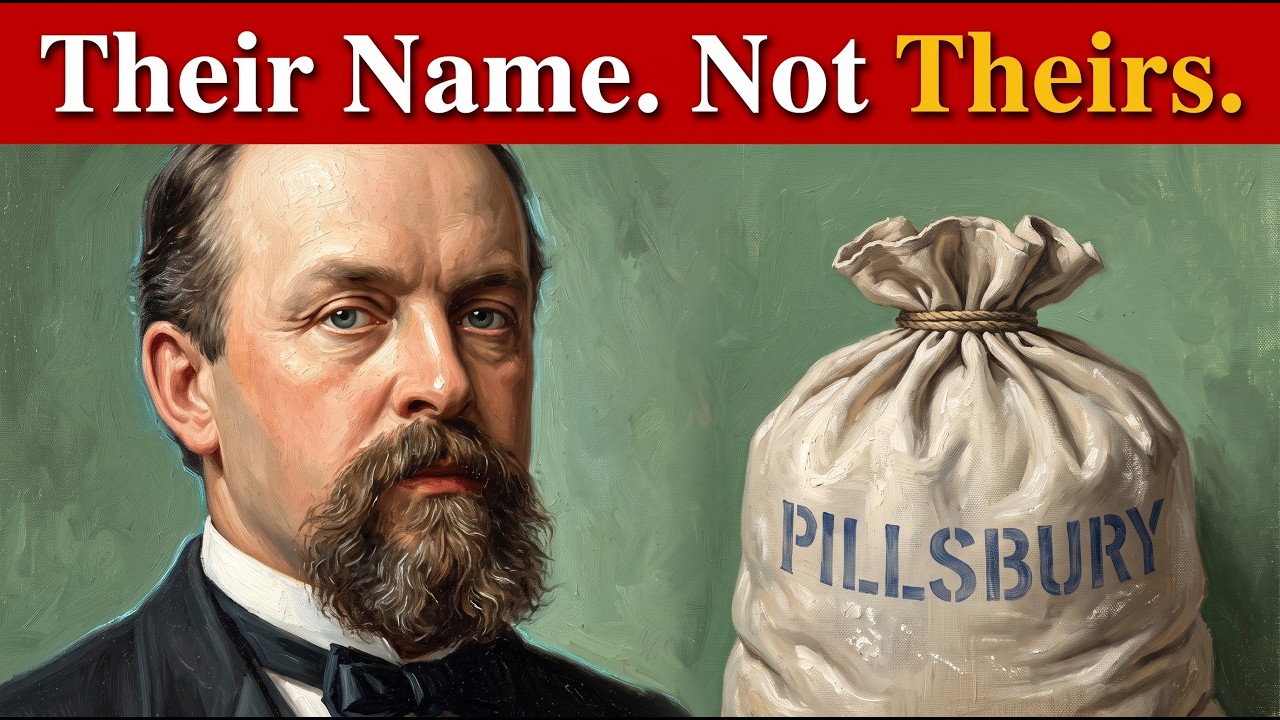
He had dedicated his career to the company, carried the family name, and held a seat at the decision-making table. Yet he could not prevent the sale. The buyer was Grand Metropolitan of London. In the end, all the Pillsburys were left with was the name itself.
No one seized the company from them. There was no fraud, no confiscation, no dramatic day when a rival snatched it away. The family did not go bankrupt, and the name never disappeared from grocery shelves. Still, as their namesake company reached a value of more than $5 billion, the Pillsburys could not retain a meaningful share of it.
The story began with $10,000, and it did not begin as a company at all. In 1869, Charles A. Pillsbury and his father pooled about $10,000 to buy one-third of a failing flour mill in Minneapolis. Charles did not simply collect what the mill produced.
He reinvested earnings, bought out partners, and pursued every opportunity until that one-third stake grew into a major company. By 1882, he built the Pillsbury A-Mill, the world’s largest flour mill, capable of grinding more wheat under one roof than any mill before it. The company that began with a $10,000 share would one day sell for $5. 68 billion.
What mattered most about Charles Pillsbury was that he controlled what he built. He had personally constructed the business from that failing mill’s third share, and he held it firmly in his own hands. That control gave him the power to decide the company’s future, making it more valuable than the plants and the brand, because it was the means of keeping both. The mill business was difficult and dangerous.
Grain prices fluctuated, crops failed without warning, fire could destroy a mill overnight, and competitors could ruin one another. Charles kept tight control of his company precisely because he reported to no one above him. He could survive bad years, take hard loans during good ones, and make fast decisions alone when conditions changed overnight. For a man in his position, that control was the key to survival.
Flour was not a luxury. It was the most common kitchen staple, the basis of daily food for an entire nation. The family that could grind it finer and cheaper than anyone else established a small, steady claim on a country’s hunger. The Pillsbury name became one that people stopped questioning, chosen by mothers without hesitation because their own mothers had chosen it.
In 1889, the first step in losing control came from Charles Pillsbury himself. He had built the world’s largest flour company, and to take it further, he sold control of the mills to a syndicate of English investors. London financiers bought the controlling interest in Pillsbury’s operations and merged them into a large British-owned combine. From that year on, the company Charles Pillsbury built was in foreign hands.
He did not sell everything. He kept a large stake and remained managing director of the mills. What he surrendered was not ownership but control. It was not a foolish move—the English capital allowed the mills to expand beyond what he could have financed alone.
To the man who knew the business to the last sack of flour, it seemed the most prudent step of his life. But control, once it leaves a family, does not always return on the family’s terms. For years afterward, Pillsbury Mills was British-owned. Profits and final decisions flowed to investors across the ocean.
Charles Pillsbury did not live to see it return. He died in 1899, ten years after the sale, still managing director of the company he had built but no longer controlled. It took the family until 1923 to buy back what he had sold—more than three decades to reverse a single afternoon’s decision. The founder’s twin sons, along with their cousin Alfred Pillsbury, reclaimed the company from British ownership.
It was a deliberate and costly act of will. The second generation had lived through the foreign years and knew what had nearly been lost. They brought control back to the family. That generation was the last to hold full control.
They understood the near loss because they had lived through it, but that understanding was not passed down in the blood. Their children and grandchildren grew up in a world where the company had always existed—a huge and famous business bearing the family name. In the years that followed, Pillsbury became a public company. Its shares were bought and sold on the open market by anyone with enough money.
That is how a private family firm became a modern corporation, and how its founders’ heirs gradually lost ownership. No family member ever announced they were giving up control. There was likely no single meeting where it was said aloud. It happened the way such things often do: a block of shares sold here to settle an estate, a stake sold there to raise cash or share risk.
Each new generation owned a little less, and strangers owned more. When a company’s shares trade publicly, control goes with the shares. Whoever holds the most shares has the most say. If the founding family no longer holds a majority, they no longer make the decisions.
A family can keep its name on a company forever—a seat in the boardroom, a portrait in the lobby—but when their shares are scattered, they lose the one thing that matters most: the power to say no. By the 1980s, the current had done its work. Pillsbury had grown into one of America’s largest food companies, far beyond the flour business. Its shares traded daily in huge numbers.
The people who actually held those shares—the majority owners of the company bearing the Pillsbury name—were not members of the Pillsbury family. The largest shareholders were institutions and arbitrageurs: pension funds, investment firms, and Wall Street trading desks. It was an astonishing calculation. Charles Pillsbury began with $10,000 for one-third of a failing mill in 1869.
One hundred and nineteen years later, the company built from that stake was about to sell for $5. 68 billion. The value of what the family created grew beyond the founder’s imagination, but the family’s share had moved in the opposite direction. Generations of selling, splitting, and shrinking shares reduced their position to the point where they could not command a decisive say in the sale.
Inside the company, one Pillsbury remained. The founder’s grandson had gone to work for the firm his family built. He stayed twenty-four years, rising to executive vice president before retirement, the last family member to draw a salary from the company. He had the name, the history, and a genuine career inside the business.
What he lacked, as did every other Pillsbury, was a stake large enough to determine the company’s fate. In the mid-1980s, this combination made Pillsbury dangerous to itself. A large, famous, cash-rich business with shares scattered across the market, no family stake, and no single powerful owner protecting it was an opportunity to those on Wall Street who buy and break up companies. A company without a controlling owner could be bought by anyone willing to pay enough to convince shareholders.
That someone was Grand Metropolitan, a British multinational. In October 1988, Grand Met made a direct offer to shareholders of $60 per share for the entire company. It was a hostile bid—the buyer did not request the company’s permission. The offer bypassed the board and went directly to the thousands of scattered shareholders who collectively held the company the family no longer controlled.
The Pillsbury board did not surrender easily. It fought the acquisition hard. There were fourteen directors, twelve of them outsiders. The only Pillsbury on the board was the founder’s grandson, the retired officer who had devoted his career to the firm.
The board rejected Grand Met’s offer unanimously. All fourteen voted no. A hostile bid does not stop just because the board says no. Grand Met returned with more money: the price rose from $60 to $63 per share, then to $66.
The board’s last real weapon was the “poison pill,” a defense mechanism written into company rules that would flood the market with new shares and make the acquisition too expensive for any buyer. As long as it stood, the board could say no no matter what shareholders wanted. Grand Met went to court to break that wall. The fight landed in Delaware, where large American corporations are chartered and their control battles are settled.
Grand Met argued that the Pillsbury board was using the poison pill not to protect shareholders but to ignore them, blocking a fair and generous offer they wanted to accept. On December 16, 1988, the Delaware Court of Chancery agreed. The court struck down the poison pill. Two days after the ruling, the directors who had voted no so many times voted to end it.
They agreed to sell Pillsbury to Grand Metropolitan for $66 per share, a total of $5. 68 billion. The chairman who signed the deal was Philip L. Smith.
He was not related to the founding family. The Pillsbury family did not decide to sell the company. A fourteen-member board submitted to a court at a time when the market had already decided. The only Pillsbury named in the records could cast his one vote, and it made no difference.
The founder’s grandson sat in the middle of it, one vote among fourteen, as the company his grandfather built from a struggling mill passed to foreign ownership. It was already too late when Grand Met arrived. The loss had been completed over the previous hundred years, every time a block of shares left the family and went to the market. The December vote was simply the moment the world found out.
There was one more twist the family felt more keenly than anyone else. Grand Metropolitan was British. Charles Pillsbury’s company had already been sold once, to English investors in 1889, and his sons had spent decades buying it back. Now, a hundred years later, it was returning to London, and this time there was no son left with the power to reverse the decision.
The Pillsburys did not lose the company in that Delaware courtroom. They lost it slowly, over a century of reasonable decisions. To understand what the Pillsburys lost, one needs only to look at another family in the same business on the other side of Minnesota. As the Pillsburys milled flour in Minneapolis, another dynasty was quietly building great wealth in the grain trade.
The company was Cargill, founded in 1865, headquartered for generations in the same Minnesota grain belt where the Pillsburys rose. The two families grew from the same corner of the country, in the same years, from the same grain. But Cargill did what the Pillsburys did not. They never sold the company to the public.
They never let its shares scatter across the open market. They kept control within the family and refused to give it up across generations. Cargill has never been listed on the stock exchange, and today it remains one of America’s largest private companies. More than 150 years later, it is still owned and controlled by the descendants of the family that built it.
They did not dilute their shares. They did not sell pieces of control. This is the hard lesson of both families. A great company remains in a family only as long as that family keeps its control out of the market.
Sell flour, sell stock, sell growth, and you can still be rich. But sell control bit by bit, and one day the company will be sold in front of you, and you will have no vote that matters. So it ended. In December 1988, the Pillsbury Company—the flour empire a single American family built from one failing mill—was sold to a British corporation for $5.
68 billion. The family whose name was on every box could only watch. They kept the name. They kept the history and pride of what their family had made.
What they could not keep was the company itself. No single villain did this to them. There was no thief, no fraudster, no catastrophic error to point at. The Pillsburys were undone by the most patient of forces: the slow surrender of control, given away in small pieces over four generations through decisions that each seemed reasonable at the time.
The heir who sold a few shares acted sensibly. The heir who took a fair price for an easier life did what almost anyone would do. Control slipped away in steps so small and over so many years that no single person could be said to have given it up. The dangers a wealthy family fears are the loud ones: market crashes, scandals, a reckless heir who gambles everything away.
What actually brought down the Pillsburys was none of those. It was prudence. It was hundreds of small, careful, supportable decisions, each easily justified, that over a century added up to the loss of nearly everything that mattered. Not far away in Minnesota, the Cargills held on to the control the Pillsburys gave away, and their name still belongs to them.
The Pillsbury name now belongs to a corporation. In 2018, the great house the family built, the Southways mansion, was demolished a century after construction. The flour is still on the shelves, and the little white doughboy still smiles on the package.
The name is everywhere, but every letter of it now belongs to someone else.