On July 14, 1966, on a film set outside London, a man in his thirties sat in a raised director’s chair in front of a tank, wearing a military uniform that was not his own. He held a single piece of paper. Journalists leaned in. He read one sentence that ended the career of the greatest runner the sport had ever seen.
He told them his intention had been to play in the 1966 season, but circumstances made that impossible. That was all. No anger. No names mentioned.
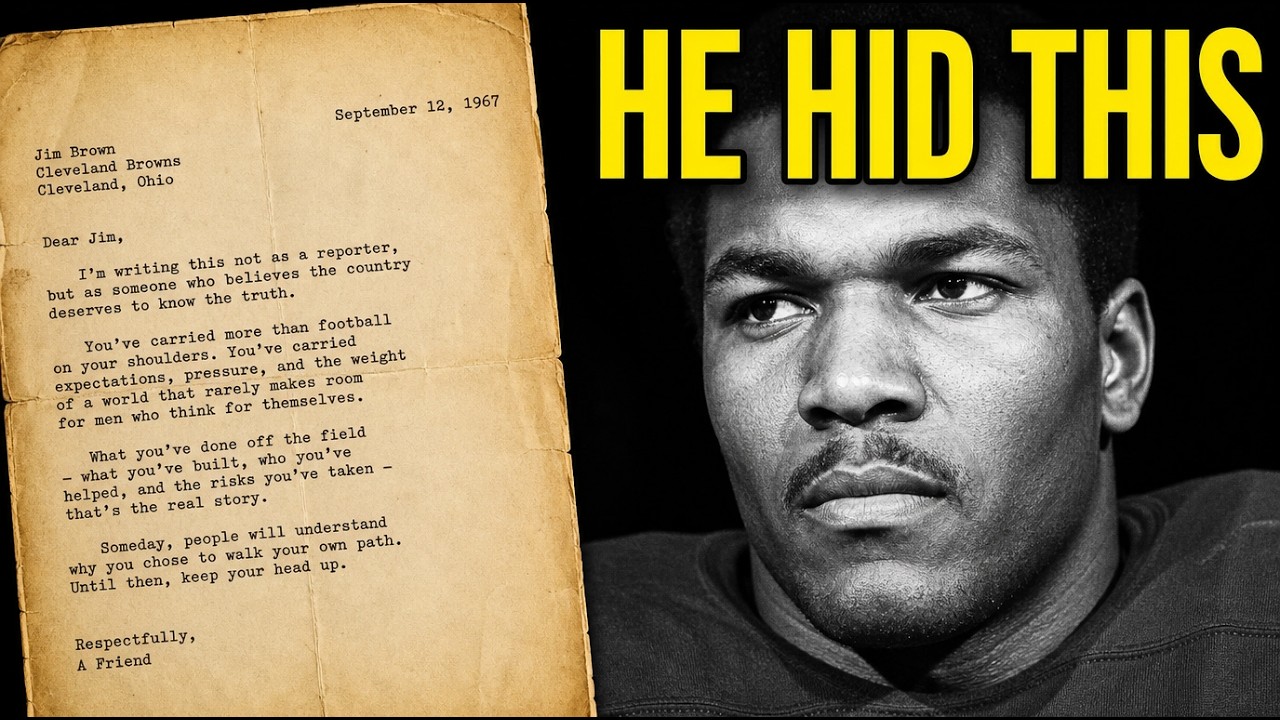
Nearly 3,700 miles away in Cleveland, Ohio, the team owner who thought he could bend this man to his will was about to discover how badly he had misjudged him. What almost every version of this story leaves out is that Jim Brown did not write one letter that week. He wrote two. And the second one was not about him at all.
To understand what happened on that film set, you have to understand what Brown was walking away from. By 1966, he was not just the best player in professional football. By every available measure, he was the best in the history of the sport. Nine seasons in Cleveland.
He led the league in rushing yards in eight of them, with the only exception coming in 1962. He was named league MVP three times. In 1964, he carried the Browns to an NFL championship with a 27-0 victory over Baltimore, the last title that franchise has won to this day. He never missed a single game in nine years, despite playing the most punishing position on the field.
He built all of it from nothing. Brown arrived at Syracuse in 1953 without a scholarship and was the only Black player on the freshman team, having been turned down by bigger programs that had watched him and said no. By his senior year, he was setting records that stood for decades. In one afternoon against Colgate, he rushed for 196 yards, scored six touchdowns, and kicked seven extra points, totaling 43 points by himself in a single game.
He finished fifth in Heisman Trophy voting that year. He was also, by the testimony of nearly everyone who saw him, the best lacrosse player in the country. Cleveland selected him in the first round of the 1957 draft. He led the league in rushing as a rookie and essentially never stopped.
Then, on January 2, 1966, he played what no one knew would be his final game, a championship loss to Green Bay. He was 29 years old. He had just finished his third season as league MVP. And he had already quietly decided that football was no longer the most interesting thing in his life.
To understand the dispute, you have to understand who stood on the other side of it. Art Modell bought the Cleveland Browns in 1961. He was a 35-year-old New York advertising man who had borrowed most of the purchase price. He was not a football man, and he knew it.
What he had was a conviction that whoever signs the checks makes the decisions. In January 1963, he proved it. He fired Paul Brown, the man who had founded the franchise, whose name was literally printed on the front of the jersey, and who had won seven titles in 17 years. Modell fired him during a Cleveland newspaper strike, when none of the city’s papers were publishing.
The most significant firing in franchise history passed with almost no noise. Jim Brown watched all of it from inside the locker room. He had played for Paul Brown, and he now played for Blanton Collier, the quiet, cautious assistant who had inherited the position. He understood something about the owner that the rest of the team may not have fully grasped yet.
Art Modell never let sentiment interfere with a business decision. Here is the part almost no one tells you. While he was still the most prominent face in the American Football League, Jim Brown had already begun building something else. He was organizing an economic union to fund and support Black-owned businesses across the country, recruiting his Cleveland teammates to join, giving it a real structure rather than just a famous name on letterhead.
At a time when no professional athlete used his platform for anything beyond the game, Brown was building an entire second career in plain sight. The press was not paying attention. Art Modell was not paying attention. So when the retirement finally came, everyone called it sudden.
It was not sudden. It was an acceleration of something that had been in progress for a while. But the timing made it look reckless. After the 1965 season, Brown traveled to England to film his second movie.
His first, a 1964 Western called “Rio Conchos,” had been successful enough that studios took him seriously as a professional actor rather than a passing novelty. The new project was a massive production, a World War II film called “The Dirty Dozen” with Lee Marvin, Charles Bronson, and Ernest Borgnine. It would become one of the biggest films of the decade, and it was running severely behind schedule. English weather halted production for weeks.
Weeks turned into months, and the delay pushed the shoot directly into the period when Cleveland’s training camp was set to open at Hiram College in Ohio. So Brown picked up the phone in London and called Art Modell to explain the situation. This is the part the story usually skips in a single sentence. It deserves more, because everything changes here.
Understand Brown’s position first. He had not signed his contract for the 1966 season yet. No document required him to be anywhere on a specific date. And in 1966, there was no free agency system.
A player belonged to his team indefinitely, which meant contracts were not negotiations so much as annual formalities. Brown was not refusing to play. He was not asking for money. He was asking for a few weeks.
By his own later account, he fully expected to be ready to play by the time the regular season started. Miss part of camp, then play. He was 30 years old, coming off an MVP season, and had never missed a game in his life. There was no reason to think a training camp schedule would be the issue that ended his career.
Modell saw something entirely different. He saw a dangerous precedent. If the biggest star on the roster could set his own arrival date, then every veteran could do it. Modell had spent five years establishing a single principle in Cleveland, that the owner makes the decisions and everyone complies.
He had fired the franchise’s founder to prove that point. So he drew a line. No veteran would be excused from reporting on time. Not for a movie, not for anything, not even for Jim Brown.
Then he did the thing that made it irreversible. He took it to the press. Modell publicly announced he would fine Jim Brown $100 for every day he did not show up at the training ground in Ohio. He told reporters.
He repeated it. In 1966, $100 a day was a considerable sum, but the amount was not the real point. The point was that it was said out loud. The private dispute over a filming schedule had become a public test of who controlled whom, and Modell had framed it so that only two outcomes were possible.
Either Jim Brown came home on the owner’s schedule in front of the entire country, or he did not come home at all. Brown’s teammate, defensive lineman Jim Kanicki, later described the situation as clearly as it could be described. You do not give Jim Brown an ultimatum. He was not going to back down before Art Modell or anyone else.
Modell had spent five years teaching the Cleveland Browns that he made the decisions. Jim Brown had been listening closely. In the second week of July, from a rented room in London, Brown sat down and wrote. The first letter went to Art Modell.
And with that, everything was over. It was not a letter of attack, and it was not intended to settle scores, but it offered no concessions either. In it, Brown told the owner directly that his manhood meant as much to him as Modell’s manhood meant to Modell. He signed it “Your friend, Jim.
” It was mailed with a London postmark. He followed it with a long-distance phone call. That letter still exists. It was sold at auction decades later.
But he wrote a second letter in the same week, addressed to Blanton Collier, his head coach, a man he genuinely respected. In that letter, Brown did not talk about himself at all. He told Collier the team would be fine at the running back position. He asked him to let Ernie Green do what he did best, which was blocking.
Then he directed his coach to a young player deep in the lineup, a second-year man out of Morgan State who had not yet been tested, and told him this kid would be amazing. Give him the ball. His name was Leroy Kelly. Think about what that gesture was.
A man ending the greatest career in football history 3,700 miles from home in the middle of the most public confrontation of his life, and his final professional act was to make sure the locker room he was leaving still had a chance to win without him. Leroy Kelly led the NFL in rushing for the next two seasons, exactly as the letter predicted. He is now in the Hall of Fame. The next morning, Brown made it official on the film set, still wearing his character’s costume.
One sheet of paper, one sentence about circumstances, no mention of the fine, no mention of Modell. But a day later, in a private session with Tex Maule of Sports Illustrated at the same location, he gave the version he had not said to the cameras. He admitted he could have kept playing. The scheduling conflict was real, but it was not the whole story.
He told Maule he wanted more mental stimulation than football could give him. He said he wanted to be part of the struggle taking place in his country and that he had the opportunity to do so now. Then he said the sentence that explains the entire decision. Maybe I won’t be able to a year from now.
Less than 12 months later, he gathered the most famous Black athletes in America in one room in Cleveland for a meeting that changed what it meant to be an athlete in this country. But that is a story for another day. Art Modell never got his running back back. Cleveland moved forward with Leroy Kelly, exactly as the letter had promised.
And the Browns spent the rest of the decade learning what they had already learned once with Paul Brown, that greatness under this ownership had a habit of leaving quietly at a time of its own choosing, keeping the last word for itself. So this story was never really about a movie that ran late. That is just the marginal version. The real story is what a man does when the people paying him decide that $100 a day is enough to keep him in a place where he no longer feels respected.
Jim Brown did not leave in anger. He did not burn bridges behind him or settle scores on his way out the door. He wrote one letter to close the door and a second letter to make sure the men he left behind would be all right. Then he walked toward the rest of his life on his own schedule, not anyone else’s.
He finished his career with 12,312 rushing yards in 118 games. That is 104 yards per game over nine consecutive seasons. Sixty years later, no one has broken that mark.