Edwin McMasters Stanton, Abraham Lincoln’s secretary of war, was a man of astonishing contradictions—personally honest yet politically ruthless, deeply grief-stricken yet relentlessly driven. In charge of the Union’s land-based operations, he made tough decisions with little regard for those caught in their path. His mission was simple: win the war. In doing so, he earned a lasting reputation as one of the most feared and least loved figures in Lincoln’s cabinet.
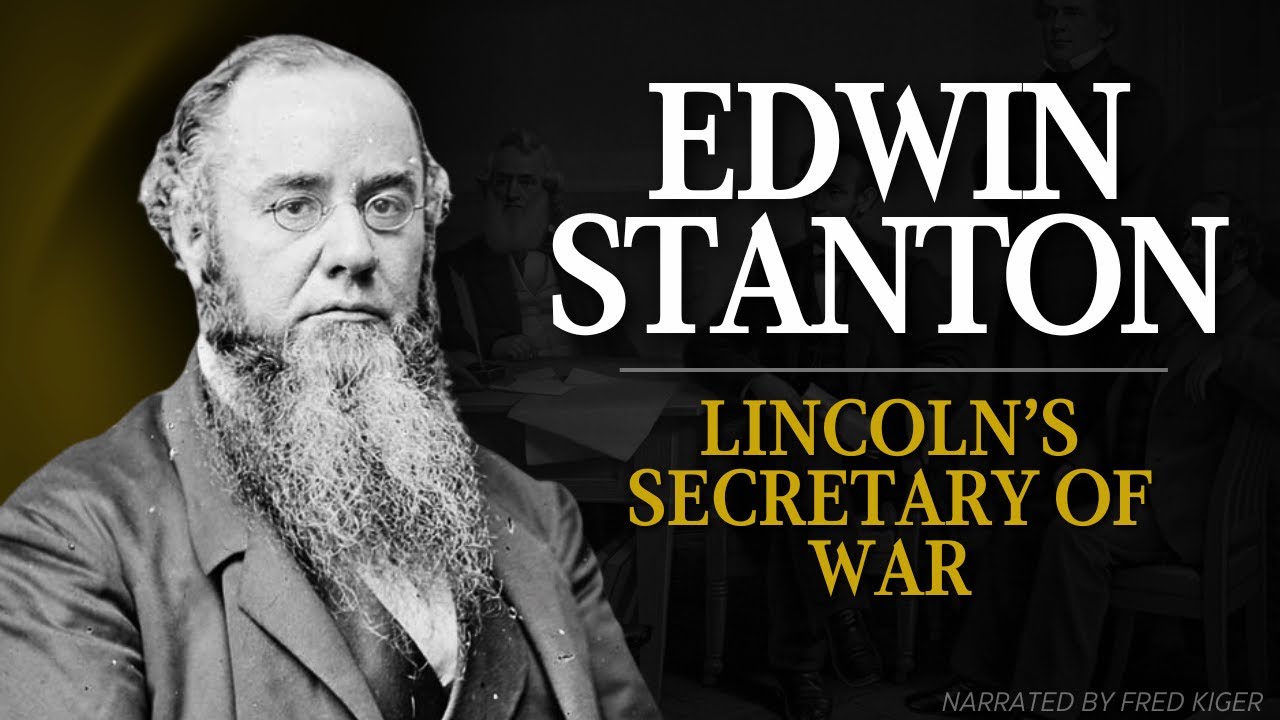
Born December 19, 1814, in Steubenville, Ohio, Stanton was the eldest of four children. His father, a physician, died when Edwin was just 13, forcing him to leave college early due to family financial troubles. He studied law and married Mary Ann Lamson in 1836, beginning a career that would quickly gain notoriety. Stanton’s pre-war legal career revealed his theatrical and obsessive nature.
Defending a man charged with murder by poisoning, Stanton famously drank the same poison in court and vomited it back up to prove it could not be retained—and won the case. In another trial, he coached a client accused of theft to appear insane in court. The judge, moved by the performance, freed the man. Soon after, it was learned the entire act had been choreographed by Stanton from the moment the client had randomly picked him from a crowd.
Tragedy haunted his personal life. His daughter Lucy died at age one, his wife Mary Ann died of a bilious fever in 1844, and his younger brother Darwin took his own life in 1846 after suffering a brain illness. These losses turned the once light-hearted young man cold and stern. He remarried in 1856, wedding Ellen Hutchinson, and the couple moved to Washington, D.
C. His legal victories continued. In 1859, he defended Congressman Daniel Sickles, who had shot and killed Philip Barton Key, the son of Francis Scott Key, after discovering an affair with his wife. Stanton won an acquittal by arguing temporary insanity—a landmark legal precedent.
Stanton’s political rise came reluctantly. In December 1860, he read in a newspaper that President James Buchanan had named him attorney general. He accepted, despite a major pay cut, after receiving assurance that Buchanan would uphold the Union. When it came to Lincoln, Stanton was openly contemptuous.
He called the future president the “original gorilla” and a “giraffe. ” The two had first met during the McCormick Reaper case in 1855, where Stanton was rude and dismissive to Lincoln. In January 1862, Stanton took over as secretary of war, replacing the scandal-plagued Simon Cameron. He immediately reorganized and expanded the department, using railroads and telegraphs for the first time in military administration.
He cleaned out shoddy contractors, took over internal security, and ran the department with volcanic energy. Employees learned to fear his arrival: each morning, a doorkeeper shouted “The secretary! ” and everyone scrambled. Stanton clashed constantly with Major General George B.
McClellan, commander of the Army of the Potomac. While McClellan delayed, Stanton grew restless. When McClellan finally launched the Peninsula Campaign in 1862, Stanton discovered that far fewer troops had been left to defend Washington than McClellan reported. To Stanton’s disgust, he realized enemies wore gray, but allies could be equally damaging.
Despite a brief effort at reconciliation, when Stanton wrote to McClellan, “No man had ever a truer friend than I have been to you,” and McClellan answered, “Maybe I have been wrong about you,” both men knew they were lying. In a letter to his wife, McClellan called Stanton “the most unmitigated scoundrel I ever knew, heard, or read of,” adding that if Stanton had lived in Jesus’s time, Judas Iscariot would have remained a respected apostle. The common soldier bore the burden of all this infighting. Stanton’s young son James died in 1862, but the secretary received little sympathy.
Many blamed him for McClellan’s failures, accusing Stanton of deliberately sabotaging the general. Tensions peaked in 1862 when Stanton and several cabinet members signed a petition to remove McClellan. They never presented it: Lincoln stunned them by announcing he had already restored McClellan to command during Lee’s invasion of Maryland. That November, a resigned Lincoln finally relieved McClellan of his command.
Stanton had pushed for Ambrose Burnside as his replacement, but Burnside led the Union to disaster at Fredericksburg. Stanton was castigated again. In 1863, Stanton found the general he had been seeking: Ulysses S. Grant.
Assistant Secretary of State Charles A. Dana described Grant as absolutely honest, doggedly determined, and lacking political aspirations. Stanton needed someone who could fight, think, and grow. When Grant took command, the relationship between the two men proved far more effective than any Stanton had managed before.
Stanton’s greatest logistical achievement came in September 1863. When Major General William Rosecrans was defeated at Chickamauga and his army besieged in Chattanooga, Stanton moved a staggering force westward. In the early hours of the morning, he met with railroad representatives and decided to transfer two entire Federal corps from the Army of the Potomac. He ordered some 8,000 Black laborers to change the entire gauge of the Louisville and Lexington Railroad so that differing train gauges would not delay the transfer.
Within ten days, over 20,000 men, ten batteries with horses and ammunition, and 100 cars of baggage had moved some 1,200 miles—one of the greatest logistical feats of the war. Stanton then raced to meet Grant personally. The two met face to face for the first time, and decisions were made: George Henry Thomas would command the forces at Chattanooga, and Grant would lead the Military District of Mississippi. The siege was broken, and Grant soon headed east to become the nation’s first three-star general since George Washington.
During the 1864 election season, Stanton unapologetically used his office to support Lincoln and the Republican ticket. He offered bounties and furloughs to keep men in uniform, and some 136,000 veterans re-enlisted. Fifteen thousand soldiers from Indiana received furloughs to vote in their home state. When he learned that a Union colonel had voted against the pro-administration candidate, Stanton had him demoted and sent south.
Lincoln carried every state except Kentucky, Delaware, and New Jersey. Stanton nearly died during the election period, recovering from an illness over three weeks. He later confided to Lincoln that he had long wished to be a Supreme Court justice. Lincoln replied he couldn’t spare him.
Grant also pleaded with Lincoln to keep Stanton at his post. When Lee surrendered to Grant at Appomattox, Stanton offered Lincoln his resignation. Lincoln refused it. There was still too much to do.
Stanton had supported the creation of the Medal of Honor, instituted conscription and absentee voting, pushed for emancipation and Black enlistment, and gathered enough supplies for the North to fight another three years. On April 14, 1865, Lincoln and his wife went to Ford’s Theatre. The Grants and the Stantons had both declined the invitation. Around 10 p.
m. , Stanton’s wife received word that Seward had been attacked. Stanton rushed to Seward’s residence, learned of the tragedy at Ford’s Theatre, and made his way to the Peterson House where the mortally wounded president had been taken. Through the rain-soaked night, Stanton remained calm and decisive.
He alerted all forces in the Washington military district, gathered witnesses and information, stopped all railroad traffic headed south, and forbade fishing vessels from touching the southern shore of the Potomac. He was present when Lincoln drew his final breath at 7:22 a. m. on April 15.
As the silence broke in the crowded room, Stanton reportedly said, “Now he belongs to the ages. ”
With the president dead, the war not yet finished, and Congress not in session, Stanton found himself in virtual control of the government. On April 21, Grant rushed to the War Department. Sherman had given Confederate General Joe Johnston terms that recognized insurrectionary governments, granted immunity to too many, and allowed Confederate troops to deposit their arms in seceded state arsenals.
Stanton blew up. He dispatched Grant to Raleigh and drafted a nine-point argument on why Sherman had overstepped. In his agitated state, Stanton went so far as to question the loyalty of the man who had marched victoriously through Georgia and the Carolinas. Sherman, learning of Stanton’s argument, which had been printed in the papers, blew up in turn.
He had believed he was extending the wishes of the recently deceased Lincoln. The personal grudge between the two men reached its peak on May 23, 1865, during the Grand Review of the armies in Washington. Sherman refused to shake Stanton’s outstretched hand when he passed the reviewing stand, staring directly into his face before moving on to greet Grant. Stanton continued to oversee the manhunt for Lincoln’s assassins.
Military courts tried the conspirators even though civil courts were available. Stanton made sure of it. Those not hanged on July 7, 1865 were sent to Dry Tortugas, not Albany Penitentiary. He also shut down John T.
Ford’s theater. The public condemned his heavy-handed tactics. After Johnson became president, tensions mounted. Congress passed the First Reconstruction Act and the Tenure of Office Act, both designed to curb presidential power.
Johnson vetoed both; both were overridden. When Johnson learned Stanton had leaked executive branch information to congressional radicals, the separation between the two men was complete. On August 5, 1867, Johnson ordered Stanton to vacate the War Department. Stanton refused to leave permanently, insisting Congress would have the final word.
He kept only $4. 76 in cash, borrowed $3,000, and left for New England. Grant served as interim secretary, but when Congress reconvened, they invoked the Tenure of Office Act and asked Stanton to return. He resumed his duties on January 14, 1868.
Johnson responded by naming General Lorenzo Thomas as the new secretary of war. When Stanton learned of it, he called Thomas “only fit for presiding over a crypt of Egyptian mummies. ” Stanton barricaded himself in his office. Senator Charles Sumner sent him a one-word message: “Stick.
” Thomas, arrested on Stanton’s orders after returning home from a dance, appeared before a judge who upheld the charges. The next day, Thomas tried to arrest Stanton. The standoff broke into something approaching comedy, with the two men sharing a bottle of whiskey. The impeachment of Andrew Johnson began.
The Senate held the first vote on May 16, 1868, needing a two-thirds majority to convict—Johnsoibwas acquitted by one vote. A second vote on May 26 ended the same way. Afterward, Stanton voluntarily left the War Department, surrendering it to interim secretary Edward Townsend, then permanently to Major General John Schofield. Stanton moved with his family back to Steubenville, Ohio, and returned to law practice.
His health deteriorated. On his 54th birthday, December 19, 1868, Stanton was nominated to the Supreme Court—a position he wrote was the only public office he had ever desired. He accepted with great pleasure, but fate would be cruel. His asthma returned with a vengeance, and his coughing fits lasted for hours.
On Christmas Eve 1869, Stanton was too ill to come downstairs. His family gathered at his bedside. In his final hours, he dictated a letter from “Chris Kringle” to his children, full of warmth and gentle instruction. He hoped his daughter Ellie would learn to govern her temper, that Lewis would learn to read, and that Bessie would stop crying when she got angry.
“I give you all a kiss, wish you a merry Christmas, and hope to see you all well,” he wrote. Within hours, he was dead. He was only 55. Robert Lincoln, remembering Stanton’s kindness on the night of his father’s assassination, sent a note to Stanton’s widow.
But some refused to forgive even in death. Sherman and Gideon Wells attacked him in their memoirs. Manton Marble of the New York World, who had long feuded with Stanton, wrote, “All men die, and death does not change faults into virtues. ”
President Grant credited Stanton as much a martyr to the Union as generals John Sedgwick and James McPherson.
Late in life, Stanton himself reflected, “In my official station, I have tried to do my duty as I shall answer to God at the great day. But it is the misfortune of the station that most of my duties are harsh and painful to someone. ”
Edwin McMasters Stanton remains a nearly tragic Shakespearean figure—often remembered simply as the unloved secretary of war.