The name George Armstrong Custer is almost inseparable from a single image: a Montana hillside in June 1876, surrounded, outnumbered, and beyond rescue. The Battle of the Little Bighorn has spent a century and a half absorbing nearly all the light around his legacy, leaving the four years before it in shadow. The result is a portrait built around one afternoon that largely erases a Civil War record that produced some of the most consequential cavalry outcomes in American military history. The reckless, theatrical, self-promoting characterizations that stick to Custer were not invented; they were earned.
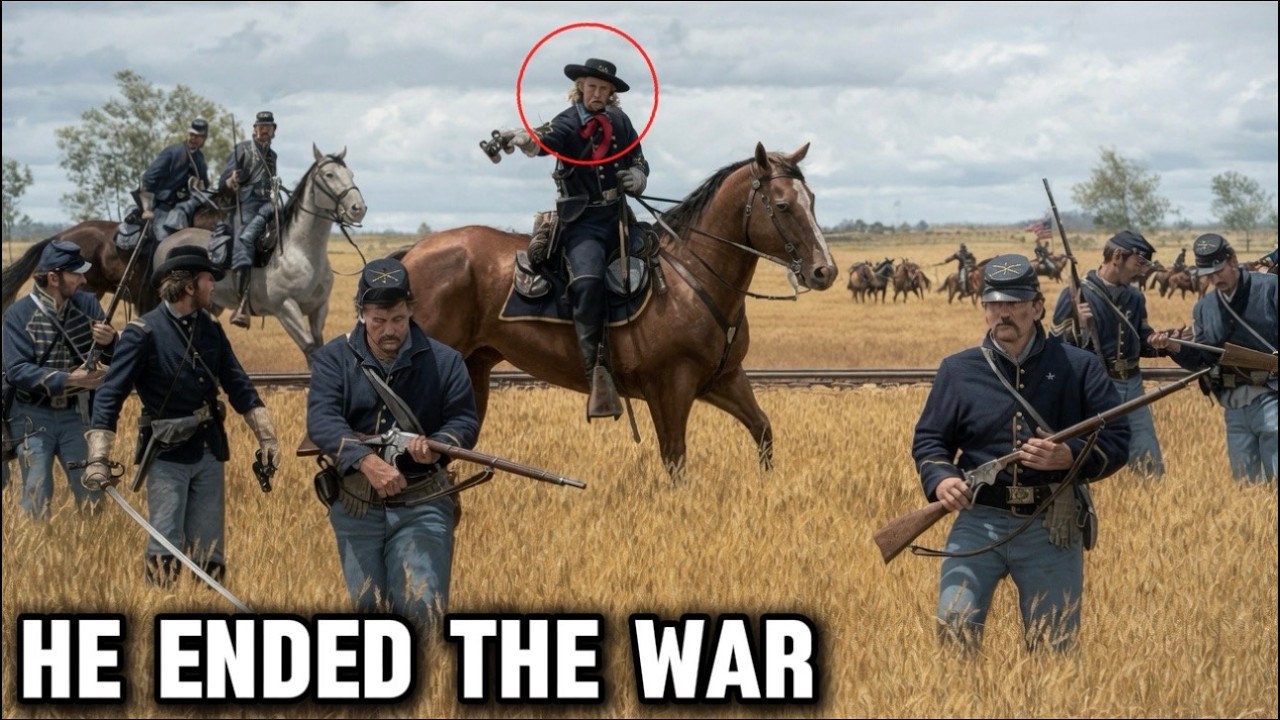
But when the Civil War record is read on its own terms, without 1876 distorting every conclusion, a different figure emerges: a cavalry commander whose body of operational work few officers on either side could match in volume, in outcome, and in the decisive moments where his performance shaped when and how the war ended. He arrived at West Point in the summer of 1857 and spent four years conducting himself as though the institution’s rules existed primarily to create occasions for him to be disciplined. He graduated in June 1861, dead last in a class of 34, with more demerits than almost any cadet on record. He was also facing a court-martial at the moment of graduation over an incident during guard duty.
The paperwork was moving through channels when Confederate artillery opened on Fort Sumter in April 1861. Suddenly the army needed officers in quantities that made processing disciplinary actions against junior lieutenants nearly impossible. The charges were set aside. Custer reported to Washington with a commission he had come very close to never holding.
His introduction to large-scale combat came at First Bull Run in July 1861, serving as a courier for General Irvin McDowell. He watched the Union Army cease to function as a coherent military force in a single afternoon. Confederate lines held, then pushed back, and the organized assault that had crossed into Virginia that morning became a mass of retreating men and horses that did not stabilize until it reached Washington. Custer moved through it all, crossing a stream under fire and carrying dispatches through formations dissolving around him.
What he took from the experience was not primarily fear. It was a firsthand education in the anatomy of military failure: what it looked like from inside, what produced it, and what separated the men who contributed to it from those who did not. That education would shape how he led soldiers for the rest of his career. A year later, during the Peninsula Campaign of 1862, a moment changed his trajectory permanently.
When a Union advance needed to determine whether a creek was fordable before committing troops to a crossing, Custer resolved the question by riding his horse into the water himself, in plain view of Confederate riflemen on the opposite bank. George McClellan was present and witnessed it. Within days, Custer was on McClellan’s personal staff. The assignment gave him direct access to army-level planning: how intelligence was weighed against available forces, how operations were evaluated against realistic constraints, how the sequencing of movements shaped battlefield outcomes before any fighting began.
He absorbed it with a seriousness his West Point record had given no one reason to anticipate. He was learning the way he fought: by getting as close to the thing as possible and paying attention to what was actually happening. Alfred Pleasonton, commanding the Army of the Potomac’s Cavalry Corps in the spring of 1863, took notice of Custer during the engagements along the Rappahannock River. What Pleasonton saw was an officer who moved consistently toward the heaviest fighting, who understood that the most reliable information about a battle came from being inside it.
At Brandy Station in June 1863, the largest cavalry engagement in North American history, Custer confirmed what Pleasonton had been observing. When the cavalry corps reorganized and new brigade commands opened, Pleasonton recommended Custer directly and explicitly. The promotion jumped him from lower grade to brigadier general of volunteers, bypassing dozens of men who had waited far longer for the opportunity. He was 23 years old.
He received the Michigan Cavalry Brigade: the 1st, 5th, 6th, and 7th Michigan regiments, veterans who had formed clear opinions about what they expected from an officer. He arrived wearing a uniform he had designed himself: black velvet trimmed in gold lace, a wide-brimmed hat, a crimson necktie visible across an open field. The men received him with the measured skepticism experienced soldiers apply to untested commanders. The officers he had bypassed were not subtle about their resentment.
He took the brigade into action at Aldie, Upperville, and Hanover within days and weeks of arriving, and the atmosphere in the command began to shift. Then came the afternoon of July 3rd, 1863: specifically, the portion of that afternoon that rarely appears in accounts of Gettysburg at the scale it deserves. While Pickett’s infantry formed on Seminary Ridge for the assault against the Union center, J. E.
B. Stuart was moving roughly 6,000 Confederate cavalry three miles east of the main battle, intending to strike the Union rear at the moment the infantry struck the front. The design was to catch the Army of the Potomac under simultaneous pressure from opposite directions. Against a federal army already fighting hard for its position, a well-timed rear assault could divide its attention between two crises at once and force a collapse neither alone would produce.
Stuart had the experience to execute it. The window was closing as the afternoon advanced, but it had not yet closed. Custer’s Michigan Brigade, alongside David Gregg’s Cavalry Division, placed itself between Stuart and the Union rear. What followed at East Cavalry Field lasted several hours of charges and countercharges across ground the armies three miles west could neither see nor respond to.
Stuart held numerical superiority throughout. Custer attacked regardless, leading the decisive charge personally at the front of the 7th Michigan Cavalry. Confederate veterans who fought there described it afterward as among the most intense cavalry combat they had seen in the war. Custer later recorded that he was so far ahead of his regiment that when he turned to look back, he could see nothing through the dust and powder smoke.
Stuart’s attack was broken before it reached its objective. Pickett’s infantry failed against a Union line never struck from behind. Gettysburg produced the outcome history records, secured in part by a 23-year-old officer in his first weeks of brigade command, fighting a battle the armies three miles away never knew was determining their own. The following spring brought him under the commander whose philosophy matched his own more closely than any previous assignment.
Philip Sheridan assumed command of the Cavalry Corps in April 1864 and changed its operational identity. His predecessors had used cavalry primarily to screen infantry; Sheridan wanted it operating as an independent strategic arm, raiding Confederate territory, destroying supply networks, and engaging Confederate cavalry with the explicit goal of eliminating it as a force. The approach required commanders willing to press contact without waiting for favorable conditions and pursue broken formations until the pursuit produced permanent damage. Custer had been operating on that template for a year.
Sheridan recognized it immediately. Sheridan’s first major raid in May 1864 drove south toward Richmond, compelling Stuart’s cavalry to respond. On May 11th at Yellow Tavern, six miles north of the Confederate capital, the two forces collided. The battle was not the largest cavalry engagement of the war.
It produced the most consequential cavalry outcome of the conflict. Stuart, who had twice encircled the Army of the Potomac, whose intelligence had shaped Lee’s most critical decisions for three years, was shot by a dismounted Union trooper during the close fighting and died in Richmond the following evening at 31. Custer’s brigade drove through the Confederate position with the relentless pressure that had become its defining quality. When the news reached Lee, those present described his response as going beyond the loss of a capable subordinate: the removal of the instrument through which Lee read the battlefield.
The Confederate cavalry that continued after Stuart’s death was determined and skilled. It was never again what it had been under him. At Trevilian Station in June 1864, the results ran the other direction. Wade Hampton’s Confederate cavalry caught Custer’s brigade isolated during a deep raid into Confederate territory.
His troopers fought their way out at genuine cost, and Hampton captured Custer’s personal baggage. It was a Confederate success, and an honest accounting includes it. Sheridan evaluated the outcome and continued deploying Custer as his most reliable forward instrument. The Shenandoah Valley campaign of autumn 1864 placed Custer’s third division at the leading edge of operations Grant had ordered to destroy the valley as a Confederate strategic resource: burning its harvest, removing its livestock, eliminating its capacity to supply Lee’s army.
Through September and October, Custer’s division drove Confederate forces from successive positions at Third Winchester and Fisher’s Hill. At Cedar Creek in October, a Confederate dawn assault nearly destroyed the Federal Army in its camps. Sheridan’s return from Winchester rallied the force, and Custer’s division led the counterattack that closed the battle as a Union success. October 9th produced the campaign’s most personal encounter.
Thomas Rosser, a West Point acquaintance and genuine friend before the war, had commanded the Confederate cavalry harassing Union supply operations. Before the engagement near Tom’s Brook opened, Custer sent Rosser a note across the lines, informing him that what followed would be the worst professional day of his career. The prediction proved accurate without qualification. Rosser’s command broke and retreated south along the Valley Pike for more than twenty miles, Custer’s troopers in pursuit the entire distance.
The men called it the Woodstock Races. Custer captured Rosser’s headquarters wagon, personal effects, and dress uniform, then sent a note suggesting Rosser have a better fitting coat made for future occasions. Rosser’s cavalry ceased to function as an operational presence in the valley. Five Forks on April 1st, 1865, destroyed the strategic logic of defending Petersburg in a single afternoon.
Sheridan’s combined force captured close to 5,000 men and cut the South Side Railroad, the last operational supply line sustaining the Army of Northern Virginia. Custer’s division drove the Confederate cavalry from the field and exposed the infantry flanks to the assault that shattered the main position. Grant ordered the general attack the following morning. Lee evacuated Petersburg on the night of April 2nd.
The eight days of pursuit that followed are the least examined portion of Custer’s Civil War and carry the most weight in explaining why the war ended precisely when it did. Sheridan’s cavalry moved parallel to and ahead of Lee’s retreating columns, cutting roads and destroying supply wagons. The Confederate escape strategy depended on reaching Appomattox Station, where four trains loaded with rations and ammunition waited to allow Lee to push southwest and link with Johnston’s force in North Carolina. On April 6th at Sailor’s Creek, Custer’s division struck a Confederate column separated from the main body and participated in the capture of roughly 6,000 Confederate soldiers, including six general officers.
Lee, watching survivors straggle toward him, reportedly asked his staff what would become of the country. On the night of April 7th, Grant sent Lee a letter requesting surrender. Lee declined but responded in language acknowledging the situation’s reality. Custer kept his division driving through the darkness toward Appomattox Station, arriving on the evening of April 8th before Lee’s infantry.
His troopers seized all four supply trains and sealed the road south. On the morning of April 9th, every remaining direction led to the same outcome. A Confederate officer rode forward under a white handkerchief. The first Union officer he encountered was Custer.
The flag was forwarded to Sheridan, then to Grant, and the exchanges that brought Lee and Grant together at Appomattox Courthouse proceeded directly from that moment. By the war’s end, Custer had fought in more than forty engagements. He had captured 111 Confederate artillery pieces, a total no other Union cavalry commander in the Eastern Theater came near. He held brevet rank as major general in both the volunteer and regular armies.
He was 25 years old. His losses were real, documented, and inseparable from the methods that produced his results; the aggression that made his command effective also made it costly. But the outcomes were not peripheral to the Union victory. They were embedded in how the victory was produced.
The man who graduated at the bottom of his West Point class closed the road that left Lee no option but to surrender. The lieutenant who came within an administrative signature of discharge before seeing his first engagement received the Confederate flag of truce on the morning the war in Virginia finally ran out of road.