In the damp Harlem darkness, Bumpy Johnson walked alone, his pace unhurried, his eyes straight ahead. He gave the empty alley nothing. Then footsteps sounded behind him and ahead of him. From the mouth of the alley stepped two men; from behind, three more emerged.
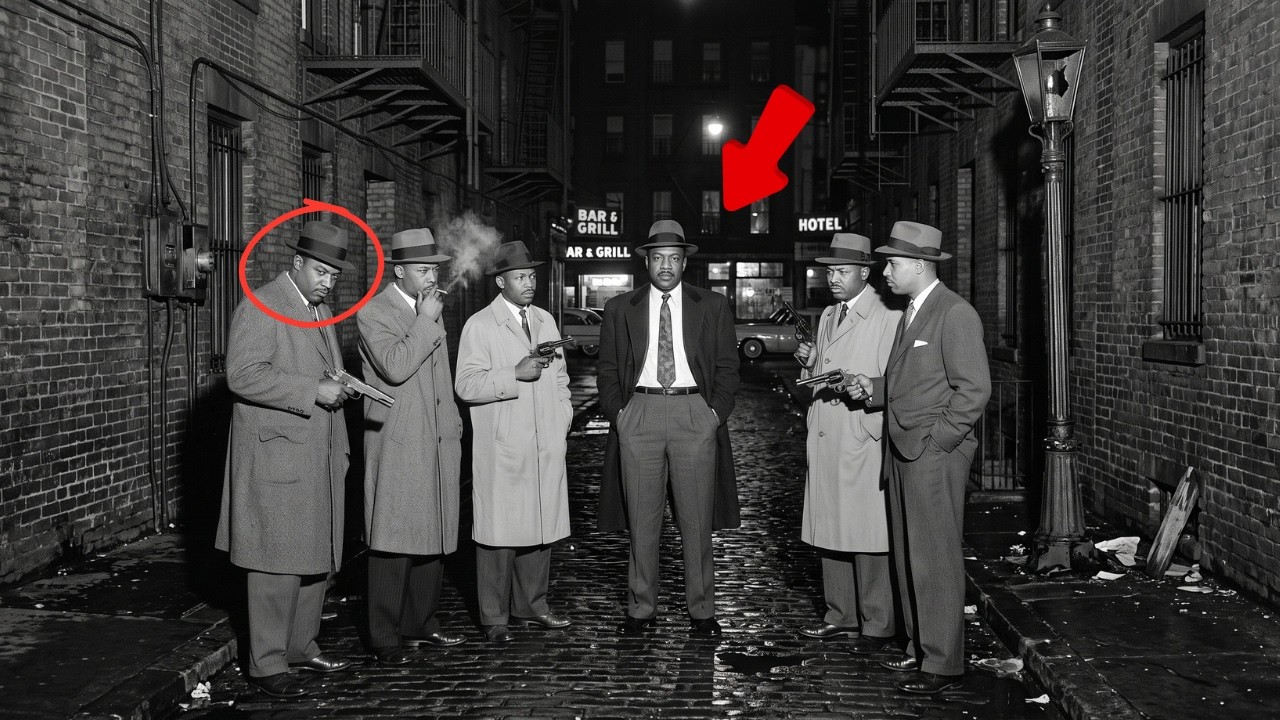
Five men now stood between Bumpy and escape, arranging themselves precisely in a space that had become a room without doors. Water dripped from a rusted fire escape. Beyond the brick, cars rolled past and music leaked from a basement club. Inside the alley, everything had gone still.
One of the men smiled. He told Bumpy he had taken a wrong turn. Bumpy said nothing. His coat stayed buttoned, his hands visible, no reach toward a weapon.
The stillness unsettled the men more than a drawn gun might have. They had expected anger or fear, an apology or a plea. Instead, when one enforcer moved closer and repeated the threat, Bumpy answered in a low, almost polite voice: he had heard him. The man pressed on.
“You’ve been making people nervous. ”
“Then they should learn to control their nerves,” Bumpy said. The smile vanished. Behind him, leather creaked, and a hand disappeared beneath a coat.
Bumpy noticed everything but reacted to nothing. He glanced toward the blocked mouth of the alley, then the blocked end. Five men had carefully cornered one man, and somehow it was beginning to feel as though they were the ones who stood surrounded. Bumpy Johnson carried a name that mattered in Harlem.
But more important than the name itself was what happened when it was attached to a promise. A family needed money. A shopkeeper needed protection. A young man needed someone to speak before a mistake became a sentence.
Bumpy remembered favors, and people remembered that he remembered. That was his true network, not an army rushing from doorways but a thousand small loyalties built over years. The men surrounding him could threaten his body. They could not isolate his name.
One of them asked if he thought people would save him. “No,” Bumpy said, his answer coming too quickly for the man to enjoy the question. “People save themselves. ”
He let the words sit.
Then he gestured past the alley. “You boys think this is about five men in one alley. That’s why you’re here. ”
The first man’s jaw tightened.
Bumpy had not raised his voice, which made the insult worse. He spoke with a calm that forced a man to decide whether he had actually been disrespected, and by the time he figured it out, the moment had passed. The five had entered the alley believing numbers would settle everything. Now they were discovering that numbers only mattered when everybody believed in them.
Bumpy did not. He had been tested before by men with money, men with guns, men who believed cruelty made them important. He had survived because he understood one thing they did not: a man who reacts to every insult can be controlled by anyone willing to insult him. So Bumpy waited.
The leader stepped closer until their chests nearly touched. He demanded, “You think you’re untouchable? ”
“No,” Bumpy said. “I think you’re trying very hard to touch me.
”
A short laugh escaped one of the men behind him before he caught himself. In that instant, the circle broke, not physically but psychologically. The men were no longer thinking as one unit. One had laughed, one was embarrassed, one was angry that someone had laughed, another was watching the others instead of Bumpy.
Pressure had shown them what weak alliances were made of. The leader’s hand went beneath his coat. The possibility of violence became real. One bad movement could fill the alley with gunfire.
Bumpy stayed still. A frightened man might have reached first, a proud man might have. Bumpy had survived too long to confuse speed with strength. He let the leader feel the weight of his own decision because drawing a gun was easy.
Using it against Bumpy Johnson in Harlem was something else, a choice that carried a tomorrow and every day after that. Bumpy lowered his voice. “You sure everybody here understands what you’re starting? ”
The men went quiet.
For the first time that night, they stopped asking what they could do to Bumpy and began asking what would happen after they did it. Once that question entered the alley, the numbers meant much less. “This ain’t over,” the leader warned. Bumpy turned only his head.
“It was over when none of you wanted to be first. ”
He walked out at the same measured pace he had entered with, unhurried, unbothered. The men parted. No one followed.
No shot came from behind. He did not look back, not out of recklessness but commitment. Once a man chooses calm, he has to carry it all the way through. By the next morning, the alley was just an alley again, rainwater collecting near the curb, shopkeepers lifting their metal gates.
But Harlem did not need blood on the pavement to understand what had happened. Stories traveled there as fragments: a broken half-sentence from a bartender, an overheard version at a storefront, a memory repeated before breakfast. By noon, nobody could agree on every word spoken. The shape of the story remained the same.
They surrounded Bumpy. He did not panic. Nobody touched him. He walked out.
Later that day, his own men gathered, expecting orders for retaliation. Names, locations, cars, schedules. One leaned forward and said what the others were thinking. “We can handle it tonight.
”
“No,” Bumpy said. The room quieted. “They came for you. They surrounded you.
”
“I know that, too. ” He poured himself a drink slowly, not because he needed time to think but because he wanted everyone else to use theirs. “What do you think happens if we go hunting them now? ”
One man answered quickly.
“They learn. ”
Bumpy looked at him. “What? That I got angry?
That I needed five more men to fix what five men couldn’t do? ” He set the bottle down. “No. They already learned what they needed to learn.
”
It was restraint in its hardest form, restraint when a man has the power to strike back. Anyone can call himself peaceful when nobody fears him. Bumpy’s restraint carried weight because people knew the alternative existed. He had men and reach and a loyalty that could turn one insult into a long season of funerals.
Choosing not to use it meant something. He was not forgiving them. He was measuring them. Revenge would have been easier, but it would have weakened the story.
It would have turned frightened men into martyrs and forced people to choose sides. Better to let the story already circulating stand: they had the numbers, the darkness, the surprise, and still they could not make him bend. The story grew because it rested on something solid underneath. Harlem had seen plenty of violent men.
The stronger story was that Bumpy did not always need violence. He could stand in front of it, wait, measure it, let it expose itself, and leave without giving it what it wanted. That was harder to imitate. A man could buy a gun, hire muscle, teach people to fear his temper.
Patience could not be bought. Self-control could not be rented. Respect could not be forced into existence in a single night. Those things took years.
By morning, no bullet holes marked the brick. Nobody needed identifying. And still, something had changed. The five men had wanted to create a story about Bumpy Johnson, one in which he could be cornered, reduced, made smaller by numbers and fear.
Instead, the neighborhood received another story entirely, about a man surrounded in darkness who understood that the first person to lose control usually lost more than the moment. Bumpy had left without a scratch. The real mark was elsewhere, on the men who stepped aside, on the reputation that grew another layer, on the neighborhood that understood the difference between noise and authority. The alley disappeared into the city behind him.
The story did not.