On May 23, 1934, a carefully assembled posse waited on a rural road near Gibsland, Louisiana. For months, the men had tracked the most wanted criminals in America, a young couple whose crime spree had turned them into national legends. When the stolen Ford V-8 finally appeared on the road, the trap was sprung with overwhelming force. The gunfire was so intense that people miles away believed a logging crew had set off dynamite.
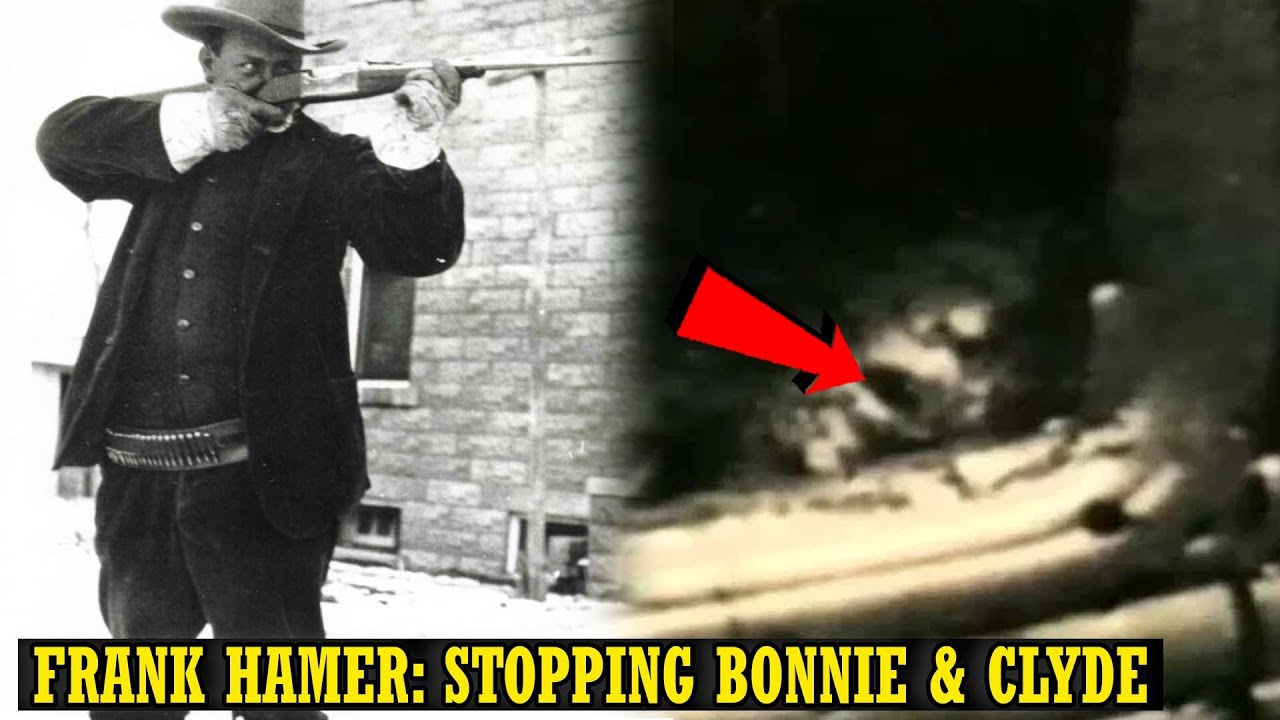
Bonnie Parker and Clyde Barrow, the outlaws who had robbed banks, escaped jailbreaks, and murdered lawmen across multiple states, were dead. The man responsible for the ambush was not a young gunslinger seeking glory, but a weathered, methodical Texas lawman named Frank Hamer, a man whose long career had prepared him for exactly this kind of mission. Hamer had spent his life in service on the Texas frontier. Born Francis Augustus Hamer on March 17, 1884, in Fairview, Texas, he grew up on ranches in San Saba County, where frontier life shaped his character from childhood.
By his teenage years, his skill with firearms was already well known. As a young ranch hand, he faced a serious test. A rancher named Dan McWain, involved in a dispute with another man, tried to pressure Frank into harming his rival. The young Hamer refused.
Two days later, McWain attacked him with a firearm, wounding Frank seriously. Frank managed to escape with his brother, carrying fragments from that encounter for the rest of his life. After a long recovery, he returned to face McWain on June 12, 1900. McWain, shocked to see him alive, made no further move against him.
The confrontation marked the beginning of Hamer’s reputation as a man who could not be intimidated or easily defeated. In 1905, while working as a cowboy, Hamer volunteered to help Sheriff Dud Barker capture a horse thief. The success impressed the sheriff so much that he recommended Hamer to the Texas adjutant general. On April 21, 1906, at just 22 years old, Frank Hamer officially joined the Texas Rangers.
He patrolled along the southern border, serving in the Del Rio region through 1908. Law enforcement became a family calling. Three of his brothers also served as Texas Rangers. Hamer briefly left the Rangers to serve as city marshal of Navasota, an oil boom town with a reputation for disorder.
His strong leadership brought stability to the community. Over the following years, he served as a special investigator in Houston, a deputy sheriff in Kimble County, and then returned to the Rangers in 1915 to patrol the turbulent US-Mexico border during the Bandit War, a period of widespread unrest, smuggling, and ethnic violence. In 1917, at age 33, Hamer married Gladys Johnson Sims, a widow with two daughters. The couple later had two sons.
Later that year, an unexpected confrontation ended with the death of Gus McManus, a former ranger and a relative of Gladys’s late husband, and Hamer was wounded in the encounter. He then worked as a federal agent with the Prohibition unit, curbing the flow of illegal alcohol into the United States from El Paso. In 1921, he returned to the Texas Rangers once more and was promoted to senior ranger captain on January 1, 1922. Across Texas, oil boom towns were springing up overnight, bringing surges in population and lawlessness.
During this era, Hamer took a firm stand against mob justice, personally intervening to prevent at least fifteen attempted lynchings. In 1928, Hamer turned his attention to a different kind of injustice. The Texas Bankers Association offered a $5,000 reward for anyone who killed a bank robber, but nothing for apprehending one alive. This dangerous incentive led to false accusations and staged incidents where innocent people were wrongfully targeted so corrupt officials could collect the reward.
Hamer investigated and authored a detailed exposé, calling the practice the “banker’s murder machine. ” The publication triggered public outrage, legislative investigations, and formal indictments. Yet many law enforcement agencies refused to support him, and the bankers association defended its policy. The tragic incidents continued into 1930.
By 1932, after nearly 27 years of service, Hamer decided to step away from the Texas Rangers. His departure came just one week before Miriam “Ma” Ferguson was elected governor of Texas for a second term. Ferguson’s relationship with the Rangers was hostile. More than forty Rangers resigned in protest rather than serve under her leadership, and those who stayed were dismissed.
The entire force was dismantled and reorganized under her authority. Despite retirement, Hamer was allowed to keep a special Ranger commission with the honorary title of Senior Ranger Captain. Retirement did not last long. In 1934, Hamer was recruited as a special investigator for the Texas prison system, tasked with capturing Bonnie Parker and Clyde Barrow.
The couple had become national figures, leading a crime spree that spanned Texas, Louisiana, Arkansas, and Oklahoma. Their activities, which included robberies, jailbreaks, and deadly confrontations, deeply embarrassed law enforcement across multiple states. The pursuit intensified after a daring prison break orchestrated by the Barrow Gang on January 16, 1934. The gang stormed the Eastham Prison Farm in eastern Texas, liberating inmates Raymond Hamilton, Henry Methvin, Hilton Bybee, and Joe Palmer.
During the escape, several guards were injured, and Major Joe Crowson, a respected prison officer, lost his life. The incident shocked the public. Determined to restore confidence, Lee Simmons, head of the prison system, personally recruited Hamer to lead the manhunt, granting him full autonomy. Hamer officially began his pursuit on February 1, 1934, and soon partnered with Manny Gault, a retired Texas Ranger and trusted friend.
Rather than rushing the chase, Hamer was methodical. He studied the gang’s travel patterns, collected intelligence from multiple states, and analyzed eyewitness reports. He deduced that Clyde Barrow and his companions followed a predictable circular route between Dallas, Joplin, Missouri, and northwest Louisiana, deliberately staying near state borders to exploit jurisdictional boundaries. Hamer also came to a critical realization: Clyde Barrow had no intention of surrendering.
This understanding shaped the entire strategy. Bringing the pair to justice would require patience, precision, and coordination across multiple jurisdictions. In early 1934, Bonnie, Clyde, and their associate Henry Methvin continued their crime spree, targeting banks from Lancaster, Texas, to Poteau, Oklahoma, and as far north as Iowa. Wherever they went, Hamer and his network of law enforcement allies followed, often arriving just hours or days behind them.
On April 1, 1934, a confrontation near Grapevine, Texas, resulted in the deaths of two Texas Highway Patrol officers. Five days later, Constable Calvin Campbell, a respected 60-year-old single father, was killed near Commerce, Oklahoma. Public outrage intensified, and newspapers demanded swift justice. Hamer’s investigation, now spanning multiple states, was closing in.
Months of surveillance, intelligence gathering, and coordination between Texas and Louisiana agencies culminated on May 23, 1934. Acting on precise information about the gang’s movements, Hamer and a carefully assembled posse prepared an ambush on a rural road near Gibsland, Louisiana. When the gang’s vehicle appeared, the trap was sprung, ending one of the most dramatic manhunts in American criminal history. The deaths of Bonnie and Clyde dominated front pages nationwide, symbolizing the end of a violent chapter in the nation’s struggle with Depression-era crime.
Hamer was widely praised for his persistence and tactical brilliance and received a special citation from Congress. Yet he remained characteristically humble. He declined interviews, refused to participate in publicity events, and quietly returned to private life. In his later years, he worked as a security adviser for oil companies and shipping firms.
In 1948, Texas Governor Coke Stevenson asked him to temporarily return to Ranger service to review election returns in Jim Wells and Duval counties during a hotly contested US Senate race. After completing that assignment, Hamer retired permanently in 1949. In 1953, he suffered a serious heat stroke and never fully recovered. He passed away on July 10, 1955, at age 71.
Over the course of his career, Hamer was involved in more than fifty armed confrontations, enduring seventeen injuries. Historical records credit him with resolving numerous life-threatening encounters, and estimates suggest he may have neutralized between 53 and 70 dangerous individuals in the line of duty. He was honored with induction into the Texas Ranger Hall of Fame.
History often remembers the outlaws, but it was men like Hamer, quiet, relentless, and dedicated to justice, who shaped the world they lived and died in.