For decades, a single locked door at Graceland has drawn more curiosity than any of the mansions glittering public rooms. Behind it lies a vault that remained sealed for nearly half a century, protected by the Presley family with a secrecy that only fueled the rumors surrounding it. When the vault finally began to open to the world, its contents did not reveal a dark conspiracy. They revealed something far more intimate: the carefully preserved daily life of a man who became a legend.
Graceland itself was never planned as a monument. In 1957, a 22-year-old Elvis Presley, already the most famous young man in America, bought the modest Southern colonial house built in 1939 for $100,000, with just $2,500 down. He wanted a place of comfort rather than chandeliers. His parents, Vernon and Gladys Presley, moved in with him, but the family idyll was brief.
Gladys died in 1958, a loss that shaped the rest of Elvis’s life. Over the years, he reshaped the mansion to reflect his personality. He created the Jungle Room, with shag carpet covering the floor and ceiling and oversized tropical furniture, where he later recorded songs. He built a meditation garden with fountains and flowers, which would eventually become the final resting place for Elvis himself, his parents, his grandmother, and his daughter Lisa Marie.
After Elvis died on August 16, 1977, Graceland opened to the public in 1982. More than 20 million visitors have since walked through its halls. But the public was only shown part of the story. Behind the touring route, away from the crowds, Graceland kept a hidden side.
The upstairs bedroom and private bathroom where Elvis spent his final hours were sealed and frozen in time. And deeper still, in a secure area of the estate, stood the vault. The vault was not a room of trophy displays. It functioned as a repository for the ordinary debris of a remarkable life: hastily scribbled shopping lists, receipts from diners, handwritten notes, stage jewelry, jumpsuits, sunglasses tossed aside on a table.
The keeper of this collection was Angie Marches, who arrived at Graceland at age 17 to apply for a summer job as a tour guide. Over decades, she became the custodian of Elvis’s most intimate history, leading a team of 21 people trained to protect and preserve the estate. The rooms of Graceland were dusted three times a week, not out of vanity, but because chairs, rugs, and curtains carried history that needed to be saved. Elvis and his manager, Colonel Tom Parker, had kept nearly everything, a habit that looked like hoarding to some but became a gift to historians.
Unlike the archives of other legends kept in institutions, Graceland’s collection stayed in a home still echoing with the voice and presence of its owner. In 2010, Oprah Winfrey was granted an exclusive private tour that went well beyond the public route. Accompanied by her friend Gayle King, she was escorted through secret hallways into areas that even routine staff rarely entered. As the group approached the vault, the filming stopped.
No image of the entrance ever aired, and no recording of the door’s unlocking was ever made. The silence deepened the mystery for years. Once inside, Oprah entered one of the most secure rooms on the estate, built to withstand fire, tornadoes, and earthquakes. The air was cool, the lighting dim, and a strict rule governed everything: nothing could be touched without gloves.
Every drawer was neatly labeled, every artifact wrapped or sealed against damage. This was not chaos. It was a museum hidden inside a mansion. The vault’s contents gradually became known, and they painted a picture different from the myth.
Eighty-eight jumpsuits, folded and wrapped in protective tissue, waited as if their owner might slip them on again. Jewelry boxes held rings and cufflinks that had sparkled under stage lights. Sunglasses from 1972 were preserved, the very lenses through which Elvis once watched the world. Beyond the stagewear lay more than 60,000 photographs, some professional portraits for magazines, but many personal snapshots capturing unguarded moments with family and friends.
Black-and-white images from the early 1950s showed a young man before superstardom consumed him. Later photos revealed the weariness that fame had brought. More surprising than the glamour items were the everyday documents. Elvis had saved thousands of signed checks, each written in his unmistakable hand.
These were not about money. They were about recordkeeping. Elvis seemed to understand that even the smallest details of his daily life might one day matter. Shopping lists, handwritten notes, and receipts from ordinary days became extraordinary only because they belonged to him.
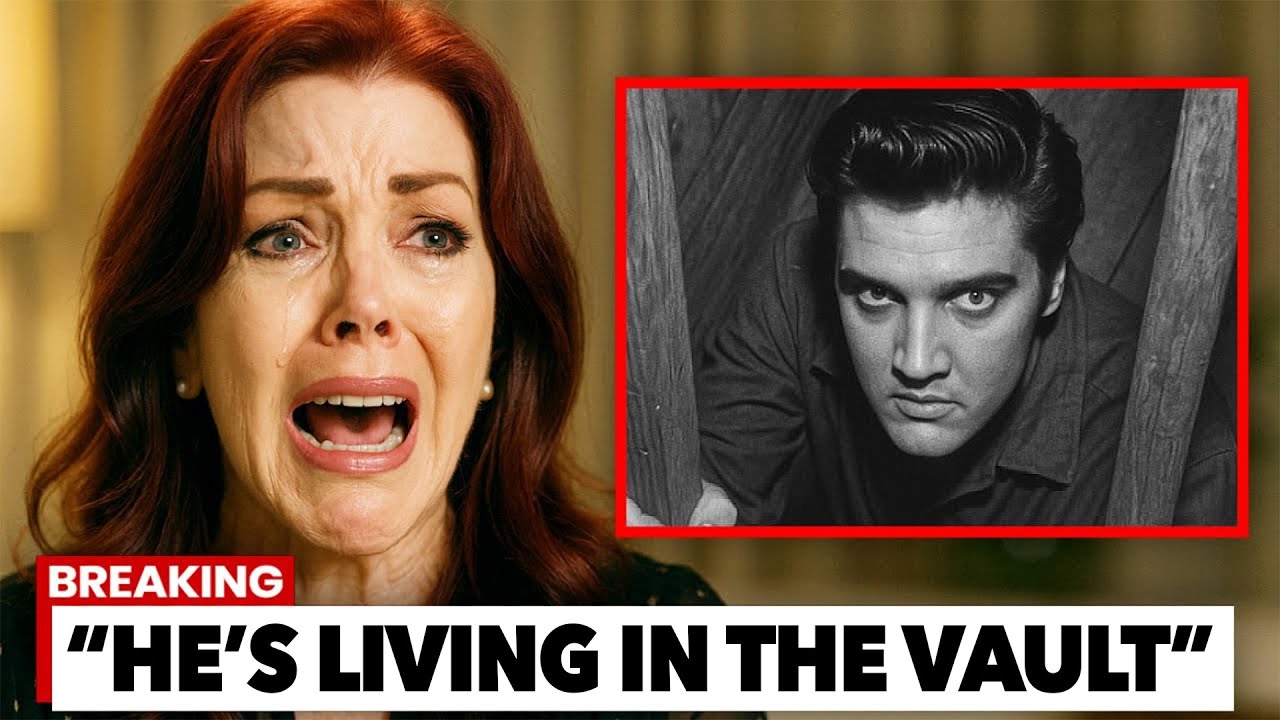
The vault read less like a treasure room and more like a diary written in objects: the father who kept his daughter’s toys, the son who held onto his mother’s memory, the man who knew that fame fades but memory endures. The secrecy of the vault fed theories that stretched far beyond artifacts. Fans whispered about tunnels beneath the mansion, passageways that could have allowed Elvis to escape the pressure of fame or even stage his own death. Former employees hinted at exits leading beyond the property line, though no photograph ever confirmed their existence.
The rumors of a faked death gained traction immediately after August 16, 1977. In the weeks and years that followed, people reported sightings of Elvis in airports, small-town diners, and a Burger King in Kalamazoo, Michigan. When a masked singer known as Orion appeared after Elvis’s death, releasing records under the same label Elvis had once used, fans were certain the impossible had happened. The performer was eventually revealed to be Jimmy Ellis, but even then, many refused to let the theory go.
Authors like Gail Brewer-Giorgio stoked the flames, claiming in books and television appearances that Elvis had chosen to walk away from fame rather than be destroyed by it. The vault, with its silence and secrecy, became part of this mythology. Every locked door and forbidden staircase reinforced the belief that something remained hidden. The facts of Elvis’s final day were straightforward, though no less tragic for their ordinariness.
He was found unconscious in his upstairs bathroom by his fiancée, Ginger Alden, hours before he was scheduled to fly to Portland, Maine, for another tour. His father Vernon rushed to his side, his friend Joe Esposito tried to help, and young Lisa Marie, barely nine years old, wandered into the unfolding chaos. He was pronounced dead at Baptist Memorial Hospital, and the world entered a mourning that felt deeply personal. Crowds gathered outside the gates of Graceland, newscasts ran without pause, and millions grieved as though they had lost family.
Yet the official story never fully silenced the whispers. A man so legendary could not simply die in an ordinary way, some insisted. The vault became part of that doubt. If so many belongings were hidden behind steel, what else might be hidden there?
For Lisa Marie Presley, the vault had a meaning that had nothing to do with conspiracies. She knew of its existence long before the public ever heard of it. For her, it was not about glamour or display. It was a place of connection.
She would sit in that space, open old boxes, and hold items her father had once held, finding comfort in a photograph, a ring, or a note scribbled in his handwriting. It was her secret sanctuary, a room where she could still be her father’s little girl. When Lisa Marie died in 2023, her daughter Riley Keough spoke of the vault’s ongoing meaning. She took joy in watching strangers visit Graceland and see their faces light up with wonder, proof that Elvis’s spirit had not faded.
The vault, for Riley, was not merely about history. It was about legacy, a reminder that the family remained connected through a hidden chamber of memory. Even the rare outsiders allowed into the vault understood its weight. When Oprah Winfrey sat at Elvis’s dining table inside the secure room, tasting the meatloaf, fried chicken, and macaroni and cheese he had once loved, she described the experience as surreal, like stepping into the presence of someone who had just left the table.
The vault was never merely a room. It was a time capsule holding every era of Elvis Presley’s life at once: the shy boy from Tupelo dreaming of stardom, the king commanding Las Vegas stages, the quiet father holding his daughter, and the man whose family prayed outside a locked door. Graceland remains open to millions, but its deepest secret belongs to the family alone. That is where the myth becomes a man again, a father, a son, a friend, a flawed human being who lived with intensity and loved with abandon.
The king is still there, not in the crowds or the music alone, but in the quiet vault where his story lives on.