A boy sits down at a kitchen table, opens a box bigger than any model kit he has ever held, and finds over a hundred pieces of clear plastic. The year is roughly 1960, and what he is about to assemble is not a toy in any ordinary sense. It is a quarter-scale model of a real V8 engine, rendered in transparent plastic so that every piston, valve, and wire remains visible once finished. The box itself carries a painting that states the promise plainly: a father in a button-down shirt and suit jacket, pipe in his mouth, standing behind his teenage son as both look at a completed engine on the desk.
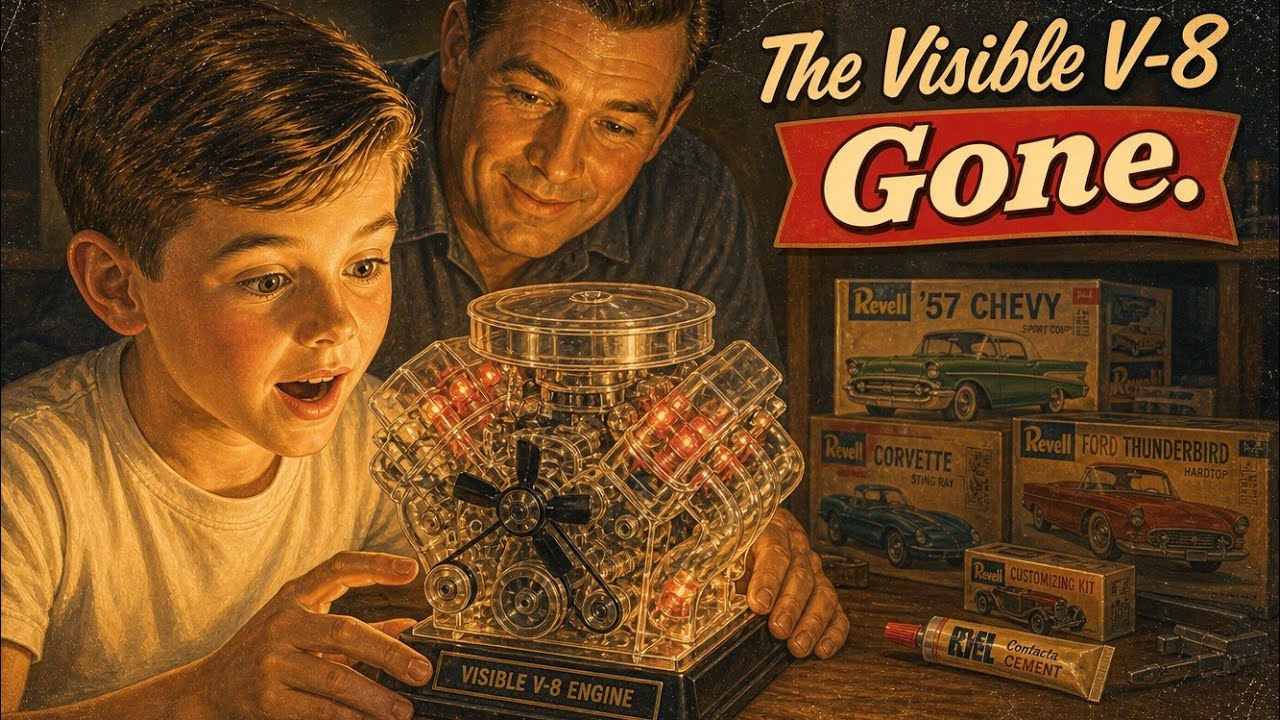
The model was called the Visible V8, made by a company named Renwal. The name is Reull written backward, and it belongs to an industrial puzzle of its own. Renwal had begun in the late 1930s, founded by Irving Lauer in New York City. The firm started by selling plastic kitchenware, bowls and cups and containers, with no intention of entering the model business.
But plastic was the material of the future, and the market pulled the company in unexpected directions. The man responsible for the Visible V8 itself was not Lauer. He was Marcel Joine, an Italian soldier captured during World War II and brought to the United States as a prisoner of war. When the war ended, Joine stayed.
He became an American, trained as a sculptor and designer, and in 1958 he produced a transparent model of a V8 engine intended to teach boys how automobiles actually work. The kit was substantial. It measured roughly twenty-two inches long and nearly seventeen inches wide, heavy enough to feel important before the lid was even opened. The instruction booklet was thick, with diagrams, part numbers, and step-by-step assembly instructions that assumed the builder was serious.
The parts included pistons, connecting rods, a crankshaft, rocker arms, push rods, valve springs, a camshaft, a distributor, an oil pump, an intake manifold, exhaust headers, a water pump, and a fan. Each component was placed in its correct position, and the relationships between parts were accurate to the real engine. Assembly began with the crankshaft, mounted in the clear block that would reveal everything once complete. The connecting rods were attached, and the pistons had to slide into the cylinders with just the right fit.
The lesson of tolerance was built directly into the task: tight enough that the piston moved smoothly, but not so tight that it jammed. Small pieces followed, the camshaft, push rods, rocker arms, and valve springs, some no bigger than a thumbnail, each placed in the correct position and facing the correct direction. Parts were dropped and retrieved from under refrigerators. Frustration came and went.
The work continued because this was understood, even by a twelve-year-old, as a serious undertaking. The genius of the design was the hidden electric motor placed inside the model’s starter. The starter looked exactly like a starter on the side of an engine block, but wired to batteries. Flipping a switch engaged the motor, and the entire model came alive.
The crankshaft turned. The connecting rods pushed the pistons. The camshaft rotated and opened the valves. The distributor spun and sent a tiny electrical pulse to each of the eight spark plugs in the correct firing order: 1-5-4-2-6-3-7-8.
Those small spark plugs were light bulbs, and they lit up in sequence, exactly as a real engine fires. That moment, when the switch was flipped and the engine moved, was powerful in a way that reached far beyond the table. Through the transparent walls, the builder could see every movement, every connection, every cause leading to effect. The mystery under the hood of every car on every road became visible and understandable.
A diagram could explain an engine on paper, but this model explained it in thirty seconds of motion that made the whole mechanism legible. Fathers took different roles in the project. Some could not keep their hands off it, eager to show their sons what they knew about real engines. Others sat back and let the boy figure it out himself, stepping in only when a part would not fit or frustration showed.
Still others simply stayed in the room, reading the paper or drinking coffee, and looked up when the pistons first moved. Whatever the approach, the kit created a shared project that the son would remember long after the specifics faded. The Visible V8 became a teaching tool as much as a hobby item. Boys took finished models to school for science class and show-and-tell, explaining the four-stroke cycle of intake, compression, power, and exhaust to their classmates.
Schools purchased the kits for science departments. Auto shop teachers used them to show the interior of an engine without tearing apart a real one. The model was so respected that a genuine automobile manufacturer intervened in the market. When Chrysler learned that a competing company planned to make a transparent model of a a Chevrolet small-block V8 to compete with the Renwal kit, the company stepped in and convinced the competitor to build a cutaway six-cylinder engine instead.
The success of the Visible V8 led to an entire series. Renwal produced a visible automobile chassis in 1963, a complete car frame with a working clutch, a shiftable transmission, working brakes, and steering, with the V8 engine sliding right into place. The company expanded beyond machines as well. There was a Visible Man, a transparent human body with removable organs meant to teach anatomy in the same tactile way.
A Visible Woman followed, with what could only be called a period-specific marketing detail: the box assured parents that the pregnancy feature was optional and sold separately. There was also a Visible Horse, a Visible Head, and even a Visible Pigeon. The company that had built all of this did not survive. Renwal eventually went under, and its molds were sold to another manufacturer, the Revell company, which still sells a Visible V8 today.
But the modern kit is not the same. The electric motor is gone, replaced by a hand crank. The light-up spark plugs are gone. The firing-order sequence built into the original kit is gone.
The version of the model that was once a working machine has become an object that moves only by manual effort. Commenters on collector forums noted the loss plainly, noting that these features were key to the appeal. The working motor and the lighting sequence were precisely what had made the kit something more than a model. The personal testimony scattered through the memories of hobbyists tells the true history of the object in a direct way.
One man on a classic car forum wrote that he built the Visible V8 in the late 1960s and that it inspired him to become a mechanic in the 1970s. Another wrote that his father built one for him when he was learning the basics of modeling, and he credited that kit, and his father, for his later love of classic car restoration. The model taught the mechanics of the engine, and the father taught the act of building, and the two lessons fused into a single memory that returned every time he opens a hood or picks up a wrench. There is one comment that stands apart from all the others.
A man on the same forum wrote that he still owns an unbuilt Visible V8 he bought for his son’s birthday, so the two of them could build it together. He and the boy’s mother had divorced. The kit was never built. The son passed away several years ago, and the father was left uncertain what to do with the box that was meant to be opened with someone who was gone.
The original Visible V8, the complete one with the motor and the glowing spark plugs, now sells for hundreds of dollars on collector markets. The painted box alone sells for more than the kit itself, because the box carries the promise. That image of father and son, the model between them, the pipe in the father’s mouth, the pride in both faces, was what Renwal sold in 1958 for under five dollars.
It was a promise that a father and a son could sit together and build something together that would teach the boy how part of the world works, and that the father would stand behind him, and both would be proud.