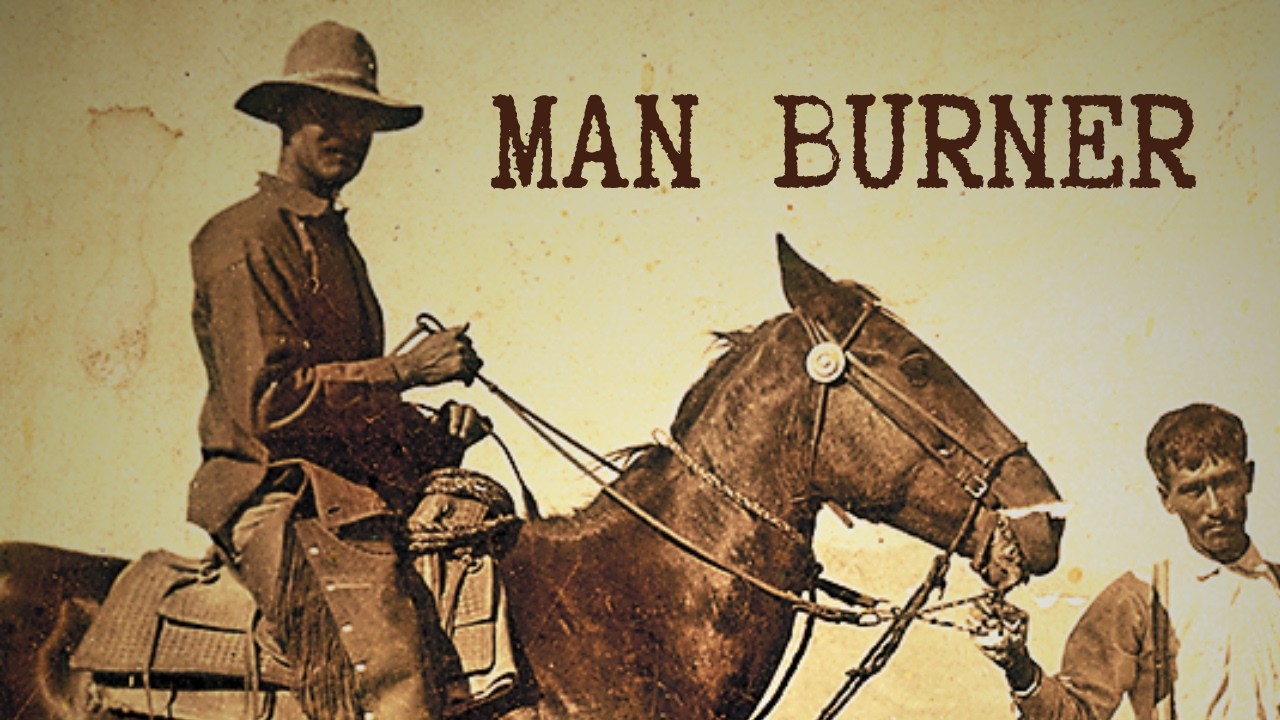
Print Olive built his reputation the hard way. Born in Union Parish, Louisiana, in 1840, he was still an infant when his family moved to Texas, where his father established a ranch in what would become Williamson County. Practically raised in the saddle, Olive was trailing cattle east to market while still a teenager. When the Civil War broke out, he joined Company H of the 2nd Texas Infantry and saw heavy combat at Shiloh, where he was wounded in the hip, then at Farmington, Tallahatchie Bridge, the Second Battle of Corinth, and finally the Siege of Vicksburg.
At Vicksburg he was taken prisoner, paroled, and sent to Galveston, where he spent the rest of the war guarding the docks. While he was away, Texas ranches had been left understaffed or abandoned, and the cattle had run wild. By the time the war ended, millions of unbranded mavericks roamed the state, free for anyone bold enough to rope them. Olive and his brothers took full advantage, rounding up and branding everything they could catch.
That put them in direct conflict with the rustlers who had the same idea. Olive could not abide cattle thieves. In late 1865 he caught a man named Rod Murray driving some of his cattle, drew his pistol, and blew him out of the saddle. Murray survived, and it turned out he had not known the cattle were stolen, so Olive took him home, mended his wounds, and gave him a job.
Another rustler, Dave Freeman, was not so fortunate. Caught driving Olive steers, Freeman shot it out with Olive from horseback and lost. Though Olive was wounded in the fight, he went to trial for murder, and the jury scoffed at the charge and freed him. That pattern would repeat itself many times over the following years.
When he was not fighting off thieves, Olive built a family. In February 1866 he married Louisa. The couple had five children, though their firstborn, Mary Ann, only lived three months. Olive also built one of the largest ranches in the region, running thousands upon thousands of cattle.
He began trailing herds north to the Kansas railheads, and those trips were usually uneventful, until 1872. After delivering a herd to Ellsworth, Olive got into a poker dispute with a man named Jim Kennedy, the son of Mifflin Kennedy, who had helped form the King Ranch. Kennedy accused Olive of cheating, and Olive told him to leave the saloon while he still could. Kennedy left but later returned, went behind the bar, took a revolver, walked up in front of Olive, and fired.
Olive threw up his hands and cried out, “Don’t shoot. ” Three bullets hit him, one in the groin, one in the thigh, one in the hand. Kennedy likely would have finished the job had Olive’s devoted friend, James Kelly, not been nearby. Kelly returned fire, put Kennedy out of commission, and got Olive to safety.
James Kelly was a remarkable figure in his own right. His parents had been former slaves who lived near the Olives, and James had grown up alongside Print. He was wholly devoted to the family and deadly with a pistol. As historian Leon Metz put it, as a gun hand Kelly had few peers and might have been as well known as Billy the Kid or John Ringo had his skin been white.
When homesteaders tried to charge the Olives tolls for passing over their land, Print simply sent Kelly to negotiate. One cowboy remembered that when the farmers saw Kelly approaching, with his eyes rolling and his teeth gritted, they dropped their price from twenty-five dollars to five. Once Olive recovered from his wounds in Texas, he and his brothers went on the warpath. Over the next few years they killed at least half a dozen rustlers, and an Austin newspaper credited them with killing twelve people in just three or four months.
In one gruesome incident, Print and his brother Jay caught two thieves in the act of butchering their cattle. According to legend, the Olives wrapped the men in fresh cowhides, tied them to a tree, and left them for the hides to dry and constrict in the Texas sun, a slow death that old-timers called the death of skins. Contemporary newspapers described the two men as simply having been shot to death, with one body found covered, not wrapped, in a cowhide bearing the Olive brand, likely a message. Olive was indicted for both killings and acquitted.
The local outlaws grew tired of Olive’s vigilante justice and attacked his ranch in force. It was a full-blown battle. Olive was wounded, the ranch house was burned to the ground, and his younger brother Thomas was killed, along with at least one hired hand. Olive caught one of the attackers, Fred Smith, as Smith was crossing a river, and put a bullet through the bridge of his nose.
A few weeks later he killed another man who showed up at the ranch asking for water, apparently pegging him for an assassin. Charged with murder yet again, he was acquitted yet again. By the spring of 1877, the violence had become too much. Olive closed up shop in Texas and moved his family north to Custer County, Nebraska, where he established a new ranch that would grow into one of the largest in the state.
Nebraska was no safe haven. The notorious horse thief Doc Middleton was operating in the region at the same time, but the two men came to an understanding. According to the biography The Ladder of Rivers, Olive liked Middleton and struck a deal, allowing him the use of his camps as long as he brought no stolen stock. He told Middleton he could steal from him all he liked, but warned that if he was caught, Olive would stretch his neck between two saddle horses.
Middleton apparently took the hint and caused no trouble. Homesteaders were a different matter. Large ranchers like Olive considered the open range theirs alone, and they resented the farmers who filed claims under the Homestead Act and put up fences. Olive threw his weight around, sometimes violently.
There is a story about him pistol-whipping a farmer so hard it broke the man’s jaw. But two small-timers, Luther Mitchell and Amy Ketchum, refused to be intimidated. Both were often described as rustlers, though whether that was true or simply the cattle barons’ label for anyone who defied them remains uncertain. There were claims they had been caught with close to a hundred head of Olive’s cattle.
Whatever the case, Olive’s brother Bob, who had somehow become a deputy despite facing a murder charge down in Texas, secured warrants for both men. When the posse rode out to serve them, Ketchum went for his gun. Bob shot him in the left arm, and Mitchell put a round through Bob’s lungs. Bob lingered a few days before dying on November 27, 1878.
Print Olive went nearly blind with rage and offered a seven-hundred-dollar bounty, a small fortune in those days. Two weeks later Mitchell and Ketchum were apprehended near Loop City. A judge ordered them transferred to Custer County for trial, but they never arrived. The sheriff escorting them met Olive at Plum Creek and handed over the prisoners.
The two men were taken by wagon to a place called Devil’s Gap, about fifty miles west of Kearney, and strung up from an elm tree. According to historian Leon Metz, Olive’s cowboys seated the men in a wagon under the low-hanging branches, put ropes over the limbs, and knotted nooses around their necks. Mitchell began to beg, and Olive shot him with a rifle, the slug knocking him backward. His boots kept him in the wagon and the rope prevented him from falling.
Olive then told the driver to move the wagon forward, and the bodies were hauled into the air. Afterward, both were doused with oil and set on fire. Olive denied lighting the match, and there is some evidence that two of his employees did the burning after he had already left. But the lynching earned him the nickname Man Burner.
The burning caused outrage across Nebraska. Olive was arrested and charged with murder, and this time the jury did not let him go. Despite top-notch lawyers and rumors of jury tampering, he was found guilty and sentenced to life in the Nebraska State Penitentiary. He served only about two years.
The Nebraska Supreme Court overturned the conviction because the trial had not taken place in the county where the lynchings occurred. The case was sent back for retrial, but by then some witnesses had died, others had left the state, and the rest refused to appear. Without witnesses, the charges were dropped. Olive left prison a broken man.
He had lost half his cattle in a harsh winter, and what money remained had gone to lawyers. Many of his neighbors in Custer County had tolerated the lynching but drew the line at burning the bodies, and they did not welcome him back. He moved his family to Dodge City, established a new ranch, became director of the Western Kansas Stockmen’s Association, and opened a butcher shop. Around the same time, he lost his oldest son, Billy, who killed a man in a drunken brawl, fled into the territory, and was ambushed and killed in Beaver City.
Olive’s ventures in Dodge proved disastrous. His partner in the butcher shop disappeared, leaving him about ten thousand dollars in debt, and the winter of 1885 killed about forty percent of his remaining cattle. With no way to pay his debts, he drifted west to the new town of Trail City, Colorado, which had been founded in 1885 as a direct response to Kansas quarantine laws. The quarantine had been enacted because of Texas fever, a tick-borne illness carried by Texas longhorns that devastated local cattle.
With the longhorns no longer welcome in Kansas, drovers began driving their herds through eastern Colorado, and Trail City soon filled with saloons, gambling joints, and brothels serving the cowboys. Olive hoped to rebuild his fortune there. By September 1885 he was part owner of a saloon and running a livery stable, while still traveling back and forth to Kansas to manage his remaining herds. Around the same period he co-signed a loan for a former Texas drover named Joe Sparrow, who had opened a dance hall in town.
When Sparrow failed to repay the last ten dollars, Olive began pressuring him, threatening him and receiving promises to pay but never any money. Sparrow brooded over the matter, slipped into Trail City, and waited for Olive to make one of his periodic trips to town. On August 16, 1886, as Olive stepped inside a Trail City saloon, Sparrow began shooting. Olive fell to the ground wounded and threw up his hands, pleading for his life.
Sparrow paid no heed. He walked over and delivered a final shot to Olive’s forehead. Print Olive was forty-six years old. Joe Sparrow was tried for murder three times and found innocent each time.
He drifted down to Mexico, where he died as an old man in 1924. James Kelly, Olive’s loyal friend, died in Ansley, Nebraska in 1912. The man who had once been one of the largest ranchers in Nebraska, a Civil War veteran, a vigilante, a convicted murderer, and a man known for his refusal to tolerate cattle thieves, bled out on the floor of a saloon in a town that barely existed, killed over a debt of ten dollars.