On Christmas Day 2007, Barron Hilton gathered three generations of his family around the tree in his Bel Air home and told them what would become of the money. He was 80 years old, and his personal fortune stood at an estimated 2. 3 billion dollars. Ninety-seven percent of it was going to charity, and the remaining 3 percent would be split among 24 family members.
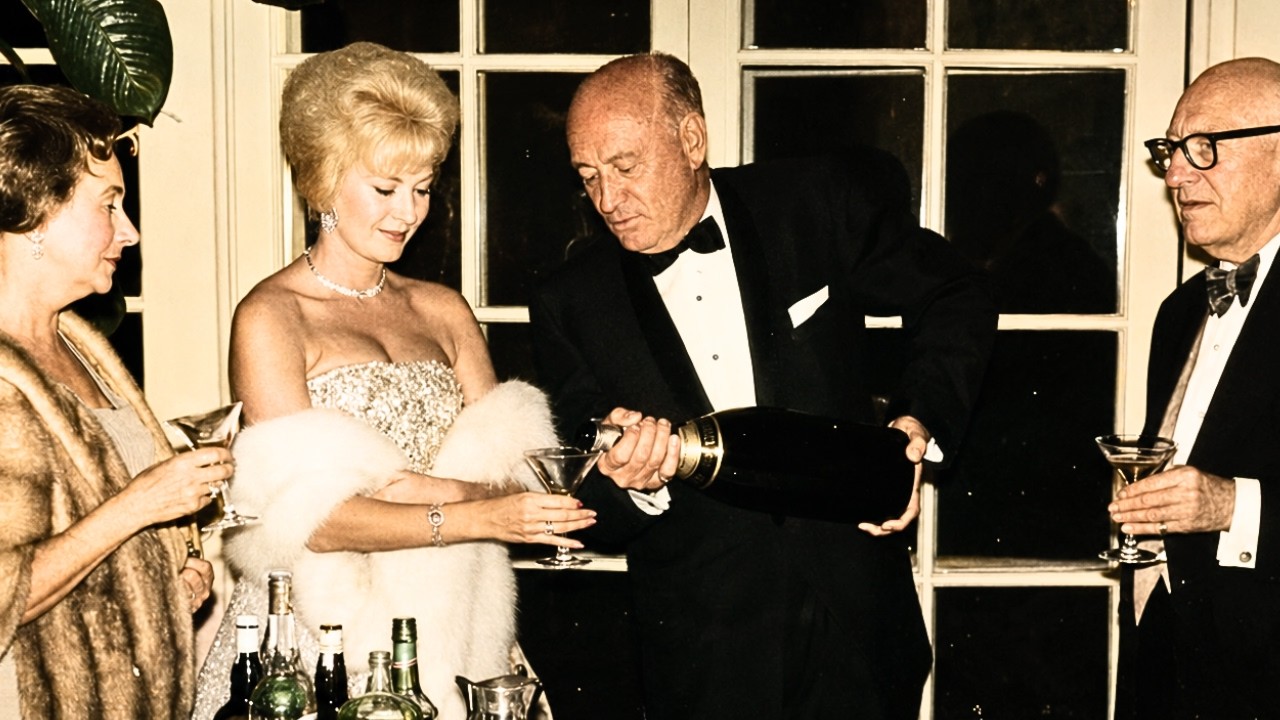
That was still serious money, but what the family lost was the rest of it, an inheritance most of them had quietly assumed would eventually be theirs. The granddaughter left out of nearly everything was Paris Hilton. The date Barron chose was not a coincidence. December 25th was the birthday of his own father, Conrad Hilton, the man who had built the hotel chain starting in 1919.
And when Conrad died in 1979, he too had given away 97 percent of his fortune to the same foundation. The son was repeating the father, down to the date. Almost no Hilton documentary tells the story straight. The family did not lose the hotels, no one embezzled, no one gambled the empire away.
The brand still stands everywhere. What is gone is the family’s relationship to the money, and the patriarchs themselves broke that relationship over three generations, two disinheritances, and a charitable foundation that today holds more than seven billion dollars. Conrad Nicholson Hilton was born on Christmas Day 1887 in San Antonio, New Mexico, a frontier village of a few hundred people. The family home was a combination general store, hotel, and residence.
His father Augustus was a Norwegian immigrant with a relentless work ethic. His mother, Mary Genevieve Laufersweiler, was a German Catholic from Iowa. Those two halves shaped Conrad for the next 91 years. When the family business hit trouble, his mother did not offer financial advice.
She told him to pray. He wrote down her exact words in his autobiography: “It is the best investment you will ever make. ” He believed her, and that belief became the structural element of the entire story. Conrad served in the first state legislature of New Mexico from 1912 to 1916, decided politics was crooked, served in the army during the First World War, and came home in 1919 with $5,011 and a plan to buy a bank in Texas.
The plan fell apart. He bought a hotel instead, the Mobley in Cisco, Texas, 40 rooms for $40,000. The West Texas oil boom was at its peak, and workers were sleeping in shifts. Rooms at the Mobley rented out three customers per bed per day.
Conrad paid the place off in less than a year. Within six years he built the Dallas Hilton, and by 1930 he had four high-rise Texas hotels and was building a fifth. He was 37 years old. Then the Depression hit.
By 1931 he was carrying half a million dollars in debt he could not service. By 1933 he had lost most of the chain, and his creditors retained him as manager of the combined operation. For two years, the future founder of the Hilton empire ran hotels he no longer owned, including some he had built with his own money. He prayed his way through those years and came out with eight hotels.
By the late 1930s he was buying again, the Sir Francis Drake in San Francisco, the Stevens in Chicago, the largest hotel in the world at the time, and in 1949 the Waldorf Astoria in New York. His personal life was unraveling in parallel. He married Mary Adelaide Barron in 1925, and the marriage produced three sons: Conrad Jr. , called Nicky, in 1926, William Barron in 1927, and Eric in 1933.
The marriage came apart during the Depression, and they divorced in 1934. For a Catholic of his generation, divorce was not paperwork. It was a violation of a vow before God. The church did not recognize it, and Conrad never stopped feeling it.
He refused to remarry sacramentally for the next 42 years. He went through a civil marriage in 1942 to Zsa Zsa Gabor, which produced a daughter, Francesca. The church considered the union no marriage at all, and on some level so did Conrad. In 1944, with his soul still held at arm’s length by his church, he created the Conrad N.
Hilton Foundation. Unusually, he was 57 years old, with 35 years still to live, still in the prime of his working years. He built the foundation carefully, slowly, like a man who knew it would eventually carry weight he could not yet describe. Nicky Hilton married Elizabeth Taylor in May 1950.
He was 23, she was 18. The wedding was at the Church of the Good Shepherd in Beverly Hills, with 3,000 people outside. MGM released Father of the Bride, in which Elizabeth played a young woman marrying her first love, within weeks of the real ceremony. The honeymoon began on the RMS Queen Mary, and the drinking started on the wedding night.
By the time they reached Europe, the marriage was already in trouble. In her 1988 memoir, Elizabeth Taylor wrote that Nicky drank from the wedding night onward, became sullen, angry, abusive, physically and mentally, gambled across Europe, and some nights hit her. Unreleased recordings featured in the 2024 documentary The Lost Tapes added details she had kept out of the memoir, including a kick to the stomach hard enough to cause a miscarriage. She did not tell anyone until she got home.
The marriage lasted seven and a half months from ceremony to separation, and the divorce was final in January 1951 on grounds of mental cruelty. She was still 18. Nicky kept the Hilton job. The drinking did not stop, and drugs were added.
He died on February 5th, 1969, of an alcohol-related heart attack at age 42. At the time of his death, he was president of the Conrad N. Hilton Foundation, the charitable institution that ten years later would inherit almost everything the family had. The original line of succession ended in that cemetery.
Francesca Hilton was the only daughter Conrad ever had, and the only child Zsa Zsa Gabor ever had. She grew up with no real relationship with her father. When Conrad died in January 1979, Francesca was left $100,000 from an estate worth approximately half a billion dollars. She contested the will and lost.
The contest forced the question of her paternity into open court, as Conrad had apparently carried doubts about whether she was his. She walked away with nothing she could use. She lived another 36 years, many of them spent fighting her stepfather over control of her incapacitated mother’s care, a fight that cost her what little she had. By 2014 she was bouncing between weekly rentals and her car.
On January 5th, 2015, she had a stroke and died at Cedars-Sinai. She was 67. The only daughter of Conrad Hilton died with nothing the will had not already taken from her in 1979. Conrad Hilton rewrote his last will and testament 35 times over the last three decades of his life.
When he died of pneumonia on January 3rd, 1979, at age 91, almost none of the half-billion-dollar estate went to the family. The two surviving sons received less than a million dollars between them, and approximately 97 percent went to the Conrad N. Hilton Foundation. The will included a long preamble in Conrad’s own words, a sermon instructing the foundation to give without geographic, religious, or racial restriction, singling out the Catholic sisters who had taught him as a boy.
It also contained a paragraph, 8th A, that gave his son Barron the right to buy the foundation’s controlling block of Hilton stock at a fixed price. The reasoning was protective. Conrad wanted the company to stay in Hilton hands, and a charitable trust could not run a hotel chain. What he had not anticipated was that once the foundation actually held the shares, it would not want to give them up.
Barron had been on the foundation board since 1954. In 1983, he sued it. Both sides were right. The will did contain Conrad’s charitable intent, and it did contain the buyback clause.
The lawsuit was about which interpretation prevailed when they conflicted. In March 1988, the California Court of Appeal ruled in Barron’s favor, and the 1989 settlement divided the shares three ways. Barron received 4 million shares directly, the foundation received 3. 5 million outright, and the remaining 6 million were placed in a special trust that would pay income to Barron during his lifetime and then revert to the foundation when he died.
The shares had been worth about $160 million when Conrad died and roughly $654 million by the time the ruling came down. Barron stayed CEO for another seven years and continued on the foundation board. The company stayed in Hilton hands during his lifetime, and the foundation received the bulk of the wealth over the long term. It was, in a way, exactly what Conrad had wanted.
On Christmas Day 2007, Barron Hilton told his family he was leaving them 3 percent of his fortune. The other 97 percent was going to the Conrad N. Hilton Foundation, the exact percentage his father had left to the same foundation 28 years earlier. The trigger, by most accounts, was Paris.
She was Barron’s granddaughter, and by 2007 she was the most recognized member of the family, not for anything the family was traditionally known for, but for a leaked intimate video in 2003, a reality show, a DUI arrest, a probation violation, and a stretch in the Los Angeles County jail system in May and June of 2007, six months before Barron’s announcement. Family biographer Jerry Oppenheimer characterized Barron as deeply embarrassed by how the youngest generation was treating the family name. The other thing that had happened in 2007 was the sale of Hilton Hotels Corporation to the Blackstone Group for $26 billion. Barron became extraordinarily liquid almost overnight.
He planned the announcement carefully, obtaining advance approval from the IRS, the California Probate Court, and written waivers from each of his children, plus no-contest clauses in the will. The man who had spent a decade in court arguing that a will could be challenged had structured one that could not be challenged at all. Almost none of the press coverage noted the parallel with 1979. The man who had sued his father over this decision was now making it himself, and this time the foundation would not need to fight.
Barron Hilton died on September 19th, 2019, at age 91, the same age his father had been at death. The remainder of his estate flowed to the foundation as he had structured it. The pledge from Christmas Day 2007 had been waiting 12 years for this moment. The foundation today holds approximately $7.
4 billion in assets and has distributed roughly $3. 6 billion in grants across its history. Paris Hilton, the granddaughter blamed for triggering the second disinheritance, did not become poor. Her perfumery line generated billions in sales over the years, and her various business interests were collectively reported to be worth approximately $300 million, making her share of Barron’s actual estate almost a rounding error in her own portfolio.
She became, against most predictions, the most enduringly recognized member of the Hilton family, more famous than her grandfather was, on the strength of a name he tried to keep her out of. Two consecutive disinheritances, and the Hilton dynasty still produced a granddaughter who built her own empire. Conrad Hilton made a single idiosyncratic decision at the end of his life, leaving 97 percent of his fortune to a foundation he had built, in part to atone for a divorce he could not reconcile with his Catholic faith. Twenty-eight years later, his son, who had spent a decade in court fighting that decision, made the same decision.
Same percentage, same foundation. The fortune ended up where Conrad wanted it. The family ended up somewhere different than he could have imagined.
In the third decade of the 21st century, the hotels are still standing, the foundation is still funded, and the Hilton most people picture when they hear the name is the one who was supposed to be the disinheritance story.