In the spring of 2011, a woman died in a small hospital room in Manhattan, sixteen days short of her 105th birthday. She was one of the richest people in America, heir to a vast copper fortune built by her father in the Gilded Age. Her name was Huguette Clark, and she had not been seen by the outside world for decades.
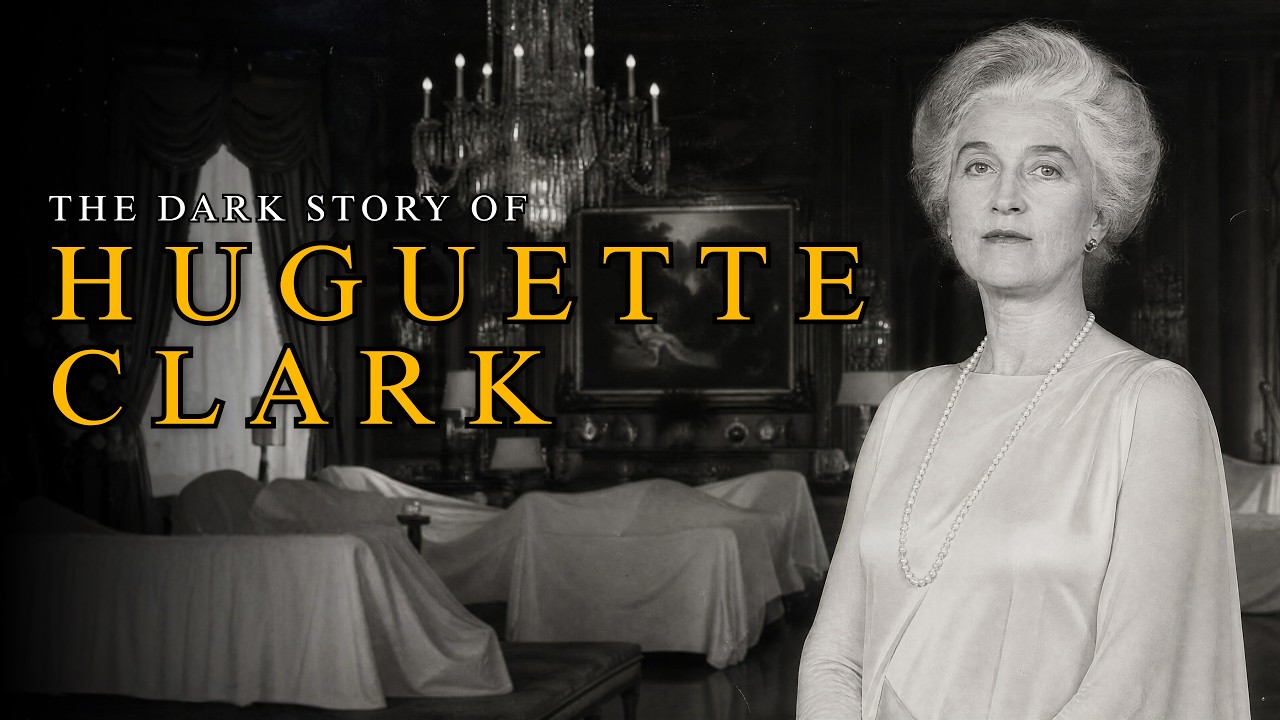
A few miles away, on the highest floor of one of the grandest apartment buildings on Fifth Avenue, her 42-room home sat empty. The rooms were kept exactly as she had left them. The sheets on the furniture were smoothed each week, the paintings were dusted, and the bed had been empty for nearly 20 years.
She owned three great houses she never entered. She had chosen instead to spend the last third of her life in a hospital room under a false name, giving her money away by the millions to the nurse who sat beside her. Whether that room was a prison or the only place she was ever free is a question no court would ever answer.
Huguette Clark was born in Paris on June 9, 1906, the second daughter of William Andrews Clark and his young second wife, Anna Eugenia La Chapelle. Her father was one of the most powerful men in America, a copper king whose fortune was spoken of in the same breath as Rockefeller and Vanderbilt.
William Clark had gone west as a young man with almost nothing and came back a king of copper, the metal on which the new century would run. He owned mines, banks, railroads, and newspapers. He owned a long stretch of desert in Nevada that he cut into building lots and stamped with his own name. To this day, the county that holds Las Vegas is called Clark County after him.
He built a mansion on Fifth Avenue at 77th Street with more than a hundred rooms, its own rail line to carry in the stone, and a pipe organ hidden in the walls. New Yorkers called it Clark’s Folly. The city answered his fortune with mockery, and the old man did not care in the slightest.
Huguette grew up partly in France and partly inside the great stone house. She was shy to the point of pain. She could not bear to be looked at. She loved to paint and would go on painting seriously for decades. She loved music and played. And she loved above everything small things—dolls, dollhouses, and the miniature furniture that filled them.
There is a truth about children that the whole of this story turns on. Give a child a hundred rooms she cannot control and she will build for herself one small room that she can. The mansion belonged to her father and to his money. The dollhouse belonged to her alone.
There were two Clark daughters of that second marriage. The older girl was named Andrée. She was the bright one, the quick one, the confident one. By every surviving account, Huguette adored her without reserve.
In 1919, Andrée fell ill with meningitis. She was about 16 years old. In that era, before the medicines that would one day make such a thing survivable, the illness moved through a young body with terrible speed. Andrée died in the fullness of her girlhood in a family that owned nearly everything a family could own and could not buy her back for any price.
Huguette was in her early teens. She had just been taught the one lesson that would organize the rest of her life. A girl learns at 16 that the world can reach into even the safest and richest house on Fifth Avenue and take the person she loves best without warning. A girl learns that copper and marble and railroads cannot purchase back one ordinary breathing life.
People who studied her life came to believe that she never fully accepted her sister’s death. Some part of her held Andrée close for the rest of her days. The seed of the recluse was planted at a graveside in 1919, and it grew patiently for the rest of the century.
When her father died in 1925 at the age of 85, Huguette, not yet 20 years old, came into a share of one of the largest fortunes America had ever produced. His estate was reckoned in the hundreds of millions of dollars, a fortune that would be worth many billions in the money of today.
In 1928 she married. His name was William MacDonald Gower, a young man connected through his own father to William Clark’s business affairs. On paper, it was a suitable match. It lasted less than two years. In 1930, the couple divorced. By the account her own family would give many decades later, the marriage was never consummated at all.
She never married again. So far as the long and closely watched public record ever revealed, she never again had a romance that anyone could put a name to. The one attempt at an ordinary life was finished almost before it had begun.
What she chose in place of a husband was her mother. Anna Clark had risen from almost nothing to the summit of American wealth and had borne the loss of Andrée at her daughter’s side. The two of them drew together into a shared life that would run for more than 30 years.
They collected paintings that other collectors could only dream of owning. They kept beautiful houses. They filled room after room with rare and delicate things. And they kept the world at a careful and deliberate distance.
Huguette owned a painting by Claude Monet, one of his studies of water lilies. She owned a painting by Edgar Degas, a study of a dancer poised on her points. She owned a violin made by Antonio Stradivari in the year 1709, an instrument of the sort that passes from great player to great player like a crown.
At the heart of that inward-turning life was Bellosguardo, the family’s retreat above the Pacific at Santa Barbara. It was a place of gardens and ocean light and enormous quiet. For the mother and daughter, it was a kind of paradise held in reserve.
In 1963, Anna Clark died. Huguette was in her late 50s. She had already lost the sister of her girlhood, and now she lost the mother of her whole adult life. The circle had contained in the end only the two of them.
What followed did not happen all at once. There was no announcement, no collapse, no single dramatic act of withdrawal. There was only a woman in a great apartment high above the park, alone now in a way she had never been alone before.
After her mother’s death, the retreat that had always been part of her nature deepened into something with no bottom. Fewer and fewer people saw her face. Fewer and fewer people were admitted through her door. In time, the number of people who could say they had laid eyes on Huguette Clark in the flesh shrank toward zero and stayed there for the rest of her life.
She was not a prisoner in those years. She was a woman of enormous wealth, sharp mind, and iron will who had decided, with what looks like complete deliberation, that she preferred the company of her own rooms to the company of the human race. She read. She followed the news of the world with real attention. She watched her television.
The instrument of her disappearing world was the telephone. Huguette Clark ran her entire life down a phone line. She could talk for hours warmly, wittily, to the small handful of people she trusted. She was, by every account of those who spoke with her, delightful on the telephone.
Nothing shows this more clearly than her long relationship with the man who cared for her dollhouses. His name was Rudolph Yaklich, a cabinetmaker of Austrian and Hungarian background. For something close to 30 years, he worked for Huguette Clark, restoring and altering and maintaining her miniature houses and their contents.
In all of that time, across three decades of trusted and intimate work on the things she loved most in the world, he never once met her face to face. Not once. Every instruction came through the closed apartment door or down the telephone line.
She furnished her days with quiet, ordinary pleasures. She watched cartoons. She redrafted her Christmas cards over and over, spending weeks getting the wording of a simple greeting exactly right. She followed presidential elections closely. She watched the markets that held her fortune.
She collected and commissioned and directed the creation of an enormous world in miniature. There were antique dolls, some of them rare and old and very valuable. There were dollhouses furnished down to the smallest detail. There were German tabletop houses that opened into little theaters complete with their own small characters.
There were exquisite scale models of Japanese castles and tea houses, designed by Huguette herself and built to her exacting specifications by an elderly Japanese craftsman. She threw herself at this work with a perfectionism that the people who served it found both maddening and moving.
Her own words survive from inside this work, and they are among the very few of her words that survive at all. “The little people are banging their heads,” she once said of the small figures in her houses. On another occasion she said, “I don’t like holidays because there is so much to do, too much.”
She kept the cabinetmaker Yaklich and his family close in the only way she allowed herself to be close to anyone—through generosity conducted at a distance. She gave them a computer. She gave them puppet theaters. She sent Christmas checks that climbed over the years from $20,000 to $40,000. And she paid to put the man’s grandchildren through college.
The pattern completed itself. The people who served the little world were drawn into the little world, cared for, provided for, remembered, and never once admitted past the door.
In 1951, she bought an estate in New Canaan, Connecticut. A property of some 52 acres carrying a substantial mansion, a house of 22 rooms with baths and fireplaces and a wine cellar and an elevator. By the accounts that survive, Huguette Clark never spent a single night in it.
She is thought to have bought it partly as a refuge she could flee to in the event of some catastrophe. And having bought it, she left it. And there it sat, empty for more than 60 years.

Then there was Bellosguardo, the great estate above the sea at Santa Barbara. After the middle of the century, Huguette simply stopped going there. By the time she was an old woman, she had not set foot on the grounds in something close to 50 years.
But the estate did not decline. She kept a full staff. She kept the gardens tended and the rooms clean and the whole vast property in a state of museum readiness worth some $85 million. The staff maintained a home for a woman most of them had never met.
And then there was Fifth Avenue itself. 42 rooms across a floor and a half of the finest building on the avenue, more than 15,000 square feet of prime Manhattan hung with her Monet and her memories. After she left it, that apartment too was held in perfect stasis for 20 years.
Three great sets of rooms that their owner had abandoned but never relinquished. She had the money to live in any of these places like a queen, and she chose instead to spend that money keeping them empty and perfect.
For years, she had lived with lesions on her face, a basal cell cancer she had let go untreated because to treat it would mean letting a doctor look at her. She had chosen her privacy over her own flesh for as long as the flesh would allow it.
In 1991, she was brought out of the sealed apartment and into a hospital to be treated. The cancer was dealt with. The neglect was reversed. She was fed and cared for and made well.
There came a point when there was no longer any reason for Huguette Clark to be in a hospital bed. She could have gone home to any of her houses. She was well enough to leave. And she chose with a clear and lucid mind to stay.
She would stay for 20 years. She would live in a hospital by choice from the age of 84 until her death just short of 105, occupying a plain room in a working medical building in Manhattan.
A hospital room, if you look at it through Huguette Clark’s eyes, was very nearly the perfect house. It was small. It was safe. It was warm and clean and watched over at every hour. No camera could find her. No demand of the outside world could reach her there.
She registered under names that were not hers. She guarded her identity from the very people caring for her. The staff learned to keep her secret. For two decades, one of the richest women in America lay in a hospital bed a few miles from her own empty mansion, and almost no one in the wider world knew she existed at all.
The woman who would spend the next 20 years at her side arrived in the spring of that first year and stayed 12 hours a day until the end. Her name was Hadassah Peri. She had been born Jella Olaroso, a Filipina who had come to the United States to work as a nurse.
In the spring of 1991, she was assigned to a private patient, an elderly and difficult and immensely wealthy woman who did not want to be seen. Hadassah Peri did not leave that patient’s side for the next 20 years.
“I give my life to Madame,” Peri would say. To the nurse, Huguette was Madame, the great lady, the center of her working life. She gave that devotion 12 hours a day for two decades.
Over the 20 years of their relationship, she gave her nurse gifts that ran in the end past $31 million and promised her tens of millions more in her will. There were more than 300 checks in all across the 20 years. Three of them were for $5 million each.
There were houses bought for the nurse and her family. A home for $450,000. Another for $150,000. A house for a brother’s family at $775,000. An apartment for the children at $885,000. Another apartment at just under $1.5 million. A shore house at nearly $600,000.
There were cars. A Lincoln at $48,000. A Hummer at $91,000. A Bentley at $210,000. There were tuition payments and medical bills and music lessons and summer camps.
Perry herself always insisted the gifts came unbidden, pressed on her by a woman who wanted to give. The relatives who would later go to war over the estate insisted on a darker reading. Both cases were made forcefully by people with every reason to believe them. The truth, if there is a single truth, went to the grave.

The two men who managed her affairs would end up written into her will. Their names were Wallace Bock, her attorney, and Irving Kamsler, her accountant. For years, they had run the machinery of Huguette Clark’s financial life.
When you give away money on this scale, the law requires that gift taxes be paid. Those taxes were not paid. The attorney and the accountant who ran her financial life failed to file and pay the gift taxes on this vast outflow. The unpaid bill, when the reckoning came, carried penalties alone estimated at some $16 to $18 million on top of the taxes themselves.
On the 7th of March 2005, she signed a will leaving everything to her family. Six weeks later, on the 19th of April, she signed a second will that tore the first one up.
The second will revoked everything that came before it. It stated that she intended to leave her family nothing. It named the intention to disinherit the very relatives the earlier will had favored.
In their place, it directed her fortune toward an entirely different set of people and purposes. The bulk of the estate would go to create a foundation for the arts at Bellosguardo. There were large bequests to Hadassah Peri, the nurse. There was $3.5 million for her goddaughter, Wanda Styka. There was money for the Corcoran Gallery, for the hospital that had housed her. And there were her attorney and her accountant, the two men who had shaped the document, positioned to benefit from the estate they would administer.
She died on the 24th of May, 2011. She was 104 years old. She left behind her a fortune of more than $300 million and two contradictory wills.
The relatives struck first. 19 of them, grandnieces and grandnephews and their descendants, challenged the second will. They argued that Huguette Clark had been the victim of fraud and undue influence. They pointed to the $31 million in gifts, to the unpaid gift taxes, to the will drawn by a beneficiary.
The district attorney’s office in Manhattan opened an inquiry into her finances and the conduct of the people around her. No one was ever convicted of anything. But the matter was grave enough that the official machinery of justice turned its attention to the strange case.
As the case ground toward a trial, the parties settled. In September of 2013, an agreement was reached that carved up the $300 million estate among the warring claimants.
The relatives cut out entirely by the second will walked away with $34.5 million. Hadassah Peri, the nurse who had received more than $31 million in life, received nothing further from the estate and agreed to return about $5 million of what she had already been given. The godaughter kept her $3.5 million. The hospital received $1 million. The Corcoran Gallery received $10 million and half the proceeds of the Monet.
Bellosguardo, the great empty house above the sea, passed to a foundation to become at last a place for the arts. The two advisers who had drawn the fatal will were removed from their roles and given nothing at all.
The great question—whether those 20 years were a refuge she chose or a captivity she suffered, whether the giving was love or theft, whether the second will was her free heart or someone else’s guiding hand—was never answered. It was settled. A number was agreed, and a fortune was divided.
Bellosguardo is open to the public now. People walk the grounds she loved and abandoned. They stand in the spaces she paid for decades to keep empty. The doors she sealed against the world swing open now on schedules and ticket times.
The dolls were cataloged and sold. The miniature houses she had tended for 90 years were dispersed to buyers at auction. The little people scattered to strangers. The apartments on Fifth Avenue, held frozen for 20 years, found new owners and new lives.
She owned three great houses and lived in a rented room. She owned a Monet and a Stradivari and looked at neither. She owned more than a hundred rooms and could not bring herself to walk into almost any of them.
She owned everything a person could own. And she wanted in the end only what the very poorest person wants: a small safe place, a little company, and to be left alone.
The little people are banging their heads, and the woman who loved them, one of the richest and most hidden in all of America, is exactly where she always wanted to be. Which is somewhere no one can find her.