In the autumn of 1947, a Virginia surveyor named Virgil Ashcroft was hired by the state to map abandoned logging roads in a remote tract of the Appalachian wilderness. He was 41 years old, a practical man who trusted his compass and his instruments, a veteran of the Pacific war who preferred the solitude of the mountains. The assignment was routine: nearly 12,000 acres of forest that had once been slated for timber operations in the 1920s, now reclaimed by the wild. He set out on October 6th, driving his truck as far as the old road allowed, then continuing on foot into old-growth forest so dense that sunlight barely reached the ground.
For the first three days, the work was uneventful. He made camp beside a stream, ate cold beans, and slept the deep sleep of exhaustion. By the third day, he found remnants of the old logging operation: rusted cables, collapsed sheds, a railroad spur swallowed by vegetation. On the fourth morning, something changed.
The forest fell silent. No birds, no insects, no rustling in the undergrowth. A stillness so complete it felt deliberate. Disturbed, Virgil checked his barometer and found the pressure steady.
There was no storm coming. Then his compass began to spin lazily, refusing to settle on magnetic north. His backup compass did the same. As if the mountain itself was interfering with the Earth’s magnetic field.
That was when he found the fence. Eight feet of rusted chain link topped with barbed wire, running in a straight line through the dense forest. It was much newer than the abandoned logging equipment, showing no signs of age or weathering that matched its surroundings. There were no signs, no warnings, no indication of what it enclosed.
He followed it east for nearly half a mile before finding a gate. The padlock was rusted so thoroughly that it fell apart at his touch. Beyond the gate, a dirt road led downhill through trees so thick they created near-total darkness. Virgil followed it with his flashlight, descending switchbacks into a hollow he hadn’t known existed.
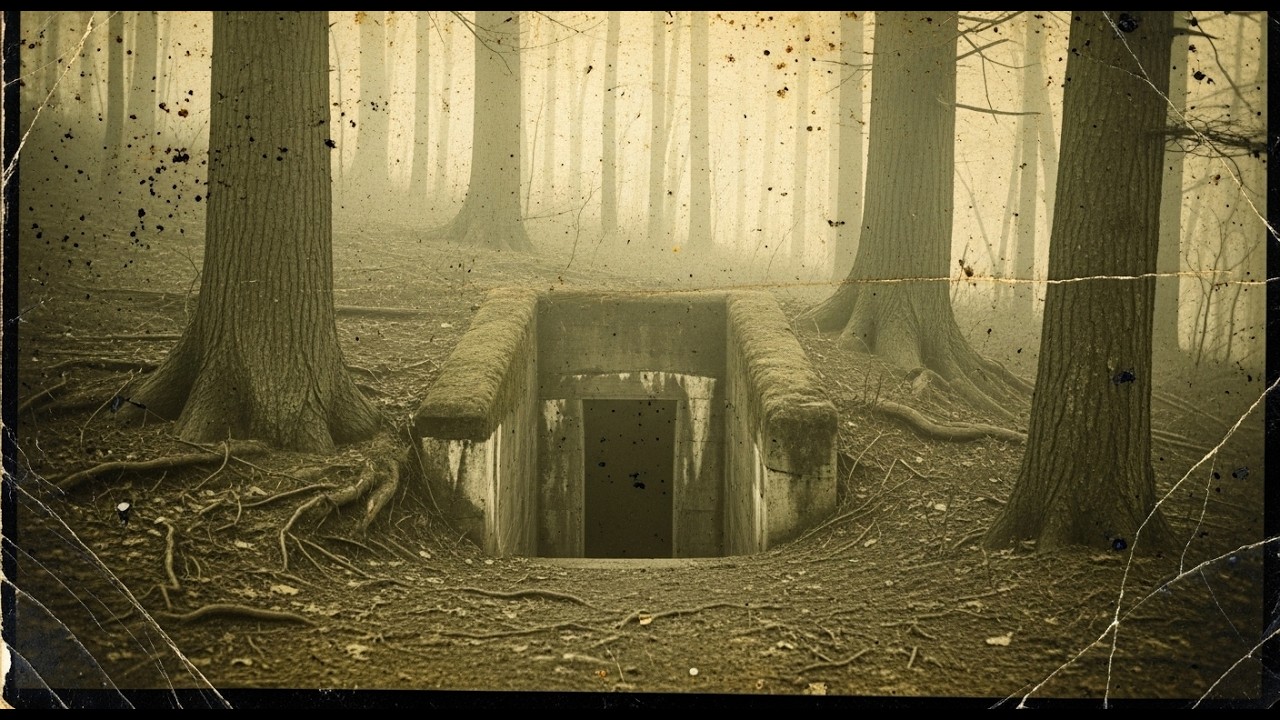
The road ended at a clearing carved into the mountainside. Set into the hill was a massive concrete bunker, its entrance a steel door painted olive drab, heavily rusted, standing a few inches ajar. The air around the entrance was cold and carried a chemical odor, stale and medicinal. A fine layer of dust covered the concrete corridor inside.
In that dust was a single set of boot prints, recent, no more than a few days old, leading inward. There were no prints coming back out. Virgil called into the darkness. There was no response.
He called again. Nothing but his own distorted echo. He had no way of knowing who had walked into that bunker before him, or why they hadn’t walked out. After a long moment, he stepped through the gap in the door.
Inside, the temperature dropped sharply. The corridor ran deep into the mountain, walls painted institutional green, peeled and faded. Electrical cables ran along the walls, connected to junction boxes. The boot prints led him through the facility, past locked doors stamped with official designations, into a central hub where multiple passageways branched off.
On a desk sat a logbook, its pages yellowed and brittle. The last entry was dated December 8th, 1943. Final evacuation complete. All specimens secured.
Project terminated by order of the War Department. Site to be sealed and forgotten. Earlier entries were even more disturbing. One noted that containment procedures had been reinforced after an incident in which two personnel were injured.
Another recorded the expiration of one of the subjects. The terminology struck Virgil with particular force. Specimens. This was not a military installation in the conventional sense.
This was a research facility, built to hold something. The boot prints continued down a corridor marked “Residential, D Wing. ” There, Virgil found dormitories, a communal bathroom, a recreation room with a collapsed pool table. In a room at the end of the corridor, someone had recently been living.
A sleeping bag lay on a bed frame, empty food cans stacked in a corner, a dead battery lantern on a foot locker. The walls were papered with handwritten journal entries, diagrams, and calculations. One entry, dated three weeks earlier, contained a chilling admission. The author had been told the project was terminated, the specimens destroyed, everything sealed.
But they could hear things moving in the lower levels, scratching at doors, testing the locks. The experiments, the journal claimed, had created something that could not die. Elsewhere, Virgil found a schematic of the facility. The levels he had explored were only the upper portion.
Below were laboratories, containment facilities, and storage areas stretching deep into the mountain. At the very bottom was a section labeled simply “Holding,” with a note scrawled in red ink: Do not enter under any circumstances. Against every instinct, Virgil descended. On the second level, he found laboratories.
Examination tables equipped with restraints lined the rooms. The dust on this level had been disturbed, not only by the boot prints he was following, but by drag marks and scraping patterns no human foot would make. Deep gouges ran along the concrete walls at waist height, as if something had been moving through the corridors and brushing against the surfaces as it went. In one laboratory, he found a body in an advanced state of decay, poorly preserved by the cold, dry air.
The dead man was Morton Kepler, 37, from Asheville, North Carolina. His driver’s license had been issued in 1946. He had been down here less than a year. Beside the body lay an old Kodak camera with exposures still on the roll.
Virgil slipped it into his pack. A stairwell at the back of the laboratory descended even deeper into the mountain, and the boot prints stopped at its edge. Kepler had gone down. He had not come back alive.
From somewhere below, Virgil heard breathing. It was slow, mechanical, deliberate, with a wet quality that suggested damaged lungs. Beneath it came movement, multiple sources, shuffling and dragging, echoing up through the stairwell. He descended anyway.
The lower corridor was unfinished concrete, lower ceiling, lined with pipes that dripped condensation. The chemical smell had mixed with something organic and foul. At the first heavy door, he stopped. Beyond it lay a corridor of cells, each with a reinforced observation window at eye level.
The first cell was empty, its walls covered in dense scratches. The second was empty as well. In the third, something moved. The shape was almost human, but wrong.
The limbs were too long, jointed in too many places. The head was misshapen and hairless. When it turned toward the window, Virgil saw a face that was a nightmare of asymmetry, with overlarge eyes that reflected his flashlight beam and a mouth that extended too far back along the jaw. It pressed itself against the observation window, hands with elongated fingers leaving wet smears on the glass.
Then it opened its mouth and made a sound that was not quite speech and not quite a scream, a vocalization that carried meaning Virgil could not translate. From other cells down the corridor, more sounds answered. Through every window, shapes pressed against the glass. After more than 30 years of confinement, the specimens were still alive, still conscious, still aware.
Virgil ran. Behind him, the things in the cells threw themselves against their doors with impacts that boomed through the corridor. He reached the stairwell and took the steps three at a time. He was halfway across the central hub when he heard the sound of a cell door opening below, metal grinding on metal.
Then footsteps on the stairs, multiple sets, moving fast. He reached the entrance corridor and saw daylight ahead. When he was ten feet from the gap, something grabbed his ankle. He went down hard, his flashlight skittering away.
Rolling onto his back, he found himself looking up at one of them. Its skin was waxy and translucent, stretched too tight over bones that had been lengthened and reshaped. Its eyes held an intelligence that was completely, terribly human. Virgil kicked free, grabbed his flashlight, and swung it like a club.
The creature recoiled, more surprised than hurt. Virgil used that moment to lunge through the gap in the door, tearing his jacket on the metal as he squeezed through. He ran until he reached the fence line. The forest was silent, the same unnatural quiet that had gripped the mountain all day.
Now he understood it. The animals knew something was wrong in this part of the mountains, and they had learned to stay away. He made it to his truck after dark and drove, without stopping, to the sheriff’s office in the nearest town. He told his story to a deputy who looked at him as if he had lost his mind.
Within an hour, two federal agents arrived. They questioned him for three hours, then set a document in front of him. The terms were clear: he would never speak of what he had found. In exchange, he received compensation for his silence and the assurance that the site would be secured.
Virgil signed. The agents took his maps, his notes, his survey equipment, and the camera he had found beside Morton Kepler’s body. They replaced his truck with a newer, untraceable model and gave him instructions to claim equipment failure and navigational error if asked. Virgil went home and tried to return to his life.
He took other surveying jobs, but he never went back to those woods. He had nightmares for the rest of his life, dreams of cell doors standing open and things hunting through the corridors. But worse than the nightmares were the questions. What had the researchers been trying to create?
What had gone so wrong in 1943 that the project was terminated mid-war? And if the journal’s claim was true, if the research had succeeded in creating something that could not be killed, then what did “sealed” actually mean? A locked door was only an inconvenience to something that had decades to work on getting through it. Over the years, he tracked stories of disappearances in the Appalachian region.
There were more than he had expected. And in 1971, a group of teenagers vanished from a campsite near Millbridge. Their equipment was still set up, their food still sitting out, as if they had all stood up and walked away in the middle of breakfast. One searcher reported strange tracks leading away from the camp, tracks that suggested something walking on legs that bent the wrong way.
The search was called off after two weeks. The teenagers were never found. When Virgil compared the location to his old maps, it was roughly 15 miles from where he had found the bunker. He considered calling a researcher who had once left him a card, a man from a private foundation that investigated anomalous historical events.
But he burned the card, and he never dialed the number. As far as he could tell, the men in suits from 1947 were retired or dead, and the project was buried under layers of classification and denial. By the time Virgil died in 1992, he had documented 43 cases he believed were connected to what he had seen in that bunker. He left instructions that all his files, his notes, his maps with pins marking each incident, be sent to the foundation the researcher had mentioned.
Whether they ever received them, he never knew. The bunker remains somewhere deep in the Appalachian wilderness. The fence may still stand, or what is left of it. The road still leads down into that hollow.
The door may still be partly open, an invitation to the curious and the foolish. And whatever was created there, whatever was sealed inside and failed to die, may still be waiting.