At the age of twenty-two, Peter Crawford Nhard walked into the American Civil War and somehow walked out of it untouched. No record places him among the wounded. No record places him among the captured. From his enlistment in 1861 to the surrender at Appomattox, he survived some of the bloodiest fighting the Army of Northern Virginia ever saw, including the slaughter at Malvern Hill, where hundreds of men around him were cut down by artillery fire that tore heads from shoulders and legs from underneath the living.
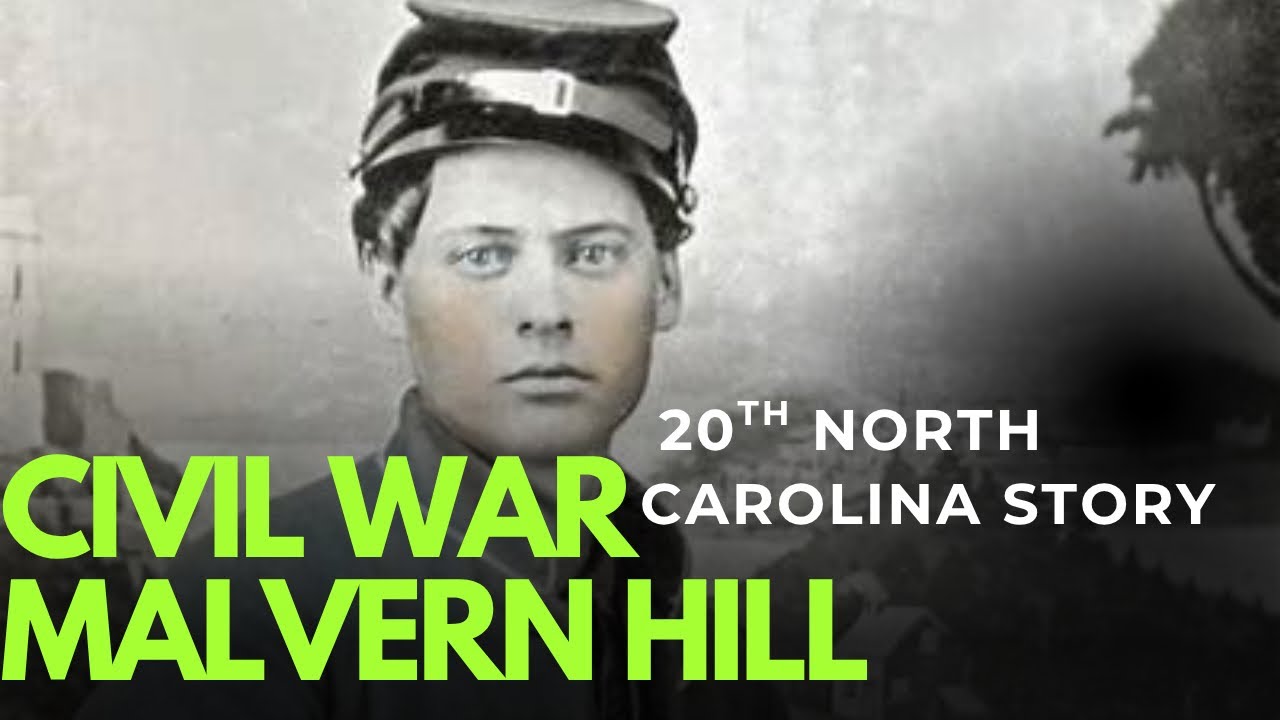
Nhard was born in February 1839 to a farming family in Cabarrus County, North Carolina, in what is today the Kannapolis area. When the war broke out, he enlisted and was assigned to the 20th North Carolina Infantry. Thousands of North Carolinians joined the Confederate cause around the same time, and pure chance decided where they ended up. Some units were sent west to the Army of Tennessee.
Others, like Nhard’s, were absorbed into the Army of Northern Virginia. That distinction would send him into the heart of the Eastern Theater and, eventually, into one of the most punishing battles of the war. By the summer of 1862, the 20th North Carolina had fought through the Seven Days battles around Richmond. The campaign reached its climax on July 1 at Malvern Hill, a field that offered the Confederacy one of its most direct and most disastrous opportunities to break the Union line.
The ground favored the defenders. The Union artillery sat along a ridge line near the Thomas J. West House, commanding a broad, open farmland that sloped gently upward from the Confederate staging areas. A paved road ran through the field and branched off, and on the far side of the ridge, thousands of Union reserves waited in a farm beyond.
Among them was the 67th New York, which had been badly bloodied at Nelson’s Farm just days earlier. One of its second lieutenants had been crossing a field when a cannonball tore the calf muscle off his leg, an injury severe enough to end his war entirely. That was the kind of fire the 20th North Carolina was heading into. The Confederate plan called for a massive frontal assault.
Robert E. Lee spent much of the day arranging his forces in an arc, with Thomas “Stonewall” Jackson’s troops off in the distance, D. H. Hill’s division behind a slope, and John B.
Magruder’s men across the street. The attack opened around 1:30 in the afternoon when Confederate artillery opened fire on the Union guns at the West House and along the ridge line across the road. But the Confederates had stumbled into a trap. Union General Darius Couch, recognizing that the uneven terrain in his section was poorly suited for artillery, had pushed his infantry forward of the guns, placing brigades under Abercrombie and Palmer to prevent the Southerners from launching a successful assault.
When the Confederate infantry stepped out into the open fields, they faced artillery that had a clear, unobstructed shot from the moment they crested the rise. The result was catastrophic. Nhard’s unit came up from the hill behind D. H.
Hill’s men, moving from the tree line across the field toward the West House. They were in what the tour guide described as the armpit of the road, advancing straight up a gentle slope straight into the mouth of the Union artillery. As soon as they topped the high point on the Union side of the road, the guns opened up. Soldiers were decapitated.
Legs were sheared off. Men were gutted beside their brothers. The Confederate line stalled and collapsed at the ridge, unable to advance and unwilling to retreat. On the other side of the road, soldiers lay flat in a divot in the ground, frozen in place.
If they stood, they were hit. If they stayed down, the exploding shells overhead rained shrapnel down on their backs, heads, necks, and legs. That was where much of the mass destruction at Malvern Hill occurred. As the fighting wore on, Union reserves marched past the West House to reinforce Couch’s brigades.
The 67th New York came up into the fray just as the 20th North Carolina came off the line. John B. Gordon’s Alabama troops pushed off from the woods around 5:00 in the afternoon and advanced across the same field, followed by wave after wave of Confederate attacks that continued until darkness made fighting impossible. Men who could not retreat in time were captured and became prisoners of war.
Others were left trapped out on the field. By the end of the day, the Confederate army was broken and disorganized. The Union generals gathered together, and all of them agreed on the same conclusion: the Confederacy was in serious trouble. If they struck hard the next morning, they believed they could knock the door open to Richmond.
That was how one officer put it. But Major General George B. McClellan, the Union commander, decided instead to withdraw his army to Harrison’s Landing. He pulled his men out of the fight, and the Confederates retained a superior position as a direct result of a Union general’s decision, not because of anything that had been won on the field.
Malvern Hill was no Confederate victory. For men like Nhard and the 20th North Carolina, it was a brutal defeat. Yet Nhard survived it. He had seen the Seven Days battles before this one, so he knew what to expect when he stepped out of those woods and onto that field.
The artillery was closer than he had imagined, sitting on a ridge line just in front of him across an open expanse of farmland. He walked through the gunfire, through the falling limbs and shattered trees, through the horrors of a battle where the dead were buried hastily in shallow graves along the tree line. Years later, two Confederate soldier graves were discovered in those woods, their identities lost to time. It is possible they were men from Nhard’s unit.
The 20th North Carolina would go on to fight in thirty-nine separate major engagements. The list includes Gaines’ Mill, Malvern Hill, South Mountain, Antietam, Fredericksburg, Chancellorsville, Gettysburg, Bristoe Station, Kelly’s Ford, Mine Run, the Wilderness, Spotsylvania, North Anna, Cold Harbor, Monocacy, Third Winchester, Fisher’s Hill, Cedar Creek, Third Petersburg, Fort Stedman, Sailor’s Creek, and finally the surrender at Appomattox. At Gettysburg, the regiment suffered roughly 56 percent casualties, an extraordinarily high number for a unit that was already reduced to just over three hundred men by the time it reached the field. After the battle, Robert E.
Lee mentioned the 20th North Carolina in his dispatches, citing their bravery, their tenacity, and their capture of an enemy flag. For an entire regiment to be singled out in those dispatches meant that something significant had happened on that field. Peter Crawford Nhard was among those who kept fighting. When the war finally ended at Appomattox Court House, only seventy-two men from the original 1,020 who had enlisted in the 20th North Carolina were present to surrender.
Of those seventy-two, only nine still carried weapons. Nhard was among the unarmed. He had survived the entire war without a documented wound and without ever being captured. The survival of that one young man would echo far beyond the fields of Virginia.
After the war, his family line continued. Generations later, his descendants would become central figures in American stock car racing. Dale Earnhardt Sr. and Dale Earnhardt Jr.
would go on to collect countless wins and championships in the NASCAR series. Remove Peter Crawford Nhard from that field at Malvern Hill, and the Earnhardt dynasty disappears with him. Some other family would have taken those titles. But because he made it across that field, because he kept surviving while thousands around him fell, the future of American racing was permanently changed by a Confederate soldier who was never supposed to make it home.
Malvern Hill itself never received the attention of Gettysburg or Fredericksburg. The bloodshed there was just as severe, the fighting just as desperate, but the outcome was obscured by McClellan’s retreat and the public confusion that followed. Because the land remained farmland long after the war, the field has survived largely unchanged. It is now part of the Richmond Battlefield Park system, a quiet place where a visitor can still stand on the ridge and see the same open ground that the 20th North Carolina crossed more than a century and a half ago.
No tour buses, no ghost stories, no crowds of vacationers buying souvenirs. Just the field, the graves, and the memory of the men who crossed it.