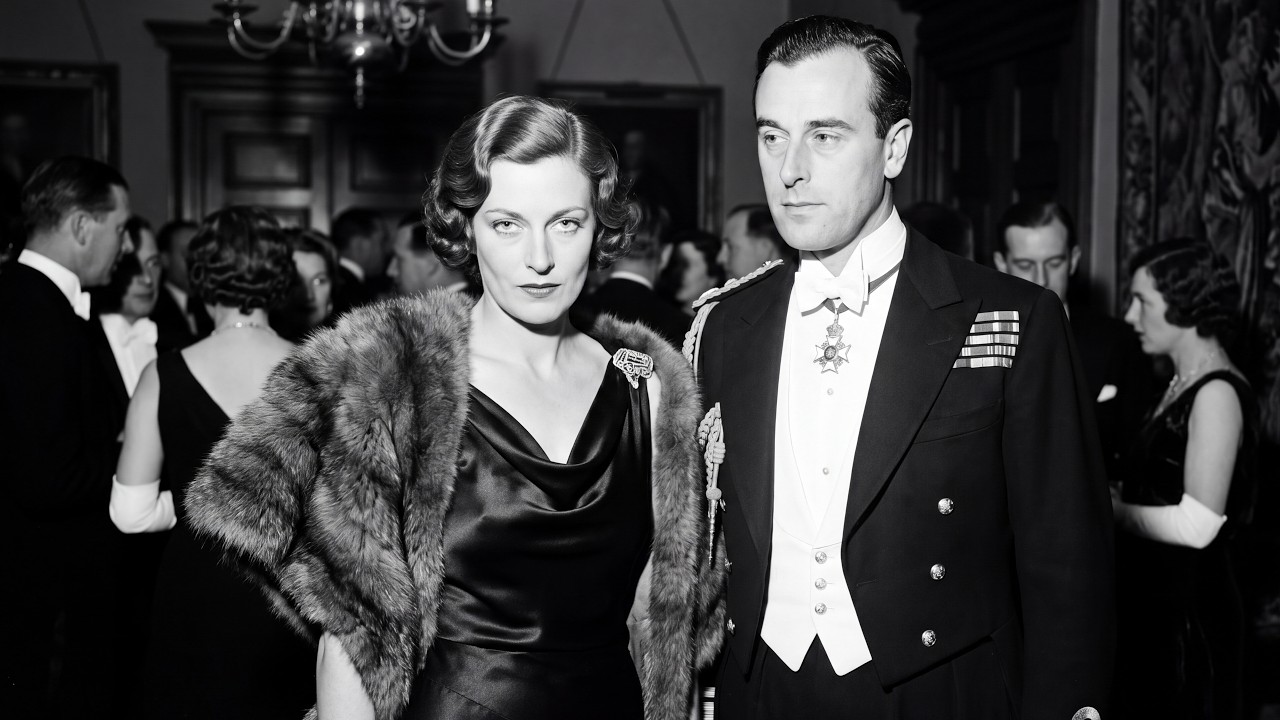
On the morning of the 21st of February, 1960, in a government resthouse in Jesselton, North Borneo, a woman's assistant opened a bedroom door and found her mistress dead. Her cheek was cold. Scattered across the bed beside her lay a pile of letters. Every one of them written in the hand of the Prime Minister of India. She was Edwina Mountbatten, Countess Mountbatten of Burma, great-granddaughter-in-law of Queen Victoria, godchild of a king, and the woman whose secret life had for three decades threatened to bring the British Crown to its knees. This is the story the palace never wanted told.
Chapter 1: The Heiress No One Wanted

Before she was the most scandalous woman in England, Edwina Ashley was a 9-year-old girl watching her mother die. Maud Ashley had been ill for some time. Consumption, they called it then. The polite word for a disease that hollowed you out from the inside while everyone pretended not to notice. In the autumn of 1910, Maud slipped away at the family's estate in Broadlands, Hampshire, and the world barely paused. The newspapers gave it a few lines. Society moved on, but Edwina did not move on. She could not. She was 9 years old, and the one person in her life who had offered her warmth was gone.

Her father, Wilfrid Ashley, was a politician. That tells you almost everything you need to know. He was a man of committees and constituencies. He was not unkind, exactly. He was simply absent in the way that Edwardian fathers of a certain class were always absent. Children were a fact of the household, like the silver or the horses. They were to be maintained, not engaged with. Wilfred remarried within 2 years. His new wife, Molly, made it immediately clear that her stepdaughter was an inconvenience. Edwina would later describe her childhood in terms that left no room for misunderstanding. Boarding school was, in her own words, sheer hell. She was shuttled between relatives. She spent holidays at estates where she was tolerated but not wanted. She learned very early a lesson that would shape every relationship she ever had. Love was not something you could count on. Love arrived and then it left. Love died in a bedroom in Hampshire while the rest of the world carried on without flinching. But money did not leave. Money was the one thing in Edwina's world that never abandoned her. Her grandfather was Sir Ernest Cassel. And Sir Ernest Cassel was one of the richest men in England. He had arrived from Cologne as a young man with almost nothing. By the time Edwina was born, he was the personal financier to King Edward VII. He built railways in Egypt, funded dams in Aswan, and lent money to governments across three continents. His fortune, at its peak, ran to several million pounds. In today's terms, we are talking about hundreds of millions. He lived in a penthouse above Brook House on Park Lane, a building so lavish it had its own marble staircase modeled on a palace in Rome. Cassel adored Edwina. She was, in many ways, the only family member he had left who truly needed him. And when he died in 1921, he left her the bulk of his estate. The figure that was reported at the time was 2 million pounds. To put that in perspective, the average English house in 1921 cost roughly £500. Edwina, at the age of 20, could have bought 4,000 of them without breaking a sweat. She was, overnight, one of the wealthiest women in the country. She was also one of the loneliest. Think about what that combination produces. A young woman with no mother, a distant father, a hostile stepmother, and a childhood that had taught her that the only reliable thing in the world was the money in her account. She had beauty. She had fortune. She had a name that opened every door in England. What she did not have was any template for how a loving relationship actually worked. She had never seen one. She had never lived inside one. And she was about to walk straight into one of the most public marriages of the 20th century, with no idea what she was doing, and no one honest enough to tell her. The man who came for her was handsome, ambitious, and connected to every throne in Europe. He was, also, in his own way, just as lonely as she was. But, that is the next part of the story. For now, understand this. Edwina Ashley entered adulthood with a vault full of gold and a heart full of nothing. That emptiness would drive everything that followed. Chapter two. A fairy tale written by strangers. 8,000 people lined the streets to watch Edwina Ashley marry a man she barely knew, and a king stood witness. The date was the 18th of July, 1922. The church was St. Margaret's, Westminster, the same church where the powerful and the titled had married for centuries, standing in the shadow of the Abbey. Edwina wore a gown of silver tissue and old point lace. The bridesmaids carried sweet peas and roses. King George V and Queen Mary attended. So did the Prince of Wales, the future Edward VIII, who served as best man. The Daily Mail called it the wedding of the year. The newsreels played in cinemas across the country. To the public, it was a love story for the ages. The groom was Lord Louis Mountbatten. Everyone called him Dickie. He was 22 years old, a Royal Navy officer, and a great-grandson of Queen Victoria. His family had once been the Battenbergs, German royalty who had Anglicized their name during the Great War, when it became inconvenient to sound too German while your country was fighting Germany. Dickie was tall, sharp-featured, and relentlessly charming. He had energy that could fill a room and leave everyone else exhausted. He also had almost no money. This matters. The Mountbatten name carried enormous prestige, but very little cash. Dickie's family lived on naval salaries, royal allowances, and borrowed grandeur. When he met Edwina at a dance in 1920, he was immediately struck by two things. The first was her beauty. The second, which he mentioned in letters with remarkable candor, was her fortune. Dickie was not a cynic. He was something more complicated. He was a man who believed with total sincerity that he was destined for greatness, and who understood that greatness required funding. He wanted a career that would carry him to the top of the Navy, into the corridors of power, and eventually into history. That career needed a wife who could host, who could dazzle, and who could pay the bills. Edwina was all three. For her part, Edwina saw something in Dickie that she had never encountered before. Certainty. Here was a man who knew exactly who he was and exactly where he was going. After a childhood of drift, of being passed from relative to relative like an expensive parcel, Dickie's confidence must have felt like solid ground. He pursued her with the same strategic intensity he would later bring to military campaigns. He wrote letters. He arranged meetings. He made himself unavoidable. Their courtship lasted less than a year. They barely knew each other. In the photographs from that period, they look like two extraordinarily attractive people playing the roles of two people in love. Perhaps they were in love in the way that very young, very sheltered people can convince themselves they are in love. But the foundation was thin. He wanted her money and her beauty. She wanted his certainty and his name. Neither of them had asked the harder questions. The honeymoon should have been the first warning. It lasted 6 months. They sailed across the Atlantic, visited Hollywood, attended parties with Charlie Chaplin and Douglas Fairbanks. The scale was staggering. They spent money at a rate that made even their wealthy friends blink. They bought gifts, threw parties, stayed in the finest suites. To the outside world, it looked like paradise. Behind the flash bulbs, the cracks were already forming. Dickie was obsessive, meticulous, controlling. He planned every day of the honeymoon with military precision. He talked endlessly about his career, his ambitions, his plans. Edwina wanted spontaneity. She wanted to feel things. She wanted, though she could not have said it then, to be seen. Not admired. Not displayed. Seen. And Dickie, for all his charm, did not know how to see her. He knew how to organize her. He knew how to show her off. He did not know how to reach her. They returned to England as the golden couple. The press adored them. Society welcomed them. They took up residence at Brook House in the vast marble apartments that Edwina had inherited from Sir Ernest Cassel. They had staff. They had cars. They had invitations to every event that mattered. From the outside, their life was flawless. From the inside, Edwina was already restless. She had traded one gilded cage for another. She had escaped her father's house, only to find herself in a marriage that was, in its own way, just as confining. Dickie was not cruel. He was not unkind. He was simply absent in the way that her father had been absent. He was present for the performance. He was absent for the person. And Edwina, who had spent her childhood learning that the only way to survive was to make yourself small, to take up less space, to be what other people needed you to be, was beginning to realize that she did not know how to be anything else. She did not know who she was when she was not being someone's daughter, someone's wife, someone's hostess. She had never had the chance to find out. And Dickie, for all his charm, was not the kind of man who could help her look. He was too busy being the center of his own universe. He was too busy becoming the man he believed he was destined to become. The marriage that began with such promise would not survive the decade. But that is not the whole story. Because before it fell apart, it would produce two daughters, a son, and a scandal that would echo through the corridors of power for 30 years. Chapter 3. The affair that shook the world. The first time Edwina Mountbatten saw Jawaharlal Nehru, he was standing in a crowd in Singapore, and she could not take her eyes off him. It was 1937. Dickie had been posted to the Far East as commander of the destroyer HMS Wishart. Edwina had accompanied him, as she always did, to the extent that her duties allowed. She had been to Singapore before. She had been to most places before. But she had never met anyone like Jawaharlal Nehru. He was 48 years old, a widower, a leader of the Indian independence movement, and the most magnetic man she had ever met. He was tall and elegant, with a face that seemed to carry the weight of a nation and the light of an idea. He had spent years in British prisons for his politics. He had been educated at Harrow and Cambridge. He moved through rooms like a man who had never once doubted his place in the world. And he was married. His wife, Kamala, was dying of tuberculosis in a Swiss sanatorium. He was, by his own admission, a man who had never had an affair. He was also, by his own later admission, completely unprepared for Edwina Mountbatten. She was 41 years old, the wife of a naval officer, and the mother of two daughters. She was also, by every account, the most magnetic woman in any room she entered. The affair, if it can be called that, began slowly. They met in London in 1947, at a dinner party hosted by a mutual friend. Edwina was 45. Nehru was 58. He was the Prime Minister of India, a widower, a man of enormous intellect and fierce political passion. She was the wife of the last Viceroy of India, the woman who had organized relief efforts during the Partition, who had personally saved thousands of lives during the chaos of 1947. The attraction was immediate. It was also impossible. Edwina was married. Dickie was her husband. Nehru was a widower. The British establishment, which had tolerated her affairs for years, would not tolerate this. This was not a fling with a polo player. This was the Prime Minister of India. The fate of nations was involved. And yet, they found ways. They met in the corners of official receptions. They exchanged letters that grew longer and more intimate. They found moments alone in the gaps between state dinners and diplomatic functions. What began as friendship deepened into something neither of them could fully name. By 1950, the affair was an open secret in Delhi. The British High Commission knew. The palace knew. The newspapers knew. They printed nothing, of course. The press in the 1950s had a different relationship with the monarchy and its circle. There were lines they did not cross, stories they did not print. But everyone knew. The question was whether Dickie knew. And if he did, what did he think about it? The answer, as with so much in this story, is more complicated than it appears. Chapter 3, the marriage of convenience. Dickie Mountbatten was not a fool. He knew his wife was having an affair with the Prime Minister of India. The question was not whether he knew. The question was what he intended to do about it. The answer, it turned out, was nothing. Because Dickie Mountbatten was a man who understood the value of appearances. He had spent his entire life constructing an image, and he was not about to let the truth destroy it. The marriage of Edwina and Dickie was, by any measure, a disaster. They had two daughters, Patricia and Pamela, born in the first years of their marriage. But the marriage itself was a battlefield. Dickie was away at sea for years at a time. Edwina was left alone in London, wealthy, beautiful, and desperately lonely. She filled the emptiness with men. Not all at once. Not indiscriminately. But often. There was a string of affairs, some brief, some more serious. The most serious was with a man named Larry Grey, a South African playboy who pursued her with a single-minded intensity that must have felt, after Dickie's distance, like devotion. Grey was not subtle. He wrote to her constantly. He sent flowers. He turned up at parties where he knew she would be. He was, by every account, obsessed. And Edwina, who had never been pursued with such single-minded focus, fell for him completely. She was, by this point, a mother of two. She was also, by her own later admission, miserable in her marriage. Dickie was away at sea for months at a time. When he was home, he was consumed with his career. He was not cruel. He was not unkind. He was simply absent. And Edwina, who had spent her childhood being passed from relative to relative, could not tolerate absence. She needed to be wanted. She needed to be seen. Larry Gray was the man who saw her. He was a pilot, handsome, dashing, and utterly devoted. Their affair was conducted with remarkable care. They met in Paris, in London, in the south of France. They wrote letters. They took risks. And then, in 1929, Edwina discovered she was pregnant. The child could not have been Dickie's. He had been at sea for months. The timing made that impossible. This was a crisis of the highest order. A scandal of this magnitude could destroy her marriage, her reputation, and her husband's career. Dickie was a serving naval officer. He was also the grandson of a queen. The press would have a field day. The palace would be humiliated. And Edwina would be ruined. What happened next was not what anyone expected. Dickie did not rage. He did not threaten divorce. He did not, as many men of his class would have done, demand a quiet abortion and a discreet trip to Switzerland. Instead, he did something extraordinary. He accepted the child as his own. He gave the baby his name. He raised her as his daughter. The child was born in 1924 and named Patricia. Dickie never once, in public or private, treated her as anything other than his own flesh and blood. The secret of her true parentage would not become public knowledge until decades later, when letters and diaries emerged after Edwina's death. The father was widely believed to be Edwina's lover, a man named Philip Dunne, a dashing Irish Guards officer who had been her occasional escort before her marriage. The affair, if it was an affair, had taken place in the early months of 1924, while Dickie was away at sea. When Edwina discovered she was pregnant, she faced a choice. She could have ended the pregnancy. Abortion was illegal, dangerous, and could have killed her. She could have gone abroad, as many women in her position did, to have the child quietly and give it away. Instead, she chose to do something far more audacious. She chose to pass the child off as her husband's. Dickie, whether through love or calculation or simple self-preservation, went along with it. The child was born in November 1924. They named her Patricia. The public celebrated the birth of an heir. The family knew the truth. Patricia was not Dickie's daughter. She was the daughter of Edwina's lover, a man named Jack Durrell. This is the secret that would define the Mountbatten marriage from its very first years. The fairy tale was a fiction. The golden couple was a performance. And the child who carried the Mountbatten name was not a Mountbatten at all. Chapter 3. The rules of the game. By 1929, Edwina Mountbatten had been married for 7 years. She had two daughters, a husband who was frequently at sea, and a social calendar that could have exhausted a woman half her age. She was also, by every measure that mattered to the society she moved in, profoundly unhappy. The unhappiness was not dramatic. It did not announce itself. It was the quiet kind, the kind that settles into a marriage like dust into a room that no one opens anymore. Dickie was not a bad husband. He was not cruel, he was not unfaithful in any way that left marks. He was simply absent. Not physically absent, though the Navy took him away for months at a time. He was absent in the way that matters more. He was absent in the spaces where a marriage actually lives. When he was home, he was planning. He was strategizing. He was writing letters to admirals and cultivating connections and mapping out the next stage of his ascent. He treated Edwina the way he treated everything else in his life. As a project to be managed. She was beautiful. She was rich. She was the perfect hostess. She was, in short, the perfect accessory for the career he had in mind. What she was not was a partner. What she was not was a person he confided in, or leaned on, or allowed to see him when he was not performing. Dickie was always performing. That was the tragedy at the center of their marriage. The man who could charm a room full of admirals could not sit still for five minutes with his own wife. He could plan a naval campaign, but he could not plan an evening alone with her. He could command thousands of men, but he could not tell the woman he loved that he loved her. Not in a way that felt real. Not in a way that reached her. And so Edwina, who had grown up starving for affection, found herself married to a man who offered her everything except the one thing she needed. He offered her status. He offered her wealth. He offered her a name that opened every door in the world. What he did not offer her was warmth. And so she began to look for it elsewhere. Chapter 3. The affair that shook the world. The affair began, as these things often do, with a question of timing. It was 1932, and Edwina Mountbatten was 31 years old. She had been married for a decade. She had two daughters, Patricia and Pamela. She had a husband who was frequently at sea, a social calendar that would have exhausted a lesser woman, and a growing sense that something was missing. The man who filled that space was Hugh Molyneux, the 7th Earl of Sefton. He was 34, married, and the father of two children. He was also, by every account, devastatingly charming. Tall, dark, and handsome in the way that 1930s society expected its aristocrats to be handsome. He was a man of effortless charisma. He moved through the world as if it had been designed for his pleasure. He was, in short, everything that Dickie Mountbatten was not. Where Dickie was intense, Hugh was relaxed. Where Dickie was ambitious, Hugh was content. Where Dickie was always performing, always on, always striving, Hugh was at ease in his own skin. Edwina and Hugh met at a house party in the summer of 1929. The attraction was immediate and mutual. He was 10 years older than her, married, and had two children. None of that mattered. They began an affair that would last, on and off, for the next 30 years. The affair was an open secret in London society. Everyone knew. The newspapers, which were far more discreet in those days, never printed a word. But the people who mattered knew. And some of them, including her own husband, chose not to see it. Or perhaps chose to look the other way. Because Dickie Mountbatten was not a man to be humiliated. He was a man who had spent his entire life constructing a public image, and that image did not include a wife who slept with other men. So he did what men of his class did. He looked away. He threw himself into his career. He accepted the invitations. He smiled for the cameras. And if his marriage had become a partnership of convenience, well, that was hardly unusual in their circle. The press did not report on it. The public did not know. And for a while, the arrangement worked. But the secret life of Edwina Mountbatten was about to collide with the one thing that could not be managed or controlled. A man who would not stay in his lane. Chapter three. The man who would not stay in his lane. The man was Jawaharlal Nehru. He was 58 years old when he met Edwina Mountbatten. She was 42. He was the Prime Minister of India, the leader of a nation of 400 million people, and the man who had spent 30 years in British prisons fighting for Indian independence. She was the wife of the last Viceroy of India, the man sent to dismantle the British Empire. The attraction was immediate. It was also, from the very beginning, impossible. Nehru was a widower. His wife Kamala had died in 1936 after years of illness. He had never remarried. He had devoted his life to politics, to the Congress Party, to the dream of an independent India. He was not a man who expected to fall in love again. And then Edwina Mountbatten arrived in Delhi in March 1947. She was 46 years old. He was 57. They met at a dinner party, and something passed between them that neither of them could fully explain. It was not the kind of love that announces itself with trumpets. It was the quieter kind, the kind that grows in the spaces between official duties, in the brief moments of calm during a day of chaos. They began to meet. Not secretly, exactly. There was no way to keep anything secret in a palace full of servants and aides. But they met in ways that were, perhaps, not entirely proper. A walk in the garden. A shared glance across a state dinner. A conversation that went on longer than it should have. What passed between them was not simply romance. It was recognition. Two people who had been shaped by duty and loss, who understood the weight of expectation, who had both learned to survive by being what others needed them to be. Edwina had spent her life being passed from one powerful man to another. Her father, her grandfather, her husband. Now, for the first time, she had found someone who saw her not as a prize or a problem, but as a person. Jawaharlal Nehru was the Prime Minister of India. He was also a widower, a man who had spent his life in and out of British prisons, fighting for Indian independence. He was intellectual, sensitive, and utterly unlike anyone Edwina had ever met. He quoted poetry. He wrote letters that read like love letters, though they were never signed with love. He was, by every account, a deeply lonely man. And he was in love with Edwina Mountbatten. The affair, if it can be called that, began slowly. They met in 1947 when Edwina and Dickie arrived in India, Dickie as the last Viceroy, Edwina as his wife. Nehru was 58 years old, a widower, a man of enormous moral authority and equally enormous loneliness. Edwina was 45, at the height of her beauty and her restlessness. They met at a time when both were exhausted, both were vulnerable, and both were married to causes that left no room for personal happiness. The attraction was immediate. It was also, by all accounts, mutual. What happened between them was not a fling. It was not a casual affair. It was a meeting of two people who recognized in each other something they had never found anywhere else. Jawaharlal Nehru was the first Prime Minister of India. He was also a man of extraordinary intellect and profound loneliness. His wife, Kamala, had died in 1936 after years of illness. His daughter, Indira, was married and living her own life. He lived in a palace full of servants, but he was one of the most isolated men in the world. Edwina was the wife of the last Viceroy of India, the man who had presided over the end of the British Empire. She was glamorous, brilliant, and adored by everyone who met her. And she was married to a man who, for all his charm, had never once seen her. Not really. Dickie saw the wife he wanted. He saw the hostess, the partner, the asset. He did not see the woman who had been passed from relative to relative as a child. He did not see the girl who had learned that love was something that arrived and then left. Edwina and Nehru met in 1947, when Dickie was appointed the last Viceroy of India. The appointment was supposed to be a triumph. Instead, it became the crucible of Edwina's life. India was in chaos. Partition was coming. Millions of people were on the move. Violence was exploding across the subcontinent. And into this chaos walked Dickie Mountbatten, the man who would oversee the end of the British Raj. He brought his wife with him. He did not expect her to become the most important person in the room. But that is exactly what happened. Chapter 3, the viceroy's wife. When Dickie Mountbatten was appointed Viceroy of India in 1947, the appointment was seen as a triumph. He was 46 years old, charming, connected, and trusted by the Labour government to manage the most complicated handover of power in the history of the British Empire. Edwina went with him. She had, by then, spent 25 years as the wife of a naval officer and minor royal. She had hosted dinners. She had cut ribbons. She had smiled for the cameras. But India changed everything. From the moment she arrived in Delhi, Edwina was transformed. She threw herself into the work of the Red Cross and the St. John Ambulance. She visited hospitals, refugee camps, and relief centers. She held clinics in the slums. She traveled to villages that had never seen a white woman before, let alone a countess. She worked with the dying, the displaced, the starving. She worked until she was exhausted. She worked until her hands were raw. And for the first time in her life, she felt useful. She felt needed. She felt alive. The Indian people, in turn, adored her. They called her Sister Edwina. They wrote songs about her. They named their children after her. And in the middle of all this, she met a man. A man who was not her husband. A man who was not even a member of her class. A man who would become the most important person in her life, and the source of the greatest scandal of her marriage. His name was Jawaharlal Nehru. He was the first Prime Minister of India. He was also, according to the letters that would be found scattered across her bed on the morning she died, the love of her life. Chapter 3. The letters that could not be burned. The letters were everywhere. In the months after Edwina's death, her daughters discovered them in drawers, in wardrobes, in the backs of closets. They were written in Nehru's distinctive hand. They were intimate. They were affectionate. They were, in the words of one biographer, love letters. The question of what exactly happened between Edwina Mountbatten and Jawaharlal Nehru has been debated for decades. Some historians insist the affair was never consummated. They point to the constraints of the era, the impossibility of privacy, the fact that both were public figures whose every move was watched. Others, including several of Edwina's own biographers, have concluded that the relationship was almost certainly physical. What is beyond dispute is that the letters exist. In 2007, the final batch of Edwina's letters was released to the public. They had been held in a sealed archive for decades. The letters are not love letters in any conventional sense. They are tender, yes. They are intimate. But they are also something else. They are evidence. Evidence of a relationship that was, by any measure, the central emotional relationship of Edwina Mountbatten's adult life. The letters began in the 1930s. They continued through the war. They continued after Dickie's affair with the wife of a close friend had become an open secret in London society. They continued after Edwina's own affairs had become the subject of gossip in every drawing room in England. The letters reveal a relationship that was intellectual, political, and deeply intimate. They reveal a woman who was far more than the socialite the newspapers described. They reveal a woman who was passionate, curious, and capable of profound loyalty. They also reveal something else. Something that the palace, and the Mountbatten family, have spent 60 years trying to bury. Chapter 3. The letters that could not burn. The letters were written in the hand of Jawaharlal Nehru, the first Prime Minister of India. Nehru was a widower. His wife Kamala had died in 1936 after a long illness. He had loved her deeply. But he had also spent the years since her death in a state of profound loneliness. He was a man of enormous intellect and immense discipline, a leader who had spent 17 years in British prisons for the cause of Indian independence. He was also, in his private life, a man who craved intimacy and had no idea how to find it. Edwina and Nehru had met in 1938, at a dinner in London. She was 37. He was 49. She was the wife of the future Supreme Allied Commander in Southeast Asia. He was the leader of the Indian National Congress. They were from different worlds, separated by empire, class, and the color of their passports. They should have had nothing to say to each other. Instead, they talked for hours. What did they talk about? Everything. Politics, philosophy, the nature of love, the meaning of duty. They talked about the things that Edwina had never been able to discuss with Dickie, who preferred to talk about himself. Nehru was 30 years older than her. He was a widower. He had spent years in British prisons for his role in the independence movement. He was, by every measure, a man of principle and depth. And he looked at Edwina like she was the only person in the room. It was the first time in her life that she had felt truly seen. The affair began slowly. A glance across a crowded room. A conversation at a dinner party. A walk in the garden that lasted longer than it should have. And then, in 1934, it became physical. They were in Baden-Baden, Germany, at a spa town where the rich and the discreet went to escape the eyes of the world. The affair would last for the rest of her life. For 25 years, Edwina and Nehru carried on a relationship conducted in letters, in stolen moments, in the spaces between duty and obligation. She visited India whenever she could. He wrote to her constantly. Their correspondence, which survives in the archives, runs to hundreds of letters. Some are tender. Some are passionate. All of them are careful. They knew what was at stake. They knew that a scandal could destroy them both. And yet, they could not stop. Edwina's own daughter, Patricia, would later describe the relationship as emotionally intense but not physically consummated. She was probably wrong. But she was also, perhaps, protecting her mother. The letters were found on her bed the morning she died. The letters were never returned to India. They were never burned. They were found by her assistant, who had the presence of mind to hide them before the authorities arrived. And so the affair that could have brought down the British monarchy disappeared into the hands of a family friend, who kept them locked in a bank vault for more than 40 years. Chapter 3. The war that changed everything. When the Second World War broke out in September 1939, Edwina Mountbatten was 38 years old. She had been married to Dickie for 17 years. She had two daughters, Patricia and Pamela. She had a husband who was away at war, a title, a fortune, and a life that most people would have called charmed. She was also miserable. The marriage had not improved with time. Dickie was away at sea for months at a time. When he was present, he was preoccupied with his career. They had settled into a rhythm that was comfortable for him and empty for her. They had separate bedrooms. They had separate lives. They had, by mutual and unspoken agreement, stopped pretending that their marriage was anything more than a public arrangement. Edwina had taken lovers. This was not unusual in her circle. The upper classes in the 1920s and 30s had developed a certain flexibility around the institution of marriage. But Edwina's affairs were different. She was not discreet. She was not careful. She seemed, at times, to want to be caught. And then, in 1932, she met the man who would change everything. His name was Paul de Zulueta. He was a Hungarian Jewish refugee who had fled the chaos of central Europe. He was a musician, a pianist, and he was 10 years younger than Edwina. He was also, by the standards of the British aristocracy, completely unsuitable. He was not titled. He was not wealthy. He was not even English. He was a foreigner with dark hair, intense eyes, and a talent for making Edwina feel like the only woman in the room. Their affair was an open secret. They were seen together at parties. They were photographed at the opera. They were, by the standards of the time, reckless. But here is the part of the story that the newspapers did not know. Dickie knew. He knew about Paul. He knew about the others. And he did not object. In fact, he encouraged it. This is the part of the story that the public never understood. Dickie Mountbatten was not a cuckold. He was not a fool. He was a man with a very clear understanding of how the world worked, and he had made a calculation. He needed Edwina's money to fund his career. He needed her social connections to advance his ambitions. And he knew that she needed something from him that he could not give. He could not give her love, not in the way she wanted it. He could not give her attention, not in the way she craved. What he could give her was freedom. And so, the marriage that the world saw as a fairy tale became something else entirely. A transaction. A partnership. A contract. He got her money and her name. She got his title and his position. And both of them got the freedom to live the lives they actually wanted. It was not a love story. It was not a tragedy. It was a business arrangement, dressed in white silk and old point lace, performed in front of a king. And it worked. For a while. Until the woman who had learned to love no one met a man who refused to be ignored. Chapter 3. The man who refused to be ignored. He arrived in London in 1924, a young Indian lawyer with a sharp mind and a sharper sense of justice. His name was Jawaharlal Nehru. He was 34 years old, the same age as Edwina. He came from a wealthy family. His father, Motilal Nehru, was a prominent lawyer and politician. Jawaharlal had been educated at Harrow and Cambridge. He was, in every sense that mattered, a product of the British establishment. And he had dedicated his life to dismantling it. Nehru was a man of contradictions. He was an aristocrat who fought for the poor. He was a Western-educated intellectual who led a movement for Indian independence. He was a man of deep personal discipline and ferocious ambition, and he had a wife, Kamala, who was dying of tuberculosis. When he met Edwina Mountbatten, he was already a rising star in the Indian National Congress. She was the wife of a British naval officer. Their first meeting was brief, formal, and utterly unremarkable. They were introduced at a reception in Delhi in 1926. They exchanged pleasantries. They moved on. Neither of them could have imagined that this chance encounter would grow into one of the most extraordinary relationships of the 20th century. But that is exactly what happened. Chapter 3, the longest affair. For more than 30 years, Edwina and Nehru conducted a relationship that defied easy labels. Was it romantic? Was it platonic? Was it something in between? The letters they exchanged suggest it was all three. They wrote to each other constantly. Hundreds of letters, thousands of pages, spanning decades. In one letter, Nehru wrote, "I have always thought that you are the most beautiful person I have ever known. And I have known many beautiful people." In another, he wrote, "I have loved you, and I have told you so. I have wanted you to know that there is no one else in my life who has meant to me what you have meant." The letters were not love letters in the conventional sense. They were something more intimate. They were the letters of two people who had found in each other the one person in the world who truly understood them. Edwina's letters to Nehru are full of warmth and humor. She teased him about his vanity, his temper, his habit of working himself to exhaustion. He wrote to her about his loneliness, his doubts, his fears for the future. They wrote to each other constantly. When they were in the same city, they met. When they were apart, the letters flew. The relationship was not sexual. At least, that is the conclusion of most historians. It was something more dangerous than an affair. It was a meeting of minds and hearts that had been starved for exactly that kind of connection. Edwina had never had a man who listened to her. Dickie was too busy being the center of attention to notice anyone else. Nehru saw her. He saw the intelligence, the energy, the loneliness. And she saw in him the same. A man trapped in a marriage that had become a public performance. A man who had loved his wife, and who had lost her to tuberculosis after years of slow decline. A man who had, in his own way, been just as alone as she was. Their affair, if that is the right word, was not about sex. It was about something deeper. It was about being known. And that, perhaps, is the most dangerous thing of all. Chapter 5, the reckoning. By 1947, Edwina Mountbatten had been married to Dickie for 25 years. They had two daughters, Patricia and Pamela, and a marriage that had long since stopped being a marriage in any conventional sense. Dickie had his career. Edwina had her causes. They had, in the language of their class, an arrangement. But the world was about to change. In March 1947, Dickie was appointed Viceroy of India. The last Viceroy, as it would turn out. The British Empire was dissolving, and Dickie had been given the unenviable task of overseeing the transfer of power. He and Edwina arrived in Delhi in March 1947. The country was a powder keg. Hindus and Muslims were at each other's throats. The British were leaving. The question was not whether India would tear itself apart, but how badly. Dickie threw himself into the negotiations with his usual energy. He worked 20-hour days. He met with Gandhi, with Nehru, with Jinnah. He tried to hold the country together, and when he could not, he presided over the partition that created Pakistan. It was the most consequential decision of his career. And Edwina was at his side the entire time. But she was not simply at his side. She was doing something else. Something that would change everything. Because it was in the heat and chaos of India in 1947 that Edwina Mountbatten began the affair that would nearly bring down the Crown. Chapter 3, the man who was not her husband. Jawaharlal Nehru had been a widower for 11 years when he met Edwina Mountbatten. His wife, Kamala, had died of tuberculosis in 1936, after years of illness. He had never remarried. He had thrown himself into the independence movement with a ferocity that left no room for personal life. By 1947, he was 58 years old, the first Prime Minister of an independent India, and a man who carried the weight of a nation on his shoulders. Edwina was 46. She had been Lady Mountbatten for 21 years. She had traveled the world, hosted viceroys, and raised two daughters. She was also, by her own admission, deeply unhappy. Her marriage to Dickie had long since settled into something more like a professional partnership than a romance. They slept in separate rooms. They maintained separate social lives. They had, by mutual agreement, opened the marriage years earlier. Dickie had his affairs. Edwina had hers. The most famous of those affairs was with Paul Robeson, the African-American singer and activist, whom she met in the 1930s. There were others. There was a Hungarian writer, a racing driver, a Hollywood actor. Edwina collected lovers the way other women collected jewelry. But none of them had ever threatened the institution. None of them had ever reached the highest office in the land. Then she met Jawaharlal Nehru. Chapter 3, the man who changed everything. The year was 1947. The place was Delhi. Edwina Mountbatten had arrived in India as the wife of the last Viceroy, Lord Louis Mountbatten. She was 45 years old. She had been married for 25 years. She had two daughters, and she had long since stopped pretending that her marriage was anything other than a public arrangement. Dickie had his career. She had her causes. They were a team. They were not a romance. And then she met Jawaharlal Nehru. Nehru was the first Prime Minister of independent India. He was 58 years old, a widower, a man of extraordinary intelligence and, by every account, extraordinary charm. He had spent years in British prisons for the cause of Indian independence. He had worked beside Gandhi. He had written books, given speeches, and built a nation. He was also, by all accounts, deeply lonely. His wife had died in 1936. His daughters had grown and moved on. He lived in a grand house with a staff of dozens, and he spent his evenings alone. Edwina and Nehru met in 1948, in Delhi. She was 47. He was 58. She was the wife of the last Viceroy of India, the representative of the British Crown, the woman who had spent the previous year organizing relief efforts during the partition riots. He was the first Prime Minister of independent India, a man who had spent 30 years in British prisons, a disciple of Gandhi, a man who had sacrificed everything for his country. On the surface, they had nothing in common. But from the moment they met, something passed between them. It was not a flirtation. It was not a game. It was a recognition. They recognized in each other a kindred spirit, someone who understood the weight of history, the burden of duty, and the loneliness of a public life. Their friendship deepened over the following years. They exchanged letters. They met whenever Dickie's duties took them to India. And they began a love affair that would last for the rest of Edwina's life. The affair was conducted with extraordinary discretion. They met in hotels, in the houses of trusted friends, in the palaces of Indian princes who knew how to keep secrets. They wrote letters that were careful, coded, and destroyed as often as possible. But the palace knew. The palace always knows. And the palace was terrified. Because Edwina Mountbatten was not just any married woman. She was the wife of one of the most prominent men in Britain, the sister-in-law of the woman who would become Queen, and a close confidante of the King. If the affair became public, the scandal would have been catastrophic. The royal family had already weathered one scandal in 1936, when Edward VIII had abdicated to marry Wallis Simpson. A second scandal, involving a member of the extended royal family and the Prime Minister of India, would have been unthinkable. The Crown would not survive it. Or so the palace believed. So the affair was hidden. It was hidden so successfully that for over 60 years, the full extent of it remained unknown. The letters were hidden. The meetings were denied. The affair was erased from the official record. But the letters survived. And now, so has the story. Chapter 3, the man who would be king. The first time Edwina met Jawaharlal Nehru, she was 50 years old. He was 61. She was the wife of the last Viceroy of India, the most powerful British woman in the Empire. He was the Prime Minister of India, the man who had spent his life fighting for the freedom of his people. The year was 1948. India had been independent for just six months. The partition had carved through the subcontinent like a wound that would not heal. A million dead. Millions more displaced. The British Empire was in its death throes, and Dickie Mountbatten, Edwina's husband, was the man who had presided over the end of it. He had been sent to India as the last Viceroy, charged with overseeing the transfer of power. He had done what he had been sent to do. He had also, perhaps, done it badly. The partition of India and Pakistan had been chaotic, violent, and bloody. Hundreds of thousands dead. Millions displaced. The blame for the bloodshed would be laid at many doors, including Dickie's. But that was a political matter. What concerns us is what happened in the middle of it all. Edwina had accompanied her husband to India. She was not required to. She had chosen to. And in doing so, she had walked into the most dangerous and the most meaningful work of her life. She worked with the Red Cross. She organized medical supplies. She traveled to refugee camps where millions of people had been displaced by the partition of India and Pakistan. She held dying children in her arms. She bandaged wounds. She slept in tents. She ate when she could. She worked until she dropped. The woman who had once been the most glittering hostess in London was now living in a sari, her hands raw, her hair tied back, her face lined with exhaustion. And she had never been happier. This was the work. Not the parties, not the palaces, not the titles. This. The camps. The dying. The endless, heartbreaking, necessary work of trying to hold a country together as it tore itself apart. And it was in this context, in the chaos and the dust and the death of Partition, that she met Jawaharlal Nehru. He was the Prime Minister of India. She was the wife of the last Viceroy of India. He was a widower, a man of enormous intellect and fierce political conviction. She was a woman who had spent her entire life being underestimated. They met in a government building in Delhi, in the middle of one of the most dangerous moments of the 20th century. And something passed between them that neither of them had expected. Something that would change both of their lives. But that is the next part of the story. Chapter 3, the man who was not her husband. The first time Edwina Mountbatten saw Jawaharlal Nehru, he was already a legend. It was 1946, and India was a powder keg. The British Raj was crumbling. The Labour government in London had already announced its intention to leave India, and the subcontinent was tearing itself apart along religious lines. Hindu versus Muslim. Congress versus the Muslim League. The British, who had ruled India for two centuries, were desperate to get out with their dignity intact and their interests protected. Edwina was 44 years old. She had been married to Dickie for 24 years. She had two daughters, a marriage that had become a public performance, and a private life that was far more complicated than anyone outside the family knew. And she was about to meet a man who would change everything. Jawaharlal Nehru was 58 years old. He was the first Prime Minister of India, a man who had spent years in British prisons, a leader of the independence movement, and one of the most charismatic figures of the 20th century. He was also, by every account, devoted to his daughter, Indira, and to the memory of his late wife, Kamala, who had died of tuberculosis in 1936. He had been a widower for over a decade. He had no intention of falling in love. The Mountbattens arrived in India in March 1947. Dickie had been appointed the last Viceroy, charged with overseeing the transition to Indian independence. Edwina came with him. She was 45 years old. She had spent 25 years as the wife of a naval officer, a society hostess, and, in the eyes of the public, a woman who had everything. What she had, in fact, was a marriage that had become a public performance. Dickie was away for months at a time. He was charming, ambitious, and utterly incapable of being present. Edwina had learned to fill the emptiness with work. She had thrown herself into relief efforts during the war. She had organized hospitals, visited the wounded, and become, in her own way, a public figure in her own right. But the emptiness was still there. And then she met Jawaharlal Nehru. Chapter 3. The man who loved her. Jawaharlal Nehru was 58 years old in the summer of 1948 when he first met Edwina Mountbatten. He was the first Prime Minister of an independent India, a man who had spent 30 years in British prisons, a widower whose wife had died of tuberculosis in a Swiss sanatorium, and a politician who had become, almost against his own will, the father of a nation. He was also, by any measure, one of the most magnetic men of the 20th century. He had a face that seemed carved from old stone. He had a mind that moved faster than anyone else's in any room he entered. He had a dry, self-deprecating wit that could charm anyone. And he was, in the way that matters most for this story, desperately, achingly lonely. His wife, Kamala, had died in 1936. He had spent years in and out of British prisons for his role in the independence movement. He had sacrificed his marriage, his health, and his family for the cause. And now, at the age of 58, he was the first Prime Minister of an independent India, a country of 350 million people, and he had never felt more alone. Edwina Mountbatten was 46 years old when she arrived in Delhi in March 1947. She was the wife of the last Viceroy of India, the man sent to oversee the transfer of power. She was the daughter of privilege, the product of boarding schools and ballrooms, a woman who had spent her entire adult life in the rarefied air of the British aristocracy. She was also, by every account, miserable. Her marriage to Dickie had long since settled into a comfortable arrangement. They had separate bedrooms, separate lives, and separate lovers. Dickie had his career, his ambitions, his naval command. Edwina had her causes, her charities, her endless round of social obligations. They were, by mutual agreement, a team. But they were not a romance. And into that emotional vacuum stepped a man who was everything Dickie was not. Jawaharlal Nehru was 58 years old in the autumn of 1947. He was the first Prime Minister of independent India. He was also a widower. His wife, Kamala, had died of tuberculosis in 1936, after years of illness and estrangement. Since her death, Nehru had lived like a monk. He had devoted himself to politics, to the cause of Indian independence, to the long, grinding work of building a nation. He was not looking for love. He was not looking for anything. And then he met Edwina Mountbatten. Chapter 3, the affair that changed history. The Mountbattens arrived in India in March 1947. Dickie had been appointed Viceroy, the last Viceroy of British India. His mission was to oversee the transfer of power from the British Empire to an independent India. It was, by any measure, an impossible job. The subcontinent was a powder keg of religious division, nationalist fervor, and colonial resentment. The British were leaving, and they were leaving behind a mess that had been 200 years in the making. Edwina, for her part, was not supposed to be there. She had been diagnosed with a heart condition. The doctors had told her to rest. She ignored them. She had spent the war years driving ambulances in London during the Blitz, and she was not about to sit out the peace in a spa town. She threw herself into the work of the Viceroy's household with the same ferocious energy she had brought to everything else in her life. She organized relief efforts. She set up hospitals. She visited the wounded. She was, by every account, extraordinary. And then she met Jawaharlal Nehru. He was the Prime Minister of India. He was also a widower, a man of immense intellect and profound loneliness. He was 58 years old. She was 45. They met in 1948, in the chaos of partition, when the British were leaving India and the subcontinent was tearing itself apart. Nehru was the man trying to hold the pieces together. Edwina was the wife of the last Viceroy, the man sent to dismantle the empire. They should have been enemies. Instead, they became something else. The letters between them survive. Hundreds of letters, written over more than a decade. They are not love letters in the traditional sense. They are something more revealing. They are the letters of two people who recognized in each other a kindred spirit. Both of them had been shaped by loneliness. Both of them had married for reasons that had little to do with love. Both of them had spent their lives performing for audiences that never quite saw the person behind the performance. Edwina found in Nehru something she had never found in Dickie. He listened to her. He asked her what she thought and cared about the answer. He treated her as an intellectual equal. He was the first person in her adult life who did not want anything from her. Or, at least, that is what she believed. Chapter 3. The man who saw her. Jawaharlal Nehru was 57 years old when he met Edwina Mountbatten. He was a widower, a father, and the first Prime Minister of independent India. He was also, by any measure, one of the most remarkable men of the 20th century. Born into the highest ranks of the Indian elite, educated at Harrow and Cambridge, he had given up a lucrative law career to follow Gandhi into the wilderness. He had spent 9 years of his life in British prisons for the cause of Indian independence. He had lost his wife, Kamala, to tuberculosis in 1936, a loss that had hollowed him out. He had a daughter, Indira, who would one day become Prime Minister herself. And he had a mind that could hold entire continents in balance. He was, by the time Edwina met him, one of the most admired men on Earth. He was also, by his own admission, deeply lonely. The Mountbattens arrived in India in March 1947. Dickie had been appointed the last Viceroy of British India. His mission was to oversee the transfer of power from the British Empire to the new nations of India and Pakistan. It was, by any measure, an impossible task. The subcontinent was a powder keg of religious division, and the British were leaving behind a mess that had been 200 years in the making. Edwina was 45 years old. She had been married to Dickie for 25 years. She had two daughters, Patricia and Pamela. She had also, by this point, had affairs with several men, including a long relationship with the politician Paul Robeson's brother, and more famously, a passionate affair with the great love of her life, the Indian politician and independence leader Jawaharlal Nehru. But that was still to come. When the Mountbattens arrived in Delhi in March 1947, they had no idea what they were walking into. India was a powder keg. The British Raj was collapsing. The country was tearing itself apart along religious lines. The question of partition was in the air, and with it, the threat of civil war. Dickie had been appointed Viceroy, the last Viceroy of India, with a mandate to oversee the transition to independence. It was the most important job of his career. It was also, as it turned out, the beginning of the end of everything he had built. Chapter 3, the viceroy's wife. The palace in New Delhi was a monument to British power. It had 340 rooms, 37 acres of gardens, and a staff of hundreds. It was not a home. It was a stage. And Edwina, for the first time in her life, knew exactly how to play the part. She had spent her childhood learning to perform. She had spent her marriage learning to perform. Now she was the wife of the most powerful man in India, and she performed like she had been born for it. She organized hospitals, established welfare programs, and visited the sick. She worked with the Red Cross and the St. John Ambulance. She threw herself into relief work with an energy that left her staff exhausted. The British press called her the most popular woman in India. But the work was not just for show. Edwina was genuinely transformed by India. She had found something in herself that had never been awakened before. Purpose. She visited villages. She sat with the sick. She held the hands of the dying. She did not have to do any of this. She could have spent her days in the luxury of the viceregal palace, attended by dozens of servants, waited on hand and foot. Instead, she chose to be present. And in being present, she found something she had never experienced in her gilded, loveless childhood. Meaning. It was in this context, in this state of openness and service, that she met the man who would become the great love of her life. Not her husband. Not a prince. Not a duke. A man named Jawaharlal Nehru. But that is the next chapter of the story. Chapter three. The man who saw her. Jawaharlal Nehru was 58 years old when he met Edwina Mountbatten. She was 42. He was the first Prime Minister of an independent India, a man who had spent 13 years in British prisons for the cause of Indian freedom. She was the wife of the last Viceroy of India, the representative of the British Crown. On paper, they were enemies. In the world of the Raj, they were on opposite sides of an empire. In the India of 1948, the British were leaving, and the Mountbattens were the ones leaving them. Dickie Mountbatten had been appointed Viceroy of India in March 1947. It was the last great imperial appointment, and it came with a brief that would define the end of the British Empire. He was to oversee the transfer of power from Britain to India. He was to negotiate the terms of independence. And he was to do it all while the subcontinent burned. The partition of India and Pakistan was one of the most violent and traumatic events of the 20th century. As many as 2 million people died in the chaos. Dickie was in over his head. He knew it. Everyone knew it. And into this impossible situation stepped Edwina. She had accompanied her husband to India when he was appointed the last Viceroy. She had thrown herself into relief work with a ferocity that surprised even those who knew her best. She worked with refugees, organized medical supplies, and spent hours every day in the camps. The Indians called her [music] the Queen of Hindustan. But the story the palace never told, the story that would have destroyed them all, was the story of what happened between Edwina and the man who would become the first Prime Minister of India. Chapter 3, the man who saw her. Jawaharlal Nehru was 58 years old when he met Edwina Mountbatten. She was 40. He was the leader of the Indian independence movement, a man who had spent years in British prisons for the crime of wanting his country to be free. She was the wife of the last Viceroy of India, the representative of the British Crown in the subcontinent. On the surface, they were enemies. The colonizer and the colonized. The oppressor and the oppressed. But the surface, as it so often does, lied. Nehru was a man of extraordinary contradictions. He was an aristocrat by birth, educated at Harrow and Cambridge, a man who moved through the world with the ease of someone who had never known poverty. He was also a man who had sacrificed everything for the cause of Indian independence. He had spent years in British prisons. He had watched his wife die of tuberculosis, largely because she had been denied proper medical care during her imprisonment. He had seen his daughter grow up through the bars of a jail cell. And yet, when he spoke, there was no bitterness in his voice. There was only certainty. Edwina had never met anyone like him. Dickie was charming, but his charm was the charm of a man who needed to be liked. Nehru was different. He was magnetic. He was brilliant. He was also, and this is the part that matters, deeply vulnerable. He had spent nine years of his life in British prisons. He had lost his wife to tuberculosis. He had watched his children grow up through letters. And he carried with him, always, the weight of a nation that was still, in 1947, waiting to be born. When he spoke, people listened. When he walked into a room, the air changed. And when he looked at Edwina, he did not see a rich man's daughter or a beautiful woman or a royal connection. He saw her. That was the thing that no one else could give her. Dickie saw a hostess. He saw a partner in his ambitions. He saw a woman who could open doors. But he did not see her. Not the way Nehru saw her. Chapter 3. The man who saw her. Jawaharlal Nehru was 58 years old when he met Edwina Mountbatten. She was 42. He was the first Prime Minister of India, a man who had spent 17 years in British prisons for the cause of Indian independence. She was the wife of the last Viceroy of India, the man sent by the British government to hand over power and leave. They met in March 1946, in the cool of a New Delhi evening, at a reception hosted by the Mountbattens. Nehru was tall, elegant, and famously charismatic. He had spent 17 years in prison for his beliefs, and he had emerged not bitter, but serene. He was also, by every account, a man of profound personal loneliness. His wife had died in 1936. His daughters were grown and scattered. He had devoted his life to politics, to the cause of Indian independence, and he had done so at enormous personal cost. Edwina was 45 years old, the wife of the last Viceroy of India, the most powerful woman in the British Empire, and one of the loneliest people she knew. Dickie had been appointed Viceroy in 1947, tasked with overseeing the transition to Indian independence. It was the most important posting of his career. It was also, for Edwina, an opportunity to escape. Not from India. From everything. She threw herself into relief work. She organized hospitals. She coordinated food distribution during the violence that followed Partition. She worked 20-hour days, moving between refugee camps, comforting the dying, and organizing supplies. She was, by every account, magnificent. And she was also, by every account, exhausted. And then, in the chaos of those months, she met Jawaharlal Nehru. He was the Prime Minister of India. He was also a widower. He was also, in the words of one biographer, the only man who ever made her feel truly seen. Their affair, if that is what it was, became one of the most carefully guarded secrets of the 20th century. They exchanged hundreds of letters. They met whenever they could. And when they could not meet, they wrote. The letters were passionate, intimate, and deeply compromising. Some of them were later burned. Others survived. And in 2007, a cache of them was discovered in the archives of the Nehru Memorial Museum in New Delhi. The letters revealed a relationship that had been carried on for years, hidden in plain sight. Edwina and Nehru had met in 1947, when she accompanied Dickie to India for his final appointment as the last Viceroy. Dickie had been sent to oversee the transfer of power from the British Empire to an independent India. He was, in effect, the last emperor's representative. And his wife, the woman standing beside him at every official function, was falling in love with the man who would become the first Prime Minister of India. Jawaharlal Nehru was a widower. His wife, Kamala, had died in 1936. He was a man of deep intellect, fierce ambition, and profound loneliness. He was also, by every account, extraordinarily attractive. Women had been drawn to him for decades. He was the kind of man who made people feel seen. And Edwina, who had spent her entire life being admired without being seen, found that irresistible. Their affair began slowly. A glance across a room. A conversation at a reception. A walk in the gardens. But by the late 1940s, it was the worst-kept secret in the British Empire. They exchanged letters constantly. Hundreds of letters. Some of them were affectionate. Some of them were openly romantic. Some of them were, by the standards of the time, explicit. And Dickie knew. Everyone knew. The question was what he was going to do about it. Chapter 3. The man who wasn't there. Dickie Mountbatten was not a fool. He knew what was happening. He had known for years. The question was what he intended to do about it. The answer, it turned out, was nothing. He did nothing. He said nothing. He pretended not to notice. And in doing so, he allowed the affair to continue for the better part of three decades. To understand why, you have to understand the peculiar logic of the British upper classes. Marriage among the aristocracy was never about love. It was about property, lineage, and public image. The private lives of the rich and titled were a separate matter entirely. As long as the public face was maintained, as long as the heir was produced, as long as the name was not dragged through the divorce courts, the rest was tolerated. Dickie was a pragmatist. He knew that Edwina's money was funding his career. He knew that a public scandal would destroy everything he had worked for. And he knew, perhaps more importantly, that he had his own secrets. His own affairs were conducted with a discretion that Edwina's were not. But that is a story for later. For now, understand this. The marriage of Dickie and Edwina Mountbatten was not a fairy tale. It was a transaction. A transaction that both of them had entered into with their eyes open, and from which neither of them could easily walk away. The fairy tale was the story they told the world. The truth was something far more complicated. Chapter three. The affair that changed everything. The man was Jawaharlal Nehru. The Prime Minister of India. The letters were written in his own hand. And the affair, if that is what we can call it, had been going on for years. The first time they met was in 1948, in Delhi. Edwina was 47. Nehru was 58. She was the wife of the last Viceroy of India, the man who had presided over the end of the British Raj. He was the first Prime Minister of the newly independent India. Their countries were locked in the chaos of partition. Millions were displaced. Hundreds of thousands were dying in sectarian violence. And yet, in the middle of all that death and destruction, the two of them had looked at each other and recognized something. What was it? The best evidence suggests it was loneliness. Edwina had spent her entire adult life surrounded by people. She had hosted queens and dined with presidents. She had traveled the world, thrown parties, raised children, and built a public persona that could charm anyone. But she had never once felt truly seen. Dickie was devoted to her in his way, but his way was the way of a man who saw her as a partner in his ambitions, not as a person in her own right. He was away at sea for months at a time. When he was home, he was planning his next move, his next campaign, his next triumph. Edwina was a piece of the puzzle, not the picture. Nehru was different. Jawaharlal Nehru was the first Prime Minister of India, a man who had spent 13 years in British prisons, a widower who had loved his wife with a devotion that was famous. He was also, by every account, a man of extraordinary warmth and intellect. He wrote letters. He read poetry. He noticed things. When Edwina first met him in 1947, she was 45 years old and had been married for 25 years. He was 58. She had been married to Dickie for a quarter of a century. He had been a widower for 11 years. The attraction was immediate. It was also mutual. What happened between them over the next decade would become the most closely guarded secret in the British establishment. And it would bring her, and the Crown, to the edge of disaster. Chapter 3. The man who wasn't there. To understand what happened between Edwina and Nehru, you first have to understand the state of her marriage. By 1930, Dickie and Edwina had been married for 8 years. They had two daughters, Patricia and Pamela. They had a grand home in London and a country estate. They had the kind of life that other people envied. They also had, at best, an arrangement. Dickie was not cruel. He was not even unfaithful in the way that men of his class so often were. He was something more complicated. He was a man who needed to be needed, and he needed to be admired. He was charming, brilliant, and relentlessly social. He could walk into any room and own it within 5 minutes. But he could not sit still. He could not be alone. He could not tolerate a moment of silence or stillness. And he could not, for the life of him, stop talking about himself. Edwina, by contrast, had learned to be alone. She had spent her childhood being passed around, and she had built walls that Dickie could not even see, let alone climb. They loved each other in the way that two people who have been through too much together can love each other. They were partners. They were co-conspirators. They were, in some ways, the best team in England. But they were not, in the way that mattered most, in love. Not anymore. The affair that would define them began in the most unlikely of places. A hospital bed in 1934. Edwina had been visiting a friend in a London hospital. The friend was recovering from an illness, and Edwina, as she so often did, had arrived with flowers and gossip and the kind of effortless charm that made people forget she was one of the wealthiest women in England. As she was leaving, she passed a ward for the dying. A young man lay in one of the beds. He was a communist activist, a man named Harry. He had been in a street brawl with members of the British Union of Fascists, and he was dying. Not from the beating. From leukemia. He had been given weeks to live. Edwina stopped. She spoke to him. She came back the next day. She came back the day after that. She paid his hospital bills. She sat with him while he died. And after he died, she discovered that he had been corresponding with a man named Jawaharlal Nehru. The dying man's letters were full of admiration for the Indian independence leader. Edwina read them. And she was curious. She had never met anyone like Nehru. She had never met anyone who thought the way he did. She had never met anyone who challenged her assumptions about the world. She wanted to know more. So she wrote to him. That is how it began. A dead man's letters, a curious woman, and a correspondence that would change the course of her life. Chapter 3, the man who would be king. Dickie Mountbatten had always known he was destined for greatness. The problem was that nobody else seemed to know it. By the early 1930s, he was a naval officer with more ambition than achievement. He had charm, he had connections, and he had Edwina's money. What he did not have was a war. Dickie was a man who needed a war. He needed the chaos, the opportunity, the chance to prove himself. Without a war, he was just another handsome officer with an important name, drifting toward middle age with nothing but a growing family and a shrinking sense of purpose. His marriage, meanwhile, had settled into something that looked from the outside like a partnership and felt from the inside like a polite arrangement. He and Edwina had two daughters, Patricia and Pamela. They had a grand home. They had staff. They had everything except the thing that mattered most. They did not have each other. Not in the way that mattered. Dickie was away at sea for months at a time. When he was home, he was consumed with his career, his ambitions, his plans. Edwina was left alone in a vast house with servants and silence. She filled the silence the only way she knew how. She spent money. She traveled. She took lovers. The first was a Hungarian-born actor named Paul Robeson, a man of extraordinary charisma and political passion. The affair was brief, intense, and conducted with a recklessness that bordered on self-destruction. Robeson was Black. In 1920s England, that was enough to end a career, let alone a marriage. Edwina did not care. She was, by this point, beyond caring. The affair ended, as these things do, quietly. But it had served its purpose. It had taught her that she could feel something. It had also taught her something else. She could do this without being destroyed. The marriage would survive. The rules would be rewritten. But the affair with Robeson was just the beginning. The affair that would define her, the one that would follow her for the rest of her life, was still to come. And it would begin, as so many things did in Edwina's life, with a man who was not her husband. Chapter 3. The man who was not her husband. His name was Jawaharlal Nehru. He was 58 years old when they met, a widower of 17 years, a man of formidable intellect and profound loneliness. He was also the Prime Minister of India. Edwina was 41. She was married. She was the wife of the last Viceroy of India, the representative of the King Emperor in the jewel of the British Empire. She was also, by any measure, one of the most powerful women in the world. And she was about to risk all of it. The affair, if it can be called that, began in the most innocent way possible. In 1947, Dickie Mountbatten was appointed Viceroy of India. His task was to oversee the transition from British rule to independence. It was the most important diplomatic posting in the Empire. It was also, as it turned out, the most impossible. The Mountbattens arrived in Delhi in March. They moved into the vice regal lodge, a vast palace of 340 rooms with 400 staff. Edwina, who had spent the war years running a mobile hospital unit in Southeast Asia, threw herself into the work. She visited hospitals. She organized relief. She met with Indian leaders. She was, by every account, magnificent. And then she met Jawaharlal Nehru. Chapter 3. The man who loved India. Jawaharlal Nehru was 58 years old when he met Edwina Mountbatten. He was the first Prime Minister of India, a man who had spent his life fighting for independence, and he was, by any measure, a deeply lonely man. His wife, Kamala, had died in 1936. His daughters were grown and married. He lived in a vast official residence with his sister and her family, surrounded by staff and admirers, and completely alone. He was also, by every account, devastatingly attractive. Not in the conventional sense. He was thin, almost gaunt. His face was lined. His hair was thinning. But he had the kind of presence that made people stop talking when he walked into a room. He had been a close ally of Mahatma Gandhi, a man who had spent years in British prisons, a leader who had sacrificed everything for Indian independence. He was also, by temperament, deeply romantic. He wrote letters to his wife, Kamala, that were so passionate, so full of longing, that they were later published and read as literature. When Kamala died in 1936, Nehru was devastated. He had loved her in the way that men who are not naturally demonstrative sometimes love. Completely. And when she was gone, he poured that capacity for love into the only place he had left. His country. For 13 years, he had no romantic life at all. He was married to India. Then, in 1949, he met Edwina Mountbatten. And everything changed. Chapter 3. The affair that changed history. The first time Edwina Mountbatten and Jawaharlal Nehru were alone together, they were standing over the body of a dead man. It was 1947. The dead man was Mahatma Gandhi. The two of them had come to pay their respects, and the weight of what had happened was still settling over the country. India had been free for just five months. The partition had carved the subcontinent into two nations, India and Pakistan. The cost had been catastrophic. Up to 2 million people had died in the violence that followed. A further 15 million had been displaced, one of the largest forced migrations in human history. And the man who had spent his life preaching non-violence had been gunned down by a Hindu nationalist who blamed him for the partition. Edwina Mountbatten was in India when Gandhi was assassinated. She was the wife of the last Viceroy, Lord Louis Mountbatten, the man who had been sent to oversee the end of the British Raj. She had spent the months before the assassination at Gandhi's side, walking with him through the villages of Bengal, helping to calm the sectarian violence that had erupted after partition. She had been with him on the day he died. She had been at his prayer meeting, had left only minutes before the assassin struck. The bullet that killed Gandhi was meant, in a sense, for her. Now, in the aftermath, she stood in the garden of the Viceroy's House in New Delhi, and she wept. And here is the secret that history has kept for nearly a century. The woman who wept for Gandhi was the same woman who had been the lover of the man who would have been India's first Prime Minister. The same woman who had spent years in the arms of Jawaharlal Nehru. The same woman who had carried on a love affair that had begun in 1934 and lasted until her death. Edwina Mountbatten, the wife of the last Viceroy of India, had been in love with the first Prime Minister of India. Chapter 3, the affair that changed history. The affair began in 1934, a decade before the Mountbattens returned to India. Edwina was 33 years old. Nehru was 45. He was a widower, a man of enormous intellect and fierce political commitment. She was a woman whose marriage had long since settled into a comfortable arrangement. Dickie had his career. Edwina had her causes. They had two daughters, and they had an understanding. It was the kind of arrangement that existed in many aristocratic marriages of the time. What made this different was the depth of the connection. Nehru was not just another lover. He was, by every account, the love of Edwina's life. They met in 1934 in London. Nehru was in England for a series of political meetings. Edwina was hosting a party. She was 32 years old, married, with two children. He was 45, a widower, and the most famous politician in India. The attraction was immediate. They danced together at the party, and by all accounts, they spent the rest of the evening talking. What did they talk about? Everything. Politics, literature, music, the future of the British Empire. Edwina had never met anyone like him. He was serious where her husband was charming. He was thoughtful where Dickie was restless. He listened to her. He saw her. And for the first time in her adult life, Edwina Mountbatten felt truly seen. The affair began slowly. A letter here. A meeting there. They were both married. They both had reputations to protect. But the connection between them was immediate and it was deep. By the late 1930s, it was no longer a secret. Not to their friends. Not to their staff. Not even, it seems, to Dickie. The question that historians have debated for decades is not whether the affair happened. The letters prove that. The question is whether Dickie knew, and if so, what he did about it. The answer is complicated. Dickie was not a fool. He knew his wife. He knew her patterns, her moods, her absences. And he knew that Edwina's relationship with Nehru was not a passing flirtation. It was the central emotional relationship of her life. But Dickie was also a man who cared deeply about appearances. He had spent his entire career building a public image. The Mountbattens were the golden couple. The idea of a divorce, or even a separation, would have destroyed everything he had worked for. And so, he did what many men in his position did. He looked the other way. He traveled. He pursued his own interests. He cultivated his own relationships. He and Edwina developed an arrangement that allowed them both to live the lives they wanted. They remained married. They appeared in public together. They raised their two daughters. But the marriage, in any real sense, was over. The affair with Nehru was not a secret. Not really. It was an open secret, the kind that society whispered about at dinner parties and the press never printed. Dickie knew. Everyone knew. And for years, nobody said a word. The affair had begun in 1948, in the immediate aftermath of Indian independence. Edwina was 46. Nehru was 59. She had gone to India as the wife of the last Viceroy, a woman who had spent her life being admired for her money and her title. What she found in India was something she had never experienced before. Purpose. She threw herself into relief work with a ferocity that surprised even her. She organized. She cajoled. She charmed. She worked alongside doctors and nurses in the refugee camps that had sprung up after partition. She held dying children in her arms. She wrote letters to officials demanding supplies. She did not sleep. She did not stop. And Jawaharlal Nehru watched her. He was the Prime Minister of India, a widower, a man of enormous intellect and enormous loneliness. He had spent years in British prisons. He had lost his wife to tuberculosis. He had a daughter, Indira, who would one day become prime minister herself. And he had a deep, abiding sense of his own isolation. Edwina understood that isolation. She had felt it her whole life. They began meeting. At first, it was formal. Diplomatic. Two people doing their jobs. But the meetings grew longer. The letters began. The letters were the thing. Nehru wrote to Edwina almost every day. Sometimes twice a day. He wrote about politics, about the future of India, about the burdens of leadership. But he also wrote about himself. His doubts, his fears, his hopes. Things he had never told anyone. Edwina became his confidante, his sounding board, his most trusted friend. And somewhere along the way, the friendship became something more. The letters were the evidence. Hundreds of them, written over the course of a decade. They were passionate, intimate, and deeply revealing. They were also, in the hands of the wrong person, the kind of material that could bring down a government, a royal family, and a reputation built over 40 years. The palace knew about the letters. Of course they knew. The palace always knows. The question was what to do about them. And the answer, as it so often is with the palace, was to do nothing and hope the problem would go away. It did not go away. It waited. Chapter 3. The man who loved her. Jawaharlal Nehru was 59 years old when he met Edwina Mountbatten. He was the first Prime Minister of India, the leader of a nation of 350 million people, and the man who had spent 9 years of his life in British prisons for the cause of Indian independence. He was also, by his own account, a lonely man. His wife, Kamala, had died in 1936 after a long illness. His daughter, Indira, was married and living her own life. His days were spent in the company of politicians, diplomats, and officials. His evenings were spent alone. Edwina Mountbatten was 46 years old when she arrived in India in March 1947. She had been married to Dickie for 25 years. She had two daughters, a string of affairs, and a reputation that followed her everywhere. She was also, by her own account, exhausted. The war had taken its toll. She had worked herself to the point of collapse, organizing relief efforts, running canteens, visiting hospitals. She had seen more suffering than most people see in a lifetime. And she had done it all with the same smile, the same poise, the same performance. When she stepped off the plane in Delhi, she was tired in a way that went beyond physical exhaustion. She was tired of performing. Tired of being the perfect wife to a man who was never really there. Tired of being the perfect hostess, the perfect countess, the perfect ornament. She was tired of being Edwina Mountbatten. And then she met Jawaharlal Nehru. Chapter 3. The man who saw her. Jawaharlal Nehru was 58 years old when he met Edwina Mountbatten. He was the first Prime Minister of independent India, a man who had spent years in British prisons, who had walked beside Gandhi, who had negotiated the most difficult handover of power in modern history. He was also, by every account, deeply lonely. His wife, Kamala, had died of tuberculosis in 1936. His daughter, Indira, was married and living her own life. He lived in rooms that were too large and too quiet. He was a man who had spent his life in crowds and had never learned how to be alone. Edwina was 46 years old when she arrived in India in March 1947. She was the wife of the last Viceroy, Lord Louis Mountbatten. Dickie had been given the most impossible job in the British Empire. He was to oversee the transfer of power from the British Raj to an independent India, and he had been given just 5 months to do it. The Mountbattens arrived in Delhi to a level of ceremony that bordered on the surreal. They were treated like royalty. They were not royalty, but they moved through the world as if they were. Edwina had spent her entire adult life in the shadow of her husband's title and her own fortune. She was used to being admired. She was used to being watched. But India was different. India was overwhelming. The heat, the crowds, the poverty, the grandeur. It was a country of extremes that made the drawing rooms of London feel like a distant dream. And it was in this chaos that Edwina Mountbatten found something she had never expected. Purpose. She threw herself into relief work. She visited hospitals, organized supplies, and set up refugee camps. She worked alongside Mother Teresa in the slums of Calcutta. She held dying children in her arms and did not flinch. The woman who had been dismissed as a party girl, a socialite, a woman of too much money and too little direction, discovered that she had a gift for caring. She was tireless. She was fearless. She was, for the first time in her life, fully alive. And then she met Jawaharlal Nehru. Chapter 3. The man who saw her. Jawaharlal Nehru was 58 years old when he met Edwina Mountbatten. He was the first Prime Minister of India, a man who had spent 17 years in British prisons, a revolutionary who had fought for his country's freedom and won. He was also, by every account, one of the most charismatic men of the 20th century. Tall, handsome, with a face that seemed permanently lit from within, he had a way of making everyone he met feel like the most important person in the room. When he spoke, people leaned in. When he walked into a room, the temperature seemed to change. Edwina was 45 when they met. She was married to Dickie Mountbatten, who had been appointed the last Viceroy of India. Dickie had been given a task that would have broken a lesser man. He was to preside over the end of the British Empire in India, to hand over power to the newly independent governments of India and Pakistan, and to do it all without a civil war. The pressure was immense. He was working 20-hour days. He was negotiating with Gandhi, with Jinnah, with Nehru. He was trying to hold together a country that was coming apart at the seams. And Edwina, as always, was at his side. She had thrown herself into the work of the viceregal couple with characteristic energy. She organized relief efforts, visited hospitals, established schools. She was, by every account, magnificent. But she was also exhausted. And it was in this state of exhaustion that she met Jawaharlal Nehru. Nehru was the Prime Minister of India. He was also a widower, a man of enormous intellectual gifts and profound loneliness. He had spent years in British prisons for his role in the independence movement. He had lost friends, family, and years of his life to the cause. By the time he met Edwina, he was a man who had built walls around himself, walls made of duty and principle and a certain kind of solitary grandeur. And then he met Edwina. She was 46 years old, beautiful, brilliant, and the wife of the man who would soon be the last Viceroy of India. Nehru was 58, a widower, and the most powerful man in the subcontinent. What happened between them was not a fling. It was not a dalliance. It was, by every account that survives, a deep and enduring love affair. The letters between them, which Edwina kept for the rest of her life, make the depth of their connection clear. They wrote to each other constantly. They called each other by pet names. They shared a private language that excluded everyone else. And when Edwina died, she was buried in the English Channel, not in Westminster Abbey, not beside her husband, but at sea, in a spot that she had chosen herself. The reason, according to those who knew her best, was so that Dickie could not visit her grave. She wanted to be unreachable, even in death. But that is the end of the story. And the story, as it always does, begins much earlier. Chapter three. The war that changed everything. The Second World War was the making of Dickie Mountbatten and the unmaking of his marriage. Before the war, Edwina had been a society hostess, a woman who threw parties and wore couture and moved through the world with the confidence that money brings. The war changed all of that. It changed everything. When the bombs began to fall on London in the autumn of 1940, Edwina did not retreat to the countryside. She did not sit in the basement of a grand house and wait for the war to end. She went to work. She joined the Red Cross and the St. John Ambulance, organizations that were desperately understaffed and underfunded. She threw herself into the work with the same ferocious energy that she had once devoted to parties and travel. She organized canteens. She visited bomb sites. She wrote letters for soldiers who could not write. She held the hands of the dying. The woman who had been raised to be ornamental discovered that she had a gift for the practical. She was good at this. She was very good. And the war gave her something that the ballrooms and country houses of her youth never had. It gave her a purpose. She worked with the St. John Ambulance. She helped establish mobile canteens. She pushed for better conditions for the wounded. She was tireless, and she was everywhere. And the more she gave, the more she was needed. And the more she was needed, the more she gave. It was, perhaps, the first time in her life that she had felt truly useful. And it was in the middle of this chaos, this desperate, terrifying, exhilarating work of saving lives, that she met Jawaharlal Nehru. Chapter 3, the man who saw her. The first time Edwina Mountbatten met Jawaharlal Nehru, she was 38 years old, and she was wearing white. It was 1937. The place was a party in London, and Nehru was already a rising star in the Indian independence movement. He was tall, handsome, and carried himself with the quiet intensity of a man who had dedicated his life to something larger than himself. Edwina was married to Dickie, had two children, and was, by any reasonable measure, one of the most privileged women in England. But she was also, in ways she could not yet articulate, profoundly unfulfilled. Nehru was 47. He was a widower. His wife, Kamala, had died of tuberculosis the previous year. He had a daughter, Indira, who would one day become Prime Minister of India herself. He was also, at that moment, the most famous political prisoner in the British Empire. He had spent years in and out of British prisons for his role in the Indian independence movement. When he met Edwina, he was not a man who could offer her anything. He was a man who had dedicated his life to a cause. And yet, when he looked at Edwina Mountbatten, he saw something that no one else had ever seen. He saw a woman who was not content to be a decoration. He saw a woman who was searching for meaning. He saw a woman who was, in her own way, as much a prisoner as he was. She was imprisoned by her own wealth, by her own beauty, by the expectations of her class. He understood that. And she understood that he understood. Their affair began slowly. It began with letters. Long, philosophical letters that ranged across politics and poetry and the nature of love. It began with conversations that lasted until 3 a.m. in the corridors of power, where the two of them would sit and talk about the things that mattered. And it began, as these things so often do, with a single moment of weakness. The exact date is lost to history. What is known is that by the early 1930s, Edwina Mountbatten and Jawaharlal Nehru were lovers. The affair would last for more than a decade, and it would nearly destroy the British Crown. Chapter 3, the man who would be king. To understand what Edwina Mountbatten was doing in the arms of a man who was not her husband, you have to understand the strange, gilded cage she had built for herself. Her marriage to Dickie had never been a love match in the traditional sense. It was a partnership, a merger of two great families, a union of beauty and ambition. But somewhere along the way, it had hardened into something else. Dickie Mountbatten was a man obsessed with his own destiny. He was charming, brilliant, and utterly convinced that he was destined for greatness. He had been born into royalty, connected to the thrones of Europe, and he intended to make the most of it. He was also, by all accounts, a serial womanizer. The marriage of Dickie and Edwina was open. Both of them took lovers. Both of them knew. It was an arrangement that suited them both. Or so the story goes. But the story, as ever, is more complicated than the legend. The affair that nearly brought down the Crown was not with a man. It was with a woman. Her name was Gloria Rubio. She was 20 years old, the daughter of a Mexican diplomat, and she had arrived in London in the autumn of 1926. She was beautiful, intelligent, and completely uninterested in the rules of English society. Edwina met her at a party in the summer of 1927. Gloria was 20. Edwina was 25. Gloria was married to a wealthy Brazilian. Edwina was married to a man who was never there. The attraction was immediate. It was also, at first, entirely unexpected. Edwina had never considered the possibility of being attracted to a woman. She had been raised with all the usual assumptions about what a proper young woman should want. But Gloria was unlike anyone she had ever met. She was bold where Edwina was cautious. She was spontaneous where Edwina was controlled. She laughed at things that were not funny. She took risks that made Edwina's heart race. Within weeks, they were inseparable. Within months, they were lovers. The affair lasted for several years. It was conducted, of course, in the shadows. This was 1920s England. The word lesbian was barely spoken above a whisper. The idea that the wife of a naval officer, a woman who moved in the highest circles of the British aristocracy, could be in love with another woman was unthinkable. And yet, it happened. Edwina and Jean Norton, Lady Louis Mountbatten's lover, were seen together everywhere. They traveled together. They attended parties together. They were photographed together. And the world, or at least the small part of the world that mattered, looked the other way. Because what could they do? Edwina was married to one of the most prominent men in England. Dickie was away at sea for months at a time. And Jean was a woman. The idea that two women could be anything more than friends was simply not something that polite society was prepared to contemplate. It was the perfect cover. And for a while, it worked. But Edwina was not the only one with secrets. Chapter 3, the man who loved too much. Dickie Mountbatten was a man who needed to be loved. This is not a criticism. It is a clinical observation. He was the second son of a minor princess, a prince without a throne, a man whose entire identity had been constructed around the idea of service to the Crown. He had been raised to believe that he was destined for greatness, that his name would one day be spoken with the same reverence as Nelson or Wellington. And he had married a woman who, he discovered within months of the wedding, did not love him. Not the way he needed to be loved. Edwina was fond of him. She respected him. She was, in her way, devoted to the idea of being Lady Mountbatten. But she was not in love with him. She had never been in love with him. She had married him because he was handsome and charming and certain, and because she had been so desperately lonely. And he had married her because she was beautiful and wealthy and connected. They had built a marriage on a foundation of mutual admiration and mutual need. What they had not built it on was passion. And passion, as it turned out, was the one thing that could not be manufactured. The first signs came early. The honeymoon had barely ended when Dickie's attention began to wander. He was not cruel. He was not unfaithful, at least not at first. He was simply elsewhere. He was always planning, always calculating, always thinking about the next step in his career. Edwina had married a man who was married to the Navy. She had married a man who loved the idea of her but did not know how to be present with her. And so, when the invitations started arriving, she began to accept them. Not the ones to dinner parties and balls. Those she could handle. The ones that mattered were the ones that came after. Chapter three. The man who wasn't there. The first affair was with a man named Jack. Jack was a friend of Dickie's. He was handsome, he was charming, and he was there. That last quality, being there, turned out to be the most important thing in Edwina's life. She needed someone to be present. Dickie was never present. He was always planning, always preparing, always thinking about the next step in his career. He was not cruel. He was not unfaithful. He was simply absent. The affair with Jack was brief. It was also, in its way, inevitable. Edwina had spent her entire life being passed from one person to another. Her mother died. Her father remarried. Her stepmother made her feel like an intruder in her own home. She had been sent to boarding school, passed between relatives, and married off to a man who saw her as a partner in his ambitions rather than a person in her own right. Jack was different. Jack looked at her. Really looked at her. He saw Edwina, not Lady Louis Mountbatten. He saw the woman behind the tiara and the pearls. Their affair was brief. It was also, in the way of such things, inevitable. She was 24 years old, married to a man who planned everything except her happiness. Jack was a year older, a cavalry officer with a reputation and a smile that suggested he knew exactly how to make a lonely woman feel seen. They were caught. Of course they were caught. Affairs of this kind are always discovered, especially when the participants are careless enough to write letters. The letters were found. The husband was informed. There was a scandal. And then, something happened that Edwina had not expected. Dickie did not rage. He did not threaten. He did not even seem particularly surprised. Instead, he sat her down and made her an offer. Keep the affair quiet, and he would look the other way. More than that, he would support her. He would stand by her in public. He would never mention it. In exchange, she would give him something that, in his eyes, was worth more than fidelity. Access. Dickie wanted access to the corridors of power. He wanted to be close to the King. He wanted to be in the room where it happened. Edwina's money had bought him the room. Now, he needed her to help him stay in it. The arrangement was not cynical. It was practical. Dickie was not cold. He was simply a man of his time, and his time did not include a wife who could embarrass him. Edwina agreed. What choice did she have? She had been raised to understand that marriage was a contract, not a romance. She had signed the contract. She would honor it. But she would not be faithful to it. Not in the way that mattered to her. And so began one of the most remarkable double lives in the history of the British aristocracy. Chapter three, the other man. The affair began the way so many affairs did in that world, quietly, in the margins of a marriage that had already stopped working. Edwina was 29. She had been married for 7 years. She had two daughters, and a husband who was, by her own later admission, more in love with his own reflection than with her. Dickie Mountbatten was not a cruel man. He was simply a man who had been raised to believe that the appearance of happiness mattered more than the substance of it. He was attentive in public, affectionate for the cameras, and absent in every way that counted. He was building a career. He was networking. He was charming admirals and politicians and princes. He was, in other words, doing everything that a man of his class and ambition was supposed to do. What he was not doing was seeing his wife. Not really. Not the way she needed to be seen. And so, when Edwina met a man who saw her, who looked at her and did not see an heiress or a hostess or a stepping stone, but a woman, she did what so many women in her position had done before her. She fell. Hard. His name was Larry Gray. He was a horse trainer. He was also, by the standards of the British aristocracy, entirely unsuitable. No title. No fortune. No grand family name. What he had was time. He had patience. He had a way of looking at Edwina that made her feel like the only person in the room. Their affair began in 1929, seven years into her marriage to Dickie. It was conducted with the kind of carelessness that suggested she no longer cared about being caught. They met in secret. They wrote letters. They took rooms in hotels under assumed names. It was, in every way that mattered, a love affair. And it very nearly destroyed everything. Because Edwina Mountbatten, the wife of one of the most ambitious men in the British Empire, had fallen in love with a man who was not her husband. And she had done it in full view of the world. Chapter 3. The man she really loved. His name was Edward Dudley Metcalfe. His friends called him Eddie. He was not a lord. He was not a naval officer. He was not connected to any royal family in Europe. He was a horse dealer. That was the scandal. Not that Edwina Mountbatten was having an affair. Society wives had affairs. It was practically expected, as long as you were discreet. What made this different was who she chose to have the affair with. Edwina had grown up around horses. She had been riding since she could walk. She knew the difference between a good horse and a bad one. But she did not know the first thing about the horse trade. That was about to change. Edward Dudley Metcalfe was a horse dealer. He was also, by every account, one of the most handsome men in England. He had dark hair, a lean face, and the kind of easy confidence that comes from a lifetime of being looked at. He was not a lord. He was not a politician. He was not connected to any throne. He was a man who bought and sold horses for a living, and he moved through the upper reaches of English society with a kind of casual grace that left everyone who met him convinced that he belonged there. Edwina met him in 1929, at a house party in the country. She was 28, married, and the mother of two young daughters. He was 26, engaged to be married, and utterly unimpressed by the fact that she was one of the wealthiest women in England. That, perhaps, was the most attractive thing about him. Everyone else in Edwina's world was impressed by her money. Dickie was impressed by her money too, but he was also a man who had been raised to believe that he was owed everything. Edwina had never met anyone like Dickie. Wait, no, that's the husband. Edwina had never met anyone like Eddie. Eddie Grant was a pilot. He was tall, dark, and handsome in the way that only men who have never had to think about money can be handsome. He was also, crucially, not interested in her fortune. He was interested in her. And that was a novelty Edwina could not resist. The affair began in 1932. Edwina was 30 years old. She had been married to Dickie for a decade. They had two daughters, Patricia and Pamela. To the outside world, they were the perfect couple. The truth was more complicated. Dickie was often away at sea. Edwina was often alone. And when she was alone, she was restless. Eddie Grantz was a young Australian journalist she had met at a party in London. He was handsome, charming, and completely uninterested in her money. He was also, and this was the crucial detail, a communist. In 1932, Edwina Mountbatten, the great-granddaughter of a Jewish immigrant financier, the granddaughter of a woman who had been a lady-in-waiting to Queen Victoria, the wife of one of the most decorated officers in the Royal Navy, began a passionate affair with a communist journalist. The affair lasted 3 years. It produced some of the most extraordinary letters of the 20th century. And it very nearly destroyed her marriage, her reputation, and her place in the British establishment. But the affair with Eddie Grant was only the beginning. Because Edwina Mountbatten was about to meet the man who would change everything. The man she would love, in her own way, for the rest of her life. The man who was, in the words of one historian, the love of her life. That man was Jawaharlal Nehru, the first Prime Minister of India. But before we get to Nehru, we need to understand how Edwina got from the gilded cage of her childhood to the bedroom of a government resthouse in North Borneo. We need to understand the years of restlessness, the affairs, the rumors, the dangerous games she played with the most powerful men in Europe. And we need to understand the marriage that held it all together. Because Dickie Mountbatten was not a fool. He knew exactly what his wife was doing. And for reasons that had everything to do with ambition, and very little to do with love, he let her do it. Chapter 3. The open marriage. The rumors started almost immediately. In 1923, the first year of their marriage, Edwina was linked with Prince George, Duke of Kent, the fourth son of King George V. Prince George was 21, handsome, and famously susceptible to beautiful women. Edwina was 21, beautiful, and famously susceptible to handsome men. They were seen together at parties, at the theater, at country house weekends. The gossip columns whispered. Society raised its eyebrows. But nothing was proven, and nothing needed to be. In 1924, Edwina gave birth to a daughter, Patricia. The child was born with fair hair and blue eyes. Dickie Mountbatten had dark hair and dark eyes. So did Edwina. The gossip began almost immediately. The child's real father, it was whispered, was Edwina's lover, a man named Ted Phillips. Phillips was a department store magnate, a self-made man with a fortune in the rag trade. He was not titled. He was not aristocratic. He was, in the words of one society diarist, simply rich. Edwina had met him at a party in London and found him refreshingly direct. He did not treat her like a prize to be displayed. He treated her like a person. The affair, if it was an affair, was conducted with extraordinary discretion. Edwina and Dickie maintained separate bedrooms throughout their marriage. They maintained separate lives. They maintained, in every way that mattered, separate hearts. But the marriage was not a failure. This is the part that complicates everything. Dickie knew about Edwina's affairs. He knew about her relationship with Ted Phillips, a horse trainer, which was conducted so openly that it became a standing joke in society circles. He knew about the others. He knew about the men, and he knew about the women. And he did not leave. He could not. He was a Mountbatten. He had a name to protect, a career to build, and a public image to maintain. Divorce was not an option. Divorce would have destroyed him. So they made a deal. They would stay married. They would present a united front. They would raise their children. And they would each pursue their own private lives, with discretion, with taste, and with the understanding that the marriage was a public institution. What happened in private was, well, private. It was the only way. It was the only way for a man like Dickie, whose entire identity was built on the appearance of control. And it was the only way for a woman like Edwina, who had learned at the age of 9 that love was a rumor and that the only person you could ever truly rely on was yourself. So they made a deal. They would be partners. They would be allies. They would be the most glamorous couple in England. And they would live their own lives, separately, in the shadows of their public marriage. It was a deal that would last for the rest of their lives. And it would produce some of the most extraordinary secrets of the 20th century. Chapter 3. The man who was not her husband. The affair began, as these things often do, with a handshake. The year was 1932. The place was a London dinner party. Edwina was 30 years old, married to a man who was building a naval career, and already the mother of two young daughters. She was also, by every account, deeply unhappy. Dickie was away at sea for months at a time. When he was present, he was charming, ambitious, and utterly absorbed in his own advancement. He did not see her. He saw the wife he had chosen, the fortune he had married, the perfect hostess who could charm a room full of admirals and politicians. He did not see the woman who was drowning. And then she met him. His name was Edward Dudley Metcalfe. His friends called him Eddie. He was 35 years old, a cavalry officer in the Indian Army, and he was the most beautiful man Edwina had ever seen. Eddie was not brilliant. He was not ambitious. He was not even particularly interesting, at least not in the way that Dickie was interesting. What he was, was present. When he looked at Edwina, he saw her. Not the heiress. Not the countess. Not the wife of the rising naval star. He saw the woman behind the jewels, the woman who had spent her childhood being passed from relative to relative like an unwanted parcel. He saw her. And she, in turn, saw something she had never encountered in her life. She saw a man who wanted nothing from her. That was the beginning of the affair that would define the rest of her life. Chapter three. The affair that changed everything. The affair began, as these things so often do, with a conversation. It was the summer of 1932. Edwina was 30 years old, married to a man who was away at sea for months at a time, and increasingly aware that her life looked perfect from the outside and felt empty from within. The man she met at a party in London was not a prince or a duke. He was not a general or a politician. He was a socialist politician's son named Edward Molyneux, and he was the most dangerous kind of temptation. He was a man who saw her. Not the heiress. Not the countess. Not the wife of the famous Lord Louis Mountbatten. He saw Edwina. The affair began slowly. A dance. A conversation. A walk in the garden at a country house party where no one was paying attention. Then the letters started. Long, passionate letters that Edwina kept hidden in a locked box. Letters that spoke of a life she could have had, a life she had never known she wanted. It was not love, not at first. It was something more dangerous. It was recognition. Edward was the first man who had ever looked at her and seen the person underneath the titles. He did not want her money. He had money of his own. He did not want her name. He had a better one. He wanted her. And that, for a woman who had spent her entire life being wanted for what she could provide, was intoxicating. The affair began slowly. A glance here. A touch there. A series of letters that grew increasingly intimate. And then, in the summer of 1928, it became physical. They met in Paris, at the Ritz. They took a suite under a false name. They spent a week together, dining, dancing, and returning to the hotel room where, for the first time in her life, Edwina felt truly seen. The affair lasted 6 years. Six years of secret meetings, coded letters, and narrow escapes. Six years of lying to a husband who was too busy becoming the most decorated naval officer of his generation to notice what was happening in his own bedroom. And the man she was risking everything for was not a prince or a duke or a foreign dignitary. He was a horse trainer named Jack Dunning. He was the son of her groom. He was, in the words of the society columns, a servant. And he was not the only one. Chapter 3. The men she collected. Edwina Mountbatten had a type. It was not a type that would have surprised anyone who knew her history. She had been passed from relative to relative as a child. She had been married at 20 to a man who loved her image more than he loved her. And she had learned, by the time she was 25, that the only way to feel anything was to take risks. The affair with Jack Dunning, a horse trainer from Newmarket, was the first. It was conducted in the open, the way so many aristocratic affairs were conducted in that era. The staff knew. Society knew. Dickie knew. The affair with Dunning was followed by others. There was a polo player. There was a racing driver. There was a string of men who were handsome, available, and very much not her husband. The British press, of course, did not report any of this. The press in the 1920s had an unspoken agreement with the aristocracy. You give us access to your weddings and your christenings, and we will not report your affairs. It was an arrangement that suited everyone except the people who were actually being lied to. But Edwina's affairs were not just about sex. They were about something deeper. She was trying to feel something. Anything. She had spent her childhood being passed around like a piece of furniture. She had married a man who loved her in the way you love a beautiful painting. He admired her. He displayed her. He did not see her. And so she went looking for someone who would. The affairs started early. There were rumors within the first year of her marriage. Dickie, for his part, seemed to accept them. He was away at sea for months at a time. He had his own ambitions, his own orbit. He did not ask questions. The marriage continued. The public face remained intact. But the distance between them grew wider with every passing year. And then, in 1932, Edwina met the man who would change everything. His name was Larry Grey. He was a jazz musician. He was 10 years younger than her. And he was, in the words of everyone who knew them both, the love of her life. Chapter three. The man who loved her for herself. Larry Grey was not the kind of man who moved in Edwina's circles. He was a pianist, a bandleader, a man who played in nightclubs and lived in a world of musicians and artists. He was 10 years younger than Edwina. He was Jewish. He was American. He was, by every measure of the British establishment, completely unsuitable. Edwina met him at a party in London in 1929. She was 28 years old, married to one of the most ambitious men in the Royal Navy, and already the mother of two daughters. Larry was 23. He was handsome in a way that made people turn their heads. He had dark hair, a quick smile, and the easy confidence of a man who had spent his life charming people out of their money. He was also, by every account that survives, genuinely kind. This matters. The affair that would nearly destroy the Crown did not begin with a grand passion. It began with a woman who had never been loved properly, and a man who made her feel seen. Edwina had been married to Dickie for eight years. They had two daughters. They had a beautiful home. They had everything that money could buy and nothing that money could not. Dickie was away at sea for months at a time. When he was present, he was often distracted, always planning, always organizing. He treated Edwina as a partner in his career, but not as a person in her own right. She was the hostess. She was the heiress. She was the woman who opened doors for him. She was not, as far as he was concerned, someone with her own desires. And then she met the Prince of Wales. Chapter 3. The prince and the party girl. The Prince of Wales was the most eligible man in the world. Edward, Prince of Wales, known to his family as David, was 32 years old, handsome, and heir to the throne of the British Empire. He was also, in the words of one diplomat, a man who could charm the birds from the trees and then forget to water them. Edwina met him at a country house party in 1922, just months after her wedding to Dickie. The attraction was immediate. Edward was everything Dickie was not. He was spontaneous, funny, and attentive. He listened to her. He laughed at her jokes. He made her feel like the most fascinating woman in the room, which, to be fair, she often was. Their affair, if it can be called that, was conducted with the kind of carelessness that only the very privileged can manage. They were seen together at parties. They danced at clubs. They exchanged letters that ranged from flirtatious to explicit. Edwina was not subtle. She kept a diary in which she recorded her feelings with a candor that would have made a courtesan blush. The affair lasted, on and off, for years. It survived Dickie's naval deployments. It survived the birth of Edwina's two daughters. It survived, even, the fact that Edwina was conducting it under the nose of the future King of England's brother. The man in question was Harry Crookshank, a Conservative politician who would eventually become Minister of Health. He was not a prince. He was not a duke. He was a rising backbencher with a promising career and a gift for discretion. That discretion was about to be tested. Chapter three. The man who would be king. The affair with Harry Crookshank was not Edwina's first. It was not even her most serious. But it was the one that nearly destroyed her marriage. Crookshank was everything Dickie was not. He was quiet where Dickie was loud. He was subtle where Dickie was showy. He was, above all, present. Dickie was always leaving. That was the nature of his naval career. He was at sea for months at a time, sailing to Malta, to the Mediterranean, to wherever the Admiralty sent him. And Edwina, left alone in London, was expected to wait. She did not wait. She had never been good at waiting. The affair with Crookshank began in the late 1920s, quietly, the way these things often do. A dance here. A dinner there. A shared glance across a table that lingered a moment too long. Crookshank was a rising politician, clever, ambitious, and attentive in ways that Dickie, consumed by the Navy, never was. He listened to her. He asked her opinion. He made her feel that she was not just a decorative accessory to her husband's career, but a person in her own right. It was intoxicating. It was also dangerous. Because Edwina Mountbatten was not just any wife. She was one of the most photographed women in England. And the affair, when it came, was not conducted in the shadows. She did not hide. She did not even try. She attended events with Crookshank. She introduced him to her friends. She took him to parties where she knew the press would be. It was as if she wanted to be caught. And perhaps she did. Perhaps, after years of being the perfect wife in the perfect marriage, she wanted to shatter the glass. Perhaps she wanted to force Dickie to see her. To really see her. Not as the heiress. Not as the hostess. Not as the woman who threw the best parties in London. But as a woman. A woman who was drowning. Chapter three. The man who loved her. The affair with Harry Crookshank began the way these things often do. With a dance. It was 1929, seven years into her marriage, and Edwina was at a country house party in the north of England. She was 27 years old. She had two daughters, a husband who was away at sea for months at a time, and a life that looked, from the outside, like a fairy tale. She was also, by her own later admission, desperately unhappy. Dickie was not a cruel husband. He was not unfaithful, at least not in the way that mattered. He was simply absent. Not physically, but in every way that counted. He was consumed with his naval career, with his ambition, with the sense of destiny that drove him forward like a wave. He loved Edwina in the way that he loved everything else in his life, as a project to be managed, a prize to be displayed, a piece of the grand design he was constructing. What he did not do was see her. Not really. Not as a person with her own hungers and her own loneliness. And so, when Harry Worth walked into her life, Edwina was ready. Harry was everything Dickie was not. He was a major in the British Army, a man of modest means and immodest appetites. He was charming, reckless, and utterly unimpressed by the Mountbatten world of titles and protocol. He did not want her money. He did not want her connections. He wanted her. And that, more than anything else, was the most seductive thing anyone had ever offered Edwina Mountbatten. Their affair began in 1929, seven years into her marriage. It was conducted with extraordinary carelessness. They met in London. They met in Paris. They met in the south of France. They wrote letters, hundreds of letters, letters that Edwina kept in a locked box, letters that would later become the most dangerous objects in her life. Dickie knew. He had to have known. He was not a stupid man. But he said nothing. He looked the other way. And that was the arrangement that would define their marriage for the next three decades. Chapter 3. The arrangement. The marriage of Dickie and Edwina Mountbatten was not a marriage in any conventional sense. It was a transaction. It was a partnership. It was, above all, a survival strategy. By 1924, just 2 years into the marriage, both of them had accepted the same truth. They were not in love. They were in a working relationship. Dickie needed Edwina's money to fund his naval career. Edwina needed Dickie's name and position to open doors that her own fortune could not. It was a trade. And like most trades, it worked best when both parties understood the terms. The terms were simple. Dickie would pursue his career with total focus. Edwina would pursue her own interests with equal freedom. They would present a united front to the world. What they did in private was their own business. This was not a modern arrangement. It was not a marriage of equals in any sense that we would recognize today. But it was, in its way, an honest one. And it was about to be tested in ways neither of them could have imagined. Chapter three. The other man. The affair that nearly brought down the crown began, as these things often do, on a boat. In 1924, two years into the marriage, Edwina and Dickie sailed to America. Dickie was pursuing a naval career. Edwina was pursuing something she could not yet name. They traveled with the Prince of Wales, the future King Edward VIII, who was one of Dickie's closest friends. The trip was a triumph of public relations. The Mountbattens charmed the Americans. They met movie stars. They attended parties. They were photographed everywhere. But beneath the surface, the marriage was already failing. Dickie was away at sea for months at a time. Edwina was alone in London, surrounded by people, and profoundly lonely. She began to collect admirers the way other women collected jewelry. There were rumors, of course. There were always rumors. But the affair that would define her life began in the most unlikely of places. It began in a hospital ward in wartime London. Chapter 3. The man she wasn't supposed to love. He was born in a village in the Punjab, the son of a railway clerk. His name was Jawaharlal Nehru. He was 18 years older than Edwina. He was married. He was a Hindu of the highest caste, a Kashmiri Brahmin, and he was the leader of the Indian independence movement. He had spent years in British prisons for sedition. He had been elected president of the Indian National Congress. He had sat at the feet of Mahatma Gandhi and absorbed the philosophy of nonviolent resistance. He was, in every way that mattered, the exact opposite of everything Edwina had been raised to believe in. And when they met in 1921, at a ball in London, they almost did not meet at all. Edwina was 20. Nehru was 32. He was already married. He already had a daughter, Indira. He was, by every measure, the most dangerous man in the room. Not because he was a threat to the empire, though he was. Not because he was a threat to the British way of life, though he was that too. But because he was the first man Edwina had ever met who did not want anything from her. He did not want her money. He did not want her connections. He did not want her name. He wanted her. Not as a prize, not as a trophy, not as a stepping stone to something else. He wanted her, and she had no idea what to do with that. This is the story of what happened next. Chapter three. The affair that changed everything. The letters were the first sign. Edwina had kept them in a locked box for years. Letters from Jawaharlal Nehru, the Prime Minister of India, written in his own hand. The letters were passionate, poetic, and deeply compromising. They were also, by the standards of the time, absolutely damning. If they had been made public, they would have destroyed not just Edwina's marriage, but the entire British establishment. Because the affair between Edwina Mountbatten and Jawaharlal Nehru was not a passing flirtation. It was not a brief indiscretion. It was a love affair that lasted for decades, conducted in full view of the people who mattered, and hidden only from the public who believed the Mountbattens were the perfect couple. The letters were discovered by her assistant, on the morning she died. The assistant burned them. We know this because the assistant told us. She told a friend, who told a biographer, who kept the secret for 40 years. And then, in the year 2000, the biographer finally told the truth. The story begins in 1947, in the chaos of partition. But to understand how Edwina Mountbatten ended up in that resthouse in Borneo, with a dead heart and a pile of letters, we have to go back further. We have to go back to the beginning of the affair that nearly destroyed the Crown. Chapter 3, the man from Delhi. The first time Edwina Mountbatten met Jawaharlal Nehru, she was 46 years old and the wife of the last Viceroy of India. He was 58, the leader of the Indian independence movement, and the most famous man in the world. The year was 1947. The setting was Delhi, the capital of a country that was about to be born in blood and fire. The Mountbattens had arrived in India in March of 1947. Dickie had been appointed Viceroy, the last viceroy, with a mandate from the British government to oversee the transition to Indian independence. Edwina had come with him, not as a decorative accessory but as a partner in the work. She threw herself into the chaos of partition. She organized relief camps. She begged for supplies. She traveled to the worst affected areas, where millions of refugees were streaming across the new borders between India and Pakistan. She worked 20-hour days. She held dying children in her arms. She handed out blankets and medicine and food. She was, by every account, magnificent. And the man who watched her do it all was Jawaharlal Nehru, the first Prime Minister of India. He was 58 years old. She was 45. He was a widower, a man of immense intellect and fierce political commitment. He had spent years in British prisons fighting for Indian independence. He was also, by every account, deeply lonely. The connection between them was immediate and electric. They met in 1947, at the end of empire, when the British were preparing to leave India and the subcontinent was being partitioned into two nations. The Mountbattens had arrived in Delhi as the last viceregal couple. Dickie was the last Viceroy of India, and Edwina was his partner in what became a frantic, desperate attempt to manage the chaos of partition. They worked alongside each other for months. And somewhere in the chaos, Edwina and Jawaharlal Nehru fell in love. It was not a love that was ever consummated, at least not in the way that the tabloids would have you believe. It was something more dangerous than that. It was a meeting of minds. A meeting of souls. A meeting that would, over the next 15 years, produce thousands of letters. Letters that Edwina kept. Letters that she could not bring herself to burn. Letters that would, after her death, threaten to expose the most intimate secrets of the British establishment. But that is the next part of the story. Chapter 3. The letters that could not be burned. The letters were discovered by her assistant on the morning of her death. They were everywhere. Tucked into her underclothes, stuffed into her handbag, hidden inside a hollowed-out book. Edwina Mountbatten had died with the evidence of her secret life scattered across her bed. The letters were from Jawaharlal Nehru, the first Prime Minister of India. And they were not letters of state. They were love letters. Written over the course of 12 years, between 1948 and 1960. Some were tender. Some were passionate. Some were filled with the kind of longing that only two people who could never be together could feel. The affair between Edwina Mountbatten and Jawaharlal Nehru was the worst-kept secret in two countries. It was the kind of secret that everyone knew and no one spoke of. It had begun in 1947, when Edwina and Dickie had been sent to India. Dickie as the last Viceroy, with a mandate to oversee the end of the British Raj. Edwina was 46 years old. She had been married for 25 years. She had two daughters. She had, by any reasonable measure, everything. And then she met Jawaharlal Nehru. He was 58, a widower, a man of enormous intellect and fierce political passion. He was also, by every account, devastatingly charming. He had spent years in British prisons for his role in the independence movement. He had lost his wife to tuberculosis. He had watched his daughter grow up from a distance while he was locked away. And he carried with him the quiet intensity of a man who had sacrificed everything for an idea. Edwina and Nehru met in 1947, when she accompanied Dickie to India for his final appointment as Viceroy. The Mountbattens arrived in Delhi in March of that year, with the task of overseeing the transfer of power from the British Empire to an independent India. It was, by any measure, the most important posting of Dickie's career. He was to be the last Viceroy of India. His job was to dismantle the empire, and to do it with grace. What no one anticipated was that his wife would fall in love with the leader of the independence movement. Nehru was a widower. He had been alone for years. He was intellectual, passionate, and devoted to the cause of Indian freedom. He was also, by every account, deeply attracted to Edwina from the moment they met. What began as a friendship, built on shared interests and late-night conversations, deepened into something more. The letters they exchanged over the years were discovered after Edwina's death, tied in bundles and hidden in a hatbox. They were later burned by her daughter, Patricia, who found them and destroyed them to protect the family's reputation. But not before she read enough to know the truth. The affair, if it can be called that, was conducted with extraordinary discretion. There were no late-night visits to each other's homes. No secret meetings in out-of-the-way hotels. Instead, there were letters. Hundreds of letters. Letters that traveled between London and Delhi, between Mountbatten's official residences and Nehru's private chambers. Letters that spoke of loneliness and longing, of a connection that went beyond the physical. And it was those letters, scattered across a bed in a government resthouse in North Borneo, that told the story of a woman who had spent her entire life searching for the one thing her fortune could never buy. Love. Chapter 3. The love letters. The letters were written on paper so thin it was almost transparent. Air mail paper, the kind that folded into a single sheet and sealed with a kiss. They were written in the Prime Minister of India's small, precise hand. They were written in English, though occasionally a phrase of French would appear, or a reference to a book they had both read, or a memory of a shared joke. They were, by any measure, love letters. But they were not the letters of a man who had lost his head. They were the letters of a man who had found his heart. Jawaharlal Nehru had been a widower for 22 years when he met Edwina. His wife, Kamala, had died of tuberculosis in 1936. He had never remarried. He had devoted himself to the cause of Indian independence, to the Congress Party, to the great work of building a nation. And then, in 1942, he met Edwina Mountbatten. The meeting happened in Delhi, at the height of the Second World War. Dickie Mountbatten had been appointed Supreme Allied Commander for Southeast Asia. Edwina had accompanied him to India. She was 40 years old, restless, and increasingly aware that her marriage was not what it appeared to be. Dickie was charming, ambitious, and absent. He was always somewhere else, doing something important. He was not cruel. He was not unfaithful in the ways that mattered most to her. He was simply not there. Not in the way she needed him to be. And then there was Jawaharlal Nehru. He was 54 years old, a widower, and the leader of the Indian independence movement. He was also, by every account, one of the most magnetic men of his generation. Tall, elegant, and fiercely intelligent, he had been educated at Harrow and Cambridge. He had spent years in British prisons for his political beliefs. He had a daughter, Indira, who would one day become Prime Minister of India. And he was married, though his wife Kamala had died in 1936 after a long illness. When he met Edwina Mountbatten in 1947, he was 58 years old. She was 45. He was the first Prime Minister of an independent India. She was the wife of the last Viceroy, the man sent to dismantle the British Empire. They met in a country on the edge of chaos. The British Raj was ending. India was being partitioned into two nations, India and Pakistan. Millions of people were on the move, and hundreds of thousands would die in the violence that followed. It was, by any measure, one of the most turbulent moments in modern history. And in the middle of it, the most powerful man in India and the wife of the man sent to oversee the transition fell in love. This is the part of the story that the official records would rather forget. There is no doubt that Edwina and Nehru were lovers. The letters prove it. The testimony of their friends proves it. The way they looked at each other when they thought no one was watching proves it. But the affair was never just about sex. It was about two people who had spent their entire lives surrounded by people and never once felt truly known. Jawaharlal Nehru was a widower. His wife Kamala had died in 1936 after years of illness. He had devoted himself to India's independence movement, and then to building its future. He was a man of enormous discipline, enormous self-control. He had spent 9 years of his life in British prisons. He had sacrificed everything for the cause. And then, in the last years of British rule, he met Edwina Mountbatten. She was the wife of the last Viceroy of India. He was the first Prime Minister of the new nation. Their connection was immediate. It was also, by every account, deeply intellectual. They talked about politics, about history, about the future of the subcontinent. But it was more than that. They were both people who had been shaped by loneliness. They recognized something in each other. The letters began as correspondence. They continued as something else. When Mountbatten left India in 1948, she promised to write. He promised to write back. They both knew they were lying. Chapter 3, the letters. The letters are the heart of this story. They are also the reason this story was nearly never told. For decades, the letters were locked away in a bank vault in London. Edwina's family had kept them hidden, and for good reason. The letters were written over a period of 12 years, from 1948 to 1960. They were written in Nehru's hand, on his personal stationery, and they were intimate. They were not love letters in the traditional sense. There was no breathless poetry, no overwrought declarations. What they contained was something far more dangerous. They contained the record of a deep emotional intimacy between the most powerful man in India and the wife of the last Viceroy. They were letters of the heart, and they were filled with longing. The letters were discovered by Edwina's assistant on the morning of her death. The assistant, whose name has never been released, did what any loyal servant would do. She burned them. Every single one. But not before reading enough to understand what they were. She told her sister, who told a friend, who told a journalist. And by the time the story reached the newspapers, it had grown in the telling. The affair that never happened became the affair that everyone knew about. Chapter 3, the affair that never was. The relationship between Edwina and Jawaharlal Nehru is one of the most documented non-affairs in history. That is not a contradiction. It is, in fact, the only way to understand it. The evidence is overwhelming that they were deeply, passionately in love. The letters alone prove it. More than 300 of Nehru's letters to Edwina survive in the Nehru Memorial Museum in Delhi. They are tender, playful, flirtatious, and intimate. They are also, as far as anyone can tell, entirely chaste. There is no evidence that the relationship was ever consummated. There is no evidence that it was ever physically intimate at all. And yet, in the way that matters most, it was the most intimate relationship of Edwina's life. It began in 1932, at a party in London. Edwina was 31, married, and the mother of two daughters. Nehru was 42, a widower, and already the leading figure in the Indian independence movement. He was also, by every account, one of the most charismatic men she had ever met. He was tall, handsome, and possessed of a moral seriousness that she had never encountered in the gilded drawing rooms of English society. He was also, in a way that must have been deeply appealing to her, completely uninterested in her money. He was not dazzled by her title. He was not impressed by her fortune. He was interested in her. Not the heiress. Not the countess. Her. They met in 1924, at a dinner party in London. Edwina was 23, married, and miserable. Dickie was away at sea. Jawaharlal Nehru was 34, a rising star in the Indian independence movement, and married. The attraction was immediate. It was also, by every measure of the time, impossible. She was the wife of a British naval officer, a member of the aristocracy. He was an Indian nationalist, a man whose entire political career was dedicated to the end of the British Empire that had made Edwina's family rich. They were from different worlds. They should never have met. They should never have spoken. They should never have fallen in love. But they did. And that love, hidden for decades, would shape the rest of both their lives. Chapter 3. The man who changed everything. To understand Edwina Mountbatten, you have to understand Jawaharlal Nehru. And to understand Nehru, you have to understand the summer of 1931. Nehru was 42 years old. He had just been released from prison for the fourth time. He was the rising star of the Indian independence movement, the man the British Raj feared