On November 22, 1963, a photograph was taken aboard Air Force One that almost no one can look at for long. It shows a woman in a pink wool suit, still stained from the hours before, standing near the swearing-in of Lyndon B. Johnson as president of the United States. She is not crying.
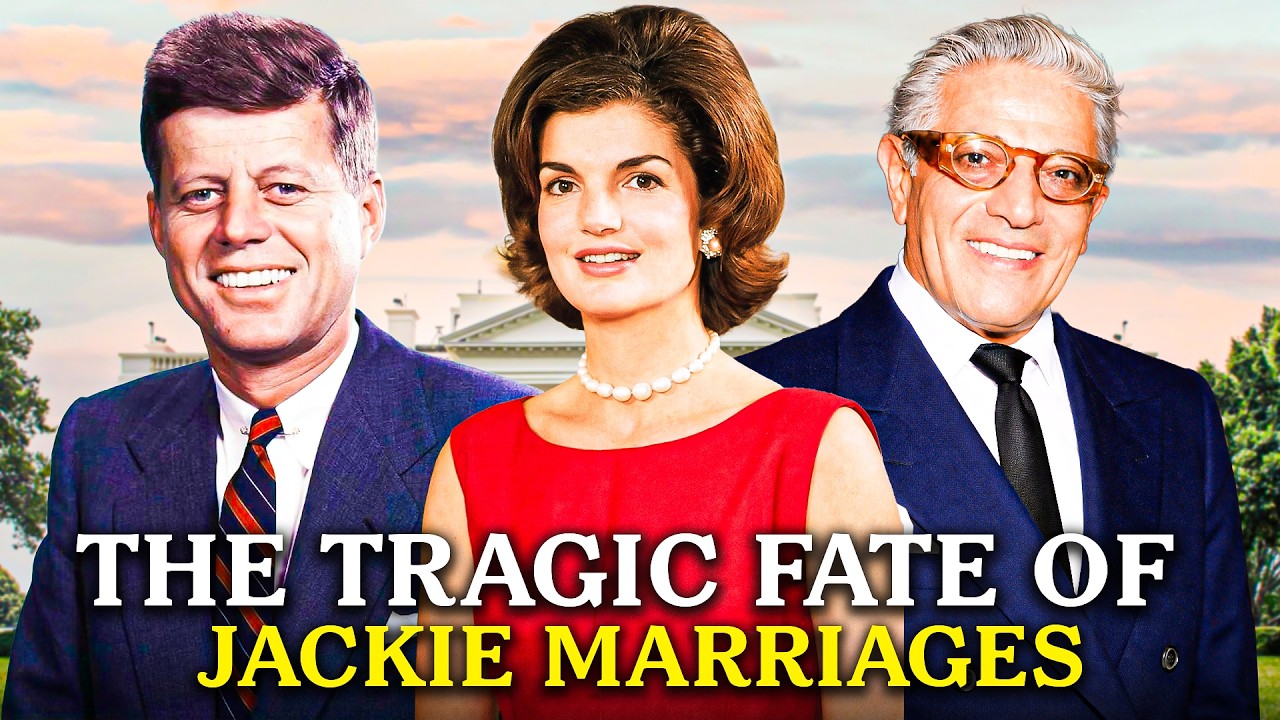
She is not looking at the camera. She is somewhere else entirely. That woman, Jacqueline Kennedy, had spent a lifetime learning how to be somewhere else while remaining present for everyone who was watching. The suit was still marked because she had refused to change out of it.
When asked why, she said she wanted people to see what they had done. The woman in that photograph was born Jacqueline Lee Bouvier on July 28, 1929, in Southampton, New York. She grew up in a world of old money and careful appearances. Her father, John “Black Jack” Bouvier, was charming, handsome, and deeply unreliable, a man who drank too much, spent too much, and still managed to be the most magnetic person in any room.
Her mother, Janet Norton Lee, was sharp, ambitious, and entirely concerned with status. Between them, Jackie learned early what the world expected from a beautiful woman, and how much of herself she would have to manage to meet those expectations. Her parents divorced when she was eleven. The rupture was quiet in public, but Jackie carried it for the rest of her life.
She adored her father despite his flaws, and that capacity to love someone deeply while recognizing their unreliability became a defining feature of her adult life. She was educated at Miss Porter’s School, Vassar College, and the Sorbonne in Paris, where she studied French literature and history. That year in Paris shaped her permanently. She fell in love with European art and architecture, with the idea that culture was worth protecting.
She returned to the United States with a refined sensibility and an impatient relationship with American superficiality. She met John F. Kennedy at a Georgetown dinner party in May 1951. He was a congressman from Massachusetts, ten years older, already known for his intelligence, ambition, and restless eye.
The attraction was immediate, but Kennedy did not move quickly toward commitment. Their courtship stretched over two years, conducted largely through distance. Kennedy was often traveling, eventually winning a Senate seat in 1953. Their connection deepened through letters rather than time spent together.
Kennedy was not demonstrative in person, but in writing he was different, and Jackie, who understood the power of language, responded to that. By the spring of 1953, Joseph P. Kennedy Sr. was pushing his son to settle down.
He understood optics with ruthless precision. His son was positioning himself for something larger than the Senate, and a suitable marriage was part of that architecture. Jackie Bouvier, beautiful, educated, photogenic, and genuinely cultured, was an excellent choice. Jackie was aware of the calculation.
She accepted the proposal anyway. Only she ever knew whether that decision came from love, ambition, her socially conscious mother’s influence, or some combination of all three. The wedding took place on September 12, 1953, in Newport, Rhode Island, at St. Mary’s Church.
More than 700 guests attended the reception at Hammersmith Farm. Jackie wore an ivory silk taffeta gown designed by Ann Lowe, a Black designer whose contribution went largely unacknowledged at the time. From the outside, the day looked like the beginning of a fairy tale. From the inside, the complications were already present.
Kennedy’s health was a serious concern from the start. He suffered from Addison’s disease and chronic back pain from his naval service during World War II. In 1954, he came close to dying during a dangerous back surgery. Jackie sat with him through months of recovery.
She read to him, kept him company, and helped him work on the book that would be published in 1956 as Profiles in Courage and win the Pulitzer Prize the following year. Historians have debated her contribution to that book ever since, but substantial evidence suggests it was significant. There was also the other matter. Kennedy’s infidelity began causing pain very early in the marriage.
The details were not publicly known during their lifetimes, but Jackie was living with them. She did not leave. What happened next, the miscarriages, the Senate years, the long stretches of loneliness, would test her in ways the wedding photographs could not have predicted. In 1955, she suffered a miscarriage.
In August 1956, while Kennedy was on a sailing trip in the Mediterranean and could not be reached, she gave birth to a stillborn daughter. She named the baby Arabella and buried her without her husband present. The isolation of that experience is almost impossible to absorb. Yet it was largely passed over in the public narrative of her life.
The press of the 1950s did not consider personal suffering news, particularly for women in public life. It remained private, even as it left real marks on her. Friends described a woman who could go very quiet after a loss, not visibly broken, but somehow removed, retreated to an interior space she did not invite others to follow. Caroline was born in November 1957.
John Jr. followed in November 1960, just weeks after his father was elected president. Another child, Patrick Bouvier Kennedy, was born prematurely in August 1963 and lived only two days. Kennedy was devastated.
He and Jackie held the baby’s hand together in the hospital. People who knew them both said the loss brought them closer in a way the public events of the previous years had not. The Senate years from 1953 to 1960 were difficult for another reason. Kennedy was absent in the most literal sense, frequently traveling, frequently occupied with building his national profile.
Jackie spent long stretches alone in Washington or at the Virginia estate they rented, riding horses, reading, managing the isolation as best she could. She was, by inclination and training, an intellectual. She read widely and seriously in history, biography, poetry, and French literature. She spoke French and Spanish fluently.
She had informed opinions about architecture and painting. And she was living inside a world that had no particular use for those qualities in a wife. The role expected of a senator’s wife in the 1950s was largely ceremonial. You appeared when required.
You were charming and deferred to the demands of the career. Jackie did all of this with more grace than most, at a cost that was invisible to the people watching the performance. In January 1961, John F. Kennedy was inaugurated as the 35th president of the United States.
Jackie stood beside him in twenty-degree weather, wearing a coat and pillbox hat that would be imitated for decades. She was 31 years old, the second-youngest first lady in American history. From the moment she entered the White House, she began doing something no one had asked her to do. She found the building embarrassingly under-furnished with genuine American historical artifacts.
Many rooms contained reproductions and pieces of uncertain provenance. She found this unacceptable. Within weeks, she established the White House Fine Arts Committee and began soliciting donations of authentic period pieces. She hired a curator to catalog the existing collection.
She worked with designer Sister Parish and Henry Francis du Pont of Winterthur Museum to guide the restoration. She moved through storage rooms and cellars, finding original furniture from the Monroe and Lincoln periods buried under decades of institutional indifference. She tracked down pieces that had left the White House and persuaded their owners to donate or lend them back. In 1961, at her encouragement, Congress passed a law declaring White House furnishings permanent property of the building, meaning future administrations could not simply remove or replace pieces at will.
That law remains in effect today. In February 1962, she hosted a television tour of the White House watched by approximately 80 million people. She walked through the restored rooms calmly, speaking about the history of each piece with quiet authority. The program won her an honorary Emmy Award.
More importantly, it showed the American public that this was not a decorative first lady. This was a woman with a serious interior life and something real to offer. The state dinners she organized became benchmarks of American cultural diplomacy. She brought writers, artists, musicians, and scientists to the White House in a way that had not been done before.
Cellist Pablo Casals performed there in November 1961, his first American performance in decades. A dinner in April 1962 gathered 49 Nobel Prize winners, prompting Kennedy to remark that it was the most extraordinary collection of talent and human knowledge ever gathered at the White House, with the possible exception of when Thomas Jefferson dined alone. On the trip to France in June 1961, Kennedy stood up at a press luncheon and announced he was the man who had accompanied Jacqueline Kennedy to Paris. The crowd loved it.
Charles de Gaulle was reportedly enchanted by her. She spoke fluent French, knew French history and art, and engaged with cultural figures as a genuine exchange rather than a diplomatic performance. But the White House years were not an uncomplicated triumph. Kennedy’s behavior did not change after the inauguration.
If anything, the scale and risk of what was happening became larger. Jackie maintained her composure with discipline that was almost architectural in its precision. She found ways to manage the pressure that were entirely her own. She rode horses whenever she could, painted watercolors, kept her reading life intact.
These were not performances. They were the things she did when no one was watching, and they were the things that kept her coherent through years that would have undone someone with less of a private interior life. In November 1963, partly because of the closeness she and Kennedy had found after Patrick’s death, she agreed to travel with him to Texas. The motorcade through Dealey Plaza was moving slowly through warm, enthusiastic crowds.
Jackie was leaning toward her husband to hear something he said when the first shot was fired. She did not leave the car. She climbed onto the back of the limousine, an instinctive movement whose precise purpose has been debated ever since, and was pulled back in by a Secret Service agent. She held her husband’s head in her lap for the drive to Parkland Memorial Hospital.
She was in the trauma room when doctors worked on him. She was present when the time of death was called at 1:00 p. m. She refused to change her clothes before the swearing-in of Lyndon B.
Johnson that afternoon. She wanted people to see what they had done. In the days that followed, she managed the state funeral with the same focused attention she had brought to the White House restoration. She researched Lincoln’s funeral of 1865.
She insisted on the riderless horse with reversed boots in the stirrups. She walked behind the coffin through the streets of Washington, overruling Secret Service objections. She lit the eternal flame at Arlington Cemetery. Her children were three years old and not quite one.
She was 34. The weeks after the funeral were the hardest. She wrote hundreds of personal letters to people who had written to her. She moved out of the White House in December 1963, first to Georgetown, then to an apartment on Fifth Avenue in New York City that would remain her home for the rest of her life.
In October 1968, five years after Dallas and four months after Robert Kennedy’s assassination, she married Aristotle Onassis on his Greek island of Skorpios. Onassis was 62, a Greek shipping magnate, one of the wealthiest men in the world, and in almost every visible way the opposite of John Kennedy. The American reaction was swift and unkind. Editorial pages expressed bewilderment and disappointment.
Jackie had reasons she stated rarely. Robert Kennedy’s death had left her frightened. She had two children and a level of public visibility that made her feel exposed. Onassis offered wealth that meant real security, a private world on a private island, and a man entirely unconcerned with what the American press thought of him.
The marriage was not happy in any ordinary sense. They lived largely separate lives. Onassis continued his long-running relationship with opera singer Maria Callas. His daughter Christina regarded Jackie with hostility that never thawed.
Jackie absorbed it with composure. Onassis died in March 1975. The settlement Jackie received, negotiated against Christina’s legal maneuvering, was substantially less than what the marriage agreement had originally entitled her to. She accepted it and did not fight further.
She was 45, widowed for the second time, and done with marriages. She turned to work. In 1975, she became a consulting editor at Viking Press. In 1978, she moved to Doubleday, where she spent the rest of her working life.
Authors described her as someone who understood what a book was trying to do and pushed them to do it better. She also became one of the most effective private citizens in the effort to preserve New York City’s architectural heritage. When Grand Central Terminal was threatened with demolition, she became one of the most visible faces of the campaign to save it, testifying before a city commission, writing letters, using her name and genuine love of architecture. In 1978, the Supreme Court ruled in favor of preservation.
Grand Central still stands. In the 1980s, she began a relationship with diamond merchant and financier Maurice Tempelsman. He was quiet, intellectually serious, entirely devoted to her. He required nothing from her public persona.
He was simply there. She was diagnosed with non-Hodgkin’s lymphoma in January 1994. She handled the illness without public drama, worked as long as she was able, spent time with her children and grandchildren. She died on May 19, 1994, at her apartment on Fifth Avenue with her children and Tempelsman beside her.
She was 64. She was buried at Arlington Cemetery beside John Kennedy and the two children who had not survived, Arabella and Patrick, next to the eternal flame she had lit thirty years before. She was a woman of extraordinary capability operating inside structures not built for someone like her. The marriage to Kennedy gave her a stage she used brilliantly and a private situation that was deeply painful.
She endured it with discipline that was sometimes mistaken for coldness. She made choices to stay, to rebuild, to work, to protect her children, to marry again. The culture of her time wanted the myth more than the woman. Jackie gave the myth what it required and protected the woman as best she could.
The woman was more interesting than the myth, and that becomes clearer the further we get from the photographs.